Opinion: Demonstrations in France could have international impact
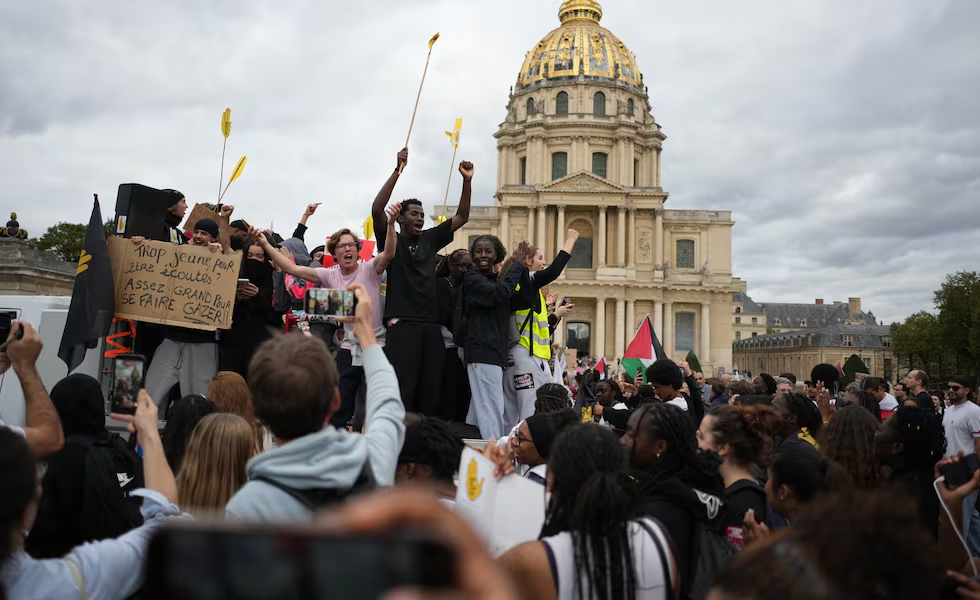
Enormous, at times destructive, public demonstrations in France have significance reaching well beyond that historically turbulent nation. Protests began in September, spurred by deteriorating conditions in the education system. More than 500 schools have been blockaded, and clashes with police have escalated to violence.
In 2023, similar protests resulted from efforts by French President Emmanuel Macron to increase the full retirement age in France. The initiative to raise the retirement age from 62 to 64 was successful but faces continuing opposition and pushback.
Macron has relied heavily on executive power rather than parliament. The lower house was bypassed in the retirement reform. The constitution of the Fifth Republic, instituted by former French President Charles de Gaulle, defines a powerful chief executive.
How student protests grew into a nationwide crisis in France
The massive displays of public hostility receive added importance given the central role of France in the European Union and the continuing war in Ukraine.
Protesters set fire to trash bins in Paris. There has been sporadic fighting with police. Separate from the pension protests, protesters near the village of Sainte-Soline clashed with police over a projected water reservoir, which was opposed by environmentalists.
These dramatic developments began only eleven months after Macron’s impressive reelection to office in April 2022. He received just over 58% of the vote, against just under 42% for opponent Marine Le Pen. This margin, while decisive, was narrower than in 2017 when these same two candidates competed for the presidency.
The presidential elections seemed to indicate political stability of domestic political institutions. However, the sustained protests reflect the growing difficulty in funding the welfare state. This is the harsh reality.
Instability historically has plagued France.
The decisive, stunning military defeat of the large, well-armed but rigid old-fashioned army of France in the spring of 1940 by the fast-moving high-tech blitzkrieg of Germany’s army began four years of humiliating occupation. Years of weak, ineffective governments followed Allied liberation of France in 1944.
General Charles de Gaulle, exceptional leader of the Free French during the war, returned as leader of France in 1958. He succeeded in stabilizing the nation’s politics, and finally reestablished effective national authority and legitimacy.
De Gaulle’s constitution creates a powerful presidency, key to long-term stability. A referendum in 1962 confirmed direct election of the president through universal suffrage. In 2000, a referendum reduced the presidential term from seven to five years.
An old rival is lending an 11th-century tapestry to England
In this century, the alliance with the U.S. has been strong. Immediately after the terrorist attacks of 9/11, French aircraft joined those of other NATO allies in patrolling the skies over North America. The struggle against al-Qaida and other groups represents a comprehensive collective enterprise, authorized and supported by the United Nations as well as the NATO alliance.
De Gaulle was in power during President Dwight Eisenhower’s second term. Ike developed good working rapport with the difficult French leader during the Second World War. While planning the Normandy invasion, some American and British air commanders argued against heavy bombing, which would unavoidably kill civilians.
General Eisenhower was able to turn to General de Gaulle for support.
The Kennedy and Johnson administrations clashed with de Gaulle’s nationalist rigidity. In 1966, France withdrew from NATO. Fortunately, in 2009 the nation rejoined the alliance.
Today, astute support from allies could help stabilize France. Recent treaties with Britain and Germany might provide useful indirect leverage. That is the topic for a future column.