Opinion: This election was evidence America is less obsessed with race and identity politics than many believe
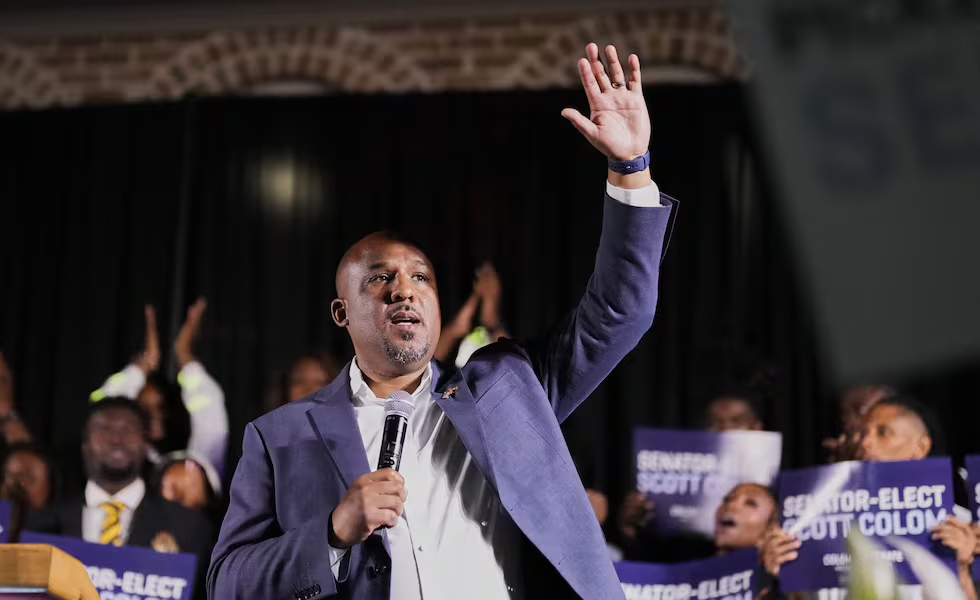
America is often at its best when it confronts its worst aspects. This past election cycle, in spite of numerous racially divisive events, voters forcefully rejected bigotry, electing an unprecedented number of racial, ethnic and other minorities to high office.
Better still, the candidates that won mostly did so not by heightening grievances but by calling to the better angels of all races.
Midterms provide glimpse of ‘blutah.’ Was it just a blip?
A stunning shift in Mississippi
This past week, Scott Colom (D), a 43-year-old African American tough-on-crime district attorney, received a gracious concession from Sen. Cindy Hyde-Smith (R) and will be the first African American to represent Mississippi in the Senate since Reconstruction.
This is the same state where, 63 years ago, civil rights leader Medgar Evers was assassinated, and shortly after that, the “Mississippi Burning” murders of three civil rights workers occurred.
Colom didn’t hide from this history — he held campaign events to discuss voting rights where Evers used to hold organizational meetings — but he didn’t emphasize it. His campaign’s introductory ad was telling:
“Look, when people outside of Mississippi think about our state, they think about our past,” he said. “I think it’s finally time to look to our future.”
He repeated similarly hopeful notes ever since. He even campaigned outside of Trump rallies, showing voters he was concerned with their welfare regardless of party.
But things are never so simple. Colom’s success stood in contrast to the racially charged environment that surrounded the election.
A confusing SCOTUS decision
The Supreme Court’s recent decision in Louisiana v. Callais, which changed past interpretations of the Voting Rights Act, allowed the Trump administration to attempt to strong-arm various states, particularly in the South, into wiping out majority-minority districts in Congress.
Needless to say, this got Black voters’ attention.
There are reasonable, entirely nonbigoted reasons to favor the Supreme Court’s legal reasoning. But what happened next didn’t happen in a vacuum. Erick Erickson, a conservative commentator from Georgia critical of the Trump Administration’s effort, was unsparing: “A lot of Republicans decided Black voters were expendable.”
Darvio Morrow, an African-American Republican radio host and journalist from Cleveland, pointed out that this judicial decision and the subsequent redistricting “didn’t just anger Black people in the South. It had a reverberating effect everywhere.”
Racism masquerading as heritage Americanism
There were also public displays of overt racism. Bo French, the Republican nominee for Texas Railroad Commission, a statewide office in Texas, tweeted disparagingly at the presence of Americans of South Asian heritage celebrating a University of Texas football victory.
This comes in a year where public displays of anti-Indian bigotry have spiked and some influencers are openly having conversations about the “Indian question,” as if there is any legitimate reason to demonize Americans for their ethnicity.
Worse still, the Trump administration’s Department of Education seemed to nod at French’s bigotry, posting a photo that looks to be cleverly alluding to French’s tweet.
Opinion: Stop giving your political party a blank check
Both French and Trump were fanning the flames of a growing online phenomenon concerning so-called “heritage Americans,” those who claim a greater degree of “Americanness” depending on how long their families have lived here.
In practice, this is not benign ancestral pride but a populist version of the divine right of kings — asserting that a superior claim to the nation is inherited through lineage and bloodline rather than through a shared civic promise.
Some Republicans, such as outgoing Sen. John Cornyn (R), tried to contain the damage, but many refused to rescind their endorsement of French. The damage had been done.
A rejection of racial politics?
The good news is that America forcefully rejected all this.
French was crushed by his Democratic opponent, and African American turnout spiked nationwide. The beneficiaries of this increased turnout were, in many instances, African Americans and other minority candidates — many of them in the states that once made up the Confederacy.
Many of the seats that had been gerrymandered to eliminate minorities did not actually do so. In one Alabama district, Rep. Shomari Figures, a Black Democrat, won easily in a strongly Republican district drawn in a way that some argued was intended to dilute minority votes and elect a Republican.
Overt racism deserves to be repudiated. However, if all the backlash amounted to was a handful of Democrats who happened to be minorities winning, that’s not necessarily a good sign for the country.
A return to what Rep. Alexandria Ocasio-Cortez (D-NY) called “Woke 1.0,” i.e., the kind of racial grievances and extremist policies that dominated left-leaning politics in the early 2020s, which even Ocasio-Cortez now agrees was “crazy,” would be a funhouse-mirror-image disaster.
But that’s not what happened either.
Rejecting identity politics
First, minorities being elected to high office in competitive races was not limited to Democrats. Rep. Byron Donalds, a Black Republican, beat back former Rep. David Jolly (D), a reasonably strong candidate, to become governor of Florida.
This was one of the few Republicans to win a seriously contested statewide race. Donalds’ victory could be chalked up to Florida’s Republican lean, but the lean of his state didn’t save Gov. Greg Abbott (R) in Texas, who lost to Gina Hinojosa (D), a Latina.
It’s also notable that Donalds won by more than Gov. Ron DeSantis (R) did eight years ago.
Second, the minority candidates who won ran almost exclusively on kitchen-table issues, like the cost of living. Keisha Lance-Bottoms (D), an African American former Atlanta mayor who is now the governor-elect of Georgia, explained it best, saying in an interview shortly after her victory that identity politics didn’t enter her calculations.
“I wasn’t running because I was a Black woman. I wake up as a Black woman every day, so I didn’t need to lead with that ... The things people were talking about when I moved across the state had nothing to do with race.”
Lance-Bottoms took a different approach than Abrams
It’s impossible to mention Lance-Bottoms’ success without looking at the failure of previous candidate Stacey Abrams to win the same office the past two cycles. Abrams, also a Black woman, with the aid of a fawning establishment media that did her no favors, leaned heavily into the idea that she’d be the first Black woman governor of Georgia.
When she lost, she refused to concede and made implausible claims of voter suppression, making arguments that were roundly rejected in court.
The problem with Abrams and her cheerleaders is that an election should never be about the individual running for office. It should be about the concerns of voters.
It is a wonderful thing that voters are willing to elect candidates who, just a few decades ago, could not have even voted in many states.
But it’s never good, and rarely successful, to prioritize faux racial progress over the will of the voters. That inevitably backfires. Neither Lance-Bottoms nor Colom nor Donalds made this mistake.
An overall positive arc
There are other victorious candidates with minority racial backgrounds who could be discussed: David Crowley, the African American governor-elect of Wisconsin; Abdul El-Sayed, the Arab American senator-elect from Michigan; Aaron Ford, the governor-elect of Nevada; a host of Hispanic Americans won in Texas districts when they were not expected to; and so on.
Not all of these candidates are equally admirable. I think El-Sayed is both an extremist and a grievance monger. And while I’ve got no particular bone to pick with Ford, defeated Gov. Joe Lombardo did little to deserve his defeat other than be a Republican in a Democratic wave year.
Opinion: 5 midterm signals that will shape future U.S. politics
But the thrust of things remains positive. Americans rejected both racism and extremist identity politics, and in so doing, elected a host of minority candidates who didn’t run on grievances — but instead on listening to the concerns of average voters of all races.
These developments seem to be good for all Americans.
And what if any of these newly elected officials do a bad job? Thank God we live under the U.S. Constitution. We can just vote them out in a few years.