Universal Mail-In Voting and Civic Responsibility
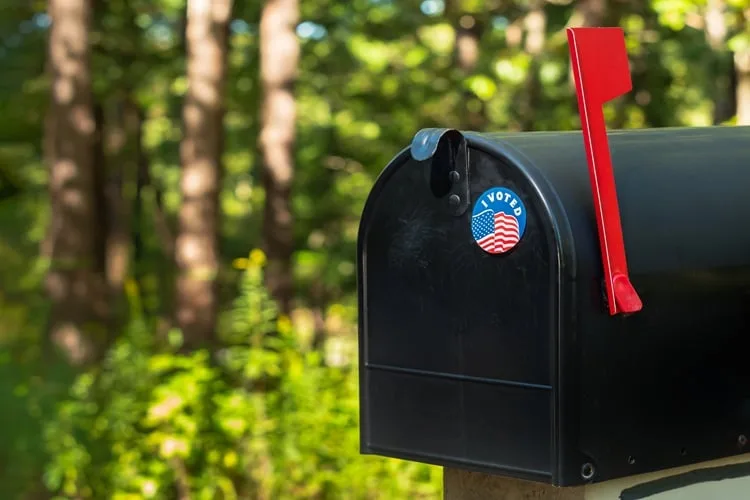
On June 16, 2026, a first-class envelope addressed to me arrived from an old friend. It was postmarked April 15, 2025. At least it made it in the end. All too frequently, letters that people send to my wife and me and letters that we send to others simply disappear. We also regularly receive misaddressed mail. On occasion, the mail is thrown into the dirt in our front yard. The condition of our local post office is disgraceful.
As we approach November 3, these matters are increasingly on my mind.
A few days ago, an oversize envelope showed up from the District of Columbia Board of Elections. On the front were the words, “Official Absentee Balloting Material.” I was taken aback. True, I had been waiting for an envelope because the upcoming election is the first in which I will have been registered to vote in the District. But when I was automatically added to the DC rolls on surrendering my New Jersey driver license and obtaining a DC one at the DMV, I had not, to my recollection, checked any box about receiving an absentee ballot.
Indeed, I had not checked a box. What I had not realized—and here I admit my civic ignorance—is that DC has conducted universal mail-in voting since 2020, formalizing the practice in a 2022 bill.
As I now know, eight mostly western states (California, Colorado, Hawaii, Nevada, Oregon, Utah, Vermont, and Washington) plus Washington, DC, allow all (or, in the case of Vermont, all general) elections to be conducted entirely by mail. Oregon was the pioneer, with voters passing a measure in 1998, but it took over a decade for another state, Washington, to follow suit. In the wake of COVID, however, three more states and DC have taken the plunge. Still, the move toward universal mail-in voting is not inexorable: Starting in 2029, voters in Utah will once again have to formally request a ballot if they wish to vote by mail.
Elections are, of course, a fraught business, even without regard to particular races and candidates. People and courts argue vigorously about the extent of voter fraud, the necessity of identification requirements, the legality of various forms of gerrymandering, and the importance of the Electoral College—and, yes, about the benefits, pitfalls, and mechanics of voting by mail. In June, the Supreme Court handed down its 5–4 decision in Watson v. Republican National Committee, which ruled that mail-in ballots received after Election Day can be counted.
Now, it is not news that increasingly many people around the country are participating in early voting or choosing to vote by mail even though they will be in town on Election Day and are thus not “absent.” I grant that voting by mail can be a good thing in many specific situations and in theory. But after reading older and newer work by my AEI colleague John C. Fortier, I remain unpersuaded that universal mail-in voting is wise.
For one thing, the United States Postal System (on which the thoughts of another AEI colleague, Kevin R. Kosar, are always instructive) cannot reliably do its part.
But there is a broader civic point.
On the same day that my unwanted non-absentee “absentee ballot” arrived, I received another envelope that likewise contained a sheet for me to fill out together with a postage-paid return envelope. This one was a survey from a medical provider: Was my experience in various ways very positive, positive, negative, or very negative?
There is a categorical difference between the ballot and the survey. But how is one to explain that difference to someone who doesn’t, or may not, know better: an impressionable young child, for example, or someone who has just turned 18 or a newly minted American citizen?
Take my three-year-old daughter. How should my wife and I go about getting her to recognize that choosing a candidate or voting yea or nay on a proposition is meaningfully unlike taking an optional survey from a business—or choosing what shoes to wear to school?
Obviously there are ways to instill in children a sense of civic responsibility without taking them once or twice a year to the local polling station and having them watch you pull a few levers or drop a piece of paper into a guarded box. But as everyone knows, civic rituals in America are important and fraying. Here’s one more ritual that universal mail-in voting will eviscerate.
I remember looking forward to my parents’ chitchat with friends and their accompanying children as we lined up at our neighborhood polling station. It is a source of regret to me that my daughter is unlikely to have the same experience.