Senate passes Sen. Lee’s permitting bill in bipartisan win
The U.S. Senate voted 62-33 to pass the Bipartisan American Affordability and Jobs Act of 2026 on Nov. 19, known by its acronym BAAJA. The bill is a sweeping permitting reform package written to speed up energy projects while tightening data center regulations.
The bill’s primary architects — Sens. Mike Lee, R-Utah, Martin Heinrich, D-N.M., Shelley Moore Capito, R-W. Va, and Sheldon Whitehouse, D-R.I. — have cheered its passage, as did Sen. John Curtis, R-Utah, a supporter.
The bill would speed up environmental reviews for energy and infrastructure projects, and adds regulations around the construction of data centers.
Independent analyses project the legislation will save households $50 to $78 annually by 2040 in electricity bills, require data centers to contribute approximately $55 billion toward transmission costs over the next decade, and support up to 105,600 trades and manufacturing jobs.
“We’re growing as a society. We’re growing economically and otherwise,” Lee told the Deseret News. “And with that growth and with changes and advances in technology, we need to be able to do things at a decent speed and not be stuck in court for years or decades at a time just getting something as simple as a review completed.”
In an earlier interview with the Deseret News, the legislation was also praised by Utah Gov. Spencer Cox, who called it “the most important bill in a long, long time — many years.”
“It’s good for energy. It’s good for transmission. It’s good for Utah,” he said. “It’s good for our country. It’s good for business. And it will help lower prices for every American. It will create jobs.”
There was some opposition to the bill, mostly from environmental advocacy organizations that claim the bill bypasses tribal considerations and rushes AI infrastructure, but it still managed to pass the Senate in a strong bipartisan showing.
The bill now heads to the House. Bipartisan negotiators hope it becomes a law in the final two months of the session, despite it being a lame-duck session.
The fight over data centers continues
Lee said the bill contains the ratepayer protection provisions against data centers.
“Your household electricity bill will not go up due to a data center being built,” he said. “Those are to be carried by the data center developers and not by the ratepayer.”
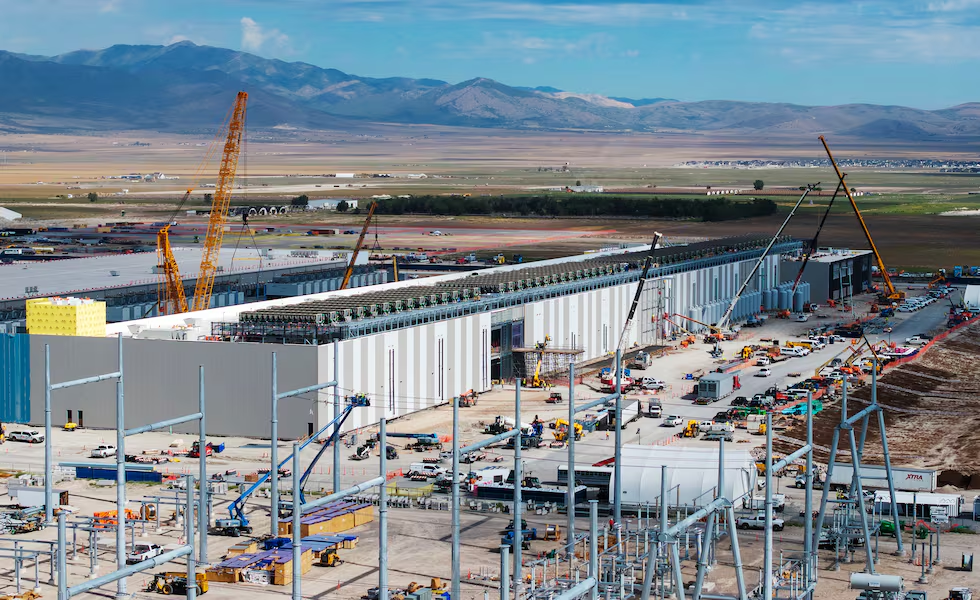
Creekstone Energy, the developer of Delta’s Gigasite in Millard County, announced that it supports the bill, including the heightened regulations.
“It gives builders the certainty to invest, and it makes sure data centers pay their own way for the infrastructure they require instead of shifting those costs to Utah families and businesses,” said Ray Conley, CEO and founder of Creekstone.
However, Aaron Weiss, executive director of the environmental group the Center for Western Priorities, believes the legislation will allow data center construction on public lands.
“This bill, as it’s written today, would give the Trump administration’s Interior Secretary Doug Burgum a two-year window to lock in data centers on public lands even though there’s no legal framework for it,” he said.
This bill would make data centers pay their own way for power
Weiss, and other environmental advocates, point to proposals such as one from Valar Atomics near Price, Utah — which envisions hundreds of small modular reactors to fuel a data center.
Lee, however, pushed back against the claim, stating that data centers remain governed by state and local law, and the bill does nothing to change that.
“BAAJA actually makes data centers pay more to interconnect to the grid to ensure other customers’ rates don’t increase,” he said. “This is the same lazy, copy-and-paste argument opponents trot out whenever Congress tries to build something in America.”
In response to critics like Weiss, Sen. Ron Wyden, D-Ore., sought a vote on an amendment to ban the construction of data centers on public lands, but it wasn’t brought up.
Lee said there were “a lot of problems” with the amendment — especially its broad definition of a data center, which Lee said would have included “any modest rack of computers.”
“It was not a well-considered or carefully or wisely drafted piece of legislation,” he added. “It was designed to do something much more simple, which was send a message — a message that I think was designed solely to help defeat the underlying bill. So, I’m grateful that it didn’t pass.”
Some tribes step up to question provision
BAAJA critics also point to the National Historic Preservation Act of 1966, specifically a section that says federal agencies need to consult with local tribes and communities about cultural and historical heritage before green-lighting projects.
Jessie Barrington, partner and chair of the Tribal Nations Practice at Cultural Heritage Partners and a citizen of the Confederated Tribes of Coos, Lower Umpqua, and Siuslaw Indians, said BAAJA guts that requirement. Title III of the bill rewrites Section 106, creating a 30-day comment period — a time frame she said limits communication.
“Cuts to Section 106 are an attack on tribal sovereignty, on our cultures, and on our identity as Native people,” she said. “Section 106 gives tribal nations a voice and a seat at the table in the federal decision-making process before a project destroys those places. Title III would take both away.”
But Lee said there was a need to add a timeframe to the existing legislation.
“One of the problems that the National Historic Preservation Act was experiencing is that there was no framework under which tribal historic preservation officers had to wrap up his or her assessment of the project and its impact on items deserving historic protection,” Lee said. “So as a result they could kind of sit on those indefinitely and delay them indefinitely.”
Senate overcomes first obstacle to speed up energy projects in sweeping reform package
“So, we made it harder for those indefinite delays to continue,” he continued. “That is not an insult to tribal sovereignty. That is simply making a federal system work as it is supposed to work.”
Environmental review changes
Title l of the bill bars agencies from pausing reviews to wait for new scientific, technical or environmental studies, a provision some environmental groups have criticized.
Under the bill, if a court finds that a federal agency violated a law from the National Environmental Policy Act or the National Historic Preservation Act, the court is barred from stopping construction — rather, the court can require the agency to fix paperwork.
“Now, it’s not surprising to me that entities that make a living challenging projects, slowing them down, delaying them or halting them altogether might have reservations about a bill that makes it harder to do that,” said Lee. “That is no more shocking than the sun rising in the east this morning.”
Environmental advocates — including Weiss — claim the bill was crafted “behind closed doors,” and wanted the Senate to pause its passage.
But the bill was largely ready to go before the midterm elections, and senators finished their work on the bill late Thursday evening, before celebrating its passage.