Opinion: Go outside — there’s so much of the physical world left to explore
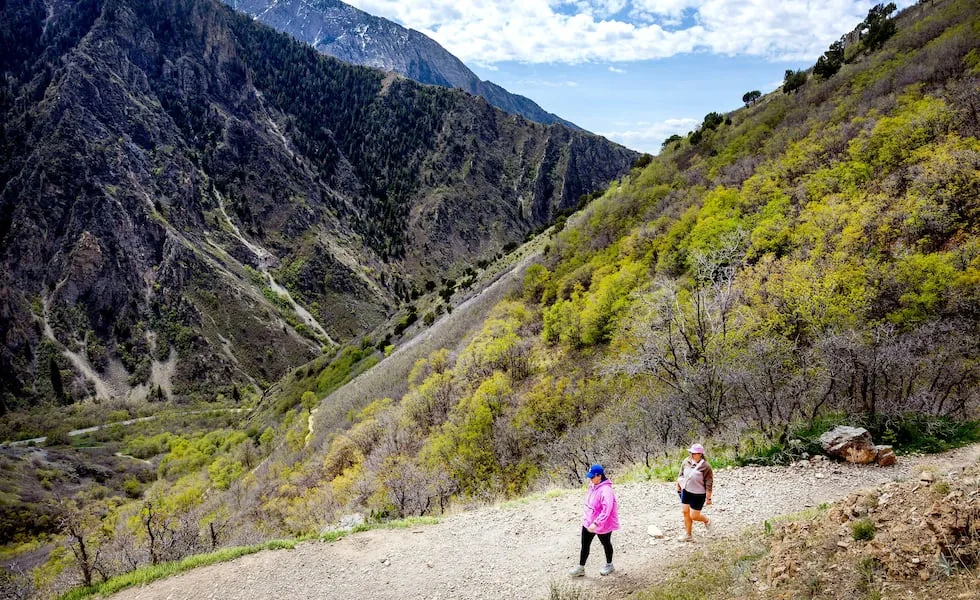
Public land across the American West lies vulnerable as data centers encroach on our nation’s undeveloped spaces. At least 16 projects on public land have been proposed, including a 9,000-acre nuclear-powered complex on BLM land in Utah by Valar Atomics. More proposals to trade our limited public lands for a theoretically boundless virtual world may soon be in the works.
Some leaders in the tech industry have claimed that because humanity has already explored all places, the future is fully virtual. This is the reasoning Marc Andreessen uses in his infamous Techno-Optimist Manifesto as he outlines his vision for an online future:
“We believe that while the physical frontier, at least here on Earth, is closed, the technological frontier is wide open.”
The reality couldn’t be more different.
This bill would make data centers pay their own way for power
Have I explored the frigid ice of the South Pole like Ernest Shackleton? Have I taken in the endless rocky view from the pinnacle of Everest like Hillary and Norgay? Have I summited the peaks of every continent or survived the barren wastes of every desert? Have I rafted the mightiest rivers of the Earth or ascended every mountain trail? Not even taking into consideration all that … have I ever even visited the state next door?
The United States contains 640 million acres of public lands, 58 million of which are roadless and only accessible by foot. Our nation contains 64 national parks, 154 national forests and 803 congressionally designated wilderness areas. Our states heap on top of that dozens of additional state parks, forests and historical areas (there are 46 state parks in Utah alone). And, should your legs tire, you could dive into the billions of pages written about these places and more; stories detailing the glorious adventures of Americans across the course of time and place, including the brave pioneers who settled the region that over three million Utahns now call home.
If you live nearly anywhere in the United States, you are a mere handful of hours from dozens of towns, conserved lands and historical wonders. Relatives, friends or hotels in other far-flung places may serve as base camps, offering access to dozens more adventures. Each a place ripe for exploration.
These airports offer easy access to ski areas
But there is no need to stop there. The world is home to 195 different nations, each replete with their own cultures and microcultures, lifestyles and dialects. It is dotted with cities and towns by the thousands and tens of thousands. There are millions of miles of roads to ride and trails to hike. Millions more species to encounter.
Yet, the explorer does not have to travel that far if they wish. The deliberate study of your own backyard can yield an endless draught of pleasure and excitement. Thoreau, immersed in the quiet delights of his cabin on Walden Pond, wrote “the universe is wider than our views of it” and marveled at his small woodland discoveries that unfolded with the days. Ours is an inestimably beautiful and complex Earth.
The real world is enough. One could spend countless lifetimes studying but one cuisine, one family of the animal kingdom, one time period of one particular region. How can we dismissively claim the “frontier is closed” when all the earth lies before us?
For the physical frontier is only closed to the royal “we” of humanity. Taken in aggregate, a human being has indeed set foot in nearly every place and mapped every corner. But that is them, and this is you.
This ‘hidden gem’ in Arizona just became America’s newest national park
You are not defined by the aggregate. What one person has seen or heard or touched or tasted has no bearing on your experiences, which still eagerly await the unknown.
The arguments peddled by technological pioneers like Andreessen attempt to dull our adventurous spirit and box us into an abstract cyberspace of faux human connection and a rat race of likes and follows. There is a reason Christine Rosen writes in The Extinction of Experience that tech pioneers use the word “space” and not “place” to describe their creations. Theirs are untethered and unreal.
The more we explore, the more we realize there is not nearly enough time and technology is merely a distraction. So hurry outside, you have a life to live.