NFL rules and officiating have reached a tipping point
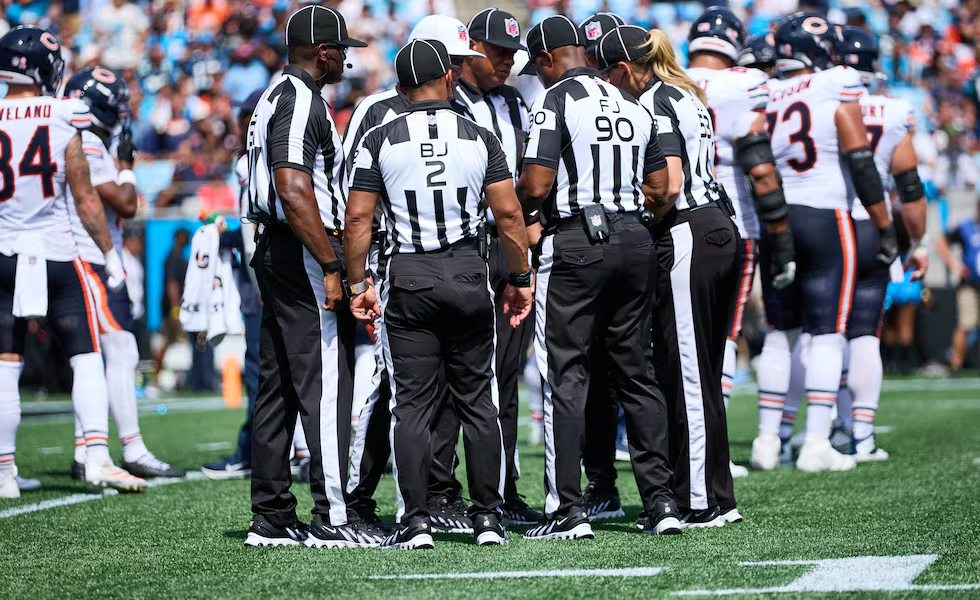
Wait a minute. NFL referees might not be completely incompetent after all, despite proof to the contrary. They are calling penalties at a record rate and many of them have been blatantly wrong, but hold the boos.
The deeper problem is this: The rules are too convoluted, complex and open to interpretation. Nobody could make those calls with any consistency, not even the guy sitting in his living room watching on TV. That’s why every time an official throws a flag he pretty much has to call in a CSI unit to figure it out.
You know the scene: The refs under the hood of the replay monitor, the review by the Wizard of Oz in New York, the referee huddle. What’s next — police tape around the scene of the crime?
Mike Pereira, who once oversaw the enforcement of NFL rules, told Fox Sports that the NFL has so many rules that game officials can’t keep them all straight.
He said this in 2013. The situation has gotten only worse since then.
The NFL rule book is like the tax code — nobody knows for sure what’s in there or how to interpret it without getting help.
Does anyone even know what a catch is anymore? Think of it this way. In 1964, Judge Potter Stewart was trying to define pornography and his famous answer was, “I shall not attempt further to define (it). … But I know it when I see it.”
No one can really define a catch anymore, either, but we know it when we see it.
The NFL doesn’t.
Amon-Ra St. Brown, the Detroit Lions receiver, caught a touchdown pass in the back of the end zone against the Vikings three weeks ago, and then they called in the CSI team. TV showed the replay repeatedly and broadcasters told the TV audience that it was a catch. Everyone thought the same thing (we know it when we see it).
The officials overturned it — not a catch, everyone else was wrong.
A week later, Christian Watson repeated nearly the identical catch — and the referees ruled it a catch.
What’s the explanation this week? That the receiver “made a football move” or “established possession” before the ball came loose? That there was a slight, microscopic movement of the ball as he went out of bounds?
It’s these same ridiculous nuanced interpretations that complicate penalties for roughing the passer, the quarterback slide, pass interference, targeting, false starts, unnecessary roughness.
The NFL season is on pace for a record 4,000 total penalties this season (compared to 3,466 last season). The sheer number of penalties has made the game unwatchable. Penalties wiped out 17 touchdowns the first four weeks of the season, which prompted sharp criticism from TV analysts Tom Brady and Troy Aikman and by fans who threatened to boycott. The number of erroneous penalties have soared, as well.
It’s time for NFL officials to be flagged
The Rams were penalized for pass interference on a would-be game-ending interception when it appeared that the Broncos receiver had initiated contact and flopped. The Broncos won.
The Dolphins’ Chop Robinson was penalized for roughing quarterback Patrick Mahomes when a) he didn’t strike the head or neck area, b) made an obvious effort not to land on him with his full body weight, and c) was one stride away from Mahomes when the pass was released.
Packers linebacker Brian Cox was whistled for roughing Jared Goff when Cox was blocked into the quarterback by Goff’s own teammate. In the same game, Packers quarterback Jordan Love was penalized for intentional grounding but a similar play by Goff was not.
A would-be game-winning touchdown by the Chiefs on fourth down in the final seconds of a game against the Broncos was negated by a false start penalty on tackle Jaylon Moore. Replays showed that all he did was turn his head to check with his quarterback — something that is allowed and does not constitute a false start. It cost the Chiefs a win.
A controversial unnecessary roughness penalty with 41 seconds remaining in a game between the Cardinals and Rams set up the game-winning field goal in an 18-16 Cardinals win. Rams cornerback Josh Wallace was penalized for contact with receiver Jalen Brooks as he went to the ground. Pereira, now working as a TV analyst, said the contact was minimal and did not warrant a personal foul.
Giants running back Cam Skattebo has been penalized and fined twice this season for unnecessary roughness — more specifically, for lowering his helmet into a tackler. “You can’t run in there and give tacklers your chest,” said Giants coach John Harbaugh. “When you run low, your head’s down there, too. You can’t move your head off your shoulders. It’s a physical impossibility.”
In 2013, after citing three instances in which officials wrongly enforced the rules that season, Pereira held up a rule book and asked, “Has this manifesto become a little bit too big and too confusing? For the third time in three weeks we have the officials mis-enforcing a penalty.”
The NFL competition committee meets every offseason and proposes a handful of rule changes and then the owners vote on them. That has added up to a lot of additional rules over the season. As Pereira suggested a long time ago, the NFL should reverse course and review the entire rule book, looking for ways to delete or simplify it; the game doesn’t need more rules, it needs fewer and simpler rules.