NFL fans want injury answers fast. A Broncos doctor explains why it takes time
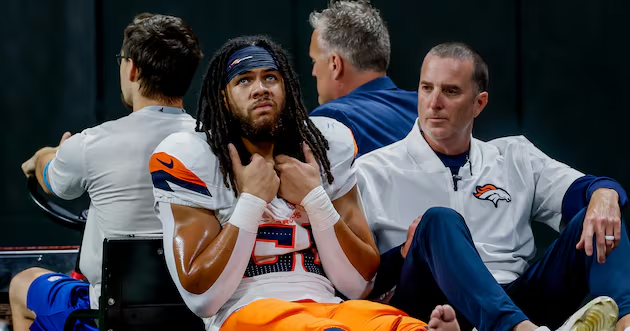
When an NFL player goes down with an injury, the questions come quickly.
What happened? How serious is it? And, perhaps most importantly, how long will he be out?
But according to Denver Broncos team physician and orthopedic surgeon Dr. Aaron Mates, the answers aren’t always as straightforward as fans and analysts might suggest.
Mates, who has worked with professional athletes across the NFL, MLB, NHL and other sports, said the evaluation process involves multiple medical professionals, diagnostic testing and a gradual determination of when an athlete can safely return to activity.
And one of the biggest misconceptions, he said, is that medical clearance automatically means a player is ready to go back out and compete.
“It’s when you say, ‘OK, from a medical standpoint, this player, this patient is fit to progress back toward activity,’” Mates said. “So it doesn’t mean you play tomorrow night.”
Instead, clearance marks the beginning of a progression that can take an athlete from rehabilitation to conditioning, practice and eventually a return to competition.
Inside the injury process
When a player gets injured during an NFL game, Mates described the initial evaluation area on the sideline as a triage tent, similar to an emergency room.
Medical personnel first assess the injury and determine whether the player can safely return or needs additional evaluation.
If further examination is necessary, the player may be taken to the training room for X-rays, additional testing and a more thorough assessment. Depending on the injury, the process can continue after the game with further examinations and imaging to determine the appropriate treatment.
The evaluation involves the head team physician, specialists such as Mates, athletic trainers and the player.
While the medical staff determines whether a return is safe, Mates emphasized that the athlete remains central to the decision-making process.
“Their voice is everything, because they’re the patient,” he said. “It’s no different than being in my clinic, it’s a doctor-patient relationship.”
Physicians must ensure players understand their injuries and treatment options, but they also have the responsibility to prevent an athlete from returning when doing so would be unsafe.
“We can say, ‘You can’t play,’” Mates said. “We can say, ‘This is not safe. We’re not clearing you.’”
That responsibility can become especially complicated when an injury occurs during the season, when teams are competing for a playoff spot or trying to make a postseason run.
Mates said the challenge of sports medicine isn’t necessarily the orthopedic treatment itself, but determining how the timing of an injury affects its management.
With professional athletes facing a limited competitive window, physicians sometimes must consider treatment options more quickly than they might in other circumstances.
“We can’t sit around and wait for something to heal for three months and it doesn’t heal, then do surgery,” he said.
The road back
For athletes recovering from surgery or an injury, Mates described a three-phase process designed to gradually prepare them for competition.
The first phase focuses on rehabilitation and recovery, including physical therapy and regaining strength and mobility.
The second phase shifts toward general conditioning, with activities such as running, jumping, balance work and changes in direction.
The third phase involves returning to the sport itself, including practice, sport-specific drills and simulated game situations.
For example, Mates mentioned he has treated hockey players who must complete land-based drills involving cutting, running and turning before he allows them to put on skates.
Football players follow a similar progression, working with trainers and conditioning staff before advancing toward full practice and game participation.
The goal is to ensure athletes can handle the demands of their sport rather than simply demonstrate that an injury has improved in a controlled medical setting.
The limits of injury reports
Another challenge for doctors comes from the speculation that often follows an injury.
Mates noted he has watched television coverage of athletes he has treated and heard injury assessments that were inaccurate, particularly when commentators attempt to identify an injury from video footage and predict a recovery timeline.
“I can’t tell you how many times I’ve been involved with an athlete who’s been injured, and then flip on whatever, ESPN or whatever, ‘SportsCenter,’ OutKick or whatever, and what they’re saying is completely wrong,” Mates said. “Or they’ll have a so-called specialist talking about what the guy saw on the video during the play, and what that injury is and what the recovery is and all these kind of things, and they’re completely wrong.”
He added that the public generally receives only the information a player and team choose to release because physicians must adhere to HIPAA rules.
NFL isn’t backing down from Paris game despite security concerns
That can leave fans with unanswered questions, especially when an injury report uses broad designations such as “day-to-day,” “week-to-week” or “questionable.”
Those labels don’t necessarily provide enough information to determine the severity of an injury or how close a player is to returning.
The uncertainty can become even more pronounced as sports betting increases interest in player availability and injury updates from the moment they happen.
For Mates, the distinction between public speculation and an actual medical evaluation is important: A diagnosis and recovery estimate require more information than what viewers can see during a play.
Advances in sports medicine
Despite concerns about injuries across professional sports, Mates said determining whether injuries are becoming more common requires looking beyond individual cases.
Researchers track injury data across leagues, helping inform safety protocols and rule changes. At the same time, modern athletes are faster and more athletic, potentially changing the physical demands placed on their bodies.
Mates noted advances in surgical techniques, rehabilitation, conditioning and nutrition have also helped change how athletes recover.
“The way we fix Achilles now is not how we did it 15 years ago,” he said. “There’s biological adjuvants, there’s rehab protocols, there’s constantly literature coming out. ... It’s the same across orthopedics. So if you got your knee replaced in 2026, it’s very different than 2010. Now we’re using robots for alignment and placement, back then it was just kind of manual guides.”
Mates also works with emerging treatments and biologic approaches, including platelet-rich plasma and cartilage repair techniques, as part of a broader effort to advance orthopedic care.
He mentioned experience treating elite athletes can help physicians develop approaches that eventually benefit patients outside professional sports.
Ultimately, Mates said, the priority remains the same regardless of the athlete or level of competition: making sure the patient is safe and healthy.
“We’re doctors, not fans,” he said. “So we need to keep that separation.”