Chinese manufacturers are making bigger bets on Africa
The News
African governments have spent decades promising to turn their countries from exporters of raw materials into manufacturing economies. But concrete progress has been limited. Now, after years in which Chinese companies appeared mostly focused on extracting African resources, a new report shows they are pivoting to building a manufacturing presence across the continent.
At least $19 billion in Chinese manufacturing investment was made across 113 projects in 19 African countries between Sep. 2024 and June 2026, according to Development Reimagined, a consultancy. That’s nearly double the $10 billion pledged by Chinese companies at a 2024 China-Africa summit in Beijing, and is separate from $41.2 billion in mining and mineral processing investments identified in a companion study.
“We last saw a big government push on Chinese FDI into Africa around 2015/2016, it seems now, post-COVID, that push is back, and it seems with more gusto than ever,” said Hannah Ryder, chief executive of Development Reimagined.
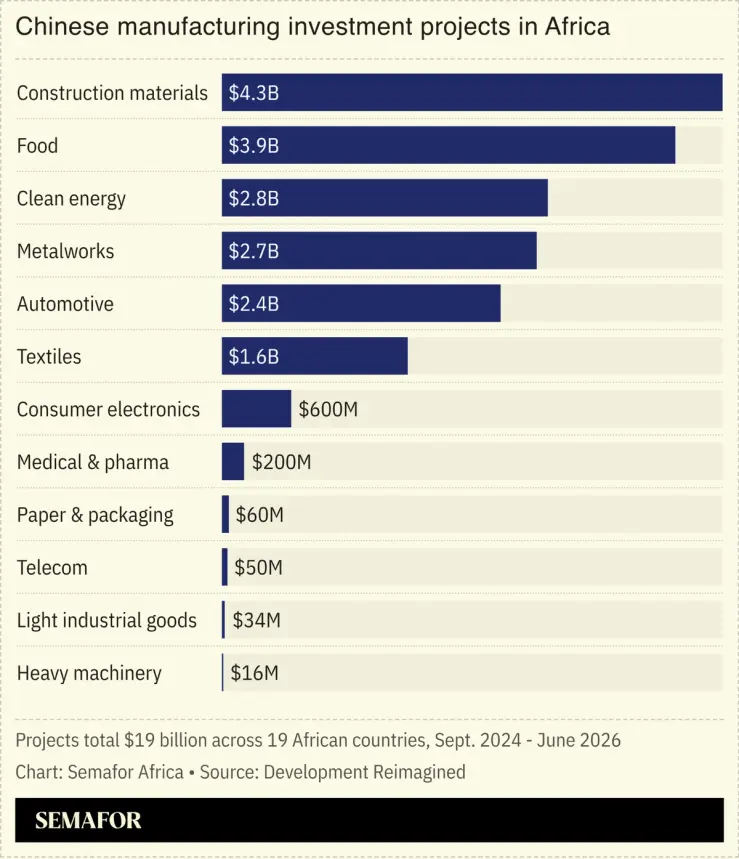
The renewed interest comes as Chinese manufacturers deal with excess capacity and intense price competition at home, while trade barriers in the US and Europe make these export markets harder to access. But it’s also clear Africa offers growing consumer markets, lower-cost production opportunities and, since May, duty-free access to China for 53 of 54 countries.
A bigger Chinese manufacturing footprint does not mean Africa is about to become the world’s next industrial hub. The continent’s share of global manufacturing output has actually fallen to less than 2% today from about 3% in the 1970s, according to the UN Industrial Development Organization. Familiar obstacles still give investors pause including unreliable electricity, poor transport links, and limited access to finance.
But the opportunity remains significant: Global supply chains are shifting just as demand grows for locally made construction materials and clean-energy equipment. Chinese companies that already operate on the continent are expanding, Ryder said, suggesting the trend has commercial momentum.
The question to consider is whether African governments can turn that interest into something more durable with local suppliers, skilled jobs, and technology transfer. Attracting manufacturers is a start but ensuring more of the value stays in Africa is the harder test.
🟡 Alexis and I will join Tiisetso in Johannesburg this week for Semafor’s Next 3 Billion on Tour. We’ll welcome MTN’s Ralph Mupita and M-Kopa’s Jesse Moore among other tech leaders on stage. Sign up here.
Notable
- Private Chinese companies are investing in African manufacturing after years of state-led infrastructure projects on the continent, with China’s total investment at almost $8 billion in 2025.