There’s pessimism nationwide about ever being able to afford a home
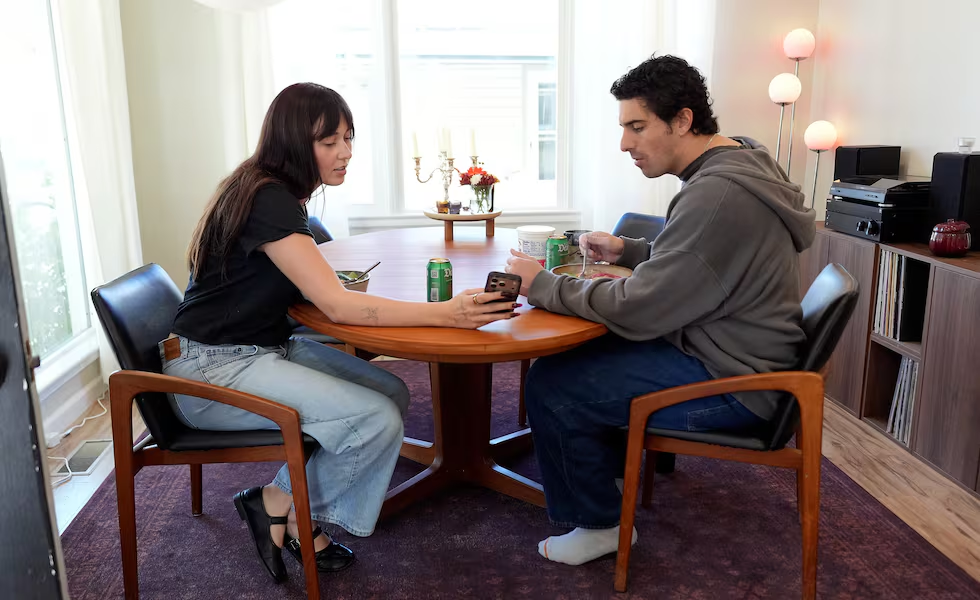
Cleaning up after sharing a weekday lunch together in their recently purchased Springville home, Cayden and Maddie Morton were clearly happy to have even a small dishwasher after living for the first two years of their marriage in his parents’ in-law suite, which lacked a full kitchen.
The young couple briefly debated the best positioning for their bowls and cutlery before giving visitors a tour of the four-bedroom, one-bath 1940s-era house in Springville, Utah, a small town that calls itself “Art City,”.
“We’re trying to figure out the best use of space,” explained Maddie Morton, 29, when asked about the sunny living room being all but filled by a single family heirloom, a massive mid-century modern dining table built for Cayden’s great-grandparents in Toronto.
A sectional couch and big screen TV are downstairs, along with a laundry room where their German shepherd-poodle mix, Gretzky, is dozing in his kennel. The main bedroom is upstairs; another nearby is set to become a crafts room and maybe in the next year or so, a nursery.
They’d found the move-in ready house after another long day of trooping through fixer-uppers with their real estate agent, a friend of Maddie’s father. Now decorated with a colorful handmade sign featuring their last name above the doorbell, “it ended up being perfect,” she said.
Don't give up on buying your first home, Utahns advised
Neither thought they’d be able to afford to become homeowners anytime soon, despite saving up because they were only paying for a storage unit to hold what couldn’t be squeezed into the in-law suite.
Both were busy with their careers. Maddie, a tattoo artist, opened her own studio this year in nearby Provo, and Cayden, 30, travels a lot as a software salesman for a data processing company also located in Provo.
But then Cayden’s brother announced he was moving home from out of state with his wife to attend grad school and needed a place to live. Cayden and Maddie had put down a deposit on an apartment when her father insisted they shouldn’t wait to become homeowners.
“Where our goals were to eventually own, it made a lot more sense to own than to rent,” Cayden said, adding they hadn’t already started looking for a place to buy “because I just didn’t think we were in a position to do it yet. And we were. It ended up being great.”
They were able to afford their home this fall without financial help from family members thanks to $10,000 in concessions from the seller and first-time homebuyer assistance from the lender. They paid $399,000 even as Utah’s median sales price for a home reached $530,000.
“The big takeaway for us was that if that’s long-term somebody’s goal, there are ways to do it,” Cayden said. “In my head, that was always something I’ll do in the future. But it’s actually possible.”
Most Americans still own their homes
Homeownership remains common in the United States, even among younger Americans like the Mortons. But the 2026 American Family Survey found a majority of the nation’s non-homeowners are pessimistic about their prospects of ownership becoming affordable.
The survey, a collaboration between Brigham Young University’s Wheatley Institute, the Center for the Study of Elections and Democracy at BYU and Deseret News, was conducted by YouGov July 20 to Aug. 6, 2026, among 4,500 U.S. adults.
That included a nationally representative sample of 3,000 adults plus an additional sample of 1,500 adults ages 18 to 40. The oversample allowed for a more detailed look at young adults’ experiences and attitudes. The margin of error for the full sample is plus or minus 1.8 percentage points.
The National Association of Realtors deputy chief economist, Jessica Lautz, told the Deseret News that the findings are in line with studies cited in the association’s new report showing the median age for first-time homebuyers in the U.S. once again hit a high of 40 years old.
“People say, frankly, they’re being shut out of homeownership,” Lautz said. “The desire for homeownership is there, but they feel like they will not be able to afford that in their future. It’s especially true for young adults. It’s especially true for lower-income adults.”
The American Family Survey found that 68% of respondents currently are homeowners, a status “closely tied to Americans’ ideas about financial security and opportunity,” according to an analysis by BYU political science professors Christopher F. Karpowitz and Jeremy C. Pope.
Yet among those 40 years old or younger, just 57% own their home compared to 75% of those over 40. Slightly more than half, 51%, of current homeowners earn less than $50,000, compared to 86% making $100,000 or more.
The report from the National Association of Realtors noted that in the 1980s, Americans typically could buy a home before they turned 30 years old. Today, first-time buyers are not only older but also need higher incomes and sometimes even inherited wealth.
“That’s a different type of first-time homebuyer,” Lautz said. The longer wait to be able to afford a home, driven by a higher cost of living, adds up to a typical loss of $150,000 in net worth over a lifetime, she said.
Who’s giving up on ever buying a home?
Age and income also significantly affect the expectations of today’s non-homeowners, the American Family Survey found.
More than a third of those 40 and younger believe it’s too expensive for them to ever own a home. That pessimism is more common among older non-homeowners, with 55% of those over 40 years old saying they’ll never be able to afford to buy.
And 56% of non-homeowners with incomes of less than $50,000 view homeownership as something that’s forever financially out of reach. Among those non-homeowners earning at least $100,000, that number drops to 20%.
Add in those who are saving to buy a home but don’t see that ownership will be affordable anytime soon, and that share reaches a majority among all Americans. Among those under 40, there are 54% who say they won’t be able to afford a home either soon or ever.
U.S. homeownership higher but affordability challenges remain
That’s worrisome, BYU’s Karpowitz said, and reflects findings in other parts of the survey.
“It’s over half of young people who don’t think (homeownership) is at least in the near future,” he said, adding that “young people especially feel pretty insecure about the ability to reach the milestones that allow them to have the kind of homes and families they would like to have.”
Looking at just young adults aged 18 to 40, 44% of those making less than $50,000 say it’s too expensive for them to ever own a home. That drops to 30% among young adults earning $50,000 to just under $100,000, and to 18% among those with an income above $100,000.
Cayden and Maddie Morton qualified for a loan with less than $100,000 in income from his job. They thought they’d have to wait to buy until Maddie’s earnings from her new business could also be counted, pushing them over the $100,000 threshold.
“We just didn’t know,” Cayden said, adding, “We feel very blessed just to make this all work.”
Although most of their friends are married, fewer than half are also homeowners. The couple is sharing their story, Maddie said, because becoming a homeowner is possible despite the “doom and gloom” surrounding the housing market.
“It’s not a big, scary thing,” she said. “It’s doable.”
Affordability worries everyone
Where age and income didn’t seem to matter in the survey is in how Americans perceive the availability of affordable housing in their communities. More than seven in 10 respondents said finding affordable housing locally is somewhat or very difficult.
The results were similar whether they lived in a city, suburb, small town or rural area.
“Everybody’s worried about affordability,” Karpowitz said. “They perceive housing in the places where they live as being unaffordable. That’s a national problem. It’s not a city problem. It’s not a problem that’s concentrated in certain states or certain places. It’s everywhere.”
That finding, he said, is a “huge take home” from the survey. “Homeownership is still quite common. Most Americans have that experience at some point in their lives. But they also overwhelmingly agree that affordability is a huge problem right now.”
Karpowitz said the midterm election results that swept Democrats into power around the county appear to make it clear that Americans want to see action taken to improve affordability across the board. What that looks like, however, remains to be seen.
“There’s room for politicians who can explain what they’re doing and how that’s going to affect the pocketbooks of ordinary Americans,” he said. “I don’t see any evidence in this survey that there’s one single silver bullet.”
None of the four broad policy options for creating more affordable housing in their local communities were selected by a majority of respondents, even though they were told to select all that apply.
Rent control topped the list, chosen by 48% of respondents, followed by increased local spending on housing for lower-income residents, 41%; increased federal spending for public housing, 31%; and reducing zoning regulations to build more homes, 22%.
Just over a quarter of respondents, 26%, picked “none of these.”
Americans aren’t experts in the economics of housing when it comes to the impact of an option like rent control on the housing supply, Karpowitz said, but as consumers, “they see that prices are high and rising and they want something that will stop that, or at least curb it.”
How Utah is addressing the housing crisis
The survey results came as no surprise to Utah’s state housing coordinator, Steve Waldrip.
“I think we’ve seen these numbers coming for quite some time,” Waldrip said. “Homeownership rates are dropping. That’s why we’re so focused on creating opportunities for homeownership, because that is one of the core principles of the American Dream.”
People seeking the stability and opportunity to build wealth that home ownership offers are increasingly being priced out of the market as inflationary pressures boost building costs and mortgage rates keep rising, he said.
“What we’re seeing as far as trends go is just continued headwinds, particularly for young people,” Waldrip said. Wages may be going up in places like Utah, but bigger paychecks aren’t keeping up with increases in housing costs.
Utah Gov. Spencer Cox set a five-year goal of getting 35,000 new starter homes built by 2028 to address the housing needs of the country’s youngest state, but so far, only about a quarter of those homes have been delivered.
“Things are getting tougher,” said Waldrip, who serves as Cox’s senior housing adviser. There are a variety of state programs underway to bolster the governor’s goal, including new grants to help with infrastructure costs and the development of surplus state-owned land.
Starter condos? Here’s Utah’s new plan to get more affordable housing built
“Starter condos” are also part of Utah’s efforts, with about $75 million expected to be loaned to developers from a special state fund by the end of the year, he said. The intent is to encourage more “owner-occupied solutions, like condos” rather than rental apartments.
The condo program was among those Waldrip said he discussed at a meeting in Denver of a bipartisan national housing crisis task force led by Cox and leaders from Cleveland and Atlanta that’s expected to lay out their proposed solutions early next year.
“Our approaches are generally more market-based,” relying less on long-term government intervention, Waldrip said. “We want to be helpful in producing supply because at a fundamental level, this is a supply issue where we just don’t have enough housing.”
He was happy to hear about the Mortons’ home purchase.
“That’s really cool,” Waldrip said. “We’re seeing young people recognizing the value of buying a home and owning property. We want to do everything we can to support those young couples. We’re encouraged by the hustle that they’re showing, and the financial discipline and fortitude.”