Worries spike among Ukrainian refugees amid uncertain legal landscape
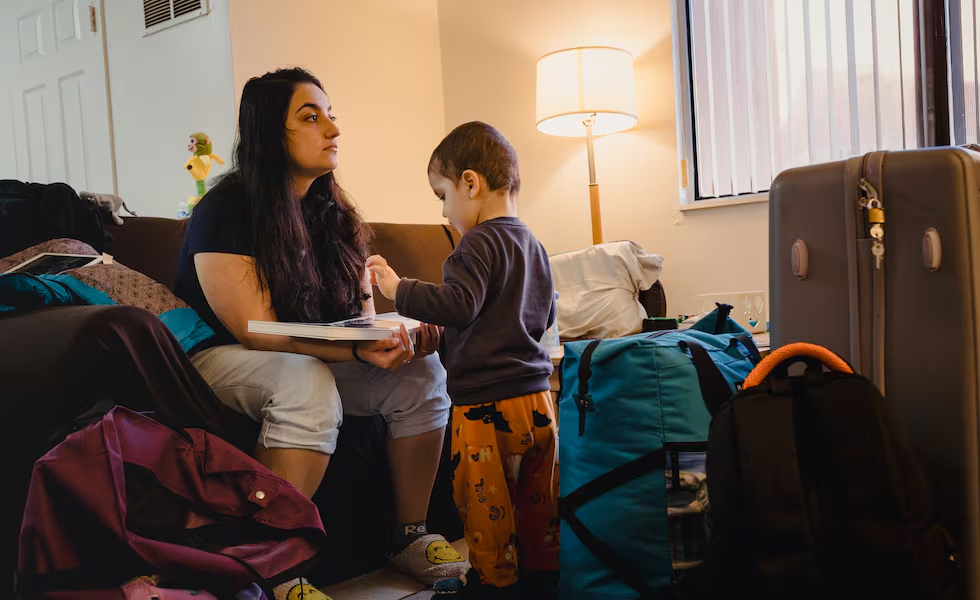
Zhanna Martyrosian, 68, barely made it out of Russian-occupied territory in 2022 after her home in Mariupol was bombed in the early months of the war. She eventually found safe haven near her daughter Anzhelika in Utah, who had married another Ukrainian while studying at BYU-Idaho.
On Oct. 10, however, their whole family — including Grandma Zhanna and 2-year-old Andrew — boarded a late flight to Argentina, fleeing an immigration limbo and uncertainty in the U.S. that had come to feel intolerable.
A shifting legal landscape
Monday marked the expiration of the 18-month extension of Temporary Protected Status for Ukrainians, which the Department of Homeland Security announced during President Joe Biden’s final days in office.
Federal law provides for an automatic six-month extension if DHS fails to make a timely decision. DHS officials told CBS on Sunday that protection against deportation is still in place for now, but a lack of clear federal guidance to this point has made it difficult for some Ukrainian immigrants to prove their status to employers. This comes at a time when humanitarian parole, granted on an individual basis for two years, has also been expiring for many refugees.
The Deseret News spoke with Ukrainian families who have reapplied for both TPS and humanitarian parole. But many months of waiting for decisions from the U.S. government has compounded fears of what may happen if they stay.
“She doesn’t feel safe here any longer,” Anzhelika said of her mother. “We all read about ICE and what’s going on.”
She and her husband, Illia, sought to “do everything right,” Anzhelika said. Neither of them even has a parking ticket. But it’s been 19 months since they applied for an extension of their Temporary Protected Status. With no response from the government, the family began to fear that if detained, they could be separated from their 2-year-old son, Andrew.
Two weeks ago, Illia said goodbye to a New Jersey job in logistics and supply chain management that he loved. The family sold their car and all the possessions they could, including many of Andrew’s toys and Anzhelika’s guitar.
The family made the choice to leave the country, departing last weekend to live in a one-bedroom apartment in Argentina, where they don’t know anyone, don’t speak the language and don’t have any current employment.
“I felt like I always was in the air,” Illia told the Deseret News, emphasizing they were seeking more permanent status and did not want to live “in a limbo.”
‘I never wanted to emigrate’
Maryna Slepak will never forget being at a playground in Kyiv with her children when the attacks started in late February 2022. Another mother from Donetsk could recognize the exact weapons the Russians were using just by their sounds.
Six months later, fearing the situation would only get worse, Slepak arrived in Maryland with her two children, approved to stay under Uniting for Ukraine (U4U). That Biden-era federal humanitarian parole program allowed roughly 240,000 Ukrainian citizens fleeing the war — mostly women, children and seniors — to find respite in the United States. Another 141,000 Ukrainians already resided in the U.S. or entered the country in other ways.
Slepak said she loved Ukraine and “never wanted to emigrate,” having just won an award for her movie script. Her “entire identity was tied to Ukraine,” she said.
But after beginning to find healing following years of building a safe life in the U.S., Slepak’s family is now likewise feeling uncertainty about their safety, this time in the United States.
Finding refuge
When Slepak heard “Welcome to the USA” from a border control officer, the young mother burst into tears — “not realizing until that exact moment how desperately I needed to feel welcomed,” she said.
It took about a month, Slepak told the Deseret News, to “truly process that I was in a safe country — that I didn’t need to fear passing planes or loud sounds.”
But it took another year before her then-9-year-old daughter’s nightmares about the war and being kidnapped finally dissipated.
Slepak fondly recalled the comforting words she heard from many Americans at the time, several of whom opened their homes to her family. A wish list of supplies for their new residence was “completely fulfilled within an hour, even before we landed,” she said. “Even strangers on the street felt like friends.”
“I felt like I was slowly growing roots again,” Slepak said, “just temporarily. Until the war ends and I go back home.”
Slepak’s husband stayed in Ukraine and has been working to rebuild homes. “I can’t be more proud,” Maryna said of her husband, who talks with them every day via video call. She described “cherishing those moments when we can be together.”
Slepak reflected on her own great-grandmother, who raised four children by herself after her husband never returned from World War II. “I always thought, how could she have done that?”
“I never thought I would go through the same thing,” she said, calling these four years of war “unimaginable.”
Planting roots in American soil
People often naturally fall in love with where they live, Slepak said, and that was the case with her family when they emigrated to the U.S. “When I came here, I felt at home because of the people and the nature and all the support.”
Slepak’s children have built lives here. Her daughter now plays soccer, sings in the choir, attends school clubs and excels academically. Her youngest plays the trumpet, plays soccer and is a “happy child.” Her son is the captain of his high school soccer team, joined the JROTC program and has a girlfriend now.
After the war ends, Slepak believes many Ukrainian families who relocated to the U.S. would prefer to continue raising their children here because of the roots so many have set down.
“I am very much a different person,” she said. “My people are not just Ukrainians now — they are Americans, too. American culture is also now my culture.”
Growing status worries
Slepak initially planned to stay for a year, “until things improved.” When her original humanitarian parole expired in the fall of 2024, she reapplied for that and the related Temporary Protected Status program.
Now with both expired, she is feeling the same increased limbo, able to stay legally but relying on “pending parole status” and “pending TPS status” as her family awaits further decisions from the U.S. government.
Slepak told the Deseret News that many of her fellow Ukrainian refugees in the United States had been awaiting similar government determinations this fall.
Zach Kahler, a spokesperson for U.S. Citizenship and Immigration Services, told Politico in October that the agency “is actively processing discretionary re-parole cases, including those for Ukrainians, on a case-by-case basis as the law intends.”
The Slepak family has discussed the possibility of returning to Ukraine if their statuses are not extended. Despite their hopes to stay, Slepak underscored that if that is not granted, the family will leave the U.S.
“No one wants to be illegal here or break the law in any way,” she said.
Ruminations amid uncertainty
“The weight of this uncertainty falls hardest on the kids,” Slepak said. “They live in a world they built here — one they cannot imagine crumbling a second time.”
This possibility of uprooting them again “feels like a lingering threat.”
Olga Bukanova, a Ukrainian who lives in Utah, described the emotional weight many refugees feel: “Every moment you can get arrested and placed in the detention center, and that’s it.”
This perception conflicts with new assurances from the U.S. government. However, an estimated 514 Ukrainian nationals have been placed in U.S. Immigration and Customs Enforcement detention since January 2025, according to an analysis Stephen Cranney shared with the Deseret News of numbers compiled by the Deportation Data Project. Of those arrested, 146 had pending criminal charges.
Others had asylum applications or immigration court appeals denied, since generalized wartime violence does not automatically legitimize an asylum claim. The Department of Homeland Security has consistently maintained in press releases and congressional testimony that programs like Temporary Protected Status (TPS) and Uniting for Ukraine (U4U) were designed as temporary humanitarian measures rather than permanent residence programs.
As of mid-2026, roughly 185 Ukrainians were held in active ICE detention centers across the country at any given point. And approximately 150 to 200 Ukrainian nationals have been formally deported or removed from the United States during the last 18 months.
As Ukrainian families await formal immigration decisions, fears of the worst-case scenario linger. For many, the administrative silence means preparing for the worst: having just 60 days to sell cars, pack up homes and find a country willing to take them.
Bukanova compares her emotional experience to “sitting on an active volcano and just wondering: ‘Is it gonna explode now or not? Is it gonna erupt at this moment, or maybe in a week?’”
“I’m tired. I cannot just go and start rebuilding stuff from scratch again and again,” one friend told Bukanova, comparing the worry about having to leave everything to the early pioneers “being kicked out again and again.”
Slepak described another Ukrainian friend in Minnesota whose physical green card hadn’t yet arrived. When immigration enforcement was heavily checking people in that community, this friend was swept up and held in detention for a week, sleeping on a concrete floor before being released.
Mounting financial pressures
Slepak emphasized the economic realities connected to this legal limbo. One friend had just gotten a new accounting job that she was excited about working hard in — then got a message that her work permit would end soon.
In Slepak’s case, she cannot pitch or sell her new screenplay without an employment authorization card — something she’s been waiting on for a year and a half.
Bukanova’s work status terminates in October. She has seen other people let go due to similar issues and then struggle to find a new job because they’ve already been replaced.
Bukanova described another family that is struggling to find work because their status will end in a month. Since they don’t know whether to extend their apartment contract, the apartment managers told them they could do a month-to-month lease instead — but for double the cost.
Giving up and leaving the U.S.
Bukanova believes some of this limbo is intentional, reflecting a push by the government to get them to leave — as if they were saying, “No, we’re not kicking you out. You’re leaving — you’re making this choice.”
She talked about friends looking for places to go, telling her: “It doesn’t make sense to stay here, especially if we’re going to be kicked out at any moment.” She pointed out the struggle to stay afloat financially amid the legal limbo.
Many of these friends have decided not to wait until new announcements by the government, Bukanova said, highlighting those who came to the U.S. but have now returned to Ukraine.
“It’s not an easy thing to go through, proving yourself all the time that you need to stay,” she said.
‘Real life of real people’
“People are exhausted,” Bukanova said. “They’re exhausted from staying on this almost-erupting volcano. They don’t know what to do. They don’t know if it’s gonna be over or not.”
Slepak got emotional describing how grateful she feels for people in the U.S. who have helped Ukrainians in recent years and who “still feel this way.”
With the churn of ominous news, she admitted this goodness is “easy to forget,” with Americans more and more likely to say about Ukraine: “Look at this situation — it’s just another conflict on the map.”
“This is real life of real people,” she said through tears. The war in her homeland is something she hopes people will “keep in their mind, thinking about and praying for,” she said.
“Ukraine needs that.”