In Syria’s ‘Little Dubai,’ Evicted Families Are Still Fighting for Justice
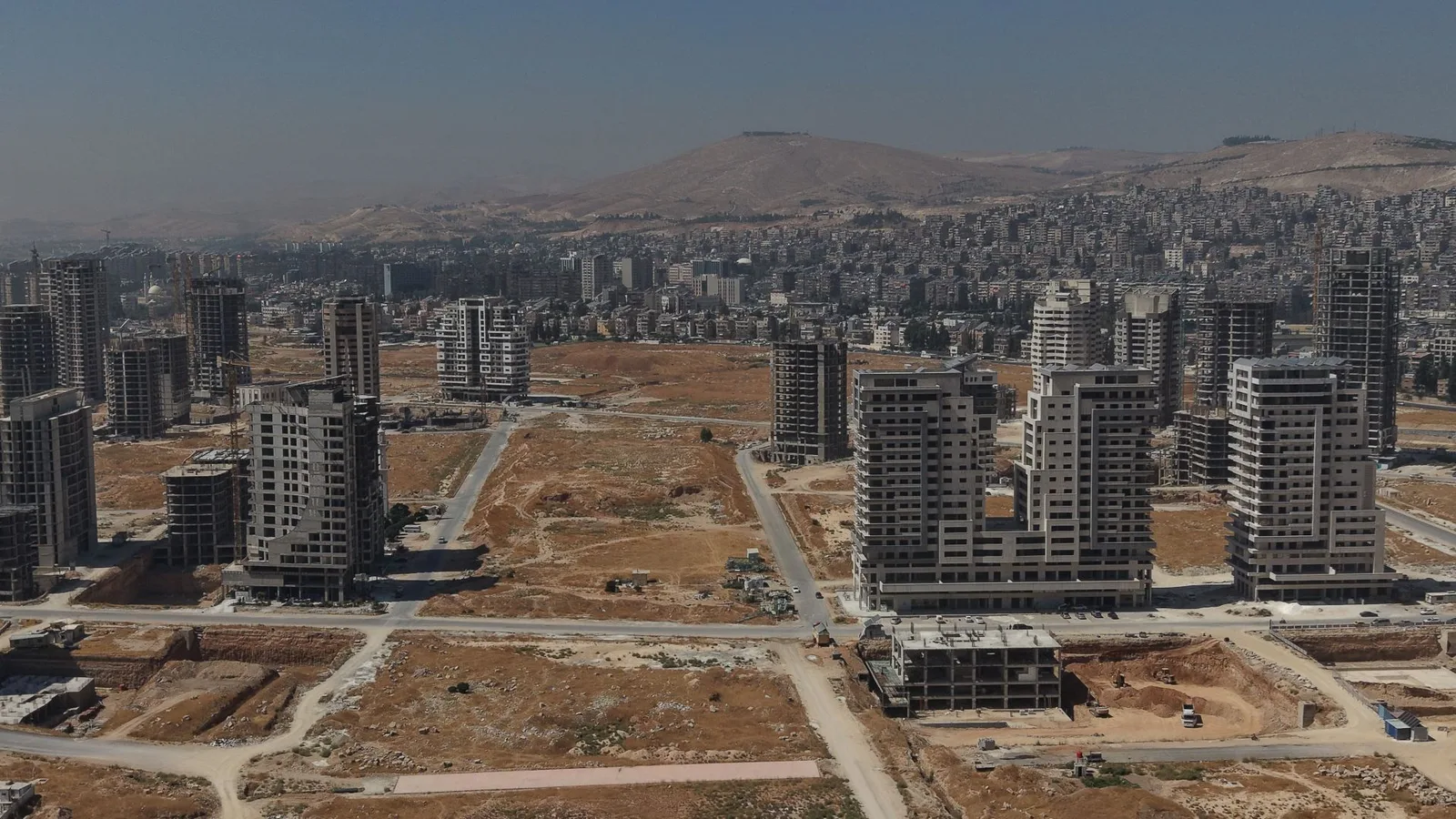
Ghiyath al-Idlibi wears a crisp blue shirt, a smart tie and a watch to match. Head of investments at the Damascus Governorate offices under the administration led by interim President Ahmad al-Sharaa, he lays out his vision for Marota City with enthusiasm.
“We want to make it a Dubai-style city. We have buildings ranging from 13 to 70 floors, skyscrapers, big spaces, gardens like in modern cities. … One tower will be a headquarters for tech companies. Before and after Assad’s fall, the vision is the same, but better. We want to make the streets wider,” he says.
That continuity is at the heart of the controversy surrounding Marota City.
In 2012, Syria’s then-President Bashar al-Assad issued Legislative Decree No. 66, paving the way for Marota City and Basilia City, two major redevelopment projects covering around 2,200 acres in Damascus. The area targeted for construction, spanning parts of al-Mazzeh and Basatin al-Razi, was politically sensitive: an affluent neighborhood where some residents had joined protests against the Assad regime, near the presidential palace, diplomatic missions and a United Nations office, as well as Daraya, a major center of opposition to Assad.
Presented by Assad as a vision for a modern, postwar Syria, the project had displaced around 7,500 families by 2017, clearing out a population associated with the uprising. “They considered the neighborhood a place harboring sleeper cells of the revolution,” says Mohammad al-Moallem, in his 50s, one of the residents whose property was expropriated. “They labeled it a slum, said it posed a threat, and decided to displace and expropriate all its residents under the pretext of redeveloping the area.”
Under the decree, expropriated landowners received shares that they could sell or pool with others to obtain plots in future towers. Developing these plots required partnering with other owners and covering construction costs. Although residents were also entitled to alternative housing or rental allowances, many say they received neither adequate compensation nor the housing they were promised.
Rules requiring continuous occupancy meant that residents who had fled abroad and were absent during official inspections lost their entitlement to alternative housing. People suspected of terrorism, even without formal charges, were also reportedly excluded.
In this way, Decree No. 66 effectively turned the fear of arrest into a means of dispossession: Residents who fled to avoid detention risked losing their housing rights simply by staying away.
A May 2024 report by Syria Indicator, an investigative news outlet, found that 5,500 of the 7,500 displaced families were entitled to alternative housing but had yet to receive their promised homes. The remaining 2,000 had received no alternative housing, compensation or rental allowance. Meanwhile, the project created lucrative opportunities for businesspeople close to the Assad family, including Samer Foz and Rami Makhlouf, Assad’s cousin, amid wider business networks linked to Assad’s wife, Asma. Damascus Cham Holding, established in 2016 under Assad as the Damascus Governorate’s investment arm, partnered with businesses connected to the former ruling elite to develop Marota City. Syria Indicator documented allegations of corruption, opaque deals and mismanagement surrounding the project, whose returns were estimated at between $3.5 billion and $7 billion.
“We, the owners of these lands, retained only 17% of the total value of the Marota City project,” al-Moallem says. This figure echoes a 2020 study by the Carnegie Endowment for International Peace, which found that the value allocated to the original landowners, after valuation and deduction of costs, amounted to only around 17% of the total land value. This is the complex legacy inherited by Damascus’ new authorities.
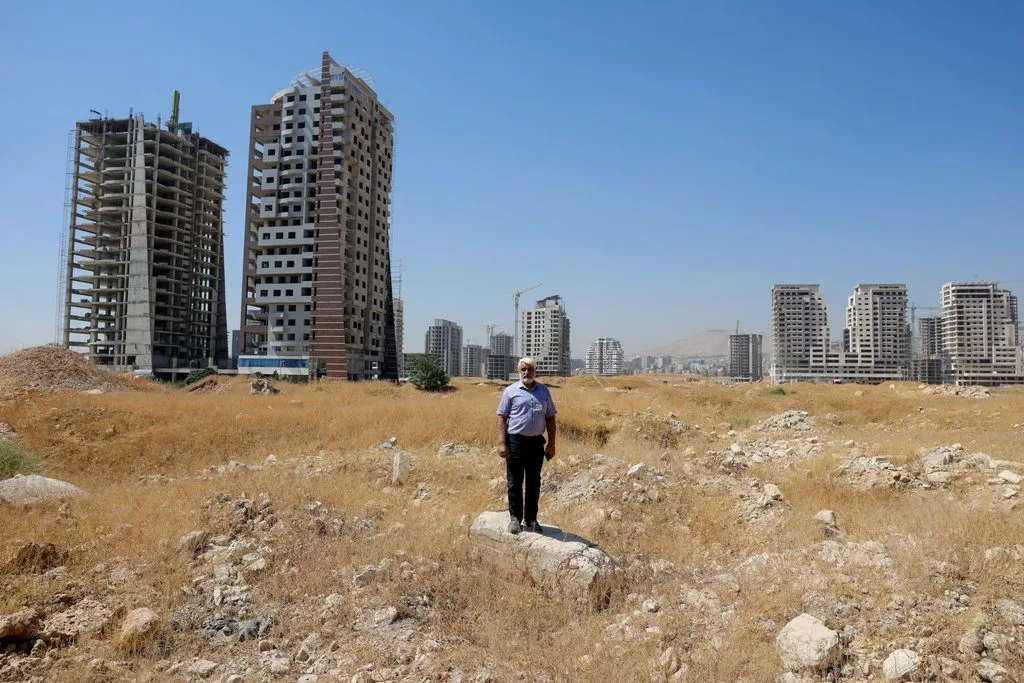
At the Marota City site, Mohammed al-Ghafir, 60, stands on a fragment of a white concrete slab: what remains of his 2,700-square-foot villa. “Every day, I visit my land to smell the soil. To remember how it used to be,” he says. The area used to be green. Around the vacant lot where his house once stood, large apartment buildings now rise, some completed and others still under construction. As he walks through the area, he begins pointing out where his family’s homes once were.
“My house was here. Around it was the house of my three brothers, the house of my sister, the house of my cousin. This whole block belonged to our family. We were all wanted by the regime. We fled to Lebanon and then to Istanbul.” His 21-year-old son, standing next to him, remembers receiving videos of the house being demolished. “I had an emotional breakdown, it was in 2015. I was so sad over my memories, our apricot tree, the library, everything.” After Assad’s fall, al-Ghafir returned to Syria with his wife and two children. He is now renting an apartment for $500 a month.
His shares, received as compensation for the eviction of his home, were put up for auction, like those of other absent owners. In his case, he was lucky: No one bought them, entitling him to compensation under the Marota City redevelopment project — shares in a commercial section that has yet to be built. “It might be worth the equivalent of $100,000. My house was worth $320,000 in 2012. But I want my land; nothing can compensate me for it. Even without a house.” He was allocated shares in what residents call the “terrorist” section, V192, comprising 50 floors and 5,000 owners, some owning as little as 5 square feet and others over 1,000 square feet.
Al-Idlibi, the head of investment at the Damascus Governorate, is no newcomer to Marota City. Before joining the governorate under the new authorities following Assad’s fall, he worked at Damascus Cham Holding, the company established under the former regime to develop the project. Before the regime fell, he held several positions at the company, including a seat on its board of directors in 2022. Now, he is helping to oversee the continuation of the same project. His own description of his move from the company to the public administration is straightforward: “Bringing expertise from the private sector to the public sector.”
Redwan al-Ghafir, Mohammed’s 52-year-old brother, lives in Turkey. He is a co-founder and general coordinator of the Association for the Repeal of Decree No. 66 and the Restitution of Rights. His brother Mohammed is also a member of the collective. Redwan is among those evicted from al-Mazzeh, where Marota City is now being developed. He says he went into exile in Turkey because the regime was looking for him after his brother was detained.
“They raided my entire house in 2012, stole everything and put a security officer in the house. And they were the ones who confiscated our property, and they received the compensation, as they were present during the inspections of the homeowners.” He then adds: “Others had their homes destroyed while they were still inside. As for me, I had to leave. I was afraid of prison and mass graves. I have a brother in a mass grave.”
After Assad’s fall, Redwan helped mobilize displaced residents through a Facebook page with 250,000 followers and a WhatsApp group of 8,000 members. The association he helped establish, whose members include lawyers and engineers in Syria and abroad, is calling for Decree No. 66 to be repealed. Since then, its members have organized protests and sit-ins. On June 12, 2025, residents protested in Damascus’ Umayyad Square. On May 8, 2026, dozens gathered outside al-Farouq Mosque in al-Mazzeh to demand the suspension of the decree, and on June 3, protesters rallied outside the Palace of Justice following the arrest of two representatives. The association’s central demand is simple: “Freeze the decree.”
“On the ground, violations of our right to housing continue. I insist on the word ‘violation.’ … On the other hand, the governorate has offered our land for sale to investors. Our big problem is with Cham Holding, the company marketing the project. … Before, we were able to protest. Now they require us to obtain prior authorization, but they don’t give us that authorization. That’s why we go to the media. We don’t see concrete justice,” says the association’s general coordinator.
He continues: “There has been no change since the fall [of Assad], not even the slightest. Why do they continue? Because they have interests. There are many investors. All the state-owned land is managed by this company.”
In his view, the state has no interest in helping the displaced families. “It should be their job to investigate who confiscated my house. The investors know the names. Damascus Cham Holding knows the names.” Assad’s fall raised hopes that Redwan and his family would recover their land. “My family and I were entitled to a tower; we owned more than 1,300 square meters [14,000 square feet]. Without a doubt, our expectation was that when the Assad regime fell, its laws and decrees would fall with it.” He adds: “We are the owners of the land. We should have been consulted about how we wanted the land to be developed. They could have preserved its rural character while maintaining the social fabric, customs and traditions. This was not our choice.” He then adds resignedly: “I feel as though Bashar al-Assad still has power over our land. … They are abusing or benefiting from the displacement that took place, and from the fact that people lost their documents, to avoid returning their rights and their land.”
“When we met the governor of Damascus, he told us that the governorate had 80 towers: around 35 for the sovereign fund and the rest sold to private investors to finance the project. Everything that was confiscated during the revolution is now owned by the current state,” Redwan says. Damascus Governorate owns approximately one-third of the plots.
The association returned to the streets to protest against this arrangement. One of the protesters is Yasser Abbas, 62, the association’s spokesperson. At the entrance to Marota City, we meet him: a tired-looking man with a white beard.
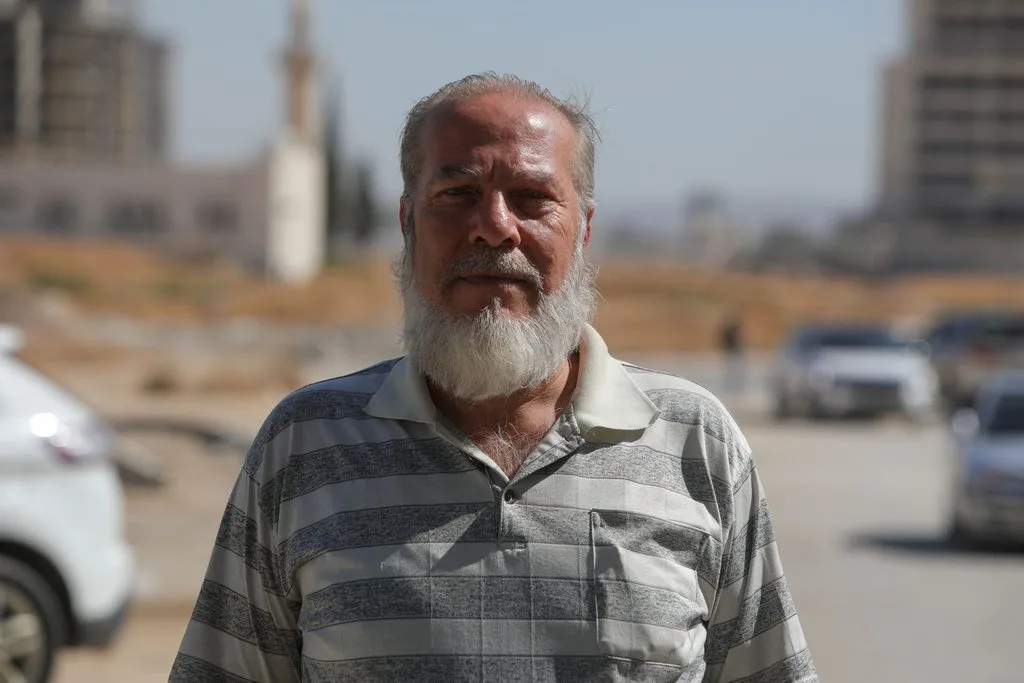
During our conversation, a member of the Ministry of Interior approaches to ask to see New Lines’ accreditation. Abbas appears to be a familiar figure in the neighborhood. He speaks about his son, whom he calls a martyr, killed on Aug. 15, 2012, during clashes between rebel fighters and government forces in the al-Ikhlas area of al-Mazzeh, near a Syrian special forces barracks. “I buried my son here on the land, along with six other fighters.” His son was 20 years old and had defected from Assad’s army.
After the regime fell, Abbas saw that construction of the towers was continuing. He then exhumed his son’s remains and moved them to a cemetery, giving him a new burial place.
Like the other homes in the area, Abbas’ house was demolished. Now unemployed, he relies on money sent by his children and rents an apartment. He says he has been arrested three times after protesting and is being prosecuted for “defamation and cybercrime.” “They took me from my house. Ten people, all armed, at midnight,” he recalls. On another occasion, he says, he was detained for 24 hours after protesting at the entrance to Marota City. He describes a further arrest involving dozens of officers and several Toyota trucks. “Will I have a heart attack?” he asks.
Regarding the sovereign fund, he complains: “Whatever the old regime couldn’t steal, the new one is stealing. They took 37 plots.”
Yet in a country devastated by years of war and facing severe financial constraints, such arrangements may also be viewed as one of the few available ways to finance reconstruction and stimulate economic development.
Abbas had been entitled to shares in the development, but insists that they were nothing compared with what he lost when his house was demolished. “I had to sell my shares to pay $8,000 to avoid my son going into the army. I want my land back. It’s still empty. They can give it back to me. I have sold everything.” For five years, he says, he was a fugitive, unable to work and without money to buy food. He describes how he was displaced and how he tried to salvage his belongings. He left with some of his possessions, but when he returned two days later, the furniture was gone and the house had been destroyed. “The project wasn’t reasonable. The country was at war. It’s not during a war that you undertake construction.”
“After the liberation, I expected us to get our rights because al-Sharaa said to go into the streets and demand your rights with a loud voice,” he says, referring to a statement made by the transitional president in January 2026. “That’s what I did, and I got arrested.”
Marota City remains at the center of unresolved property disputes inherited from the Assad era. On May 5, 2026, Syria’s official news agency SANA reported that the Damascus Governorate had received 1,606 appeals relating to the project, of which it had resolved 1,122. The authorities also announced higher rental allowances, larger plots allocated to the original landowners and funding for replacement housing.
In September, Human Rights Watch continued to highlight unresolved legal issues and the lack of durable solutions for affected residents.
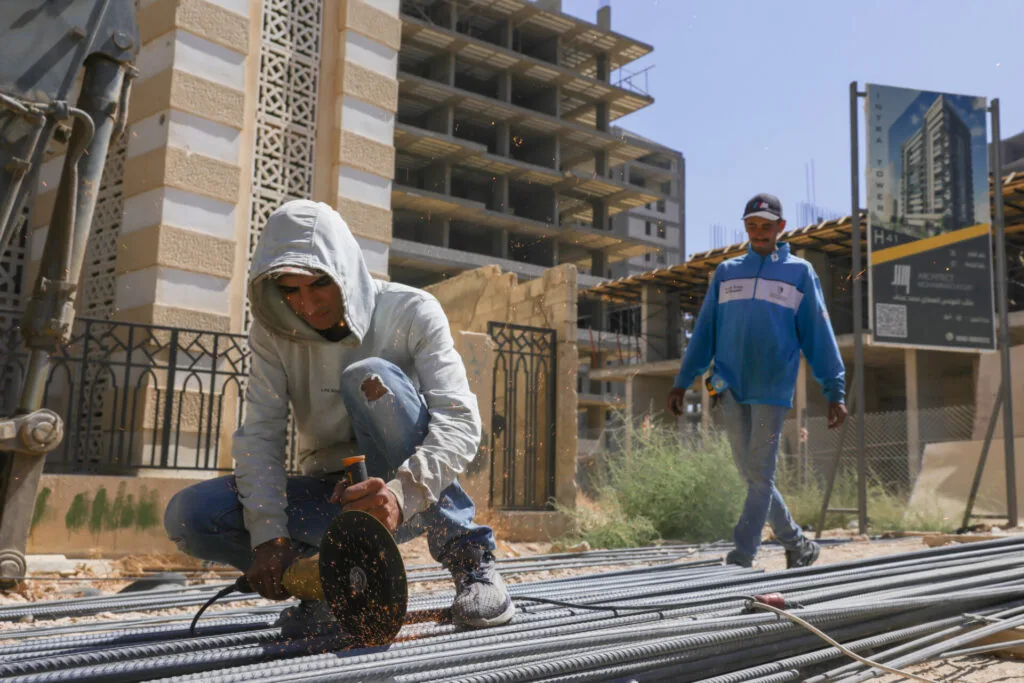
While former residents continue to demand the return of their land, construction workers press on with building the towers. Behind a mosque, one of the few buildings to have survived demolition, seven workers toil under the relentless summer sun on Tower H-41, a 12-story residential building. Asked about the fall of the Assad regime, one of the workers replies: “We stopped for two weeks, then carried on. Summer and winter. We still need four years to complete the project.”
Back at the office of the head of investments, al-Idlibi brushes aside allegations that the governorate has pursued Yasser Abbas and rejects criticism of Marota City, which he attributes to a misunderstanding of real estate development. “They don’t understand what real estate development is. For example, this building belongs to me. I’m also entitled to green public streets and brand-new public spaces — those have value too. On social media, people take part in discussions about real estate without being experts, and they interfere in these matters.”
Some of the discontent, he suggests, stems from the way landowners handled the shares they received. “When we distributed the shares among the people, some of them sold them at cheap prices, so they feel they have suffered an injustice, while others knew how to deal with it.”
He also rejects any broader responsibility. “As for the redistribution of wealth, 80% or 90% live below the poverty line in Syria, and this is not our responsibility,” he says.
For al-Idlibi, neither the criticism nor the grievances of some landowners undermine the project’s legitimacy. “The vast majority support the project, and the minority who oppose it can object. Don’t accuse us of stealing, because this project is for the people. We’re housing people.” He ends by pointing to the project’s progress. “We have completed 40% of the infrastructure, and we have an agreement to complete the rest. … We are moving twice as fast since the fall.”
Al-Moallem is among the landowners whose residential tower is now under construction. “I have started to see something that compensates me for what I have lost.” The process has not been straightforward. Finding a contractor and negotiating the terms of construction have presented their own challenges. “We are 55 owners in this section. We share 60% of it, while the contractor takes 40% because of the exceptional circumstances.”
Al-Moallem acknowledges that the criteria for allocating housing were arbitrary. “I had the opportunity to obtain a plot of land, but they held an actual lottery among those competing for plots, and it was also a matter of connections. Others were denied their share because they were accused of terrorism or were living abroad. Others were forced to sell their shares. Nothing was fair.” He also condemns the arrests of protesters. “That should never have happened. The municipality should listen to what they have to say.”
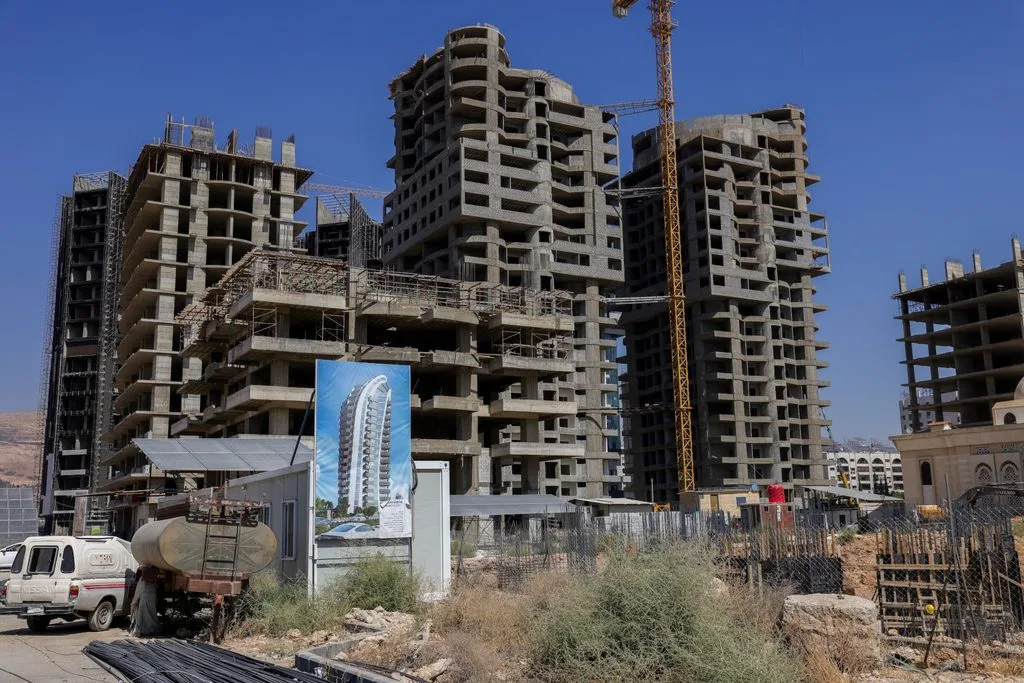
At the Marota City construction site, Mamoun, an engineer overseeing the construction of three towers, describes the challenges the project continues to face. “The project is progressing slowly. There is no water or electricity. Sanctions made it difficult to source construction materials. Everything takes time.”
On the issue of the former landowners’ rights, in his view, the authorities are attempting to address some of the injustices, but they are confronted with a process that is already well underway: Shares have been allocated, and some have since been resold. As a result, it has become difficult to reverse the entire process and compensate all the residents who have suffered losses.
Some have been able to benefit from the project, while others have been disadvantaged. For Mamoun, however, this does not mean that those affected should give up their claims. “On the contrary, they must continue to fight for their rights.”
Syria’s housing crisis predates the war: Before 2011, an estimated 40% of Syria’s urban population lived in informal settlements, according to the U.N. Human Settlements Programme. Combined with a complex legal framework and weak land administration, this has made it difficult to establish ownership and resolve competing claims — a challenge the new authorities must confront far beyond Marota City.
Ahmad Almahiry, 38, an architect and strategic urban planner, is the founder and project coordinator of Together Space, an independent Syrian initiative promoting inclusive postwar reconstruction. He points to the limitations of Marota City and the need to reconsider its development model. “Today in Syria, we are living through a phase of recovery following more than 40 years of urban injustices. In my view, the Marota City project perpetuates the urban injustices left behind by the former regime. Consequently, it must be reevaluated, and whatever can be salvaged must be reformed.
“The restoration of rights begins by involving local residents and landowners in shaping solutions and making decisions. Projects that ignore those affected lack societal legitimacy. … Investors must realize that recovery and justice ultimately protect their investments, whereas ignoring people’s rights threatens the stability and success of these projects.” He concludes, “We want projects that resemble Syria and its people, not replicas of Dubai or Beirut.”
For Benjamin Fève, an independent researcher on Syria’s economy and founder of The Syria Dispatch, Bosnia offers a model for addressing Syria’s unresolved property claims. “After the war in Bosnia, authorities established a legal framework for large-scale restitution, with international support. This shows that restitution requires more than compensation: It requires clear procedures and, above all, the political will to enforce them.”
He concludes: “How the authorities handle Marota City could set a precedent for property restitution across Syria. It will be a key test of the political transition.”
Additional reporting by Hadi al-Ali.