Center-left previews 2028 in Denver
The News
DENVER — The race for the next Democratic presidential nomination has begun, with a festival of agreement.
There was Pennsylvania Gov. Josh Shapiro, telling the What’s Next conference that voters demanded action, not “shallow litmus tests or where we fall on some political spectrum.”
There was Michigan Sen. Elissa Slotkin, explaining that voters did not want “marginal change” and Democrats weren’t in a battle of “progressive versus moderate.”
And there was Pete Buttigieg, who’d noticed the Democrats borrowing his formula. They wanted to pass cost-cutting, pro-family bills with their new majority, then convince voters that they would never go back to pre-Trump neoliberalism.
“It sounds good. It’s easy to say,” said Buttigieg. “Everybody thinks they already agree with this.”
The post-midterms conference, organized by Majority Democrats, was a payoff of a two-year investment by moderate donors. Two years before strategists and elected officials landed in Denver and grabbed their lanyards, the venture capitalist Seth London circulated a memo about how new candidate and media investments could steer the party away from “race and group-based identity politics,” and toward “prosperity for more Americans.”
This year’s Democratic landslide carried along every kind of candidate —the ones plugged into the Majority Democrats network, and the ones who worried it was a big-money ploy to defeat the populist left. But the conference elevated the candidates who wanted to build a supermajority, battling big tech and environmental attorneys. Some donors were in; the donors who wanted them to move left were out.
“Tell us which ideas you’ll stop giving permission to, the ones that defy common sense or didn’t work,” said Rep. Jake Auchincloss, the pedigreed Massachusetts Democrat who chairs the Majority Democrats PAC. “Tell us which privileges you’ll confront, even if your donors or allies object.”
Celebrating the center
The donors did know how to throw a party. What’s Next resembled the sort of well-funded, media-friendly conferences that many Democrats have envied on the right, like the multi-day “AmericaFest” put on by Turning Point Action.
This was a party for the Democratic mainstream, the staffers most likely to work for center-left presidential candidates than for Rep. Alexandria Ocasio-Cortez, D-NY. For two days, blocks of Denver’s River North Art District were cordoned off for Democrats, the people who elected them, and the reporters asking if they were running for president. (Their answers were variations on “not yet.“)
There was conflict, but it was largely limited to the argument over who should lead Democrats’ new congressional majorities. Sen. Chris Van Hollen, D-Md., who announced his challenge to Senate Democratic Leader Chuck Schumer on Thursday, paused for 10 seconds of applause when he took the stage and explained why he was running.
“Candidates from different backgrounds and different parts of our party – they ran on a strikingly similar platform,” said Van Hollen. “They didn’t run on the tired Washington labels of progressive versus moderate. They ran on an economic populist message, on a commitment to fight for working people and take on a rigged economic and political system.”
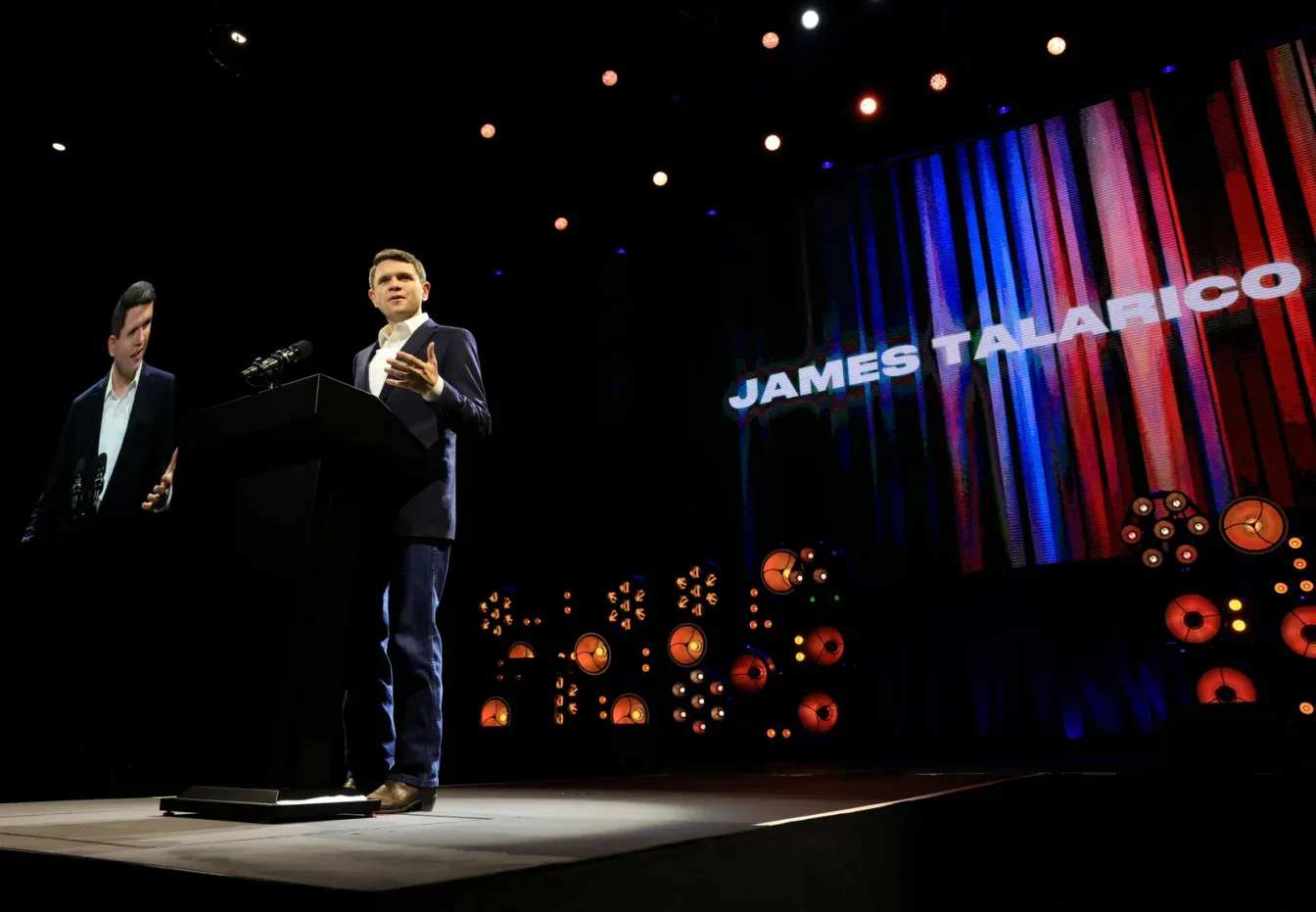
Many of those winners showed up in Denver, like Texas Sen.-elect James Talarico and Iowa Gov.-elect Rob Sand. They shared road stories of how they listened to Republican concerns, and would work with the willing ones to lower prices. But it was implied that Democrats should focus on building homes, lowering bills, and expanding health care before they did anything else. Not every attendee agreed.
“The organizers here want a big tent, one big enough to even invite anti-establishment voices like me,” said Rep. Ro Khanna, D-Ca., who Democrats see as a competitor for a Sen. Bernie Sanders lane in the primary. “A big tent cannot mean that we water down principle for political expediency.“Apart from Khanna, the likely presidential candidates didn’t quite do that. Mallory McMorrow, who Majority Democrats supported in her unsuccessful U.S. Senate bid in Michigan, told Semafor that her party had just shown that it could have a loud primary argument and then unite on the basics.
“It’s anti-corruption, getting money out of politics, protecting democracy, ending wars,” said McMorrow. “The disagreements are around the edges.”
David’s view
There will be many Democratic “cattle calls,” but I am focusing on how What’s Next was built because it’s the fruit of a two-year effort to ensure that the 2028 primary plays out differently than the 2020 primary. There is widespread agreement among Democratic strategists that their last open primary was defined by left-wing organizations that wanted candidates to commit to their ideas, eyeball to eyeball, on camera.
That meant forums organized by groups like Planned Parenthood and MoveOn, and more progressive labor unions like SEIU. That meant the ACLU asking candidates if they would commit to cutting the federal prison population in half, and Movimiento Cosecha bird-dogging Joe Biden at his own events until he committed to stopping most deportations.If the left sees Majority Democrats as an effort to swipe their strongest messaging and junk the rest, they’re right. The economic populism in Denver was more sincere than they might think, but it is against degrowth and for permitting reform; skeptical of single-payer health care, but for incremental steps to “universal” health care; basically, right in the sweet spot of the Democrats’ congressional caucuses.
Right now the Schumer-Van Hollen contest is where the fights over ideology and priorities are happening. The 2028 candidates would prefer to agree, for now.
Room for Disagreement
The left was not letting the rest of the party adopt its ideas without a fight.
In the run-up to What’s Next, reporters from three left-leaning outlets that had been critical of Majority Democrats – The Lever, The Intercept, and The American Prospect – announced that they’d been denied access. All were eventually allowed in, becoming a First Amendment nuisance for donors who didn’t want to interrupt happy hours with hard questions.
And on Friday, four protesters accessed the Mission Ballroom to interrupt the most powerful Democrat at the conference, House Democratic Leader Hakeem Jeffries. As liberal pundit Jessica Tarlov asked the likely House Speaker about his agenda, they jumped up, one after another, accusing him of complicity in genocide.
A protester with Climate Defiance, pushing back at the bouncers who dragged him out, turned to the stadium seating reserved for reporters and shouted “f— you all!“Nicole Shea Niebler, a 31-year-old organizer with the Sunrise Movement in Denver, said that she interrupted Jeffries because “the conference made it pretty clear that strong progressives are not invited to participate at the scale that centrists were.”
That limited the bounds of debate in a room where media taste-makers were starting to decide what the 2028 primary was about; little talk of climate, none of foreign policy, certainly nothing about Gaza.Niebler expected to be pulled out, but was disappointed that Jeffries spoke before Van Hollen and his challenge to the Senate leadership. “That was the one I actually wanted to see.”
Notable
- In his How Things Work newsletter, Hamilton Nolan worried that an unthinking Democratic consultant class was already limiting what the party could do, by working with mega-donors and coming up with ideas that didn’t scare them.
- In the New York Times, Reid J. Epstein and Lisa Lerer captured the scenes of powerful Democrats being stuck in the same flight re-booking bardo as everybody else.
- In The Washington Sun, Elana Schneider explored why the ambitious Democrats rejecting ideological litmus test think that the electorate is with them.