BHP bets $17.4 billion on doubling South Australian copper output
BHP (ASX, LON: BHP) plans to invest up to $17.4 billion to double copper production in South Australia by 2040, betting on rising demand for the metal despite a history of costly setbacks in the region.
The world’s largest miner expects to spend between $13.6 billion and $17.4 billion to lift annual output to about 650,000 tonnes from its Copper South Australia operations, with a final investment decision expected in the first half of 2027. The expansion would tap what BHP describes as the world’s richest copper-bearing region outside Chile.
“We start from a strong position as the world’s largest copper producer, with a sector-leading growth pathway that can be funded from existing copper cash flows,” Geraldine Slattery, BHP’s head of Australian operations, told investors during a site tour.
The investment would strengthen copper’s growing importance to BHP as electrification, artificial intelligence and digital infrastructure drive demand. The metal generated more value for the miner than iron ore, its traditional mainstay, for the first time in fiscal 2026.
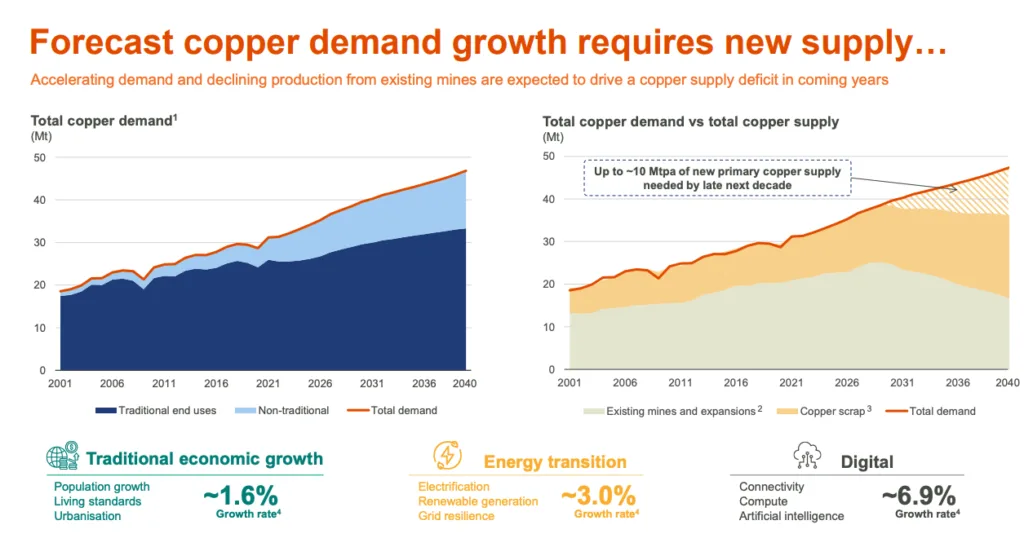
BHP expects global copper demand to rise 30% by 2040 to more than 45 million tonnes annually. Its Australian expansion would contribute about a third of the company’s planned production growth through 2035, Slattery said.
The strategy brings together the Olympic Dam mine and smelting complex, the Ankata deposit and assets acquired through BHP’s A$9.6 billion takeover of OZ Minerals in 2023.
BHP expects its South Australian operations to rival its stake in Escondida, the world’s largest copper mine, in production by 2040. The expansion supports its ambition to produce 2 million tonnes of copper annually by the mid-2030s, or 2.5 million tonnes including byproducts.
The miner is also pursuing growth in Chile, where it has operated for more than three decades. It has outlined plans to spend up to $14 billion expanding its copper operations there, targeting an additional 430,000 to 540,000 tonnes of annual production while evaluating new projects.
Costly challenges
BHP’s ambitions face considerable technical and financial hurdles in South Australia, where the company has twice abandoned development plans in previous decades because of high costs and weak commodity markets.
Operational instability, complex metallurgy and limited water and power infrastructure have constrained performance, UBS analysts said in a note.
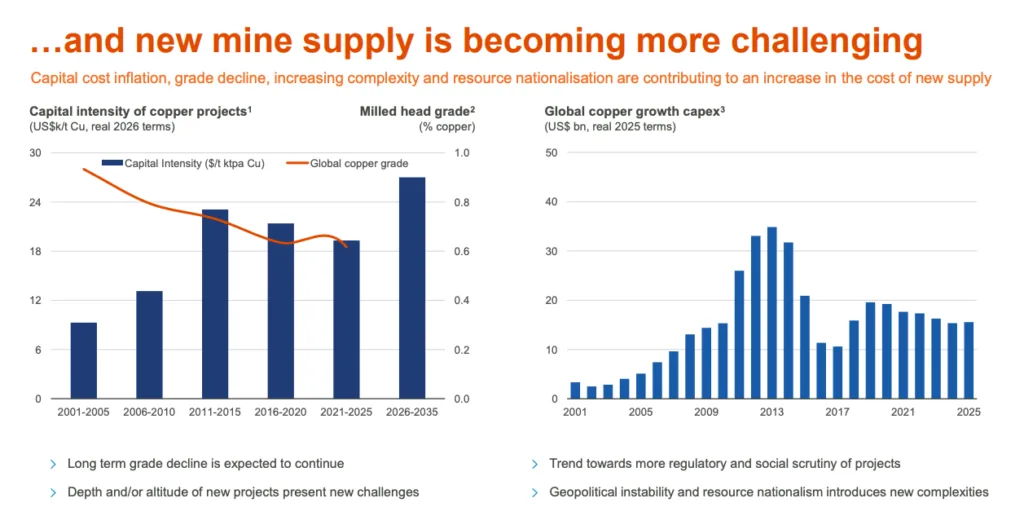
The assets generated low single-digit returns on capital employed for years, reaching 10% only in fiscal 2026 amid record-high commodity prices, according to UBS. That history raises questions about whether BHP can deliver attractive returns on another multibillion-dollar investment.
The company plans to use block caving, a bulk underground mining method, alongside two-stage smelting to reduce operating costs.
The first phase targets annual copper production of 500,000 tonnes by 2035, with a projected internal rate of return of 14% to 17% and capital intensity of $18,000 to $23,000 per tonne of copper.
The expansion would also increase production of other commodities. BHP plans to roughly double uranium processing capacity to between 5,000 and 6,000 tonnes annually while lifting gold output by 45% to more than 570,000 troy ounces a year.
Water constraints
Securing enough water and electricity could prove as important as developing the ore deposits themselves.
BHP’s operations lie within the Gawler Craton, a geological formation dating back roughly 2 billion years, in an increasingly arid region bordering Australia’s remote Outback.
The miner currently draws water from the Great Artesian Basin, a practice that has raised concerns among traditional owners, including the Arabana people, about the long-term sustainability of the resource.
To reduce its reliance on groundwater, BHP is counting on the proposed Northern Water project, which includes a seawater desalination plant at Cape Hardy on South Australia’s Spencer Gulf.
The facility would produce 260 megalitres of water daily, requiring pipelines stretching hundreds of kilometres to supply inland mining operations.
South Australia’s government is evaluating bids from two international consortia for the multi-user infrastructure project. A final investment decision is expected in 2027, with initial water deliveries targeted for fiscal 2032.
The copper expansion would also require upgrades to existing electricity transmission infrastructure, adding another major dependency to BHP’s development timetable.