Opinion: What we owe children when they lose
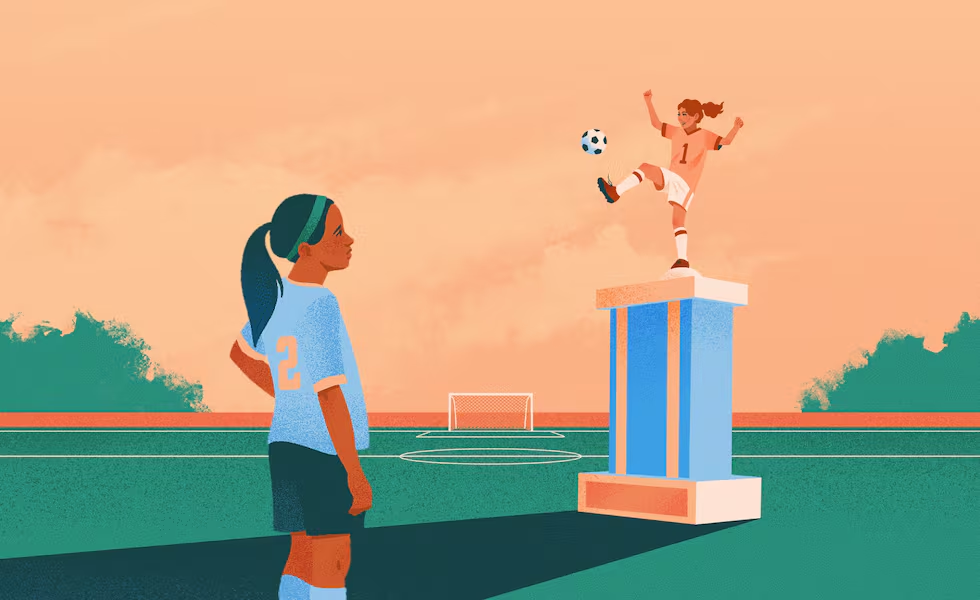
My daughter’s school lost its championship soccer game last week. The high school team had been ranked number one, and the girls had every reason to believe they could win. They had worked hard, played well all season and earned their place in the championship. But when the final whistle blew, they had lost a very close match.
My daughter and I watched the players fight for every ball and refuse to give up. We watched them maintain their composure, even as the game slipped away in overtime. My daughter was disappointed, as was I. We wanted her school to win, and there was no point pretending otherwise. But as we talked about the game, I realized that what we had just witnessed was an important teaching moment, one that had very little to do with soccer.
Is it really ‘just a game’?
My first instinct was to tell my daughter that it was just a game, that losing wasn’t important, and that it really didn’t matter.
I suspect that’s what many parents would say; who doesn’t want to protect their children from disappointment and remind them that there are bigger things in life than a soccer championship? And of course there are. But the more I thought about my gut reaction to protect my daughter and manage my own disappointment, the more I realized that my initial reaction was wrong, or at least incomplete.
In many respects, it was just a game, but the match itself and the season absolutely mattered: to the girls who had worked so hard, to their coaches and classmates, and to my daughter, who already felt such a strong connection to her school after just a few months. The disappointment was real, and there was no reason to dismiss it.
Opinion: Losing ourselves in something larger
In fact, it was precisely because the game mattered that there was something important to learn from losing it. Sometimes you can do everything right and still lose. That’s a difficult lesson for adults, let alone children, and I have trouble remembering it myself.
We tell our kids to work hard, practice, listen to their coaches, support their teammates and give everything they have. Do those things, we suggest, and good things will follow. And often they do. But not always. Sometimes the other team plays better, or a ball takes an unfortunate bounce.
I don’t think we should rush to tell disappointed children that they are all winners when they lose a hard-fought match. They know the score, and they deserve more respect than an adult’s attempt to make an uncomfortable moment disappear. What we as parents and adults can instill in them is the idea that losing a game and failing as a person are two very different things.
The importance of school sports
This is one reason school sports are so important today, and why we shouldn’t forget that schools are far more than places where children go to learn reading, writing, mathematics and history. They learn to be civil, collaborative and human. Schools are among the most important institutions we have for teaching children how to live with other people and handle moments of both euphoria and sadness.
Of course, some of those lessons happen in classrooms, in assemblies, and in formal activities like Model U.N., but many require more social and inherently collaborative environments. They happen on playgrounds, in hallways, in lunchrooms, during school performances and on athletic fields and courts. They happen when a child doesn’t get the part in the play or the spot in the school orchestra, or when a team that everyone expected to win loses the championship. These experiences are not distractions from formal education; they are core parts of a balanced education.
We often forget that a good coach teaches far more than how to pass a soccer ball or hit a target. Good educators, including teachers, coaches and others who support and lift up our youngest generations, help children understand that being disappointed doesn’t excuse treating others poorly. And a truly enlightened school community teaches children that they have obligations to one another, whether things are going their way or not.
Sports are one way schools can achieve this because they help young people learn to compete under a common set of rules, respect the judgment of referees, cooperate with teammates and recognize that their opponents are not their enemies. Students can want to win and still shake hands with the people who beat them. Losing, however painful, is not the end of the world. You get up, return to practice, and try again. Seasons end and begin again, and there is always room for growth.
Opinion: Overcoming ‘you people’ reflexes — Don’t give up on meaningful political conversations
There is an important lesson about civility here. Our polarized times and rage-filled culture have created a social and political climate where disagreement often becomes personal, opposition is regrettably treated as something to be hated, and losing is treated as something intolerable. The other team wants to win just as badly as you do, but that doesn’t make them the enemy. Both sides agree to play by the same rules, and those rules don’t become illegitimate simply because your side loses.
That lesson matters in civic life, where we have to accept that our side will sometimes lose but we must still find a way to keep participating. Being disappointed with an outcome doesn’t mean we have to resent or eventually hate the people who prevailed. Nor does losing mean that we should abandon the institutions or rules that made the contest possible in the first place. We can debate and disagree, sometimes fiercely and still embrace the civic obligations that we have to one another. Those are habits our schools must help children develop long before they are old enough to vote.
Schools are more than just the classroom and test scores
I think we often forget that schools have responsibilities far beyond the classroom and test scores. They are engines of social formation and civic education, and some of that work happens precisely when things don’t go our way.
I want my daughter to be willing to try difficult things, including things she may not be particularly good at initially. But that willingness to wade into the unknown and her openness to explore something just a bit different could disappear if every loss or setback feels like a judgment about who she is. No parent can promise their child that hard work will always be rewarded, but I don’t want my daughter to ever conclude that the possibility of disappointment or failure is a reason not to try.
The older girls in her school had played as a team, put in the time and the work for months, and carried themselves with dignity for an entire fall season. Despite their efforts, they lost in overtime. But the loss didn’t erase the fantastic season that brought them there, the friendships they built, or the discipline and skills they developed along the way.
Perspective: Horror movies are more popular than ever. That can’t be a good thing, right?
What struck me most after I tucked her into bed was that my daughter has only just begun her time at this school. She has more than a decade of school life ahead of her, yet she already feels a connection to the place and to the older girls who represented it beautifully on the field. To me, that is a sign of a school building an authentic, robust community. The older girls walk the younger girls to their classrooms and cheer for kindergarteners on their first day. A varsity victory would have been her victory, at least in some small way, and their disappointment became hers as well.
My daughter was invested in something larger than herself, and I was glad to see it, even though we were both disappointed. It is far too easy to overlook that part of school life when so much of the discussion about education concerns test scores, college admissions and individual achievement. Admissions postings make for easy imagery on social media, but they say little about a school community and what sort of people the school is helping its students become.
We wore the school colors and our school hats as we found seats in the bleachers, and we left wearing them with pride. My daughter was frustrated by the loss, but I’m grateful we were there together.
I hope my daughter remembers that afternoon and the “bigger high school girls,” in her words, who fought so hard, especially the way they carried themselves when things didn’t go their way. I also hope that she comes to understand how much courage and fortitude it takes to give everything you have to something you love, putting in the time, sweat, and passion while knowing that you might still lose. Finding the willingness to do it again after losing may take even more courage.
My daughter has many years of school ahead of her, and I hope she has plenty of reasons to celebrate. But there will be other afternoons like this one, when hard-fought losses leave her disappointed. When they come, as they inevitably will, I hope I remember that she doesn’t need me to tell her it was only a game or to minimize something that matters to her. She needs to know she can be disappointed, still belong, and come back ready to try again.