At the centers of galaxies, supermassive black holes reside.
This image of the central region of galaxy Messier 87 comes in the X-ray, via NASA’s Chandra X-ray observatory. The central, supermassive black hole is blasting out energetic particles at 99%+ the speed of light, which produces X-rays visible for up to 18,000 light-years from the galactic center. It is often easier to see these features in extragalactic objects than in our own galaxy, due to the large amount of obscuring material present within our own galaxy.
But seeing into the Milky Way’s heart, especially from within it, presents challenges.
Even the Milky Way, a relatively quiet galaxy with a relatively small central supermassive black hole, exhibits giant geysers of charged particles emanating from the galactic center. They can be revealed by radio telescopes, such as this image constructed with data from the Parkes radio telescope, a.k.a. The Dish. Credit: A. Mellinger (C. Michigan), E. Carretti (CSIRO), S-PASS Team, E. Bressert (CSIRO)
Our galactic plane is rich in dust and gas: opaque to optical wavelengths.
The European Space Agency’s space-based Gaia mission has mapped out the three-dimensional positions and locations of more than one billion stars in our Milky Way galaxy: the most of all-time, as well as many stars in sufficiently nearby galaxies. Looking toward the center of the Milky Way, Gaia reveals both light-blocking and luminous features that are scientifically and visually fascinating. Credit: ESA/Gaia/DPAC
Shorter wavelengths, like X-rays, reveal emissions from the galactic center.
Black holes, pulsars, superheated gas, and magnetic fields can all be identified from their X-ray signatures in images of the galactic center. As taken with the Chandra X-ray observatory, this image showcases many of those features. Credit: NASA/CXC/UMass/Q.D. Wang
Flares and bubbles indicate an intermittently active engine at our core.
The supermassive black hole at the center of our galaxy, Sagittarius A*, emits X-rays due to various physical processes. The flares we see in the X-ray indicate that matter flows unevenly and non-continuously into the black hole, leading to the flares we observe over time. In X-rays, no event horizon is visible at these resolutions; the “light” is purely disk-like. Credit: NASA/CXC/Amherst College/D.Haggard et al.
But at longer wavelengths, light is transparent to that intervening material.
By viewing the Milky Way in infrared wavelengths of light, we can see through large amounts of the galactic dust and view the distribution of stars and star-forming regions behind them. As revealed by the 2 micron all-sky survey (2MASS), the densest collections of galactic dust can be seen tracing out our spiral arms, but the center of the plane of the Milky Way is where the dust is densest. Infrared and visible light views both showcase this, but in vastly different ways. Credit: 2MASS/IPAC/Caltech & UMass
Far-infrared maps indicate a complex network of gaseous and plasma filaments.
This image shows the magnetized galactic center, with various features highlighted, as imaged by the SOFIA/HAWC+ FIREPLACE survey team. The giant bubble at the left of the image is some 30 light-years wide, several times larger than any other supernova-blown bubble ever discovered. This violence-rich environment is likely the only part of the galaxy too energetic for life to sustain itself. Credit: D. Paré et al., arXiv:2401.05317v2, 2024
These are shaped by star-formation, supernovae, neutron stars, and black holes.
This updated Radio/X-ray composite of the galactic center, featuring data from both MeerKAT and Chandra, showcases the new information that can be gleaned from stitching together multiple wavelengths of light. In the future, improved observations and superior observatories may help us solve the scientific mysteries of the origin of a variety of features within the Milky Way, including lobes, bubbles, and sprites. Credit: X-ray: NASA/CXC/UMass/Q.D. Wang; Radio: NRF/SARAO/MeerKAT
The largest black hole, however, emits no optical light at all.
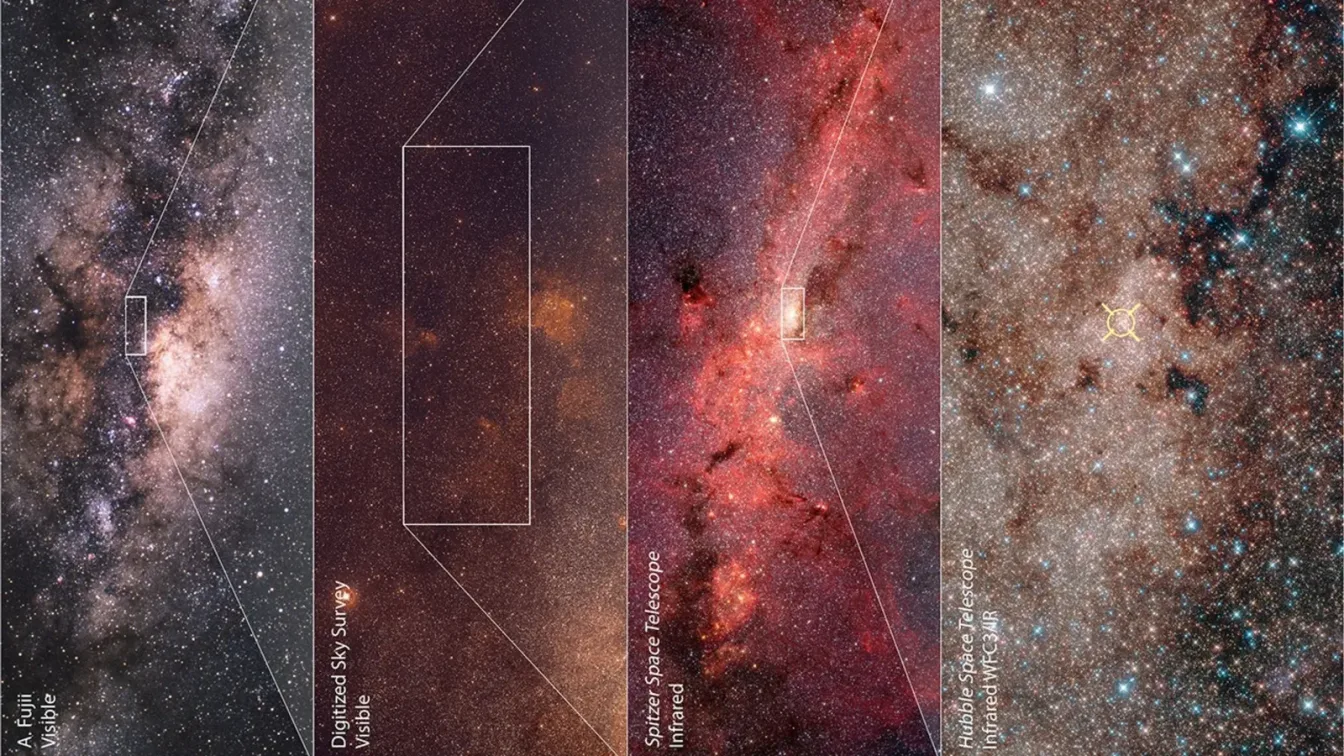
This view of the galactic center is only obtainable at longer wavelengths than the human eye is capable of seeing: even just a little bit into the near-infrared, as viewed by the Hubble Space Telescope’s WFC3 instrument. Even with Hubble’s high resolution, the galactic center is incredibly difficult to resolve. Credit: NASA, ESA, and the Hubble Heritage Team (STScI/AURA); Acknowledgment: T. Do and A. Ghez (UCLA), and V. Bajaj (STScI)
We can identify its location from radio features that point back to it.
In the main image, our galaxy’s antimatter jets are illustrated, blowing ‘Fermi bubbles’ in the halo of gas surrounding our galaxy. In the small, inset image, actual Fermi data shows the gamma-ray emissions resulting from this process. These “bubbles” arise from the energy produced by electron-positron annihilation: an example of matter and antimatter interacting and being converted into pure energy via E = mc². We are certain that no antimatter signature in our galaxy arises from either antimatter stars or large clumps of antimatter. Credit: David A. Aguilar (main); NASA/GSFC/Fermi (inset)
This 20-year time-lapse of stars near the center of our galaxy comes from the ESO, published in 2018. Note how the resolution and sensitivity of the features sharpen and improve toward the end, all orbiting our galaxy’s (invisible) central supermassive black hole. Practically every large galaxy, even at early times, is thought to house a supermassive black hole, but only the one at the center of the Milky Way is close enough to see the motions of individual stars around it, and to thereby accurately determine the black hole’s mass. Similar techniques could reveal intermediate mass black holes within globular clusters, albeit over longer timescales. Credit: ESO/MPE
In the infrared, JWST reveals intermittent flaring activity: indicative of accretion and acceleration.
This timelapse animation of the flaring activity of Sagittarius A*, as seen with the James Webb Space Telescope at 2.1 and 4.8 microns, shows the intermittent activity of our galaxy’s central supermassive black hole. The flickers are overwhelmed by a bright flare late in this 30 second looping animation, which compresses 9 hours of activity down into a speed-up by a factor of about 1000. Credit: NASA, ESA, CSA, Farhad Yusef-Zadeh (Northwestern), Howard Bushouse (STScI), Alyssa Pagan (STScI)
This artist’s impression depicts the paths of photons in the vicinity of a black hole. The gravitational bending and capture of light by the event horizon is the cause of the shadow captured by the Event Horizon Telescope. The photons that aren’t captured create a characteristic sphere, and that helps us confirm General Relativity’s validity in this newly-tested regime. Credit: Nicolle R. Fuller/NSF
In its place, we leverage arrays of telescopes all across our world.
A global map showing the radio observatories that form the Event Horizon Telescope (EHT) network used to image the Milky Way’s central black hole, Sagittarius A*. The telescopes highlighted in yellow were part of the EHT network during the observations of Sagittarius A* in 2017. These include the Atacama Large Millimeter/submillimeter Array (ALMA), the Atacama Pathfinder EXperiment (APEX), IRAM 30-meter telescope, James Clark Maxwell Telescope (JCMT), Large Millimeter Telescope (LMT), Submillimeter Array (SMA), Submillimeter Telescope (SMT) and South Pole Telescope (SPT). They all observed the same black hole simultaneously, with the ability to synchronize those separate measurements key to reconstructing the black hole’s image. Credit:
ESO/M. Kornmesser
By synching them together with atomic clocks, we make time-coincident observations.
In very-long baseline interferometry (VLBI), the radio signals are recorded at each of the individual telescopes before being shipped to a central location. Each data point that’s received is stamped with an extremely accurate, high-frequency atomic clock alongside the data in order to help scientists get the synchronization of the observations correct. For optical interferometry, rather than radio data, the various optical beams must be combined on-site, as otherwise the necessary amplitude and phase information about the electromagnetic signals will not be adequately preserved. Credit: public domain/Rnt20 at English Wikipedia
Synthesizing them with interferometry, we’ve revealed our supermassive black hole’s event horizon.
This synthesized image of the central black hole of the Milky Way’s event horizon, Sagittarius A*, comes from combining several different images extracted from the Event Horizon Telescope’s observations (shown at bottom). The hot spots and features move around in configuration and intensity on short timescales due to the black hole’s relatively small horizon size, explaining the differences between successive images. Credit: EHT Collaboration
On the left, a view of Sagittarius A*, the Milky Way’s central black hole, in polarized light as reconstructed with the Event Horizon Telescope. This is extraordinarily consistent with our models for what the polarization signal should look like. With an event horizon whose scale is measured at about 3 light-minutes, superior observations should be able to reconstruct not just snapshots of this event horizon, but movies of its time-evolution as well. Credit: S. Issaoun, A. Ricarte, EHT Collaboration
Mostly Mute Monday tells an astronomical story in images, visuals, and no more than 200 words.
↑ Back to top
Originally published by Big Think ↗· rebuilt here from its own full-text RSS feed · all rights
remain with the publisher, please read and support them there.
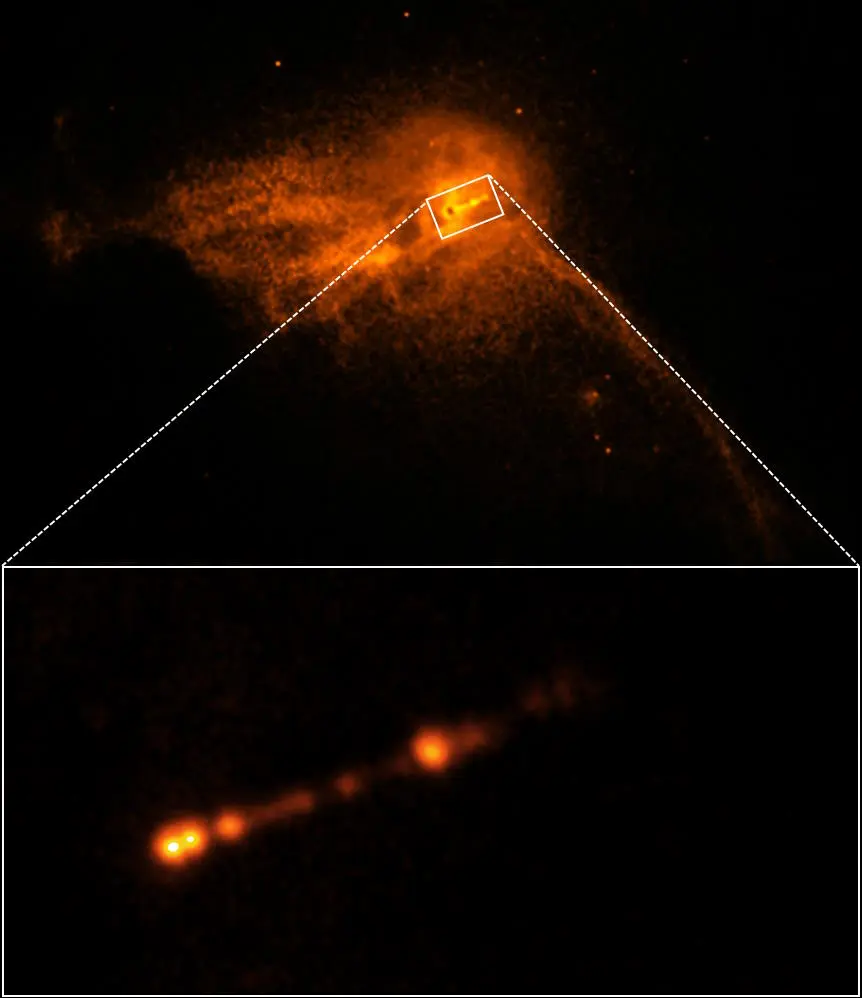 This image of the central region of galaxy Messier 87 comes in the X-ray, via NASA’s Chandra X-ray observatory. The central, supermassive black hole is blasting out energetic particles at 99%+ the speed of light, which produces X-rays visible for up to 18,000 light-years from the galactic center. It is often easier to see these features in extragalactic objects than in our own galaxy, due to the large amount of obscuring material present within our own galaxy.
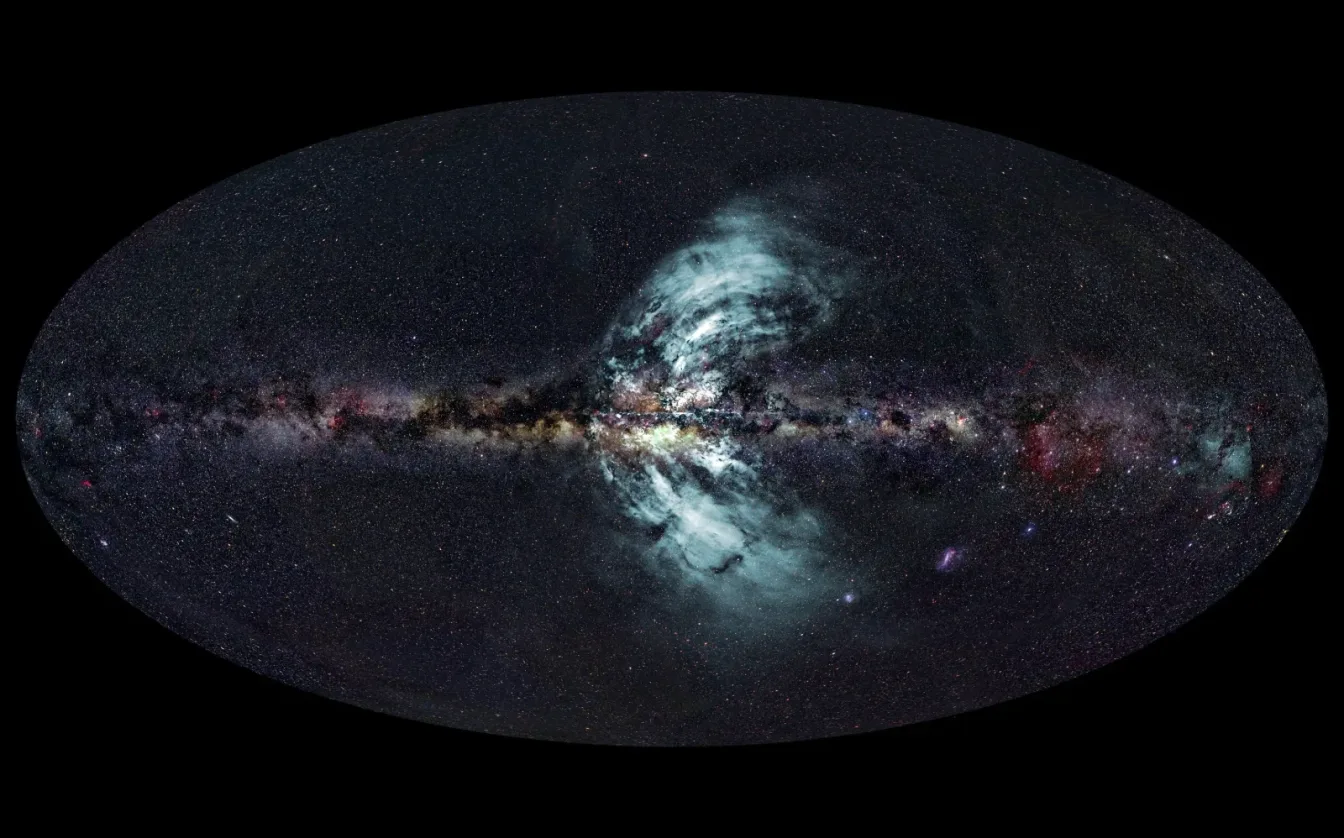 Even the Milky Way, a relatively quiet galaxy with a relatively small central supermassive black hole, exhibits giant geysers of charged particles emanating from the galactic center. They can be revealed by radio telescopes, such as this image constructed with data from the Parkes radio telescope, a.k.a. The Dish.
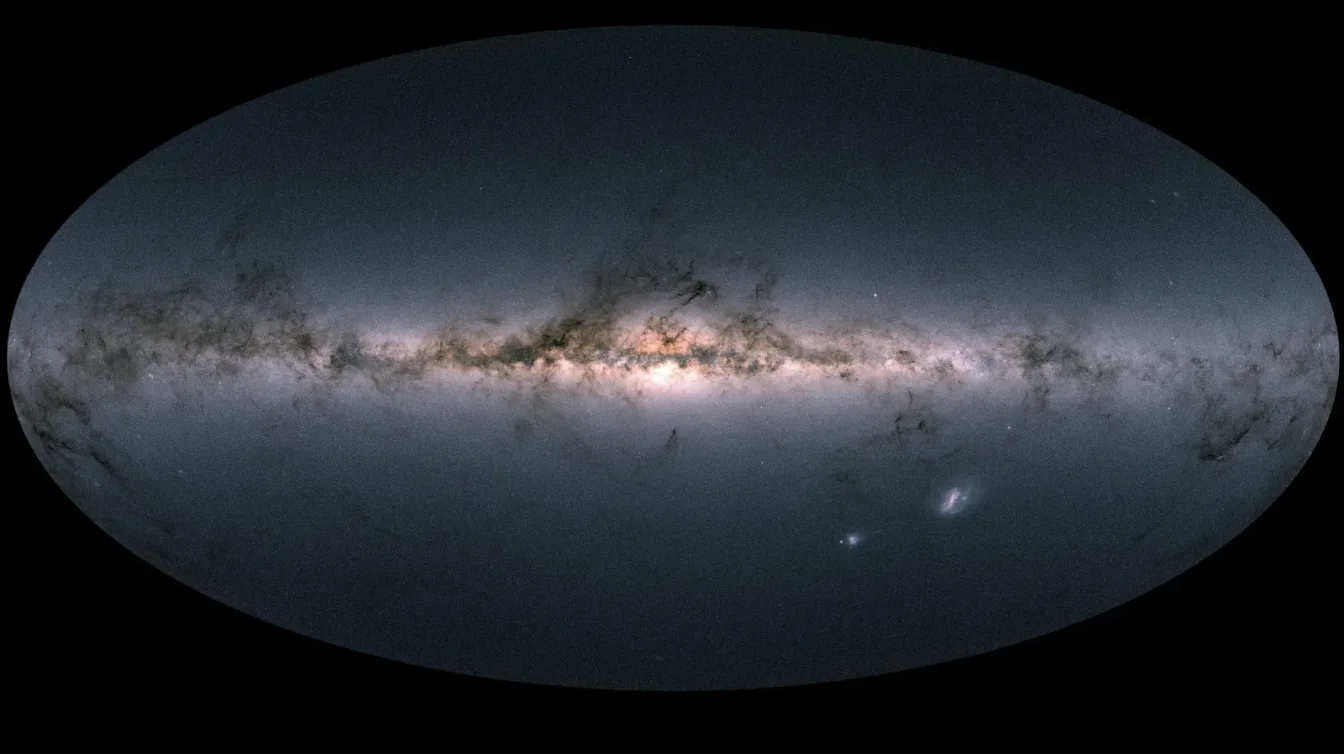 The European Space Agency’s space-based Gaia mission has mapped out the three-dimensional positions and locations of more than one billion stars in our Milky Way galaxy: the most of all-time, as well as many stars in sufficiently nearby galaxies. Looking toward the center of the Milky Way, Gaia reveals both light-blocking and luminous features that are scientifically and visually fascinating.
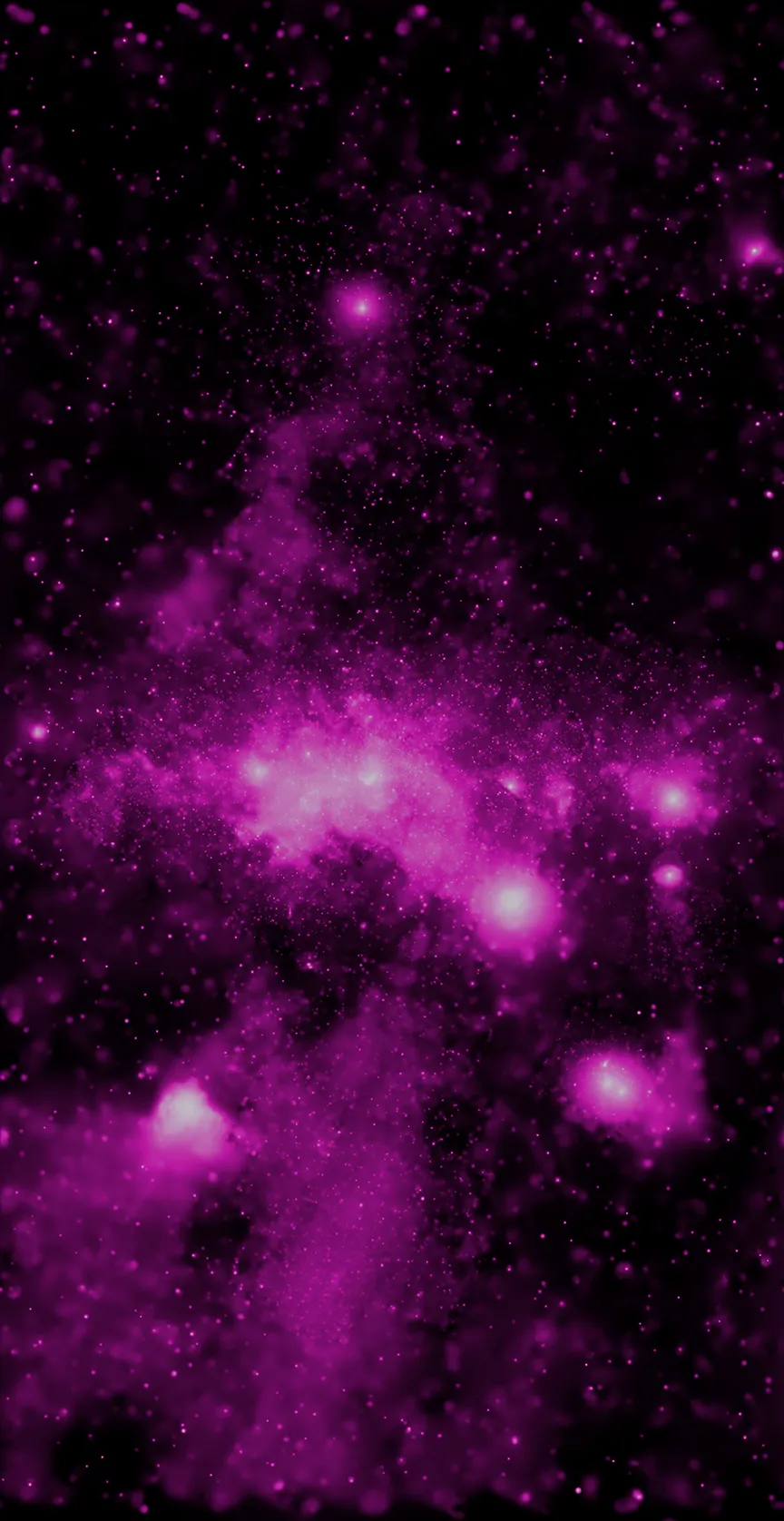 Black holes, pulsars, superheated gas, and magnetic fields can all be identified from their X-ray signatures in images of the galactic center. As taken with the Chandra X-ray observatory, this image showcases many of those features.
 The supermassive black hole at the center of our galaxy, Sagittarius A*, emits X-rays due to various physical processes. The flares we see in the X-ray indicate that matter flows unevenly and non-continuously into the black hole, leading to the flares we observe over time. In X-rays, no event horizon is visible at these resolutions; the “light” is purely disk-like.
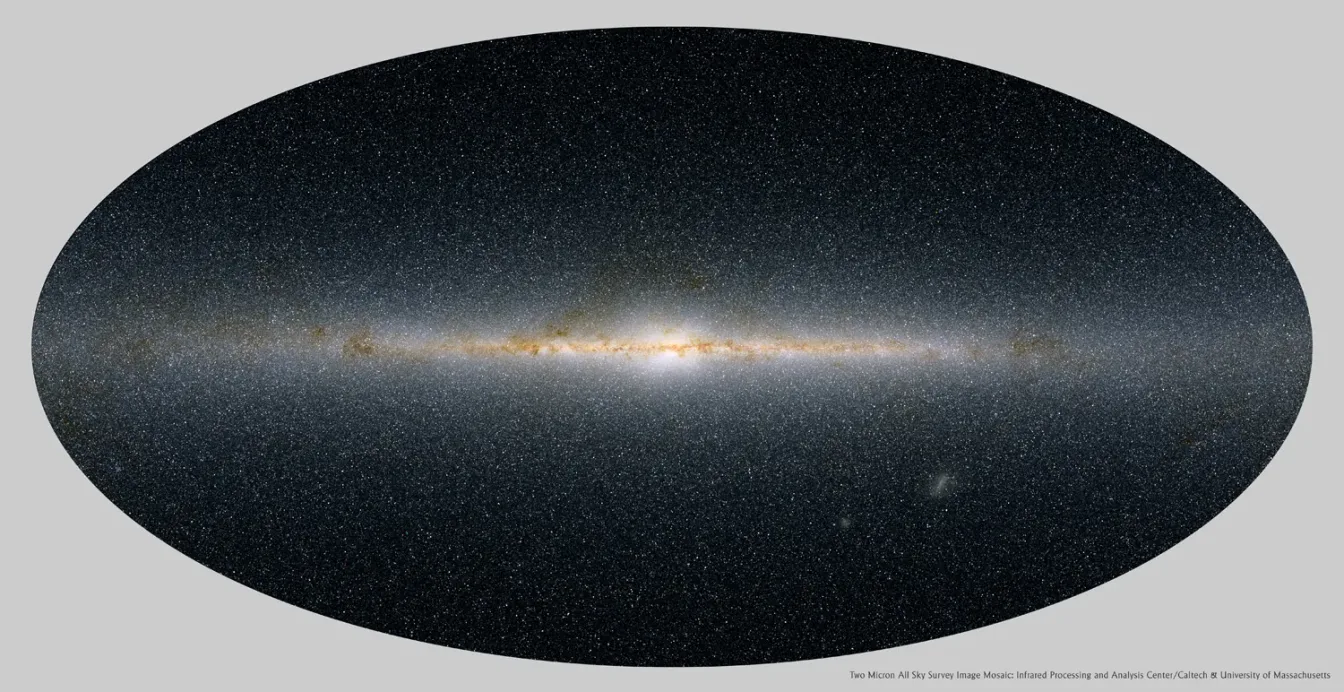 By viewing the Milky Way in infrared wavelengths of light, we can see through large amounts of the galactic dust and view the distribution of stars and star-forming regions behind them. As revealed by the 2 micron all-sky survey (2MASS), the densest collections of galactic dust can be seen tracing out our spiral arms, but the center of the plane of the Milky Way is where the dust is densest. Infrared and visible light views both showcase this, but in vastly different ways.
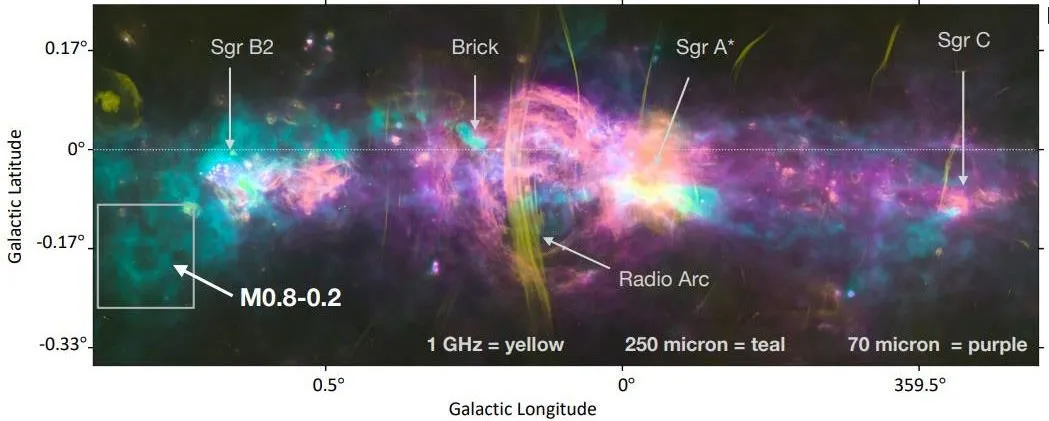 This image shows the magnetized galactic center, with various features highlighted, as imaged by the SOFIA/HAWC+ FIREPLACE survey team. The giant bubble at the left of the image is some 30 light-years wide, several times larger than any other supernova-blown bubble ever discovered. This violence-rich environment is likely the only part of the galaxy too energetic for life to sustain itself.