Why Trump’s friendly tone with Putin and Xi makes strategic sense
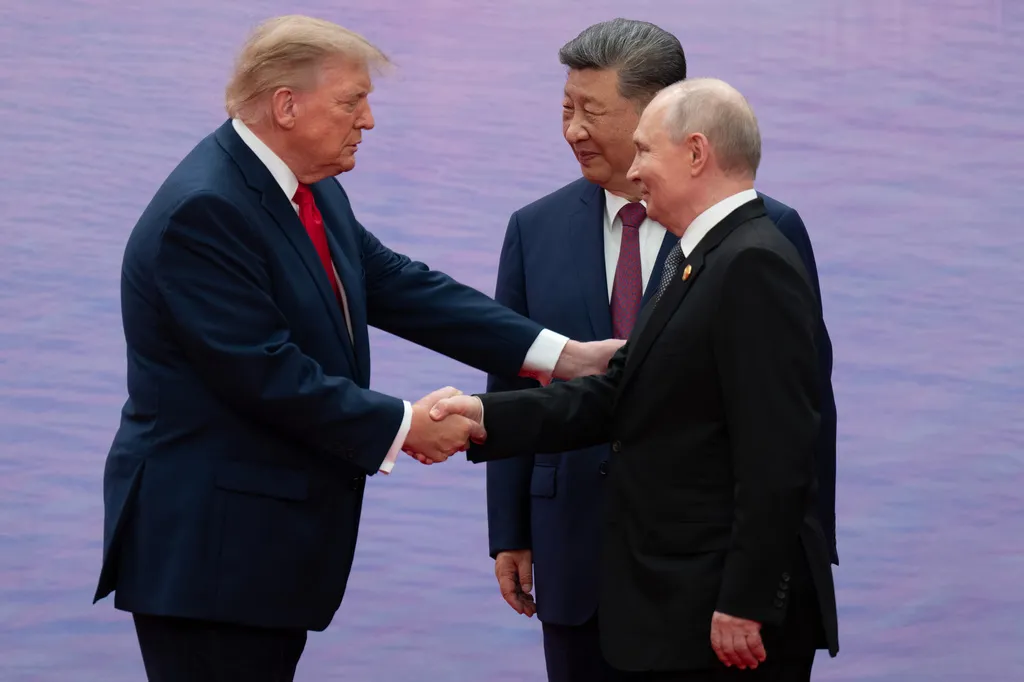
President Donald Trump is facing intense criticism over his recent diplomacy in Shenzhen, China. Critics are angry that he called Russian President Vladimir Putin his “friend.” They also objected to seeing him smile alongside Putin and Chinese President Xi Jinping.
To evaluate whether this approach works, we need to look at the full picture. We must define the core problem clearly. We also need to examine the criticism directly and look at the logic behind the president’s strategy.
The central challenge is straightforward. The United States must manage dangerous rivalries with two nuclear-armed nations without starting a major war. Neither Putin nor Xi shares American democratic values. The real question is how to get these leaders to negotiate.
On Nov. 19, 2026, Trump, Xi, and Putin sat down together alongside the Asia-Pacific Economic Cooperation summit. It was the first trilateral meeting between the leaders of the U.S., China, and Russia. They spoke for roughly 90 minutes. Afterward, they issued a four-point joint declaration committing to dialogue on strategic stability and nuclear risk reduction.
Before the talks began, Trump pointed to Putin and called him “my friend.” He repeated that phrase on social media two days later. At a White House press conference on Nov. 20, Trump defended his personal rapport with Putin. However, he also noted that he could not say whether Putin is a friend to America as a whole.
Critics from both political parties have attacked these gestures. Their arguments focus on the following points.
Congressional Democrats and critics say warm rhetoric ends Putin’s international isolation. They believe it legitimizes his invasion of Ukraine, which is now approaching its fifth year.
Foreign policy analysts at the Council on Foreign Relations also point out that the Shenzhen declaration produced no immediate breakthroughs. There were no new deals announced on Ukraine or Iran.
Additionally, analysts at the Brookings Institution and traditional diplomats argue that a president should use measured language. They believe calling an authoritarian leader a “friend” signals weakness and alarms U.S. allies in Europe.
These concerns are serious. However, critics ignore the failure of the alternative. Years of diplomatic isolation and public condemnation have not stopped the war in Ukraine. Instead, isolating Moscow has driven Russia and China closer together.
If critics reject disarming language, what do they expect Trump to do in that room? Calling rival leaders enemies ends negotiations before they start. Refusing to speak with them achieves nothing.
Trump’s strategy relies on a clear logic. In Russia and China, power rests in the hands of one man. Traditional diplomacy focuses on institutions and formal treaties. Disruptive diplomacy targets the individual decision-maker.
By offering personal respect, Trump lowers the political cost for Putin and Xi to negotiate. When nations spend years trading threats, neither side can back down without looking weak at home. A sudden shift in tone breaks that deadlock. It lets rival leaders enter talks as equal great powers rather than admitting defeat.
Words and handshakes cost the United States nothing. They do not reduce our military readiness. They are simply low-cost tools used to open a conversation.
THE EAGLE, THE PANDA, AND THE BEAR WALK INTO A SUMMIT
On Sunday, Director of National Intelligence Jay Clayton addressed the controversy on ABC’s This Week. He noted that Putin is not America’s friend in Ukraine. Still, Clayton argued that using friendly language inside a room of nuclear powers helps prevent a catastrophic conflict.
Warm rhetoric alone will not solve global crises. The Shenzhen summit will ultimately be judged by concrete results. We need verifiable agreements on Ukraine and nuclear arms control. Yet breaking away from failed diplomatic habits takes real political risk. Starting high-stakes talks with goodwill is not weakness. It is a practical first step toward peace.
Eric Wargotz is a practicing physician, geopolitical analyst, and multisector policy writer whose commentary has appeared in the Washington Examiner, the Baltimore Sun, and the Jerusalem Post. He is a judge and the 178th president of MedChi, the Maryland State Medical Society, following a career that includes serving as a Senate nominee and elected county commission president. A clinical professor emeritus at George Washington University, his views are his own and do not represent his affiliates.