Opinion: The Gettysburg Address is one of America’s great founding documents
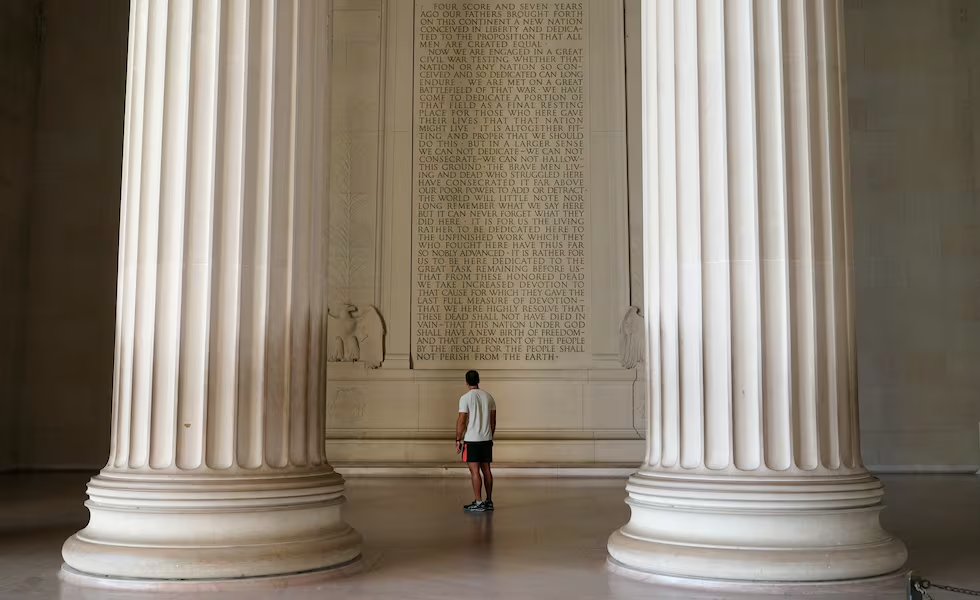
“Four score and seven years ago our fathers brought forth on this continent, a new nation, conceived in Liberty, and dedicated to the proposition that all men are created equal.”
The date: Nov. 19, 1863.
“Now we are engaged in a great Civil War, testing whether that nation, or any nation so conceived and so dedicated, can long endure. We are met on a great battlefield of that war. We have come to dedicate a portion of that field, as a final resting place for those who here gave their lives that that nation might live.”
Opinion: Reflections on the legislative branch
The place: The Soldiers’ National Cemetery, Gettysburg, Pennsylvania.
“It is for us the living … to be dedicated here to the unfinished work which they who fought here have thus far so nobly advanced. It is … for us to be here dedicated to the great task remaining before us.”
The speaker: President Abraham Lincoln.
“That from these honored dead we take increased devotion to that cause for which they gave the last full measure of devotion — that we here highly resolve that these dead shall not have died in vain — that this nation, under God, shall have a new birth of freedom — and that government of the people, by the people, for the people, shall not perish from the earth.”
From the site of the bloodiest battle of the bloodiest war in American history, fought four months before, Lincoln challenges the living — then and now — to increase our devotion to the cause for which the honored dead had demonstrated their devotion.
What was that cause? Independence?
No. In seceding, the Confederate states had declared independence from the national government established by the Constitution. Lincoln is hardly endorsing that. Lincoln echoes the Declaration of Independence, but for purposes more fundamental and universal than its assertion of separation from the mother country.
If not independence, was the cause to which Lincoln refers government by the people — majority rule?
No. That’s how Lincoln’s erstwhile rival Stephen Douglas had advocated dealing with slavery: through popular sovereignty, allowing the voters of each territory to determine whether slavery would be allowed there. (The enslaved would not be consulted.) To Lincoln, government of, by and for the people meant something else.
Opinion: What the clash of ideologies in the Civil War taught us about America’s founding
Then was the cause Union?
Again, no. The term doesn’t appear in Lincoln’s remarks. Nor does the concept. There’s an implicit acknowledgment of its opposite, separation, in his reference to the ongoing Civil War; but union versus division isn’t what the war is ultimately testing.
The “unfinished work” to which Lincoln refers, “the great task remaining before us,” is to put into practice the proposition to which this nation was and is dedicated: that all men are created equal.
Miraculous though it was, the Constitution had left that work unfinished.
Ambitious though it was, the Emancipation Proclamation had left that work unfinished.
Transformational though they were, the 13th, 14th and 15th Amendments (abolishing slavery, defining citizenship, and protecting voting rights, respectively) left that work unfinished.
Lincoln at Gettysburg calls Americans then and now to finish that work. Whatever our party, whatever our politics, that should be the ultimate aim of civic action: to recognize, respect and effectuate each individual’s equality before the law.
Well did biographer Richard Brookhiser call Lincoln the “Founders’ Son.” Lincoln inherited the political framework established by the Founding Fathers when it had begun disintegrating. He squarely confronted the tensions they of necessity left unresolved. And he took America’s founding ideals, as expressed by the Founding Fathers in our founding documents, to their logical conclusion, persevering against daunting odds, both political and military, to abolish slavery — the most flagrant possible contradiction of the founding proposition that all men are created equal.
Deseret News archives: Gettysburg Address just 272 words long, but its impact has endured
Thus, the Gettysburg Address stands alongside the Declaration of Independence and the Constitution as the third of America’s three great founding documents. In our constitutional edifice, the declaration is the cornerstone; the Gettysburg Address is the capstone. It is the most succinct expression of America’s purpose and promise.
Brief though it is, the Gettysburg Address leaves the reader inspired by America’s founding ideals, motivated to shoulder the responsibilities of citizenship, and equipped to transcend the partisanship and polarization now poisoning public discourse and paralyzing public policy.
As we commemorate this, the 163rd anniversary of the Gettysburg Address, may I suggest reading it out loud at the dinner table or in the family circle? To do so takes less than two minutes. Those two minutes may well do more than anything else to help the rising generation understand and appreciate the freedoms bequeathed to them.
As Thanksgiving approaches, that would be an especially meaningful way to demonstrate gratitude for the blessings of freedom.