Einstein’s general relativity equations: explained in plain English
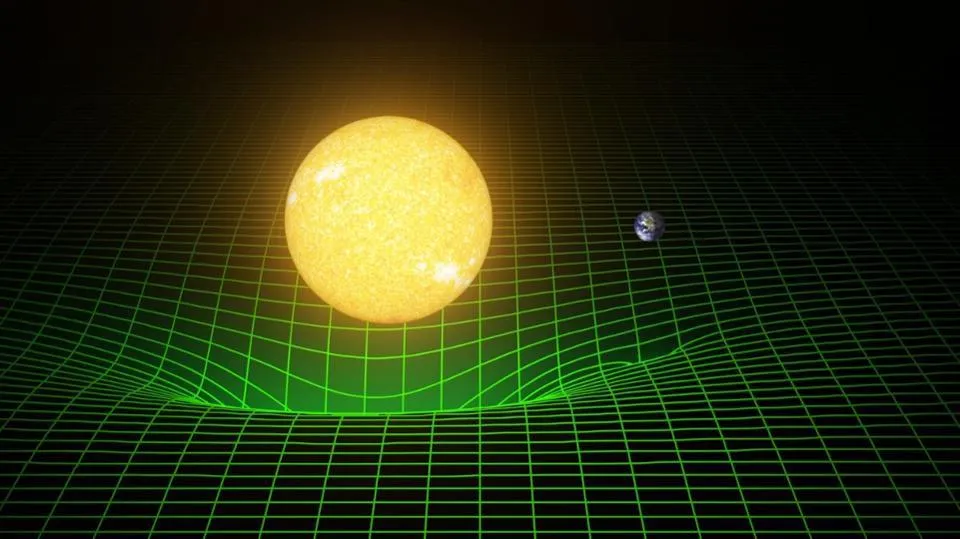
Although Albert Einstein is a legendary figure in science for a large number of reasons — including E = mc², the photoelectric effect, and the notion that the speed of light is a constant for everyone — his most enduring discovery is also the least understood: his theory of gravitation, general relativity. Before Einstein, we thought of gravitation in Newtonian terms: that everything in the Universe that has a mass instantaneously attracts every other mass, dependent on the value of their masses, the gravitational constant, and the square of the distance between them. But Einstein’s conception was entirely different, based on the idea that space and time were unified into a fabric, spacetime, and that the curvature of spacetime told not only matter but also energy how to move within it.
This fundamental idea — that matter and energy tells spacetime how to curve, and that curved spacetime, in turn, tells matter and energy how to move — represented a revolutionary new view of how gravitation worked. Put forth in 1915 by Einstein and validated four years later during a total solar eclipse — when the bending of starlight coming from light sources behind the sun agreed with Einstein’s predictions and not Newton’s — general relativity has passed every observational and experimental test we have ever concocted and thrown at it. Yet despite its success over more than 100 years, almost no one understands what the one equation that governs general relativity is actually about. Here, in plain English, is what it truly means.
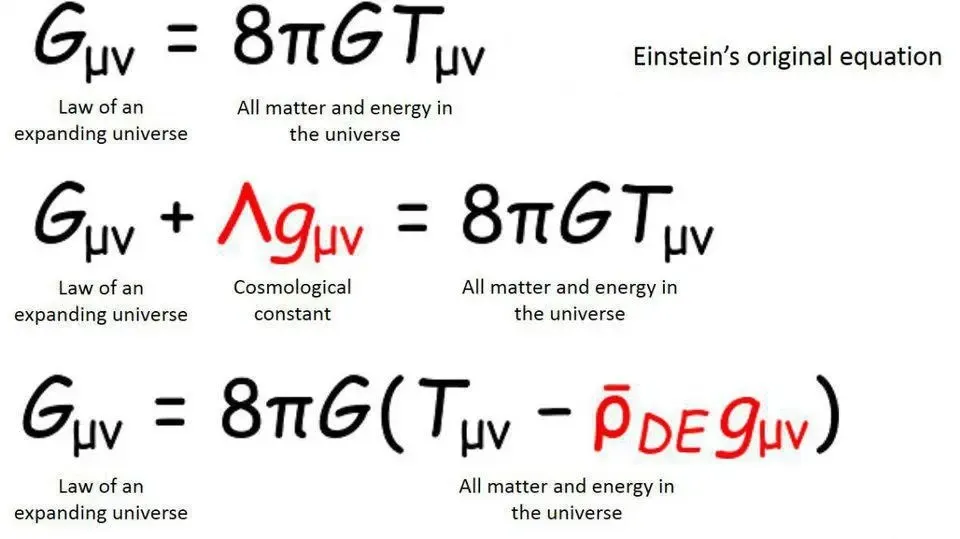 Einstein’s original equation relates spacetime curvature to the stress-energy of a system (top). A cosmological constant term can be added (middle), or equivalently, it can be formulated as dark energy (bottom), another form of energy density contributing to the stress-energy tensor.
This equation looks pretty simple, in that there are only a few symbols present. But that apparent simplicity fades away as soon as you start asking what those symbols actually mean. Let’s focus on the second version in the figure above: the ones that reads Gμν + Λgμν = 8πGTμν.
- The first one, Gμν, is known as the Einstein tensor and represents the curvature of space.
- The second one, Λ, is the cosmological constant: an amount of energy, positive or negative, that is inherent to the fabric of space itself.
- The third term, gμν, is known as the metric, which mathematically encodes the properties of every point within spacetime.
- The fourth term, 8πG, is just a product of constants and is known as Einstein’s gravitational constant, the counterpart of Newton’s gravitational constant (G) that most of us are more familiar with. (There’s also a factor of 1/c4 that gets omitted in this term in the equation, because most physicists set c = 1 when they work with general relativity.)
- And the fifth term, Tμν, is known as the stress-energy tensor, and it describes the local (in the nearby vicinity) energy, momentum, and stress within that spacetime.
These five terms, all related to one another through what we call the Einstein field equations, are enough to relate the geometry of spacetime to all the matter and energy within it: the hallmark of general relativity.
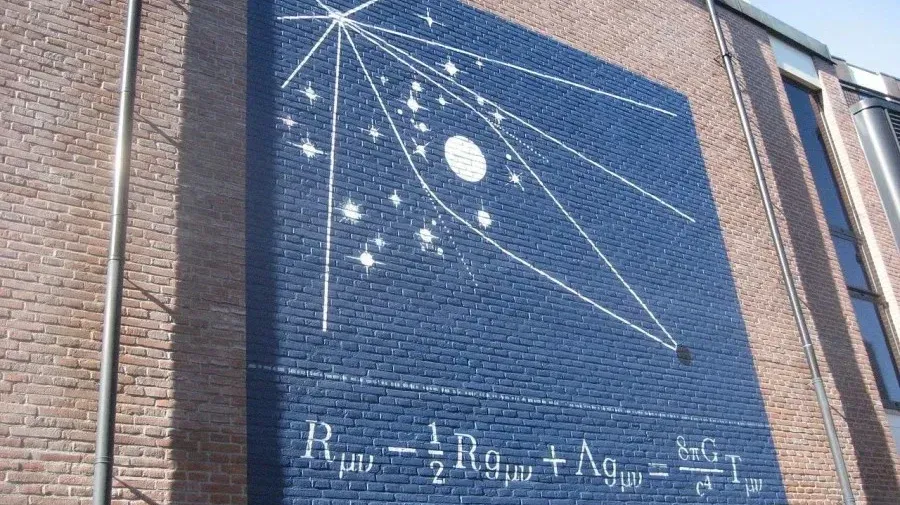 A mural of the Einstein field equations, with an illustration of light bending around the eclipsed Sun: the key observations that first validated general relativity four years after it was first theoretically put forth: back in 1919. The Einstein tensor is shown decomposed, at left, into the Ricci tensor and Ricci scalar, with the cosmological constant term added in after that. If that constant weren’t included, an expanding (or collapsing) Universe would have been an inevitable consequence.
You might be wondering what is with all those subscripts — those weird “μν” combinations of Greek letters you see at the bottom of the Einstein tensor, the metric, and the stress-energy tensor. Most often, when we write down an equation, we are writing down a scalar equation, that is, an equation that only represents a single equality, where the sum of everything on the left-hand side equals everything on the right. But we can also write down systems of equations and represent them with a single simple formulation that encodes these relationships.
E = mc² is a scalar equation because energy (E), mass (m), and the speed of light (c) all have only single, unique values. But Newton’s F = ma is not a single equation but rather three separate equations: Fx = max for the “x” direction, Fy = may for the “y” direction, and Fz = maz for the “z” direction, because we live in three spatial dimensions. Instead of a scalar equation, F = ma is an example of a vector equation
In general relativity, the fact that we have four dimensions (three space and one time) as well as two subscripts, which physicists know as indices, means that there is not one equation, nor even three or four. Instead, we have each of the four dimensions (t, x, y, z) affecting, or acting on, each of the other four (t, x, y, z), for a total of 4 × 4, or 16, equations. Instead of either a scalar equation or a vector equation, general relativity requires that we go up another level in complexity: to a (rank 2) tensor equation.
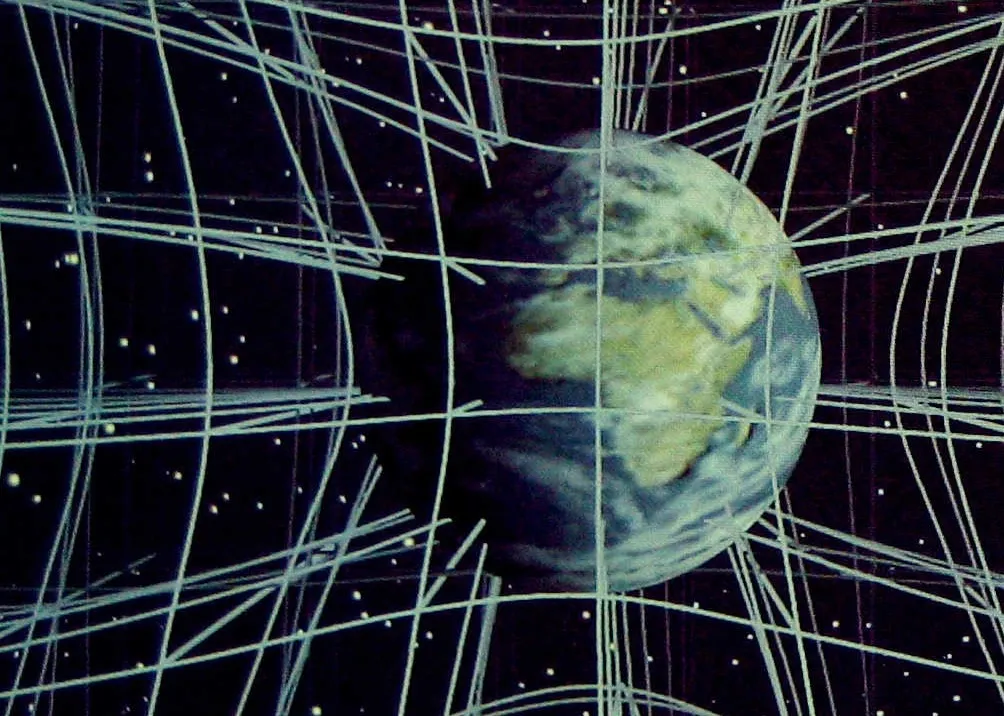 Instead of an empty, blank, three-dimensional grid, putting a mass down causes what would have been ‘straight’ lines to instead become curved by a specific amount. In general relativity, we treat space and time as continuous, but all forms of energy, including but not limited to mass, contribute to spacetime curvature. In addition, the distances between unbound objects evolve with time, owing to the expansion of the universe.
Why would we need so many equations just to describe gravitation, whereas Newton only needed one?
Because geometry is a complicated beast, because we are working in four dimensions, and because what happens in one dimension, or even in one location, can propagate outward and affect every location in the universe, if only you allow enough time to pass. Our universe, with three spatial dimensions and one time dimension, means the geometry of our universe can be mathematically treated as a four-dimensional manifold.
In Riemannian geometry, where manifolds are not required to be straight and rigid but can be arbitrarily curved, you can break that curvature up into two parts: parts that distort the volume of an object and parts that distort the shape of an object. The “Ricci” component is the volume distorting part, and that plays an role in the Einstein tensor, as the Einstein tensor is made up of the Ricci tensor and the Ricci scalar (which is the sum of the on-diagonal parts of the Ricci tensor), with some constants and the metric thrown in. (The shape distorting part is know as the “Weyl” component, and, counterintuitively enough, plays no role in the Einstein field equations.)
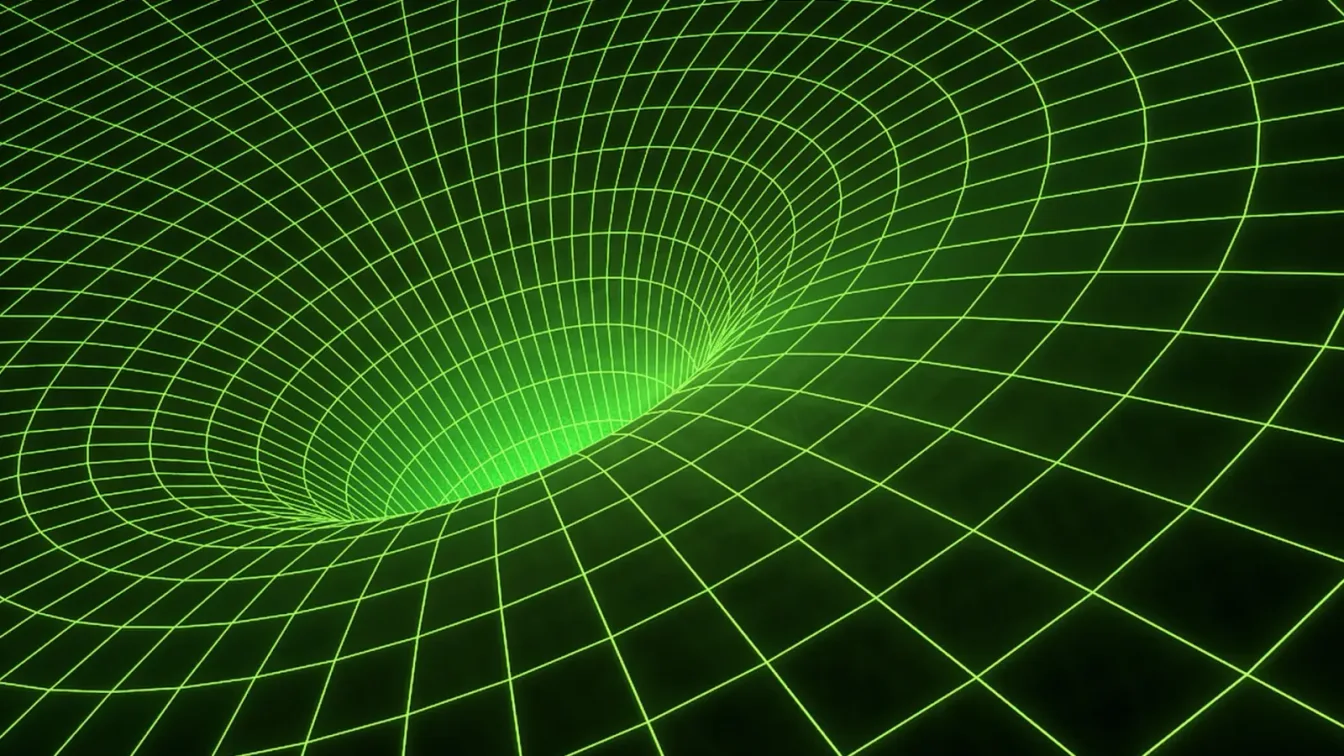 When you put down even a single point mass in spacetime, you curve the fabric of spacetime everywhere as a result. The Einstein field equations allow you to relate spacetime curvature to matter and energy, in principle, for any distribution you choose. In the case of an infinitely dense point mass, a black hole results, with an event horizon forming at a distance dependent on the total mass of the black hole. The lowest-mass black holes have the smallest event horizons, but the greatest amount of spatial curvature at those horizons.
The Einstein field equations are not just one equation, then, but rather a suite of 16 different equations: one for each of the “4 × 4” combinations. As one component or aspect of the universe changes, such as the spatial curvature at any point or in any direction, every other component as well may change in response. This framework, in many ways, takes the concept of a differential equation to the next level.
A differential equation is any equation where you can do the following:
- you can provide the initial conditions of your system, such as what is present, where, and when it is, and how it is moving,
- then you can plug those conditions into your differential equation,
- and the equation will tell you how those things evolve in time, moving forward to the next instant,
- where you can plug that information back into the differential equation, where it will then tell you what happens subsequently, in the next instant.
It is a tremendously powerful framework and is the very reason why Newton needed to invent calculus in order for things like motion and gravitation to become understandable scientific fields.
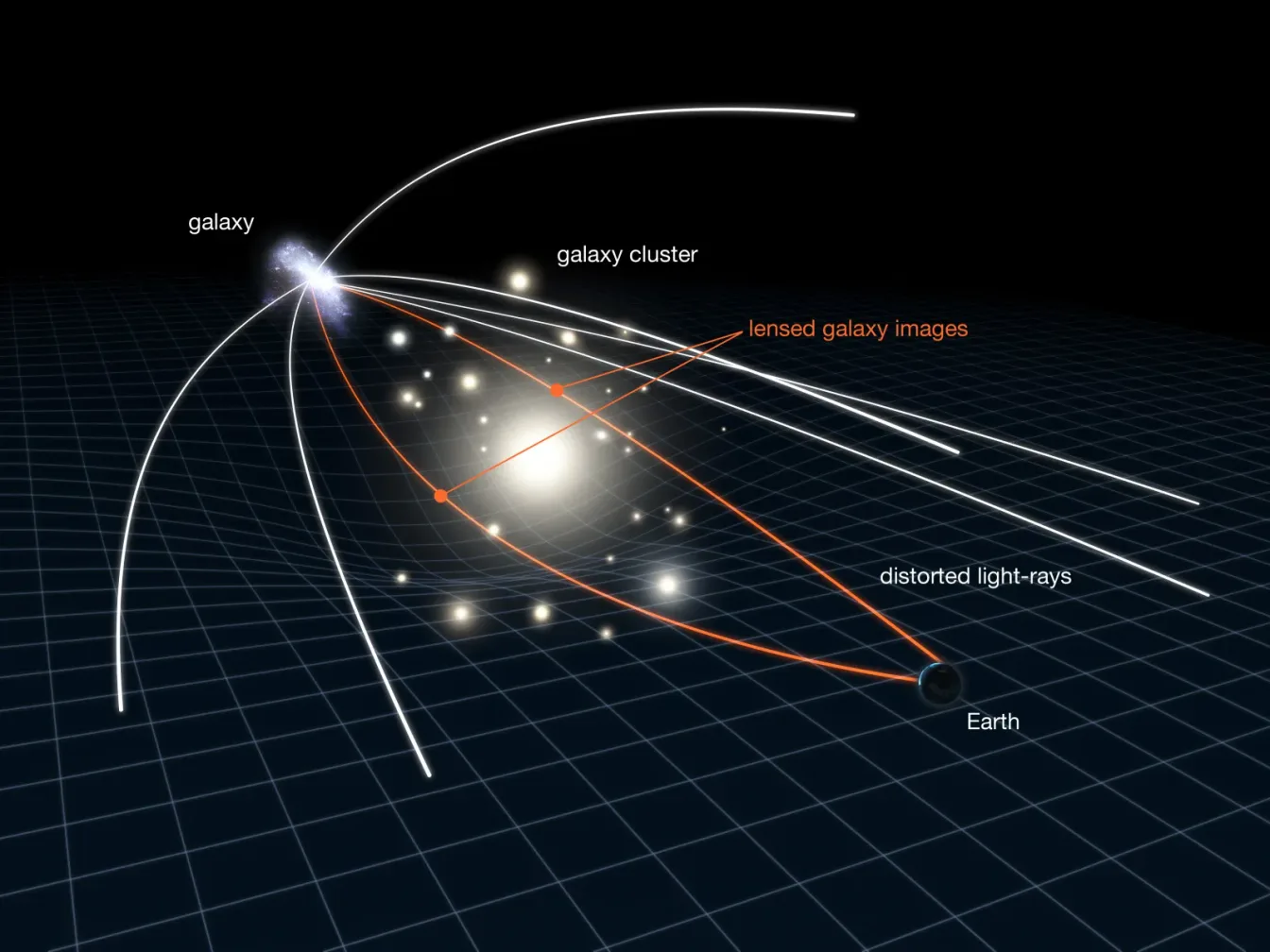 An illustration of gravitational lensing showcases how background galaxies — or any light path — are distorted by the presence of an intervening mass, but it also shows how space itself is bent and distorted by the presence of the foreground mass. When multiple background objects are aligned with the same foreground lens, multiple sets of multiple images can be seen by a properly-aligned observer, or even an “Einstein ring” in the case of perfect alignment. If a transient event, like a supernova, occurs in the background galaxy, it will appear with time delays in the various images.
Only, when we begin dealing with general relativity, it is not just one equation or even a series of independent equations that all propagate and evolve in their own dimension. Instead, because what happens in one direction or dimension affects all the others, we have 16 coupled, interdependent equations, and as objects move and accelerate through spacetime, the stress-energy changes and so does the spatial curvature.
However, these “16 equations” are not entirely unique! First off, the Einstein tensor is symmetric, which means that there is a relationship between every component that couples one direction to another. In particular, if your four coordinates for time and space are (t, x, y, z), then:
- the “tx” component will be equivalent to the “xt” component,
- the “ty” component will be equivalent to the “yt” component,
- the “tz” component will be equivalent to the “zt” component,
- the “yx” component will be equivalent to the “xy” component,
- the “zx” component will be equivalent to the “xz” component,
- and the “zy” component will be equivalent to the “yz” component.
All of a sudden, there aren’t 16 unique equations but only 10.
Additionally, there are four relationships that tie the curvature of these different dimensions together: the Bianchi Identities. Of the 10 unique equations remaining, only six are independent, as these four relationships bring the total number of independent variables down further. The power of this part allows us the freedom to choose whatever coordinate system we like, which is literally the power of relativity: every observer, regardless of their position or motion, sees the same laws of physics, such as the same rules for general relativity.
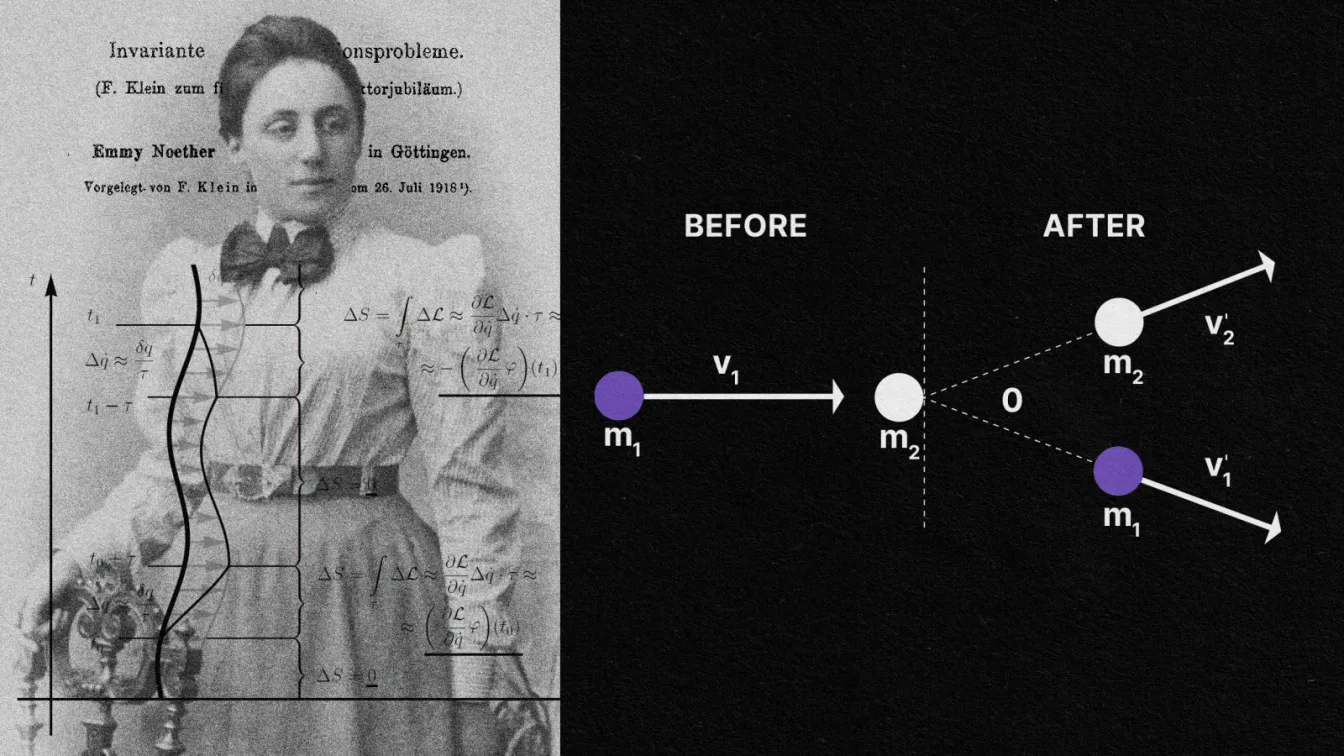 Emmy Noether, the person who proved Noether’s theorem, which connects symmetries and invariances of a theory with an associated conserved quantity. At right, the illustration of conservation of linear momentum, a consequence of spatial-translation invariance, is shown.
There are other properties of this set of equations that are tremendously important. In particular, if you take the divergence of the stress-energy tensor, you always, always get zero. This is true not only overall, for the full stress-energy tensor itself, but for each individual directional component of the stress-energy tensor. That means that you have four symmetries: no divergence in the time dimension or any of the space dimensions. And, due to the power of Noether’s theorem, every time you have a symmetry in physics, it also leads to a conserved quantity.
In general relativity, those conserved quantities translate into energy (for the time dimension), as well as linear momentum in the x, y, and z directions (for the spatial dimensions). Just like that, at least locally for you (i.e., in your nearby vicinity), both energy and momentum are conserved for individual systems. Even though it is impossible to define things like “global energy” overall in general relativity, for any local system within general relativity, both energy and momentum remain conserved at all times. This is not a preference or a prejudice: it is a requirement of the theory.
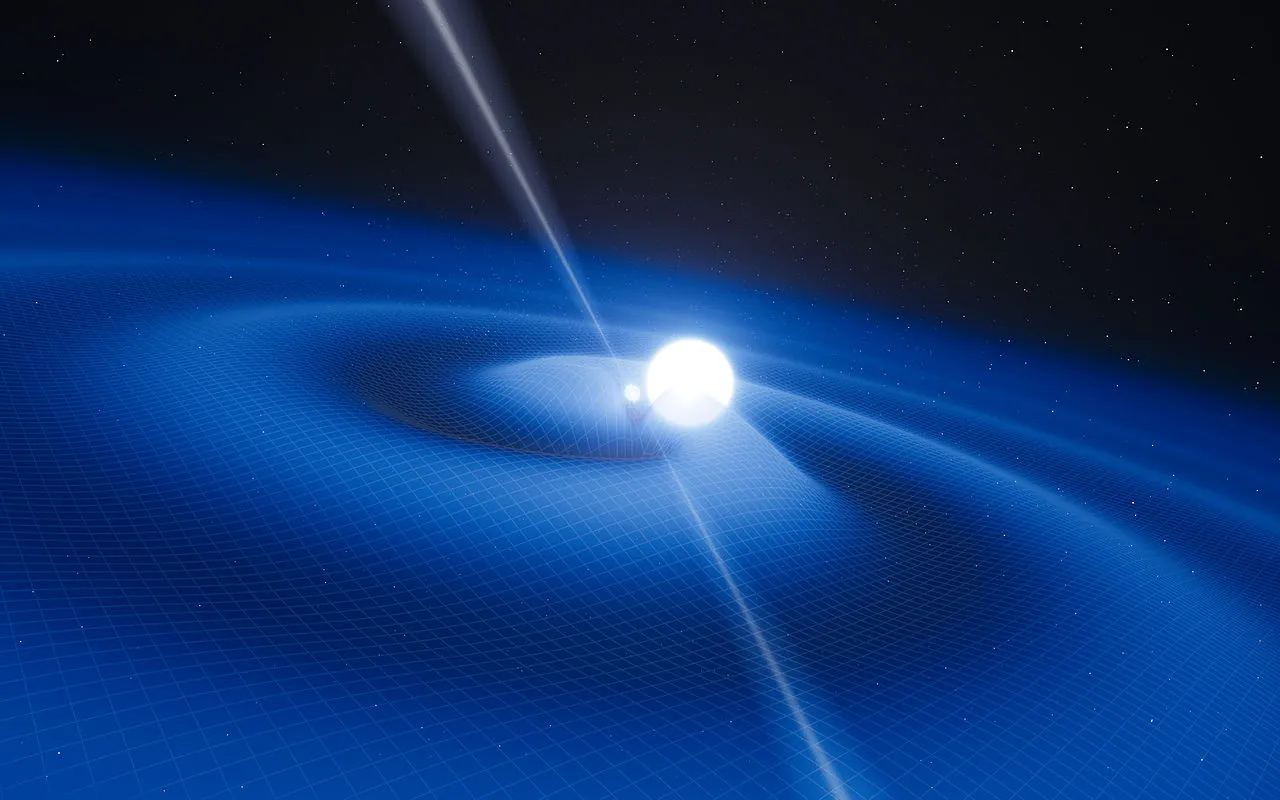 As masses move through spacetime relative to one another, they cause the emission of gravitational waves: ripples through the fabric of space itself. These ripples are mathematically encoded in the metric tensor of Einstein’s general relativity, and carry energy away from co-orbiting systems like this, leading to orbital decay and an eventual merger.
Another property of general relativity that is different from most other physical theories is that general relativity, as a theory, is nonlinear. If you have a solution to your theory, such as “what spacetime is like when I put a single, point mass down,” you would be tempted to make a statement like, “If I put two point masses down, then I can combine the solution for mass #1 and mass #2 and get another solution: the solution for both masses combined.”
That is true, but only if you have a linear theory. Newtonian gravity is a linear theory: the gravitational field is the gravitational field of every object added together and superimposed atop one another. Maxwell’s electromagnetism is similar: the electromagnetic field of two charges, two currents, or a charge and a current can all be calculated individually and added together to give the net electromagnetic field. This is even true in quantum mechanics, as the Schrödinger equation is linear (in the wavefunction), too.
But Einstein’s equations are nonlinear, which means you cannot do that. If you know the spacetime curvature for a single point mass, and then you put down a second point mass and ask, “How is spacetime curved now?” we cannot write down an exact solution. In fact, even today, more than 100 years after general relativity was first put forth, there are still only about ~20 exact solutions known in relativity, and a spacetime with two point masses in it still is not one of them.
Originally, Einstein formulated general relativity with only one term in the equations on each side: that is, with the Einstein tensor on one side and the stress-energy tensor (multiplied by the Einstein gravitational constant) on the other side. He only added in the cosmological constant, at least according to legend, because he could not stomach the consequences of a universe that was compelled to either expand or contract: something that would’ve arisen, naturally, if such a constant wasn’t included.
And yet, the cosmological constant itself would have been a revolutionary addition even if nature turned out not to have a non-zero one (in the form of today’s dark energy) for a simple but fascinating reason. A cosmological constant, mathematically, is literally the only “extra” thing you can add into general relativity without fundamentally changing the nature of the relationship between matter and energy and the curvature of spacetime.
The heart of general relativity, however, is not the cosmological constant, which is simply one particular type of “energy” you can add in but rather the other two more general terms. The Einstein tensor, Gμν, tells us what the curvature of space is, and it is related to the stress-energy tensor, Tμν, which tells us how the matter and energy within the universe is distributed.
In our universe, we almost always make approximations, for good and useful reasons: we want to model reality by the simplest means possible, while ignoring extraneous information that doesn’t pertain to the situation we’re investigating. If we ignored 15 out of the 16 Einstein equations and simply kept the “energy” component, you would recover the theory it superseded: Newton’s law of gravitation. If you instead made the universe symmetric in all spatial dimensions and did not allow it to rotate, you get an isotropic and homogeneous universe, one governed by the Friedmann equations (and hence required to expand or contract). On the largest cosmic scales, this actually seems to describe the universe in which we live.
But you are also allowed to put in any distribution of matter and energy, as well as any collection of fields and particles that you like, and if you can write it down, Einstein’s equations will relate the geometry of your spacetime to how the universe itself is curved to the stress-energy tensor, which is the distribution of energy, momentum, and stress.
If there actually is a “theory of everything” that describes both gravity and the quantum universe, the fundamental differences between these conceptions, including the fundamentally nonlinear nature of Einstein’s theory, will need to be addressed. As it stands, given their vastly dissimilar properties, the unification of gravity with the other quantum forces remains one of the most ambitious dreams in all of theoretical physics.
This article was first published in September of 2021. It was updated in October of 2026.
This article Einstein’s general relativity equations: explained in plain English is featured on Big Think.