Two U.S. professors win Nobel prize in economics
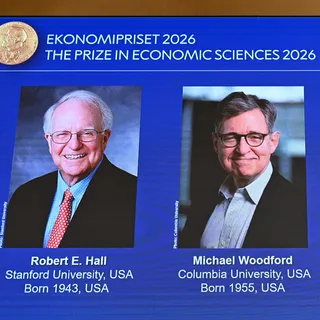
Stanford University's Robert E. Hall and Columbia University's Michael Woodford won the Nobel Prize in economics for research on how policymakers can stabilize economies, the Royal Swedish Academy of Sciences said on Monday.
Why it matters: Their work helped shape how central banks set interest rates and communicate policy. The win comes as those institutions fight energy-driven inflation and risks to economic growth.
Zoom out: For decades, policymakers relied on economic models that linked higher inflation with lower unemployment. But that framework broke down during the 1970s stagflation when both prices and joblessness surged at the same time.
- "The solution by Robert Hall and Michael Woodford was to build a new framework ground up," Timo Boppart, a member of the Nobel economics prize committee, said on Monday.
What they're saying: Woodford, who called into Monday's press conference hosted by the committee, said he was "elated" by the win.
- "It's a tremendous honor. It's a surprise — but I'm feeling very good about it," Woodford said.
The intrigue: Asked by a reporter about the threat to the global economy, Woodford said the Middle East conflict has disrupted energy markets and driven price changes with consequences far beyond the region.
- He pointed to the 2008 financial crisis as a key test of his research, when central banks cut interest rates to near zero but struggled to revive economic activity.
- His framework helped explain how other tools, including forward guidance and asset purchases, could support the economy.
Zoom in: In research culminating in a landmark 2003 book, Woodford developed a framework linking businesses' pricing decisions to inflation and monetary policy.
- Hall — a Stanford professor who chaired the committee that dates U.S. recessions for 46 years — showed in a 1978 paper how consumers' spending decisions reflect expectations about future income.
Of note: The prize comes with an award of 12 million Swedish kronor (about $1.2 million), up from 11 million kronor last year, to be divided between the two winners.
Flashback: Recent economics Nobels have recognized research on technological progress, economic prosperity and labor markets.
- Last year's prize went to Joel Mokyr, Philippe Aghion and Peter Howitt for their work explaining how innovation drives economic growth.
- In 2024, Daron Acemoglu, Simon Johnson and James Robinson won for their research on how institutions shape economic prosperity.
- Harvard economist Claudia Goldin won in 2023 for research that advanced the world's understanding of women's labor market outcomes.