Astronomers weigh the Milky Way’s mass at long last
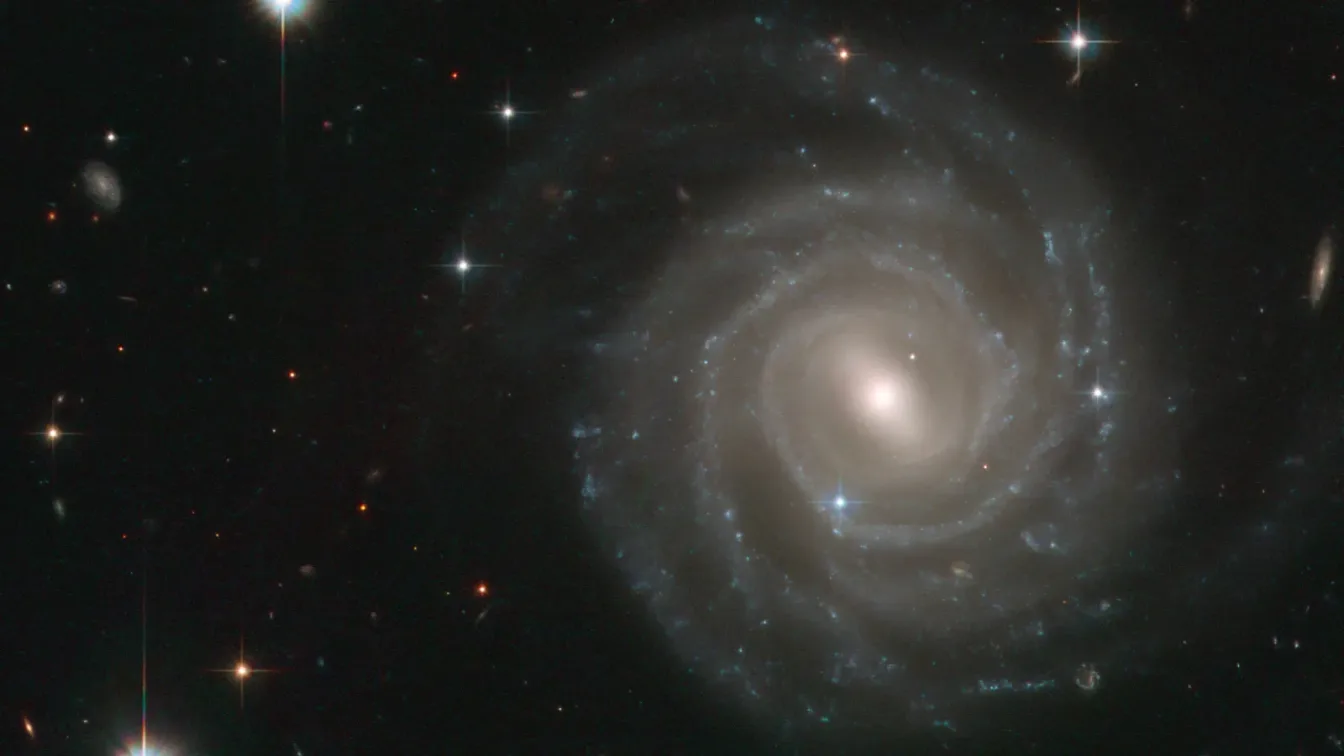
Astronomers have long since mapped out the Milky Way’s starlight.
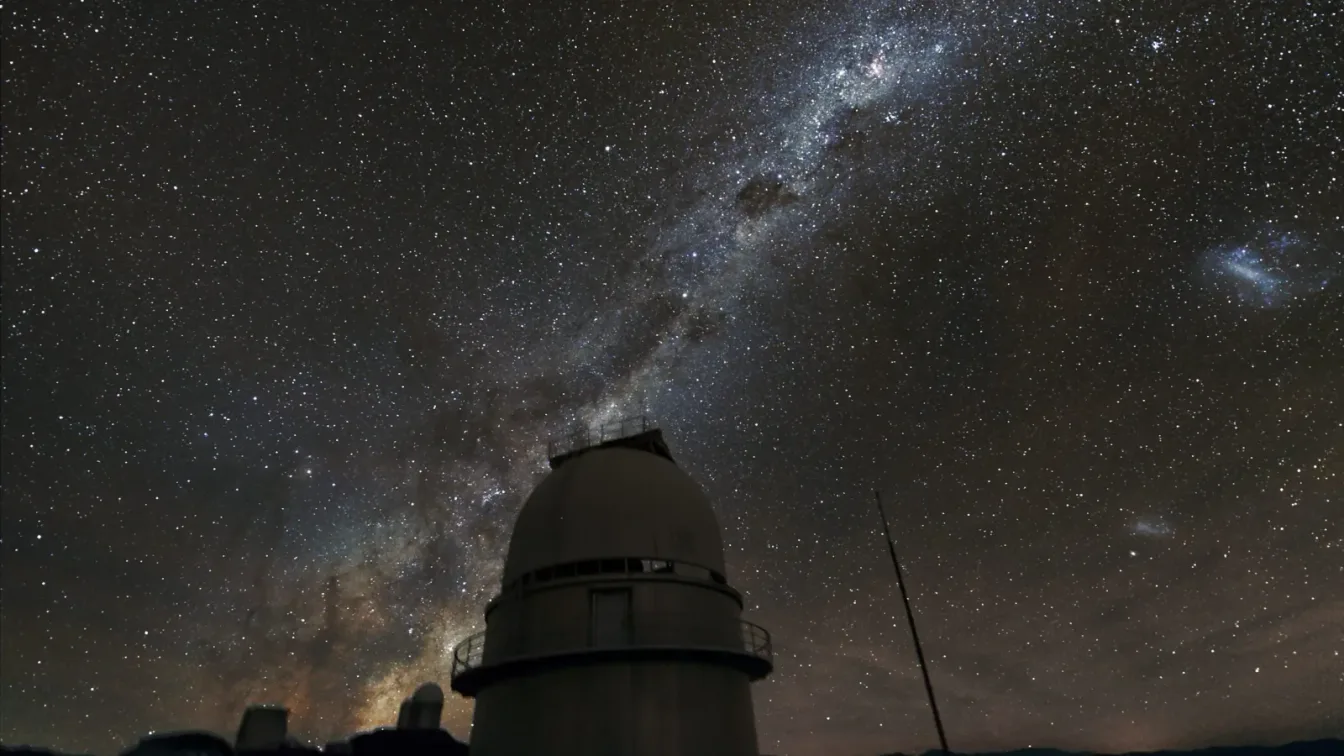 Behind the dome of a series of European Southern Observatory telescopes, the Milky Way towers in the southern skies, flanked by the Large and Small Magellanic Clouds, at right. Although there are several thousand stars and the plane of the Milky Way all visible to human eyes, there are only four galaxies beyond our own that the typical unaided human eye can detect. Although observing the normal matter and starlight within our galaxy allows us to map out the stellar and gaseous distribution, mapping out the mass distribution is a more challenging endeavor.
Credit: ESO/Z. Bardon (www.bardon.cz)/ProjectSoft (www.projectsoft.cz)
But mapping our mass — or weighing the Milky Way — has proven far more difficult.
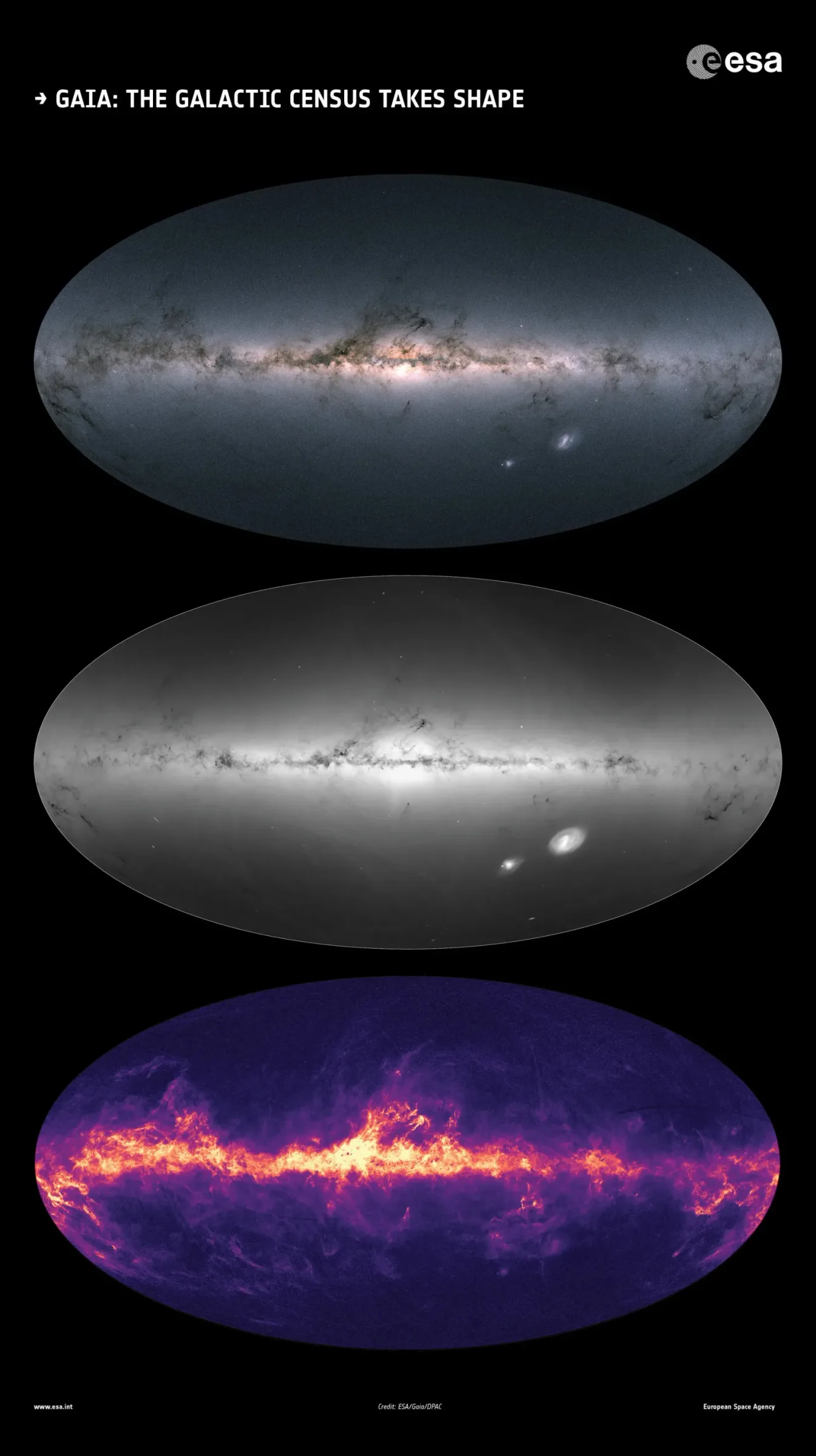 Gaia’s all-sky view of our Milky Way Galaxy and neighboring galaxies. The maps show the total brightness and color of stars (top), the total density of stars (middle), and the interstellar dust that fills the galaxy (bottom). Although this traces out the baryonic matter remarkably well in a variety of wavelengths of light, this method reveals only about 15% of the total mass of our Milky Way Galaxy. The remainder, dark matter, must be revealed dynamically.
Credit: ESA/Gaia/DPAC
Recent estimates range from 500 billion to nearly 2 trillion solar masses.
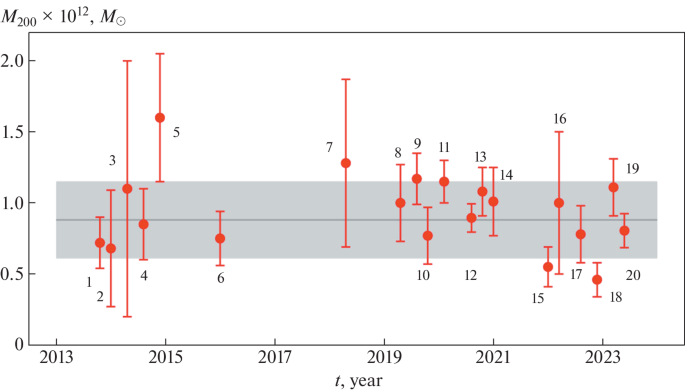 This graph, with error bars, shows a variety of estimates of the overall mass of the Milky Way from a variety of studies from 2013 through 2023. Overall masses range from approximately 500 billion to 2 trillion: a factor of 4 in uncertainty. Weighing the Milky Way, here in the 21st century, has proven remarkably difficult from our location within it.
Using a combination of DESI and Gaia data, the DESI collaboration just weighed the Milky Way.
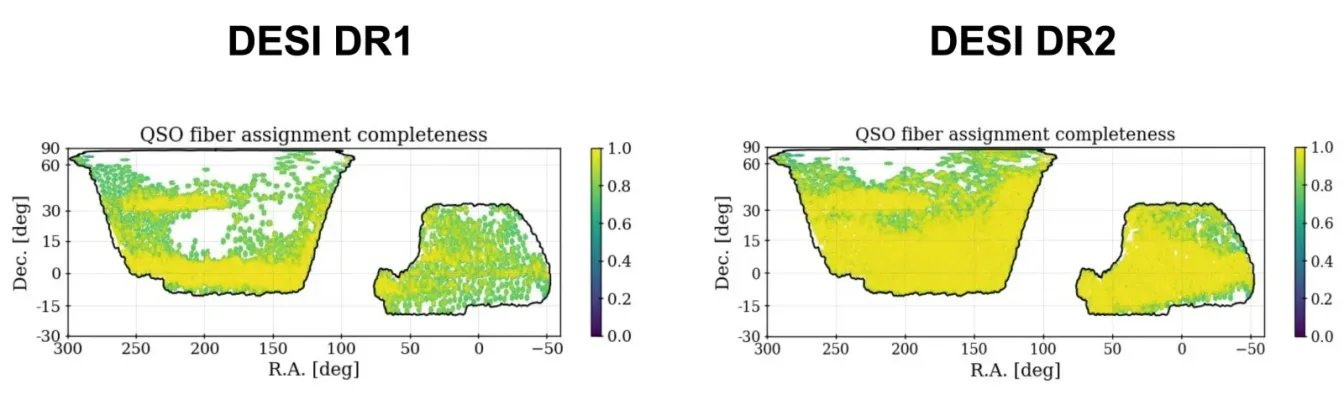 The new (DR2) DESI data set contains more than 14 million galaxies and quasars, which is more than double the number released in DR1 in 2024, over the region of the sky highlighted on the map on the right. Although its primary goal was to measure the Universe well beyond the Milky Way, it also was able to capture spectroscopic data on an enormous number of stars within the Milky Way, even though it avoided the galactic plane: the location where most Milky Way stars can be found.
Credit: DESI DR1 and DR2; Cristhian Garcia-Quintero
They identified more than 10,000 individual stars away from the galaxy’s disk: within the halo.
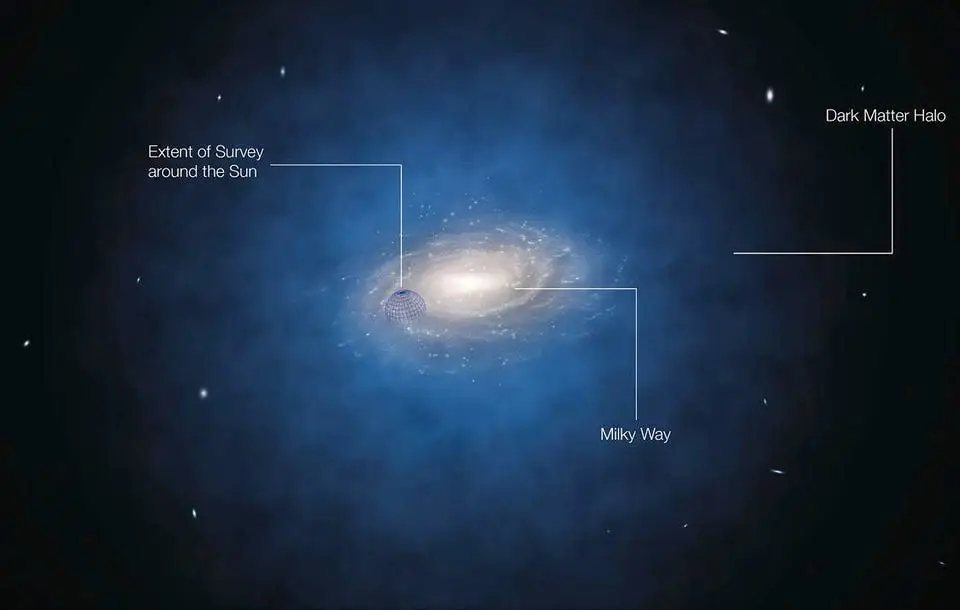 The dark matter halo around our galaxy should exhibit slightly different interaction probabilities as the Earth orbits the Sun, varying our motion through the dark matter in our galaxy. The stellar extent of each galaxy that we observe is embedded within a much larger dark matter halo, which can extend for millions of light-years for a typical Milky Way-like galaxy.
They focused on blue and RR Lyrae horizontal branch stars.
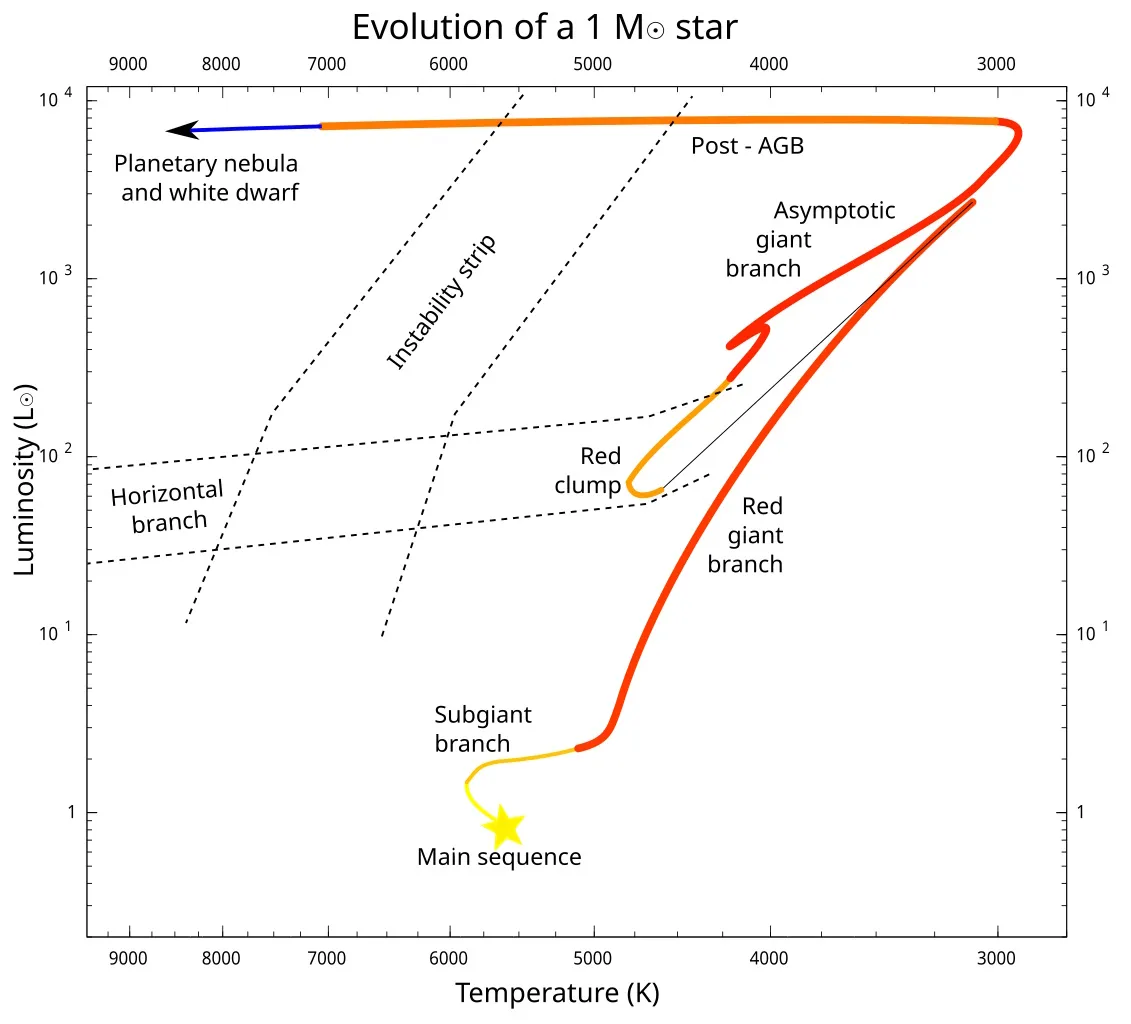 After evolving off of the main sequence (not shown), stars with similar masses and metallicities to the Sun evolve into subgiants, then true red giants, then evolve back and forth along the horizontal branch. There is typically a “gap” in the horizontal branch between the red and blue ends in an individual population of stars, like within a globular cluster, where those stars pulse and vary in their properties: RR Lyrae stars. The latest study traced both blue horizontal branch stars and RR Lyrae stars in the galactic halo.
Credit: Lithopsian/Wikimedia Commons
Stellar distances ranged from 33,000 up to 312,000 light-years.
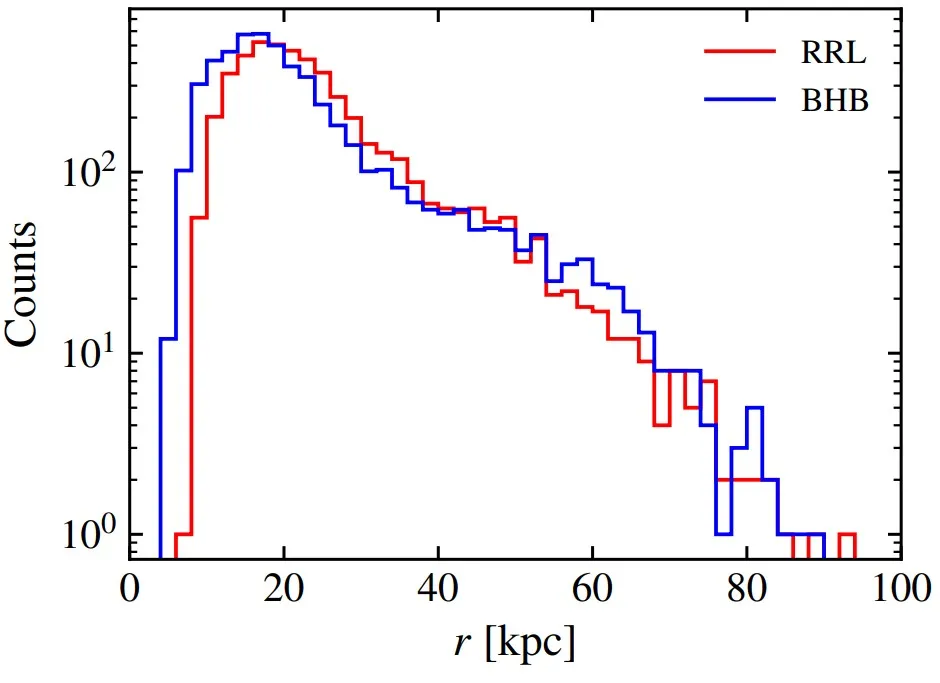 This graph shows the number of RR Lyrae (red) and blue horizontal branch (blue) stars selected for this latest study as a function of distance. No stars closer to the galactic center than 32,000 light-years or farther than 312,000 light-years were chosen, but more stars at greater distances could lead to an even superior future study.
The DESI data’s best-ever spectroscopic measurements provide exquisite line-of-sight motion data.
Credit: NASA/ESA/CSA and the NIRSpec team
This is complemented by Gaia data, which yields superior proper (transverse) motions of these stars.
They then compared the 3D positions and motions of the observed stars with 24 simulated galaxies of known masses.
Several different analysis methods were independently implemented.
The greatest uncertainties — at the galactic center and within the disk — were irrelevant for this data.
Within 80 kpc (260,000 light-years), 636 billion solar masses were robustly enclosed: within just 6-7%.
A mass estimate of 1.19 trillion solar masses was obtained over the entire galactic halo: with mere 10-12% uncertainties.
A light Milky Way, as previously suggested, is now thoroughly disfavored.
Credit: Stefan Payne-Wardenaar
Mostly Mute Monday tells an astronomical story in images, visuals, and no more than 200 words.
This article Astronomers weigh the Milky Way’s mass at long last is featured on Big Think.