‘Relationships matter’: How BYU’s long-standing kinship with Notre Dame enabled Saturday’s top-10 showdown
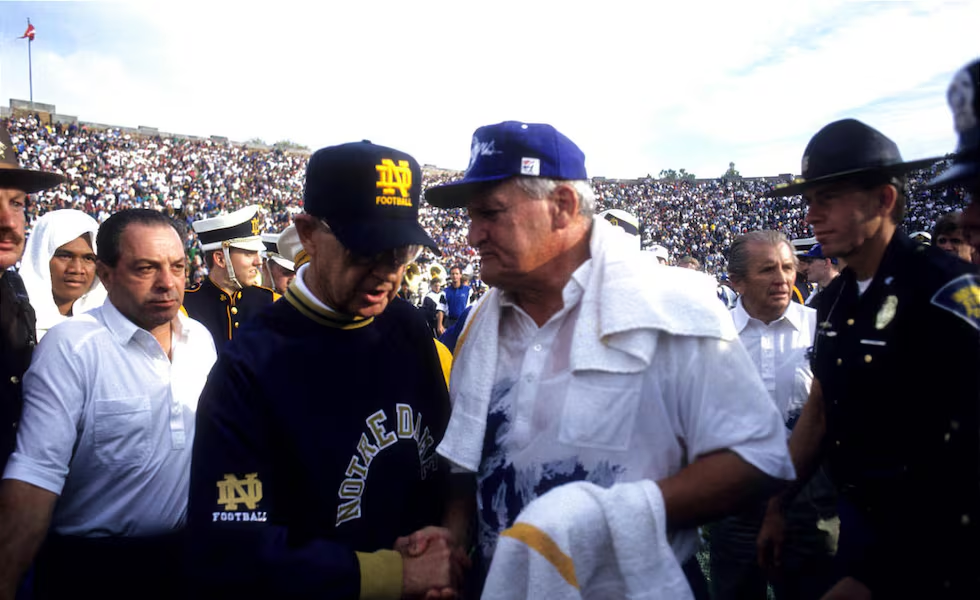
In what the school considers its first season of intercollegiate football, Brigham Young University went 1-5 in 1922, and failed to score in four of those six contests.
To remedy the bleak situation, then-BYU athletic director Eugene L. Roberts invited legendary Notre Dame football coach Knute Rockne to visit Provo in 1923 and conduct a coaching clinic, of sorts, for BYU head coach Alvin Twitchell and other coaches. Rockne was also an adjunct professor for a time at a BYU, as outlined in the book “100 Years of BYU Football.”
On his train ride back to Indiana, the story goes, Rockne wrote a letter to Roberts telling the AD that the students were incredibly earnest and good-natured and it would be a shame if anybody flunked his class.
The Cougars promptly went 2-5 the following season, which was considered a mild success in Provo because they were only shut out three times — by Utah, Colorado and Agricultural College of Utah (Utah State) — and somehow managed to score 47 points, while giving up 156.
Is BYU-Notre Dame most important game in BYU football history?
BYU and Notre Dame share much in common beyond the gridiron
More importantly, a relationship between the two faith-based institutions was born, and although the Fighting Irish and Cougars didn’t actually meet on the gridiron until 70 years later, it endured enough to produce nine matchups since 1992. In that first one, Jerome Bettis and Reggie Brooks both ran for more than 100 yards apiece and Lou Holtz-coached Notre Dame routed LaVell Edwards-coached BYU 42-16 in South Bend.
Two years later, Edwards and the Cougars upset Holtz and No. 17 Notre Dame 21-14 in the shadows of “Touchdown Jesus” — a massive 134-foot tall mural — and the fellow private religious institution from Utah supported by The Church of Jesus Christ of Latter-day Saints was entrenched a little more in the national college football landscape, despite also having won the national championship in 1984.
BYU's Sione Moa cleared, could play against Notre Dame
Which team did BYU's Bear Bachmeier root for growing up?
Edwards would later say that the 1994 win over college football’s biggest brand was one of the greatest accomplishments of his career.
Game No. 10 in the series (Notre Dame leads 7-2) comes Saturday at the stadium named after BYU’s legendary coach, and suffice it to say it is bigger and more important — at least for BYU — than the previous nine contests combined. In the first top-10 matchup in stadium history, No. 8 BYU hosts No. 2 Notre Dame at 5:30 p.m. MDT in what is being called by many the most important regular-season game in BYU football history.
ESPN’s popular “College GameDay” pregame show will be on hand for the first time since 2009 and ABC will broadcast the primetime affair nationally.
BYU still following ND’s blueprint for success
For BYU, it is fitting that the opponent is Notre Dame, because throughout its 102 seasons of football — it missed three seasons due to World War II — BYU has continually looked toward Notre Dame as a blueprint for success, especially in the 12 seasons it was an independent before joining the Big 12 in 2023.
It is also appropriate that the schools’ relationships — tested a bit last December when Notre Dame opted out of a showdown with BYU in the Pop-Tarts Bowl when the Cougars agreed to accept a bid to play in Orlando because they thought the Golden Domers would be on the other side of the ball — is the reason why this game and one next season in South Bend is happening.
No. 8 Cougars’ national standing, and the Big 12’s reputation, on the line in Provo
In May, while outlining to the Deseret News how the series was set up in a matter of days, BYU athletic director Brian Santiago said he and Notre Dame AD Pete Bevacqua were “connected through a mutual friend” early last fall who put them in touch with each other well before they were the first two teams left out of the College Football Playoff in 2025.
Santiago said the ADs “had a great conversation” that eventually led to the home-and-home agreement.
“There’s a way bigger play here to try to bring positive light to the Savior, a positive light to college athletics in a very unique way.”
BYU athletic director Brian Santiago on BYU's relationship with Notre Dame
Of course, both schools were a bit desperate. Notre Dame needed a decent team to replace longtime rival USC on its schedule and BYU needed a Power Four opponent after Cal dropped BYU due to ACC scheduling limitations.
“Bottom line is relationships matter,” Santiago said. “In our first conversation, Pete just talked about the unique nature and missions of our universities, the religious nature of our universities. And we just talked about how important it would be for us to compete in football and other sports moving forward.”
This time, it didn’t take 70 years for the programs to reconnect.
Santiago said when Notre Dame decided not to play in the postseason after the CFP snub, BYU leaders “respected their decision” and he reached out to Bevacqua a few days later to convey that message because “there was a lot out there in the hemisphere about BYU fans and their feelings about Notre Dame not playing us in the bowl game.”
Santiago said Bevacqua called him back the next day and said, “‘Hey Brian, what if we play next year in Provo?’”
The relationship was back on track.
Saturday’s game ‘not just a one-hit wonder’
In late August, BYU’s athletic department announced a restructuring after football coach Kalani Sitake publicly complained about the way his program was being funded, among other issues, and the school removed Santiago’s oversight of the football program.
Sitake now reports to BYU advancement vice president Keith Vorkink. Still, the ability to schedule a home-and-home agreement with Notre Dame remains a feather in Santiago’s cap. If BYU somehow pulls off an upset as a 10-point underdog, Sitake’s status as the most popular man in Provo will grow, and Oct. 17 will go down in the same annals as Sept. 8, 1990 — the day Edwards- and Ty Detmer-led BYU upset No. 1 Miami, 28-21.
“What I am really excited about is this game in October isn’t just a one-hit wonder,” Santiago said in May. “We both have said to each other, ‘Hey, this is just the start of something great for our two universities, well into the future, in multiple sports.’ And that’s a mutual feeling between both of us. … The religious focus of both of our institutions is connected.
“There’s a way bigger play here to try to bring positive light to the Savior, a positive light to college athletics in a very unique way,” he continued.
During his weekly press briefing Monday, Sitake was asked if this is the start of a long-term series with the Irish.
“I don’t have anything to report on that. I am just really thankful that Notre Dame reached out and wanted this game. It was a really cool opportunity for us to take it,” Sitake said. “I’m looking forward to not just this game this year, but also returning to South Bend and playing that game, too.
“So yeah, if any of teams out there want to play a game, let us know, man,” Sitake said. “We’re open for business.”
Notre Dame aided BYU’s independence
Besides being two of the most prominent faith-based universities that play major college football in the country, BYU and Notre Dame also share the experience of being a college football independent. The Irish are still independent in football, while BYU’s independence lasted 12 years before the Big 12 extended an invitation on Sept. 10, 2021.
Not surprisingly, when BYU announced on Sept. 1, 2010, that it was breaking away from the Mountain West Conference to go independent in football and put most of its other sports in the West Coast Conference, Notre Dame was there to help.
That same day, BYU athletic director Tom Holmoe announced a six-game football series with Notre Dame, with the first two games to be played in 2012 and 2013 in South Bend and two of the remaining four games to be played in Provo.
BYU also announced an eight-year broadcasting agreement with ESPN. Both announcements legitimized BYU’s move to independence and brought some much-needed energy to the BYU fanbase.
“Our vision is to play football games across the country against many of the storied football programs in their legendary stadiums and (for) those same highly regarded programs to return to Provo to play in LaVell Edwards Stadium,” Holmoe said that day.
The agreement with ESPN stuck, but the deal with Notre Dame did not.
After Notre Dame edged BYU 17-14 at Notre Dame Stadium in 2012 and 23-13 at the same venue in 2013, the Irish had to back away from their promise to play in Provo for the first time since 2004 — a 20-17 BYU win — primarily because it entered a scheduling agreement with the ACC to play five games a year against ACC opponents.
That deal severely squeezed its nonconference scheduling flexibility.
Most relationships would have been damaged beyond repair after the Irish backed out, but not this one. Credit BYU for being willing to work with the Irish, a willingness that no doubt paid dividends when Bevacqua and Holmoe’s successor, Santiago, connected last fall.
Next best thing: BYU vs. ND in Las Vegas
Holmoe annually preached patience even as an impatient BYU fanbase cried for financial compensation from Notre Dame, or a visit to Provo in the last few years of independence.
They got neither, but they did get the next best thing — sort of.
They got together for their ninth meeting in 2022 at Allegiant Stadium in Las Vegas as part of ND’s Shamrock Series for the Fighting Irish. Notre Dame controlled almost every aspect of the pregame setup, including ticket sales, and the hot dogs in the media buffet at the stadium were even dyed shamrock green (yikes, and no thanks).
Holmoe explained to a disgruntled fanbase that it was that game, or nothing, and BYU wasn’t about to pass up on an opportunity to play the Irish so close to Provo. Thousands of BYU fans attended, comprising roughly 40% of the crowd.
Powered by Drew Pyne’s 262 passing yards and Michael Mayer’s 11 catches for 118 yards and two touchdowns — Mayer is probably still open — Notre Dame jumped out to a big lead and held on for a 28-20 victory to improve to 7-2 in the series.
Quarterback Jaren Hall played hurt for BYU, which simply did not have another capable QB on the roster, and opened the game with an interception. It mostly went downhill from there, aside from Kody Epps’ four catches for 100 yards and two touchdowns.
“That game was the only time in my whole coaching career where I’ve played a quarterback that didn’t practice at all that week. He didn’t take a rep that week,” sixth-year BYU offensive coordinator Aaron Roderick said. “But I don’t think that game has a lot to do with this one, other than the fact that we know Notre Dame has really good players. They had good players when we played then, and they have really good players now.
“You know, we tried to hang in there with them, but they were too good for us that day,” Roderick continued. “Hopefully we’ve improved enough that we can hang in there with them this week.”
Because this week’s game is 10 times more important than that one was.
And regardless of the outcome, it will show that, for BYU, relationships still matter — especially with the schools with which it wants to be associated.