Norman Rockwell, American realist
In some ways, “The Problem We All Live With” is vintage Norman Rockwell.
The subjects in this 1964 painting are tangible and familiar: a six-year-old girl is walking to school, wearing a bright white dress and pigtails. The lines are crisp and defined, the brush strokes muted, the details so lifelike it could almost pass for a photograph. And the canvas achieves what the quintessential artist of salt-of-the-earth America always aspired to do: It tells a story in a single frame.
But the darkness inherent in the story itself seems to break new ground.
Rockwell’s work still resonates nearly five decades after his death in 1978, most recently at the Lucas Museum of Narrative Art in Los Angeles (which opened in September). Founded by “Star Wars” creator George Lucas, the museum explores the power of storytelling in art, and includes 160 original works from Rockwell, from sketches to completed oil paintings. The collection includes “Saying Grace,” in which a grandmother prays with her grandson in a crowded railway restaurant.
Rockwell is known for finding humanity in such ordinary moments. A truant officer shares a soda shop counter with a boy caught playing hooky. Soldiers riding in a truck look varying degrees of haggard. “These are scenes that we can either envision or aspire to,” says Stephanie Haboush Plunkett, chief curator of the Norman Rockwell Museum in Stockbridge, Massachusetts. “They gave people a picture of possibility.” Rockwell depicted not so much what America was, but what the country aspired to be.
But by the 1960s, that country was changing, and it showed in Rockwell’s work.
The little girl in “The Problem We All Live With,” published in Look magazine, is Black. Unlike most children walking to school, she is flanked by four faceless U.S. marshals, identified by badges and armbands worn over their drab suits. Behind them, a tomato is splattered against a cracked concrete wall that has been vandalized with a racial slur. The girl follows her bodyguards closely, safe and brave but, in this composition, utterly alone. The scene is more heartbreaking because the story is true.
The girl’s name is Ruby Bridges. That day, the first grader became the first Black student at a formerly all-white elementary school in New Orleans, ordered to desegregate by a federal court in 1960. Her father was still afraid to enroll her there, but her mother insisted Ruby get the best education, and open doors for other children of color. So the marshals escorted her to school, past a crowd of protesters from a local “White Citizens’ Council.”
That scene, and the girl’s stoic grace, helped spark the Civil Rights Movement, and impacted Rockwell personally. This was not what America aspired to be.
Many see Rockwell as the court painter of American democracy. In some eyes, he gave visual form to our highest ideals. In others, he painted over our shortcomings. He is often dismissed as an artist of consequence for stylistic reasons. Critics call his work too commercial, too sentimental, even “kitsch” or “propaganda.”
Yet here he was, at the peak of his popularity, grappling with a dark rift in our society and piquing our collective conscience. Had the man changed, I wondered, or had history misjudged him?
‘Pictures that didn’t disturb anybody’
No artist has defined America to itself more than Norman Percevel Rockwell. Born in 1894 on Manhattan’s Upper West Side, Rockwell grew up in a series of boarding houses. He gravitated to drawing from an early age.
At 16, he dropped out of high school to study art full time, training at some of New York City’s finest classical art programs. Two years later, he became a staff artist for Boys’ Life, published by the Boy Scouts of America. At 22, with help from a well-connected neighbor, he submitted a sketch to the Saturday Evening Post titled “Boy with Baby Carriage.” It ran on the cover on May 20, 1916.
Over the next 47 years, Rockwell would illustrate 322 covers for the Post, then one of the country’s most influential and widely read magazines. Most were scenes painted in his distinctive, hyperrealist style. Warm, funny, sentimental and evocative, these images made him a household name and beloved cultural icon.
At its peak in 1960, the Post counted nearly seven million subscribers. That was the year Rockwell himself graced the cover in his quizzical “Triple Self-Portrait.”
Elsewhere, artists with more serious reputations were engaged in a grand rebellion against representation.
Claude Monet, leading light of the Impressionist movement, was still painting blurry water lilies when Rockwell started his career. Pablo Picasso was in his Synthetic Cubism phase, deconstructing simple objects as in “Guitar,” which breaks down one such instrument in layers of abstract planes. And Gustav Klimt was finishing blending realistic features and an elongated body on a field of symbols in his highly stylized “Portrait of Elisabeth Lederer.” Modern art was a puzzle for audiences to decipher.
Rockwell, on the other hand, set out to reach the masses.
“I have always wanted everybody to like my work,” he wrote in “My Adventures as an Illustrator,” his 1960 autobiography. “So I have painted pictures that didn’t disturb anybody, that I knew everybody would understand and like.”
By 1939, Rockwell was famous enough to have detractors. That year, in his seminal essay “Avant-Garde and Kitsch,” the art critic Clement Greenberg argued that Rockwell was emblematic of a cultural dumbing down, an avatar for a kind of “synthetic art” that “predigests” meaning, obviating the effort that true art requires of the audience. The result, he wrote, was something like propaganda. The attack was oddly prescient, considering the role Rockwell would play during World War II.
Rockwell’s later work did not just entertain, but asked the audience to think and to see the world in a different way.
Rockwell watched the gulf between his work and “high art” widen through the 1940s and 1950s but didn’t seem to resent it. That was the age of abstract expressionists like Mark Rothko, known for the revolutionary juxtaposition of blocks of color, and Jackson Pollock, famous for his “splatter” paintings. Rockwell actually admired Pollock and even emulated his style in 1962’s “The Connoisseur,” in which a balding man stares at a large canvas covered in colorful splotches of paint. We see the man’s gray suit, the umbrella and hat in his hand, but can only imagine the look on his face.
“Rockwell pokes at the art world and at museums,” says Alan Wallach, an art historian who has called Rockwell’s style “capitalist realism,” and criticized the magazine where he spent most of his career. “If you had a particular viewpoint, like the Post did, you’d want an artist who would create works that supported or imagined the world from that viewpoint. So Rockwell produced, over almost all of his career, a very cheery view of American life. And more than that, one that normalized a certain set of social relations.”
For example, the Post explicitly required that Rockwell only draw Black people in subservient roles — as waiters, for example, or maids. He accepted that as a reality of the marketplace, and chose to make art within editorial limits. The purpose of his work, after all, was to sell magazines, not break boundaries or challenge the audience. That’s what makes “The Problem We All Live With,” published the year after he left the Post in 1963, so jarring.
But this wasn’t Rockwell’s first venture into political art.
From ‘Freedom of Speech’ to desegregation
In another canvas, a working man stands tall in what seems to be a town hall meeting. Surrounded by older men in suitcoats, black ties and white shirts, he looks a little out of place in a stained brown jacket, hands and face soiled from blue-collar work, with a checkered blue shirt to match. But his more established neighbors look up to him in expectation as he prepares to speak. One holds a booklet labeled “Annual Report.”
The 1943 painting, “Freedom of Speech,” portrays democracy on its most human scale. In creating it, Rockwell was also participating in the system it celebrates.
In 1942, after the U.S. entered World War II, then-President Franklin D. Roosevelt called on artists to interpret the “four freedoms” at stake in the fight against fascism: freedom of speech, freedom to worship, freedom from fear and freedom from want. Roosevelt’s rhetoric wasn’t landing, and he was looking for a boost.
Rockwell wanted to support the war effort but didn’t know how until he attended a town council meeting near his home in Vermont. There, he saw a working-class man voicing his opposition to a popular proposal, respectfully heard by his political opponents. Rockwell had found his concept.
The Post published “The Four Freedoms” in 1943: four paintings drawn from everyday American life, each named for the freedom it depicts. The Post even allied with the Department of the Treasury to sell war bonds using the images. The impact was immediate, even in other media outlets.
“You see a definite upward curve,” says James J. Kimble, a historian of rhetoric and propaganda who guest-curated the Norman Rockwell Museum’s touring exhibit, “Enduring Ideals: Rockwell, Roosevelt & the Four Freedoms.” “There was something about Rockwell’s agreement to illustrate the president’s words that made it suddenly skyrocket in public memory and public use.”
This highlighted an evolution in Rockwell’s career as an artist. He had always thrived on empathetic observations of an innocent, idealized sliver of American life that made audiences feel comfortable. Now he was bringing that same eye, that same feeling, to a new kind of work that did not just entertain, but asked the audience to think and to see the world in a different way. Still hopeful, but no longer complacent.
“He held up a mirror that allowed us to see ourselves,” Kimble says. “It’s maybe not me, but it’s the best me, the me I want to be.”
Today, the original canvases of “The Four Freedoms” live inside what Wallach has called the “sanctum sanctorum” of the Norman Rockwell Museum in Stockbridge, Massachusetts, the pinnacle of his idealized America. And “Freedom of Speech” endures as a meme on the internet, deployed by social media users to denote an unpopular opinion.
Perhaps it sowed a seed within the artist as well, for the time was coming when he too would express a viewpoint that not everybody would love.
A mirror held up to the mob
Which brings us back to Ruby Bridges and “The Problem We All Live With.”
The composition itself is harrowing: A child walks alone among faceless men. A stark white dress signals her innocence, or the purity of her mission. She is menaced by threats that stand outside the frame — precisely where Rockwell’s chosen perspective places the viewer. We are not meant to see this through the little girl’s eyes. If ever Rockwell painted a mirror, this was it.
“I have never been so deeply moved by a picture,” one man wrote to the artist in response. “Thank you for showing this white Southerner how ridiculous he looks.”
The painting seemed to announce a new Norman Rockwell to the world. It was his first painting for Look Magazine, his new publishing home after he left the Post in 1963.
The country was changing around him, or perhaps revealing its lingering wounds to people like him. In the news, he saw poverty and struggle, beside an astonishing effort to fly people to the moon. He saw more grounded hopes in the Civil Rights Movement and a startling backlash that didn’t look at all like the America of his paintings. He was fascinated by all of it. The Post’s nostalgia had become suffocating.
In 1965, Rockwell followed with “Murder in Mississippi,” depicting the killings of civil rights activists James Chaney, Andrew Goodman and Michael Schwerner. The composition borrows from Francisco Goya’s “The Third of May 1808,” which shows Spanish resistance fighters facing a French firing squad during Napoleon’s occupation. In each image, one victim stands tall, as if certain of the justice of their cause. But again, Rockwell’s perpetrators stand outside the frame, revealed only in the shadows they cast.
Both paintings are striking departures from the version of Rockwell that both admirers and critics had settled on — which may be why they’re often remembered as something he “also” did. But some scholars believe the artist was more consistent than the “two acts” framing suggests.
“There is a definite through line from ‘The Four Freedoms’ to his later work,” says Plunkett, from the Norman Rockwell Museum. “He was very focused on humanity overall,” at its best and at its worst. All his paintings, through this lens, could be seen as “political.”
How a Norman Rockwell painting turned up in Draper
Rockwell’s reputation has evolved in recent years. Even before the Lucas Museum of Narrative Art, the Guggenheim Museum — founded as a temple to modernism — featured a Rockwell retrospective in 2001. Still, his political paintings remain mostly footnotes. But Rockwell painted the world as he saw it. He was an optimist with a conscience.
The subjects changed. But the tools, and the man, stayed mostly the same. One canvas may bridge that gap in our understanding.
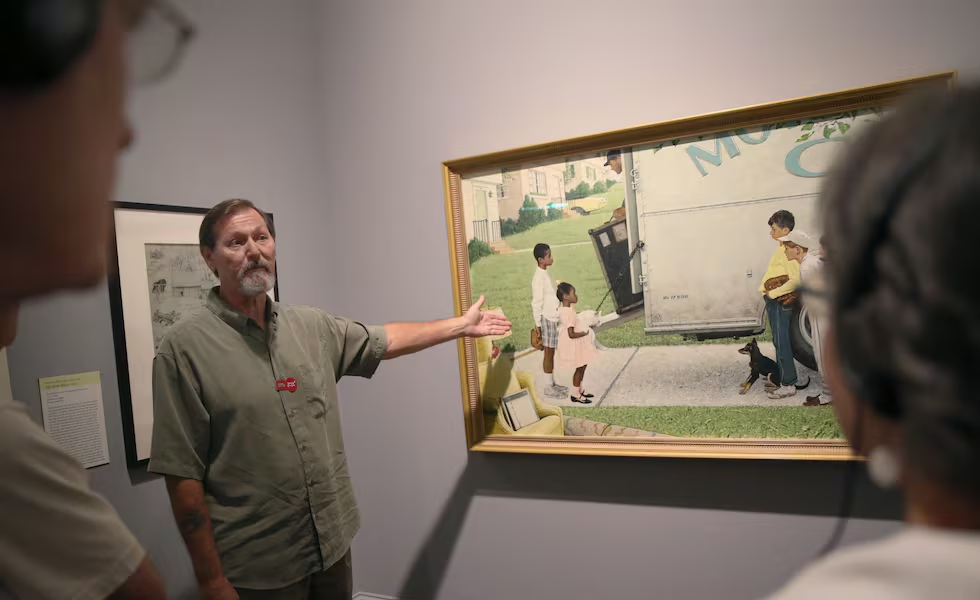
Rockwell’s 1967 “New Kids in the Neighborhood” depicts a moving truck delivering a Black family’s furniture to a suburban enclave of manicured lawns. Two Black children stand beside the truck, while three white children and their German shepherd puppy eyeball their new neighbors.
The white kids look ready to play baseball; one wears a uniform, and another carries a mitt. The Black boy, meanwhile, hides his own mitt behind his back. They are unsure of each other, but they are the same.
It is, in every way, vintage Norman Rockwell.
This story appears in the November 2026 issue of Deseret Magazine under the headline “American Realist.” Learn more about how to subscribe.