The Big Bang Theory : A Theory
Sheldon Cooper would want to begin with the numbers, so here they are: In 2026, Americans have spent more than 27.5 billion minutes watching the CBS sitcom he anchors, The Big Bang Theory—making it the year’s most popular streaming show among U.S. adults. (Its only rival? The cartoon Bluey, beloved by kids and grown-ups.) Per numbers gathered by Nielsen and aggregated by the data journalist Daniel Parris, Big Bang has surpassed the viewership of a host of newer and buzzier programs, among them The Pitt, Bridgerton, and Stranger Things—this despite the fact that the series premiered nearly 20 years ago and ended its network run in 2019.
The show’s current success, Sheldon might observe, is not a statistical anomaly. On the contrary, the series has regularly featured in Nielsen’s Top 10 streaming rankings for the past three years. This year, though, “the show’s viewership has surged to an all-time high,” Parris noted recently in his Stat Significant newsletter. No bombshell from Love Island USA, it seems, can compete with the charms of a theoretical physicist who has an IQ of 187 and an endless desire to remind you about it.
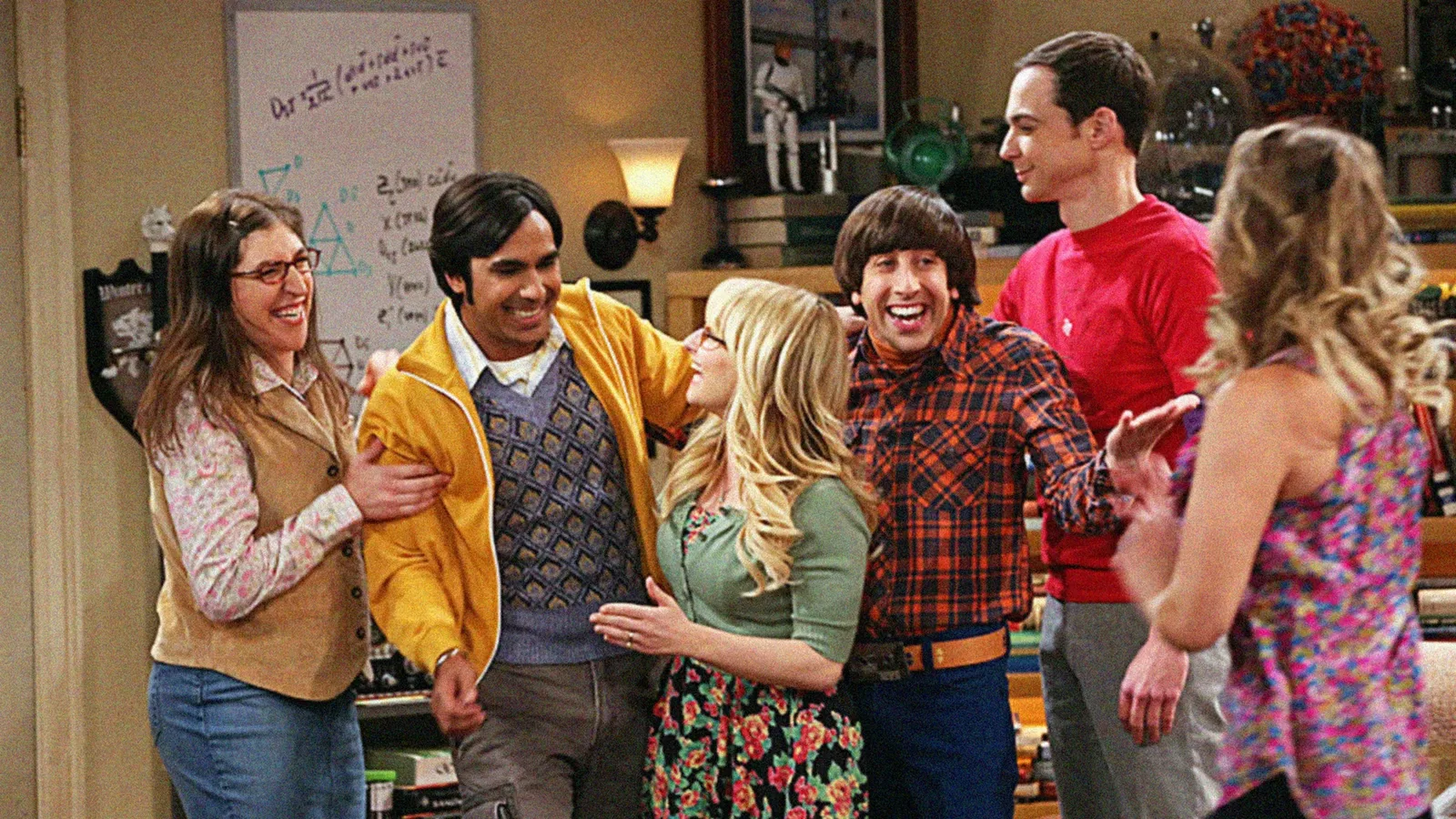
In some ways, Big Bang’s popularity tracks: Nerds are cool now, you might have heard, and few things prove that point as eloquently as the billions of minutes Americans are spending in the geeky company of Sheldon (played by Jim Parsons), the experimental physicist Leonard Hofstadter (Johnny Galecki), the astrophysicist Rajesh Koothrappali (Kunal Nayyar), and the aerospace engineer Howard Wolowitz (Simon Helberg).
In another way, though, the show’s afterlife is curious. Big Bang is notably dated, both in its storylines (see: the advent of Siri) and in its sense of humor (among other things, it has been said to have a woman problem). And even in this Muskified moment, telegenic nerdiness is not the instant sell that Sheldon et al. might want it to be. Genius is, pretty much by definition, unrelatable. Yet the show serves up storylines about science experiments and string theory and Star Trek’s Kobayashi Maru. Like a Comic-Con panel with plot points, it features cameos from an array of nerd-world luminaries—Stan Lee, LeVar Burton, Wil Wheaton, Neil DeGrasse Tyson, and many more. You might expect a sitcom to amuse you. You might not expect it to do so through assorted jokes about Schrödinger’s cat.
But Big Bang’s singularity (guess what the show also jokes about) helps explain how a TV series, like Schrödinger’s four-legged thought experiment, can be both long dead and very much alive. Series in motion tend to stay in motion, and Big Bang was big from the beginning: During its initial airing, it was regularly one of the most watched series on network TV. Today, it’s a well-promoted presence on HBO Max. Its scenes are repackaged on TikTok. Its spin-offs—Young Sheldon, Georgie and Mandy’s First Marriage, and Stuart Fails to Save the Universe—double, Parris notes in his analysis, as free advertising for the original show. And Big Bang, given the length of its run, is quite a lot of show: 12 seasons, at roughly 20 episodes each, amounting to—well, I’ll leave the exact math to Sheldon, but many, many hours of autoplay-friendly entertainment.
The physics, though—the blunt ubiquities that keep Big Bang ever in the ether—are only part of the equation. The show is one of several vintage sitcoms, among them Friends, Seinfeld, New Girl, and The Office, that have proved steadily popular in the streaming era. They owe at least some of that success to the genre they share. Sitcoms’ most widely disparaged tendencies (predictability, low stakes, high camp) are, for many audiences, their most appealing features. Their anodyne nature offers the very thing that so many modern viewers crave: comfort TV.
[Read: Why you can’t stop streaming Seinfeld. Or Frasier. Or Bones.]
Big Bang—a show that finds Leonard, the most socially aware of the geniuses, telling a joke whose punch line is spherical chickens in a vacuum—might seem to deviate from the sitcom’s standard formulas. Instead, it takes them to their logical extremes. A gang of lovable misfits? Check: Sheldon and his friends are so thoroughly misfit that they find themselves barred from a game of Dungeons & Dragons. Plotlines that find humor in banality? Check: Big Bang devoted an episode to Howard’s engineering of a “zero-gravity waste-disposal system” for astronauts on the International Space Station. Jokes that are sharp but accessible? Check again: Here’s Raj’s reaction to Howard’s creation of an extraterrestrial toilet: “This is an important achievement for two reasons: No. 1—and, of course, No. 2.”
The friends regularly tease one another; mockery, in this group, is a love language. But they also support one another, reflexively. After Howard’s space commode has been installed on the ISS, he realizes that he has made a mistake with its specs. The guys rally around him, gathering junk that mimics the equipment on the station and staying up all night to help him correct the error. The scenes that result—think Apollo 13 with pizza boxes and poop jokes—are core to Big Bang’s appeal: Competence can be its own source of comfort. And when it’s a team effort? The comfort compounds. It’s nice to watch people being good at things. It’s even nicer to watch them being good at things while being good to one another.
In this, too, Big Bang adheres to well-worn formulas. Every sitcom, whether its characters are relatives or neighbors or co-workers, will be, to some extent, a show about family. Big Bang’s variation on the theme—genius, in loco familias—is especially poignant because the family the characters build is so unlikely. These are people who, if they hadn’t found one another, might not have anybody else.
Had Friends’ Monica and Rachel lived across the hall from two guys who weren’t Chandler and Joey, they probably would have befriended the other guys anyway: Whatever the characters’ quirks, socializing came naturally to them. Big Bang’s foursome, though, are more than mere outliers; they’re also outcasts. The guys spent much of their childhoods being bullied. They grew up with families who may have loved them but who didn’t, and couldn’t, fully understand them. To be exceptionally smart, these characters have learned, is to be perpetually excluded. Their baseline condition is isolation. Friendship is a statistical improbability.
But this bleak math, rather than compromising the show’s comforts, amplifies them. It heightens the stakes of the characters’ relationships and makes the community that they find, against the odds, all the more remarkable. The guys may sometimes annoy one another. They occasionally misunderstand one another. Yet their bonds never break. Members of the group—which, over the seasons, expands to include the microbiologist Bernadette Rostenkowski (Melissa Rauch) and the neuroscientist Amy Farrah Fowler (Mayim Bialik)—keep coming back together. And all of them keep choosing one another until, eventually, they no longer need to.
The thing about chosen family is that it can keep accruing. In Big Bang’s pilot episode, Sheldon and Leonard get a random new neighbor, an aspiring actress named Penny (Kaley Cuoco). And Penny, once dumb luck has put her in the path of these geniuses, sets several forces in motion. She is a chemical agent in the guys’ lives, fizzing and sparking and transforming everything in her path. Her influence—her kindness, her wit, her tendency to call everyone “sweetie”—transforms Sheldon and Leonard. It makes them savvier and worldlier than they were before: two men, book-smart and street-stupid, whom Penny’s influence turns wise.
Insiders and outsiders, assembling and clashing and learning and growing: Writers might talk about character arcs. Scientists might talk about evolution. In his recently released memoir (titled, aptly, Sitcom), Chuck Lorre, Big Bang’s co-creator and executive producer, describes the show’s transformation from its initial premise (geeks, lol) into the one that made it to the air. Big Bang’s early pilot, he writes, lacked depth and warmth. It lacked, crucially, Penny and Raj and Howard. It was coming along at a moment when nerds were gaining cultural cachet; rather than humanizing its geeks, though, it resorted to skewering them. Network executives hated it.
But CBS gave Lorre and his co-creator, Bill Prady, an opportunity nearly unheard of in network television: a do-over. They revamped the show to feature four geniuses rather than two. They rewrote the woman-next-door character—who is smarter than she might seem, but neurotypical enough to hear “pi” and think of a baked good—as much more central to the story. The Penny who emerged was also, effectively, a stand-in for the show’s audience. Initially baffled by her wacky new neighbors, she comes to appreciate them and soon enough to love them. She encourages the show’s audience to do the same.
[Read: The (slow, awkward) love song of Sheldon Cooper]
What audiences adore is perhaps best encapsulated by a scene featured in Young Sheldon, Big Bang’s first spin-off. The show follows Sheldon, age 10, as an up-and-coming genius living in a small town in East Texas. At one point, he is shown rigging a radio to listen to a faraway event that is, for him, the Super Bowl and the Oscars in one: the announcement of the year’s Nobel laureates, live from Stockholm. Giddy, Sheldon invites everyone he knows—his family, his academic mentors, the entire student body of his very large high school—to join him for an early-morning listening party. Nobody shows.
Emotions, as Sheldon will readily admit, are not his strong suit. Still, he is crushed. The scene is hard to watch: a kid, abandoned by everyone he knows, in direct violation of the laws of comfort TV. But then the camera cuts away from Sheldon, panning out from East Texas to homes in California and India and Nebraska and to the kids who, in 1990, occupied them: Howard playing video games, Raj studying, Penny asleep in her bed. As Young Sheldon becomes, briefly, Young Howard, Young Raj, and the like—as viewers see Leonard in his room in New Jersey, riveted by the same Nobel broadcast—Diana Ross & the Supremes’ “Someday We’ll Be Together” plays in the background.
The montage is treacly, sure. You might see it as evidence of corporate interests at work: an ad for the franchise’s original show, product-placed in the new one. But the scene fits. Family is, in its way, an act of vertical integration—a series of connections that can support all of the people they touch. And Young Sheldon’s audience, for once, knows something that the genius cannot: Togetherness, for him, is a foregone conclusion. His path will lead him to his people. He is alone for now. But he won’t be for long.
When you buy a book using a link on this page, we receive a commission. Thank you for supporting The Atlantic.