A modest proposal: Europe should go full bananas
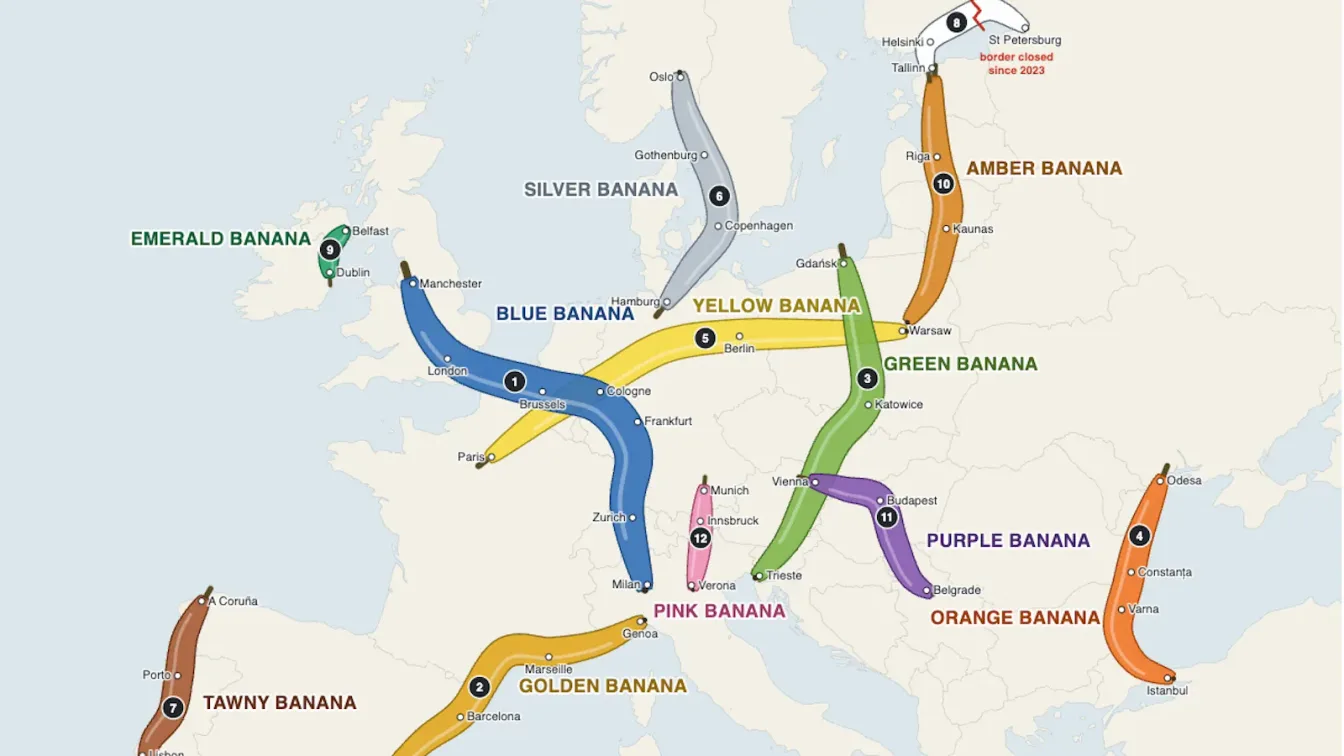
Underneath the political map of Europe’s nation-states simmers another reality: a tangle of economic and logistical corridors that transcend national borders. The best known of these is the Blue Banana.
Many others aren’t as visible, and that is due to poor marketing: They lack an equally imaginative handle. Hence this modest proposal: If the European Union is serious about integration, it should get silly about names. All 12 of its major transnational economic corridors should be named after the bendy fruit. In other words, Europe should go full bananas.
“Looks like a banana,” said the minister
The Blue Banana — the first of the bunch, so to speak — is of surprisingly recent vintage. First proposed in 1989 by French geographer Roger Brunet as an economic zone with common characteristics, this urban-industrial belt runs from Manchester in northern England to Milan in northern Italy. A French minister remarked that Brunet’s area looked a bit like a banana, an illustrator for Le Nouvel Observateur colored it blue, and hey presto, the Blue Banana was born.
That nickname did what mere economic stats can’t: It captured the imagination, thus highlighting a process that earlier maps had missed. In an increasingly borderless Europe, the logics of proximity and compatibility are creating zones of economic contiguity across multiple countries.
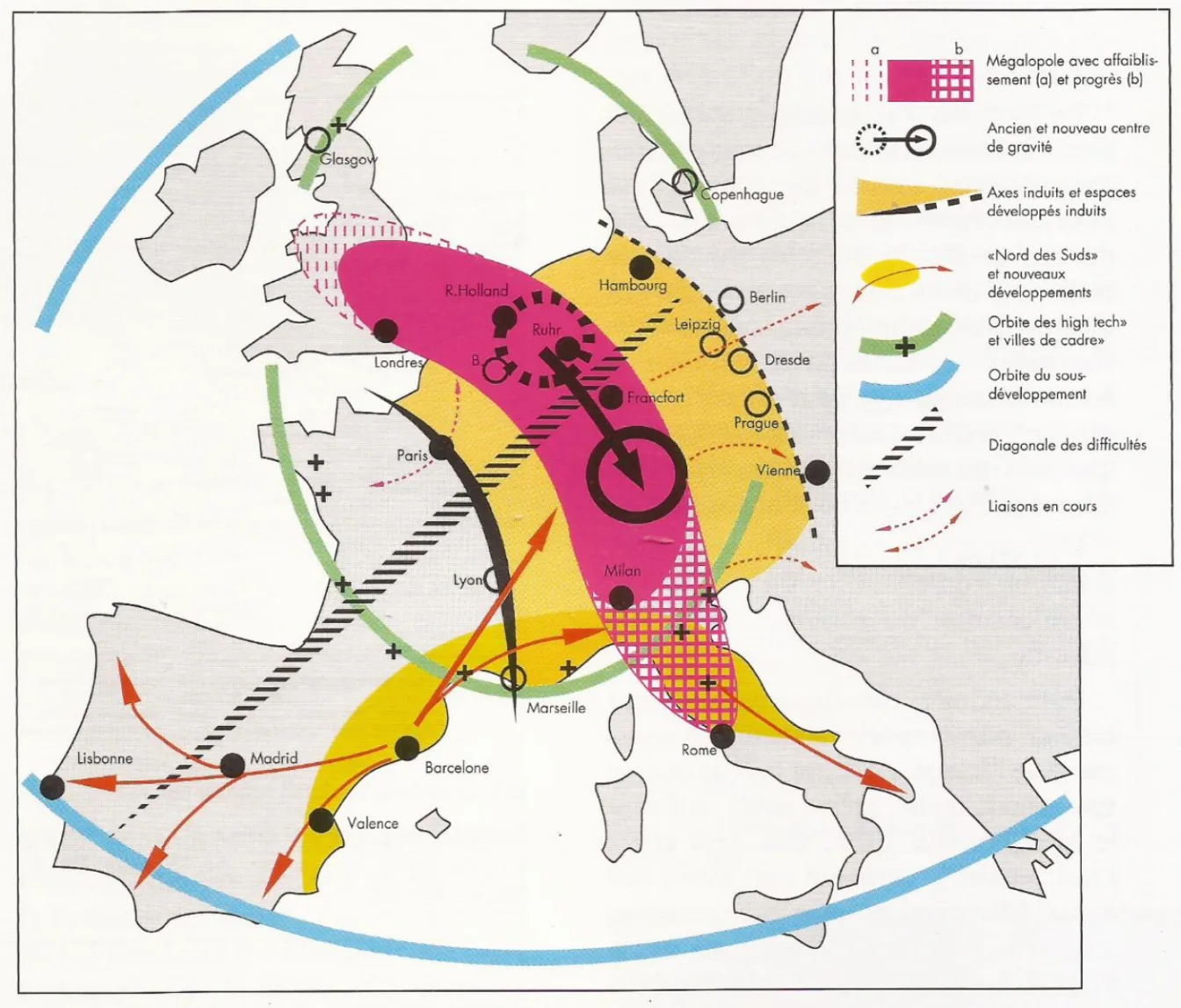
It may lack a flag, an anthem, and a parliament, but the Blue Banana has a cartographic shape, an economic weight, and — thanks to a bendy fruit and a French magazine illustrator — a catchy name.
Catchy names matter. They grab and focus attention — and attract investment. That is why some of Europe’s other international zones of economic similarity thought it useful to adopt the banana idea (see the Green, Yellow, Orange, and Golden Bananas). But many others haven’t, and Europe should do better than that half-hearted, haphazard approach.
It’s sad to see economic corridors of consequence laboring under inauspicious names like STRING, which is something you lose in a drawer, or outright ominous ones like the Atlantic Axis, which sounds like a pact with a dictator that you probably shouldn’t have signed.
An extra outlet for feelings of belonging
Giving this whole group of regions a coordinated set of catchy names would not only increase their visibility but also help their inhabitants identify with them. Knowing which banana you are part of gives you an extra outlet for your feelings of belonging, one that transcends national borders. “Going bananas” may also help the EU refocus on achieving economic excellence rather than merely being a regulatory superpower, as it is today.
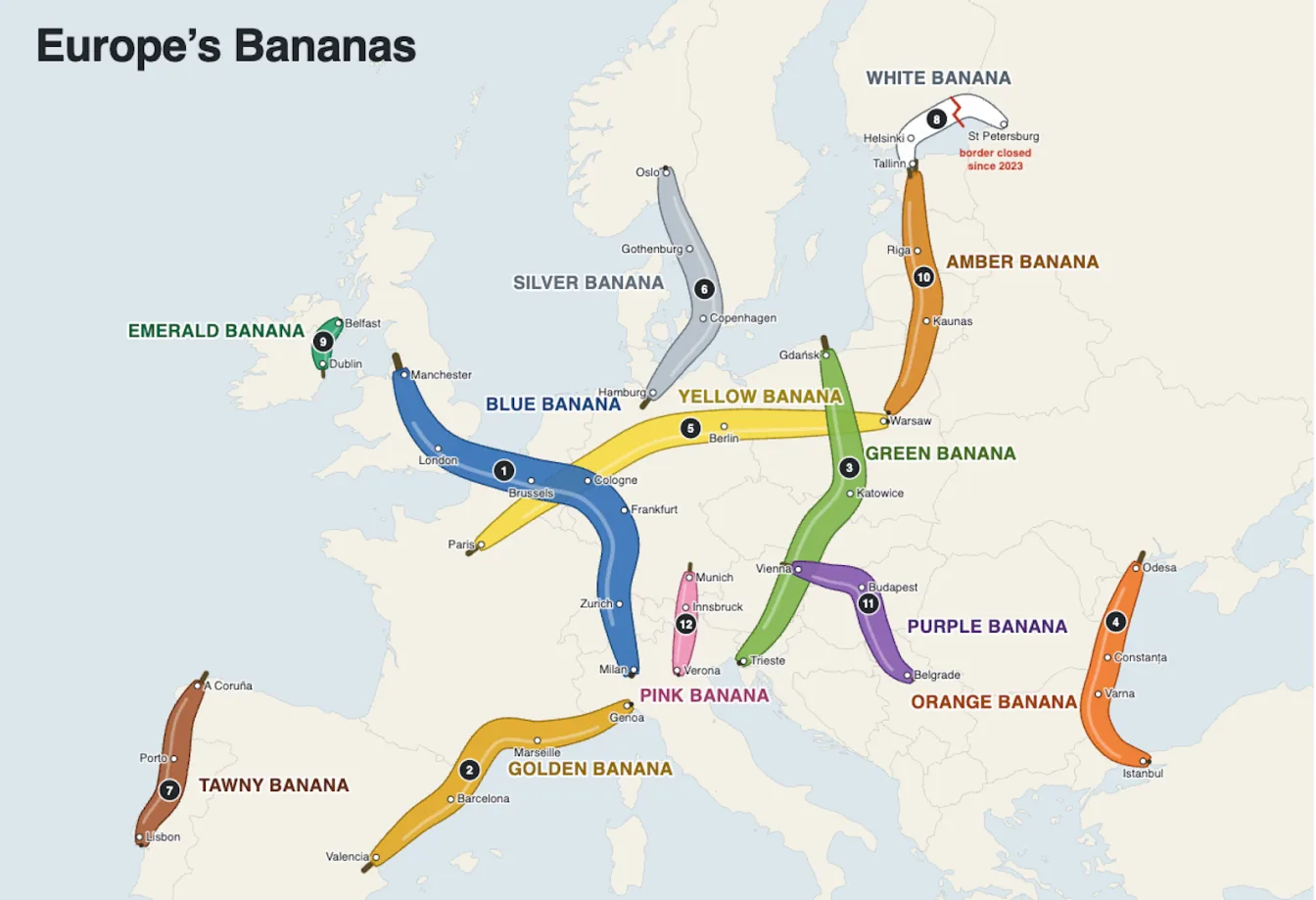
Hence this map, showing all 12 major transnational economic corridors in Europe as their own bananas. There is strength in a union: You may crush a single banana, but you can’t bend a whole bunch!
- The Blue Banana is the big boy. Home to 110 million people, it is Western Europe’s industrial heartland, by some accounts generating up to 40% of the eurozone’s GDP.
- The Golden Banana (a.k.a. the Mediterranean Sunbelt or the “North of the South”) is the Blue Banana’s southern cousin. Curving from northwestern Italy through France’s Mediterranean coast into northeastern Spain, it combines high urban density with major ports and high levels of tourism.
- Following the coastline from Odesa, Ukraine, through Romania and Bulgaria to Istanbul, Turkey, the Orange Banana is the Black Sea’s answer to the Golden Banana. Its potential is considerable, lying as it does at the crossroads of the Black Sea, the Danube, and the Bosphorus.
- The Green Banana describes an urban-economic arc running from Gdańsk on the Baltic to Trieste on the Adriatic, bridging Poland, Czechia, Slovakia, Austria, Hungary, Slovenia, and Croatia. The potential for economic growth and integration in this area came into focus only after the collapse of communism in 1989.
- The last of the existing bananas is the Yellow Banana, running from Paris across Germany to Warsaw. Its east-west orientation is a deliberate counterweight to the Blue Banana, which runs north to south. Franco-German collaboration goes back to the founding of the European project in the 1950s. Adding Poland lends weight to that partnership and acknowledges the eastward expansion of the EU.
The color of Hanseatic herring
The other seven regions have rather unimaginative names — the comparison to a piece of tropical fruit would be an upgrade.
- Take STRING, which is bizarrely short for South Western Baltic Sea Trans-Regional Area — Implementing New Geography. It stretches from Hamburg via Copenhagen, Malmö, and Gothenburg to Oslo. Those cool cities would probably prefer a cool moniker like the Silver Banana, chosen for the color of the herring on which the Hanseatic League grew fat.
- As we mentioned, “axis” gives bad historical vibes. So, how about a Tawny Banana going from Spain’s A Coruña to Portugal’s Lisbon via Porto? The clue to the name is in the latter city and the tawny (i.e., yellowish-brown) port wine it produces, among several other varieties.
- Across the Gulf of Finland you could have the White Banana. The name recalls the white summer nights of the High North. However, the banana that unites the three major cities on the Gulf of Finland is incomplete: Helsinki and Tallinn may still be linked by intense flows of trade, traffic, tourism, and investment, but relations with Russia’s St. Petersburg are currently strained, to say the least.
- What other name could the economic corridor between Dublin in the Republic of Ireland and Belfast in Northern Ireland have but the Emerald Banana? (Fortunately, Orange was already taken.)
- The Amber Banana follows the Rail Baltica corridor, from Tallinn via Riga and Kaunas to Warsaw. Its name refers to the organic gemstones — technically fossilized tree resin — that are harvested from the Baltic, and its course unites the three Baltic states, as well as linking them to the rest of the EU.
- The river Danube was once on the Roman frontier; it later became the high street of the Habsburgs. In the imperial color that recalls these two realms, the Purple Banana links Vienna to Bratislava, Budapest, and Belgrade.
- The Brenner Axis — stretching from Munich, Germany, via Innsbruck, Austria, to Bolzano and Verona in Italy — could be the Pink Banana. One tiny objection: This connection is regrettably straight. Perhaps the Brussels bureaucrats could make an exception to their famous rule about the bendiness of bananas so that this one could join the club.

Squint, and you see Lotharingia
Interestingly, many of these “new” corridors reconstitute economic zones and trade routes that are much older than the nation-states that sit on top of them. Squint, and the Blue Banana transforms into Lotharingia, the middle kingdom Lothair I received when Charlemagne’s empire was divided among his three grandsons at Verdun in 843.
The Golden Banana follows the Via Domitia, the first Roman road to tie Italy to Spain. The Green Banana retraces the Amber Road, along which Baltic amber traveled before ending up in Tutankhamun’s tomb. The Tawny Banana reunites the Roman province of Gallaecia, while the Silver Banana is the Hanseatic League but smaller (and with fewer herring).
Then came the nation-state, hardening the continent’s divisions along mainly ethnic lines. All along Europe’s internal borders, people turned their backs on their neighbors to face their capital cities.
Thanks to the single market (no more customs) and Schengen (no more passport queues), Europe’s old and new transnational regions have a chance to flourish. As a “Union of Bananas,” the EU could invent for itself a grander future than it faces as merely a collection of nation-states — one that both recognizes its member countries and values the other layers on the map of Europe.
Strange Maps #1306
Got a strange map? Let me know at strangemaps@gmail.com.
Follow Strange Maps on X and Facebook.
This article A modest proposal: Europe should go full bananas is featured on Big Think.