Naturalness: a useful principle, but not an absolute rule
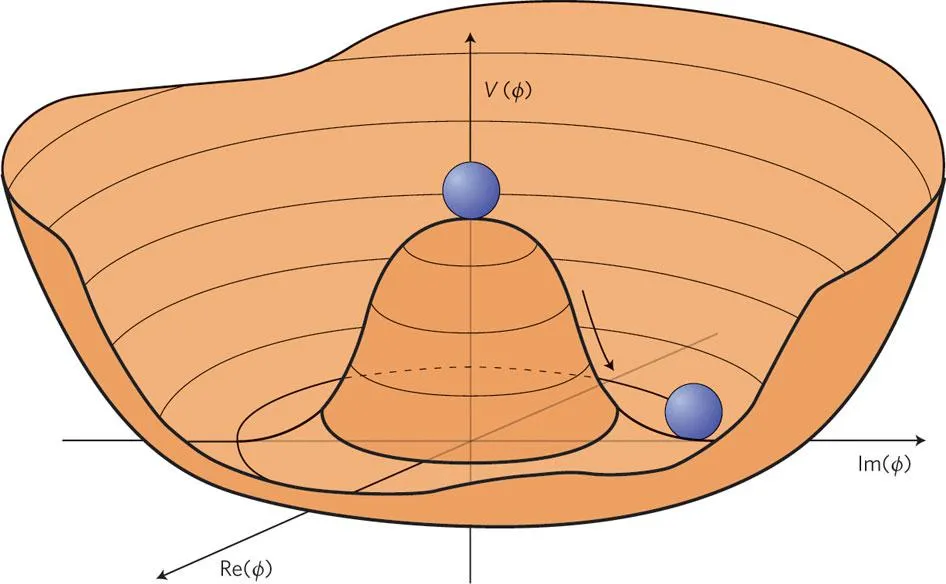
There are two classes of problems that physicists often talk about that might leave you thinking, “geez, a physicist can never be satisfied, can they?”
The first is called a coincidence problem: where things that have no apparent reason for being close together actually are close together. Examples include:
- the normal matter and dark matter densities,
- the cosmic matter density and the dark energy density,
- the total energy of the Hoyle state of carbon-12 being almost exactly equal to the rest mass energy of three helium-4 nuclei,
- or Dirac’s large number coincidence, where the strength of gravity is approximately equal to the inverse of the age of the Universe since the Big Bang.
The second is the opposite type of problem, known as a hierarchy problem: where it seems like there is a large, unnatural, inexplicable gap between things that — if everything were equal — you might expect to be close together. Examples of that include:
- the huge differences between the electroweak scale and the Planck scale,
- the huge difference in the strength between gravity and electromagnetism,
- the big difference between the mass of most of the massive particles in the Standard Model and the tiny masses of neutrinos,
- or the cosmological constant problem, arguably the largest-magnitude mismatch of them all.
You might think that having both “coincidence” and “hierarchy” problems just means that physicists are always looking for trouble, and can never be satisfied. But both sets of problems are just the extreme poles of fine-tuning, and naturalness is one often (but not always) useful way to approach it. Here’s what the big idea is all about.
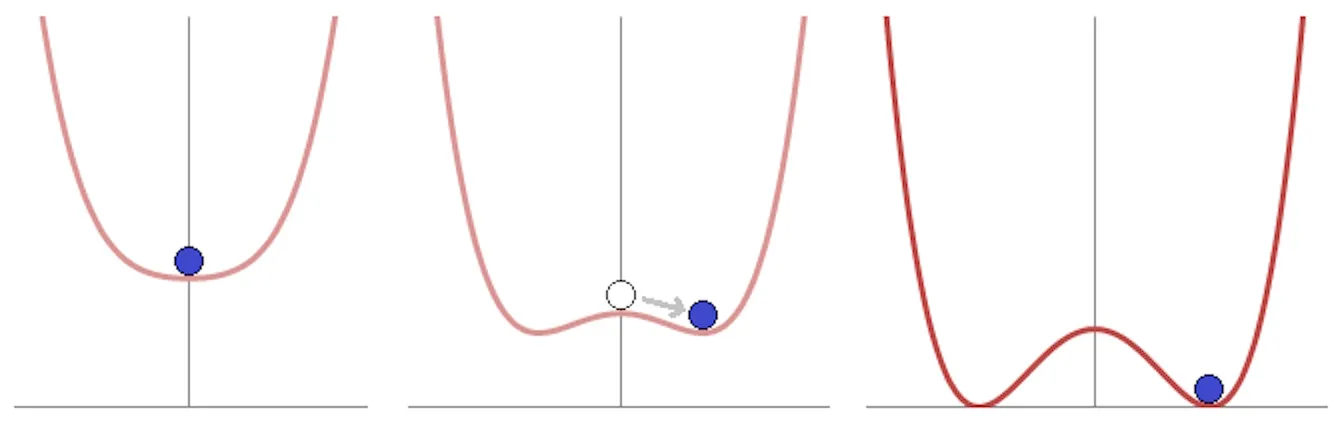 Explanatory diagram showing how symmetry breaking works. At a high enough energy level, a ball settled in the center (lowest point), and the result has symmetry. At lower energy levels, the center becomes unstable, the ball rolls to a lower point – but in doing so, it settles on an (arbitrary) position and the result is that symmetry is broken – the resulting position is not symmetrical. An outcome that may seem unlikely can be made sense of if the history of the system, and a mechanism that naturally leads to that seemingly unlikely outcome, can be correctly identified.
Credit: FT2/Wikimedia Commons
The study of the Universe itself — both in terms of the fundamental laws that govern it as well as the ingredients that make it up — is, by definition, the study of nature. Assuming that we, as humans, can intuit what is itself “natural” is kind of a bit of hubris on our part: nature simply is what it is, and we, ourselves a product of nature, can only hope to figure out what it is and how it got to be this way. And yet, it’s been an incredibly successful approach at times. A “natural” idea simply posits the following:
- When we find two quantities that are close together, but don’t appear to be related, we ask what sort of relationship could exist that would lead to those quantities matching (or nearly matching) one another.
- And when we find two quantities that we might expect to be close together, but that instead turn out to be very far apart, we ask what sort of mechanism could exist for leading to those quantities having such a severe mismatch in reality.
In other words, the idea of naturalness is simply to state that instead of the Universe just being the way it is, full of coincidences, huge disparities, and all sorts of “fine-tunings” that had to occur for it to turn out the way it did, there ought to be mechanisms in place that led to it being the way we observe it to be.
 Balanced Rock, shown here in photos from before 1975 (black and white) and after 1976 (color), showcases how weathering and erosion can lead to the collapse of structures over time. At right, the structure once known as “Chip off the Old Block” fell during the winter of 1975-1976, and someday, Balanced Rock will fall as well. However, it was created by natural processes, even if it doesn’t appear so; understanding how is the key to solving what appears, on the surface, to be a fine-tuning problem.
Throughout the history of theoretical physics, and in particular during the development of the Standard Models of particle physics and cosmology throughout the 20th century, this approach turned out to often be incredibly useful. In the early days of quantum physics, people started asking questions about the electric field that surrounded the electron and how you could reconcile that with a point-like particle, which experiments supported. If you calculated the total electrostatic energy stored in an electric field created by a charged “point,” you’d get a catastrophic answer: an infinite amount of energy.
But this isn’t possible; we know that the electron has a finite, observed rest mass, and that therefore the total energy of the electron can be no greater than the value given by E = mc², where m is the mass of the electron. This puzzle, of the electron’s self-energy, led to the development of a whole new field to get a finite answer rather than the unnatural, infinite one that was classically predicted: quantum field theory. Along with that development came a novel prediction, the existence of an antimatter particle that was oppositely charged to the electron, the positron, and eventually the development of quantum electrodynamics.
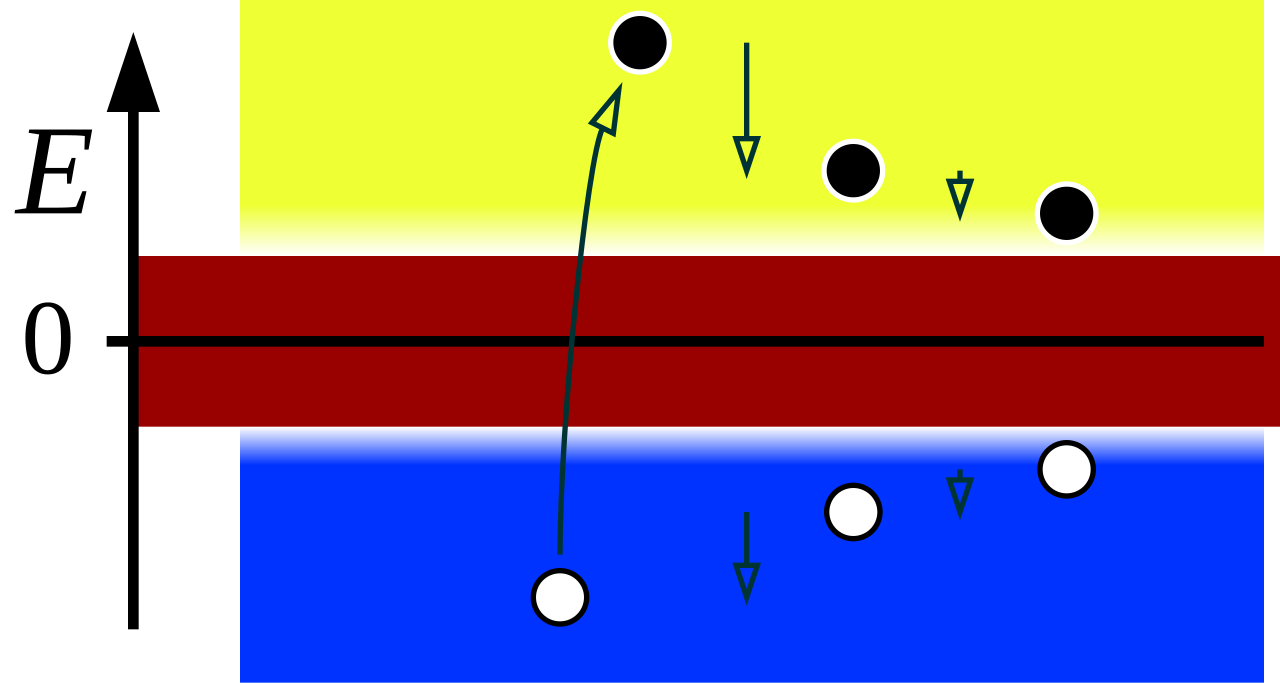 The so-called ‘Dirac sea’ arose from solving the Dirac equation, based on a complex vector space, which yielded both positive and negative energy solutions. The negative solutions were soon identified with antimatter, and the positron (antielectron) in particular opened up an entire new world for particle physics.
In nuclear physics, there was a puzzle that arose when it came to the generation of the elements in the Universe: the puzzle of carbon. We were able, even in the 1950s, to easily measure the rest mass energy of the different elements and their isotopes, including:
- hydrogen (with a single proton as its nucleus),
- helium (with helium-4, with two protons and two neutrons as its nucleus being the most abundant),
- and carbon (with carbon-12, with six protons and six neutrons, being the most common version).
But if stars were the dominant source of carbon in the Universe, then there was a problem that arose: the mass of carbon-12 was too mismatched, given the properties of the interiors of stars, from the mass of the three helium-4 nuclei, combined, that must go into creating it.
So how was carbon made?
It was by thinking along this line that Fred Hoyle hypothesized a natural solution to this problem, and a mechanism by which carbon-12 could be created in the necessary abundance: he theorized the existence of a new, excited state for carbon-12 nuclei whose energy was exactly (or almost exactly) equal to the rest mass energy of three helium-4 nuclei combined. This state, the Hoyle state, was later observed by nuclear physicist Willie Fowler, marking a remarkable success for the naturalness approach. If the value of that excited state of carbon-12, which turned out to be a 7.654 MeV resonance, were different in energy by even 5%, our Universe wouldn’t have made the carbon that enabled our existence.
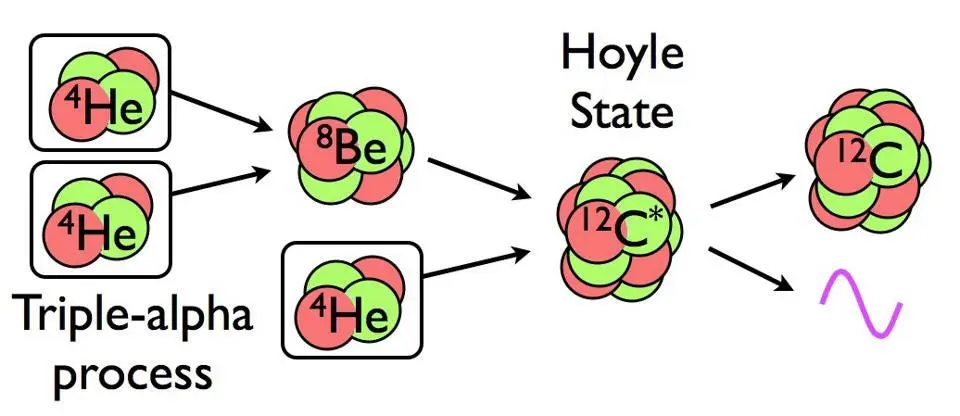 The prediction of the Hoyle State, an excited state of a carbon-12 nucleus, and the discovery of the triple-alpha process is perhaps the most stunningly successful use of anthropic reasoning in scientific history. If the mass of the excited state of carbon-12 were even 5% more or less energetic than its value above the ground state, we would make too little carbon to explain the abundance observed in our Universe. This process is what explains the creation of the majority of carbon that’s found in our modern-day Universe: created in the hearts of evolved stars that fuse helium into carbon. The work of Hoyle, Fowler, and the Burbidges demonstrated that carbon was created via the process of stellar nucleosynthesis, rather than during the hot Big Bang.
Naturalness arguments appeared time and time again in attempts to make sense of puzzles in the Universe: to explain phenomena that had been observed, but that lacked an apparent explanation. They were sometimes spectacularly successful in making novel predictions that were indeed borne out by reality, including:
- When it came to the mass differences between certain neutral kaon particles (involving strange quarks and kaon mixing), certain quantum calculations would have had to cancel almost exactly, and with no explanation or mechanism. Instead, the existence of a new, still-heavier quark could have explained it, and so the existence and rest mass of the charm quark were predicted based on this: back in 1970, by Shelly Glashow, John Iliopoulos, and Luciano Maiani, through what became known as the GIM mechanism. Four years later, in 1974, experiments discovered the charm quark exactly where it had been predicted.
- Although the Standard Model is excellent for generating the spectrum of particles — quarks, leptons, and gauge bosons — that we observe, there’s a problem: those particles, initially, come in with zero rest mass. However, we’ve measured their masses, experimentally, and except for the photon and the gluons, they all have a non-zero, positive rest mass. So where does mass come from in the Standard Model? By postulating a natural mechanism for generating it, the Higgs mechanism, masses could be generated for the fundamental particles via a new field, a broken symmetry, and a new, massive boson: the Higgs boson. That boson, discovered at CERN’s Large Hadron Collider in 2012, completed the Standard Model.
- And in cosmology, there were many unexplained puzzles about the Big Bang. There was the horizon problem, or the puzzle of how the Universe came to have a uniform temperature in such disparate regions of space if there was no time for signals to be exchanged across them. There was the flatness problem, or the puzzle of how the Universe came to have its energy density and its initial expansion rate so perfectly balanced as to leave no spatial curvature behind, even today. And there was the monopole problem, or the puzzle of if the Universe reached arbitrarily high temperatures and densities in the past, there were no high-energy relics left over in our Universe today. Cosmic inflation, the solution motivated by these “naturalness” arguments, provided the solution, and many lines of observational evidence have since validated it.
Clearly, under the best of circumstances, naturalness can be an extremely powerful approach to finding an underlying mechanism behind what seem to be mysterious coincidences in the Universe.
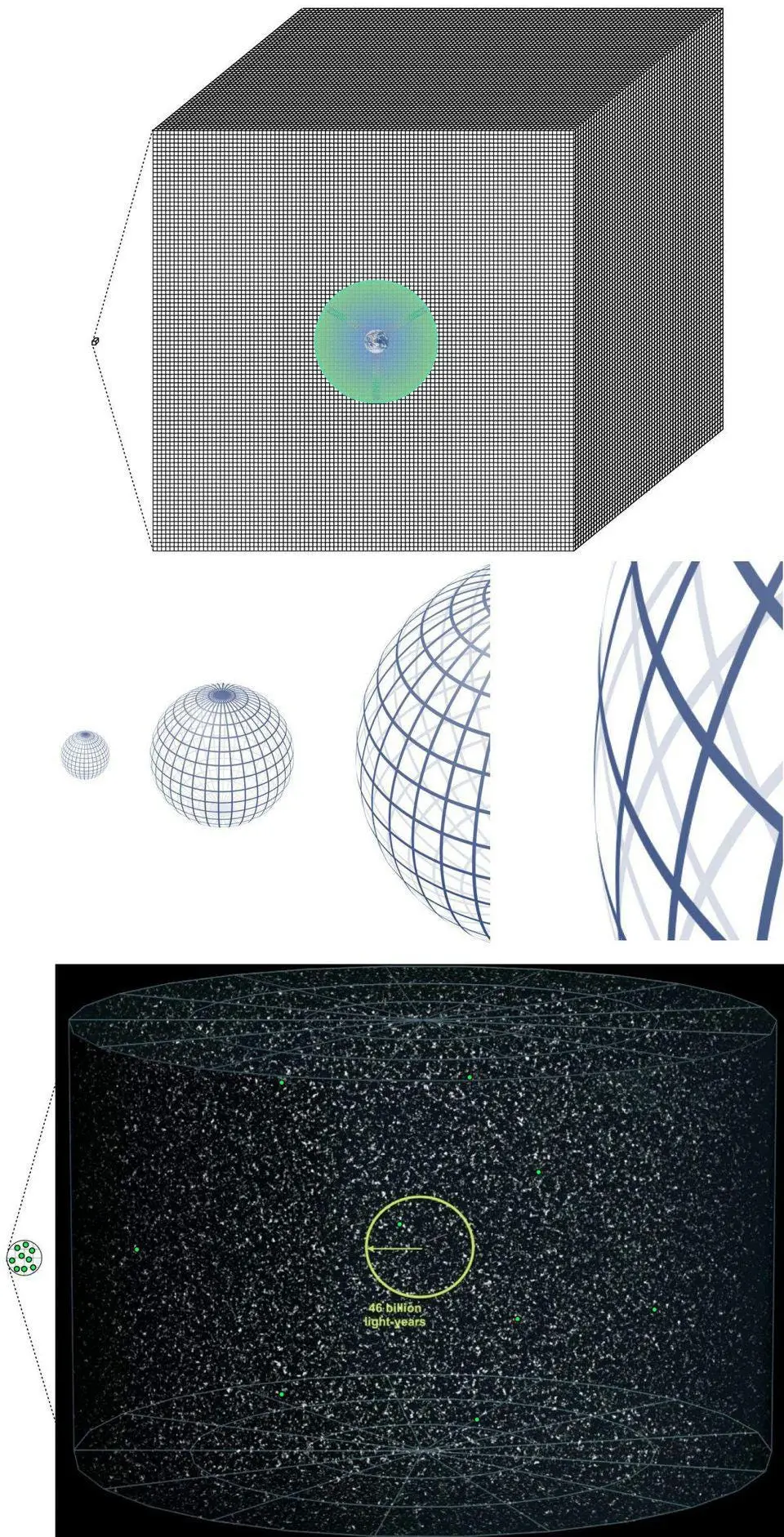 In the top panel, our modern Universe has the same properties (including temperature) everywhere because they originated from a region possessing the same properties. In the middle panel, the space that could have had any arbitrary curvature is inflated to the point where we cannot observe any curvature today, solving the flatness problem. And in the bottom panel, pre-existing high-energy relics are inflated away, providing a solution to the high-energy relic problem. This is how inflation solves the three great puzzles that the Big Bang cannot account for on its own.
But naturalness is only a guiding principle; it is not a rule or law that the Universe must obey. Sometimes, coincidences will simply turn out to be coincidences, without an underlying explanation. Other times, things that we expect should be close in scale but aren’t are simply going to be how the Universe is: in defiance of our expectations and without an underlying mechanism to put things in place in that fashion. Naturalness is one possible approach to a series of mysterious puzzles, but approaching a problem with naturalness arguments is no guarantee of success.
You might consider, for example, the seemingly unnatural mismatch between the “natural” mass scale that you get by combining the fundamental constants of G (the gravitational constant), c (the speed of light), and h (Planck’s constant), which is the Planck mass, with the actual masses of the fundamental particles, which are 17 or more orders of magnitude smaller! You can try to explain this by invoking a new type of symmetry in the Universe — a symmetry between bosons and fermions known as SUSY (supersymmetry) — and as part of the theory, you even get a dark matter candidate and a path towards the unification of the strong force with the electroweak force. As attractive as that idea is, however, the data just doesn’t bear out supersymmetry’s relevance for our Universe.
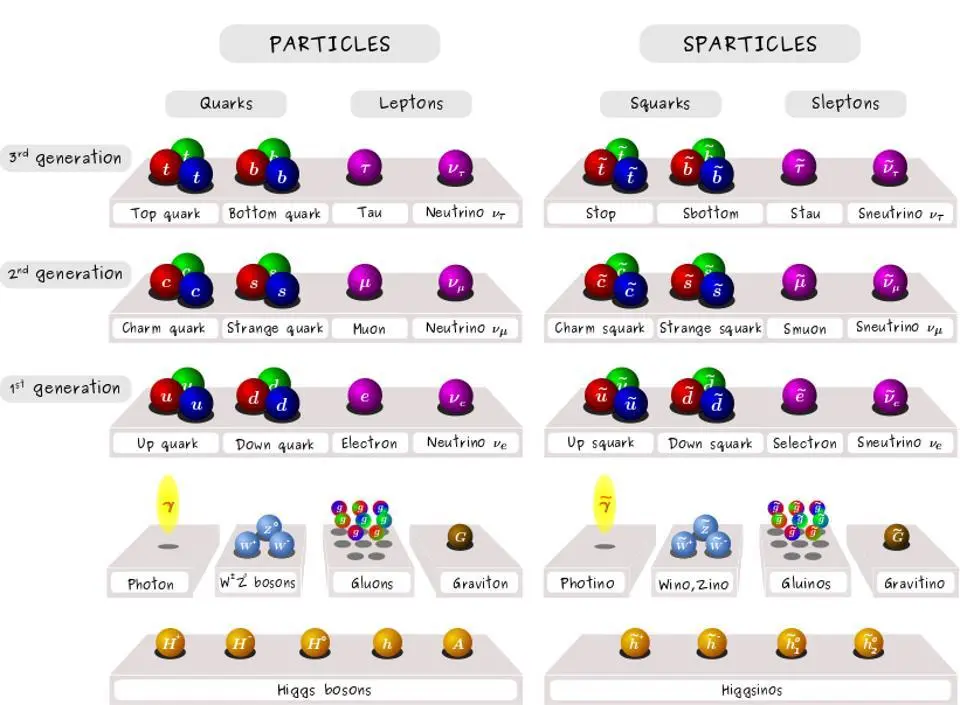 The Standard Model particles and their supersymmetric counterparts. Slightly under 50% of these particles have been discovered, and just over 50% have never shown a trace that they exist. Supersymmetry is an idea that hopes to improve on the Standard Model, but it has yet to achieve the all-important step for supplanting the prevailing scientific theory: having its new predictions borne out by experiment.
You might look at neutrinos, and think it’s odd that their masses are so tiny compared to the masses of all the other Standard Model particles. For instance, the heaviest Standard Model particle is the top quark, at 173 GeV/c², while the lightest (non-neutrino) particle is the electron, with a rest mass of just 511 keV/c²: a difference of a factor of almost 340,000. But the masses of the neutrino species, which oscillate from one type to another, can be no greater than a fraction of a single electron-volt, where each neutrino mass is somewhere between about a hundredth and a tenth of an eV: a difference of several million from the electron’s mass.
There’s a tempting, natural explanation to add in for that: the see-saw mechanism. The idea is that there’s some very high mass scale, like around the grand unification (GUT) scale (around 10¹⁵ GeV), where neutrinos aren’t just left-chiral like we see in our Universe, but where there’s a right-chiral version of them as well. Then, since neutrinos mix, you can posit that they have a “natural” mass that’s similar to the masses of the other heavy particles, perhaps at the ~100 GeV scale or so, but the see-saw suppresses the mass of the ones in our Universe by a factor of that normal mass scale squared divided by the GUT scale, leading to sub-eV neutrinos.
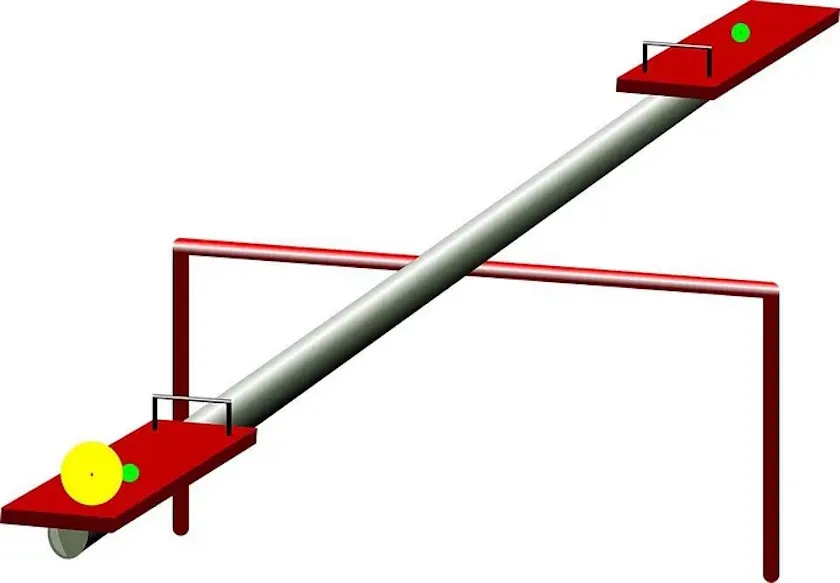 This graphic indicates the see-saw mechanism, which could explain the very light (but non-zero) nature of neutrino masses. If you begin with equal left-and-right handed masses (green dots) but a large, heavy mass falls on one side of the see-saw, it creates a super-heavy particle that can serve as a dark matter candidate (acting as a right handed neutrino) and a very light normal neutrino (acting as a left handed neutrino). This mechanism would cause left-handed neutrinos to behave as Majorana particles.
This is an attractive option, theoretically, for many reasons. It can explain the tininess of neutrino masses, for one. It leads to neutrinos being Majorana particles (rather than Dirac particles), which have a special set of properties that allow them to act as their own antiparticles in certain instances. It enables the creation of an initial lepton asymmetry, which could get converted to a baryon asymmetry and explain the origin of why there’s more matter than antimatter in the Universe. It gives you a dark matter candidate in the form of the ultra-heavy right-handed neutrino — a WIMPzilla dark matter candidate — that’s theoretically very attractive in many ways.
And, perhaps most excitingly, it opens the door for a fascinating experimental signature: the possibility of observing a new type of nuclear decay: neutrinoless double beta decay, where two neutrons decay into two photons and two electrons, but not with two antineutrinos, because Majorana neutrinos could act as their own antiparticle, or as neutrino and antineutrino both.
Of course, efforts have been made to search for this exact decay, and while double beta decay with two neutrinos has indeed been seen, we have no evidence for the neutrinoless version, and hence, for this scenario for particle physics.
You might also look at the “natural” scale for the cosmological constant, which again involves putting the Planck mass as the natural mass scale (to the fourth power) for what the cosmological constant’s value ought to be. The answer is wrong, and by an incredible amount: 120 orders of magnitude, making it the worst prediction in the history of science. But if you can replace the Planck mass with the observed mass of neutrinos, this tension goes away completely, and suddenly everything lines up. Does that suggest a natural connection between the cosmological constant and the neutrino sector?
It was a naturalness argument that led to the idea that the ratio of the strength of the gravitational and electromagnetic forces evolves over time — cosmic timescales — to reach their current, and enormously mismatched values. That is contradicted by observations of the early Universe.
It was a naturalness argument that led to the idea of grand unified theories, providing a solution for the generation of a matter-antimatter asymmetry in the early Universe. But it brought a new prediction along with it, of proton decay, that experiments simply didn’t bear out. It’s true that proton decay experiments gave birth to neutrino astronomy, but that’s still a loss for naturalness in our Universe.
Credit: INFN/Borexino Collaboration
Even today, naturalness arguments are often invoked when considering the merits of a scenario. It makes sense to do so: in the absence of any evidence, naturalness considerations allow us to think about whether a mechanism is viable or not, or whether it demands an enormous amount of fine-tuning. In general, if you have two large numbers, call them A and B, then the difference between them, A – B, is also going to be a large number. If it’s not, either it’s a remarkable coincidence, or there’s some underlying connection between A and B that explains why their difference is small.
However, there are times when coincidences really do just happen, naturally, without an underlying connection or explanation. The more things you track or look at, the more likely you are to notice correlations that are, in fact, spurious and coincidental in nature. There’s a whole website devoted to recording thousands of such spurious correlations, including:
- between annual US spending on alcohol and the number of sewage servicers in New Hampshire,
- between the popularity of the distracted boyfriend meme and the number of office clerks in Kentucky,
- and between the per capita consumption of margarine and the divorce rate in the state of Maine.
Naturalness can be a guide, but it not always a reliable guide as to what the best way forward is when we encounter a puzzle or mystery in physics. Like Occam’s razor, it is highly suggestive, but it’s not a law or a rule. It can lead you to a breakthrough, or it can lead you astray. It can also lead you to rejecting ideas that are ultimately correct, just because they appeared unattractive on the grounds of naturalness.
However, when we have nowhere else to turn, naturalness can often be a guiding light as far as what to do next. Just as Carl Sagan lauded the invocation of human imagination, naturalness, too, can often carry us to worlds that never were. But without it, we would never have gone to many of the great and profound places that it’s already taken us.
This article Naturalness: a useful principle, but not an absolute rule is featured on Big Think.