The Optical Superhighway For AI
There is much disagreement on the timing of the transition from copper interconnects to optical interconnects, but almost everyone agrees we are moving to all-optical interconnects over the next five years.
Optical interconnects already dominate scale-out. Optical interconnects will next move into scale-up by connecting racks in very large pods of hundreds to thousands of XPUs (AI compute units), then optical scale-up will replace copper within the rack.
Today, optical is dominated by pluggable transceivers mostly using single wavelengths (DR) with 2 or 4 fibers. Increasing performance using pluggables would require power-hungry, higher-speed PHYs (physical layer interfaces) and/or more fibers, which will drive up costs because connectors cost more than fibers.
To reduce power and cost while increasing bandwidth, the industry consensus is shifting toward multi-wavelengths per fiber with bidirectionality, using NPO (near-packaged optics), then CPO (co-packaged optics). Alternatives may develop, but the emerging consensus for the future of optical interconnect appears to be OCI-MSA.
The optical superhighway for AI: OCI-MSA
OCI-MSA (Optical Compute Interconnect Multi-Source Agreement) is an industry consortium recently formed for an open, interoperable optical interconnect spec for AI scale-up. Founding members include AMD, Broadcom, Meta, Microsoft, Nvidia, and OpenAI. In that mix are both GPU giants, the largest maker of custom AI compute, two of the hyperscalers, and one of the two Frontier Model companies. This is a big bandwagon. Of these, AMD, Broadcom, Meta, and Microsoft have made presentations on their plans for OCI-MSA at recent industry conferences.
The stated objectives for the OCI-MSA are:
- To create an open, interoperable specification for AI scale-up that breaks the constraints of proprietary interconnects to ensure seamless cross-vendor compatibility for hyperscale AI clusters.
- To provide architectural guidance to transition the industry to low-power optical SerDes, delivering the latency, bandwidth, and energy efficiency required for next-generation AI.
- To secure a scalable, multi-vendor AI supply chain, uniting hyperscale end-users and silicon innovators to reduce integration risk, accelerate development, and ensure long-term scale deployments without vendor lock-in.
Drew Alduino (Meta’s director of optical infrastructure), Near Margalit (VP & GM of Broadcom’s Optical Systems Division) & Matthew Streshinsky (AMD senior director for photonics) were on a panel in September at the AI Infra Summit. “We want AMD GPUs talking to Broadcom switches,” Alduino said. “We want all of our compute and switches to be interoperable.”
Alduino went on to say:
- Meta wants to standardize as little as possible to achieve interoperability while making it possible for everyone to rapidly innovate.
- Multi-wavelength means we don’t ever need faster SerDes for faster optical.
- Meta wants OCI to look like Ethernet today.
- Gen 1 OCI has 4 wavelengths of 50Gbps in each direction. Gen 2 is in definition and will double the bandwidth, while Gen 3 will double the bandwidth again.
- 200G × 16 wavelengths has already been shown to be “viable,” which is 16 × the bandwidth of Gen 1.
As Near Margalit noted, what matters for interoperability is what appears on the fiber.
OCI-MSA Gen 1
The spec for Gen 1 of OCI-MSA can be found at oci-msa.org.
OCI is workable for pluggables, NPO, CPO in the package, or CPO on the interposer.
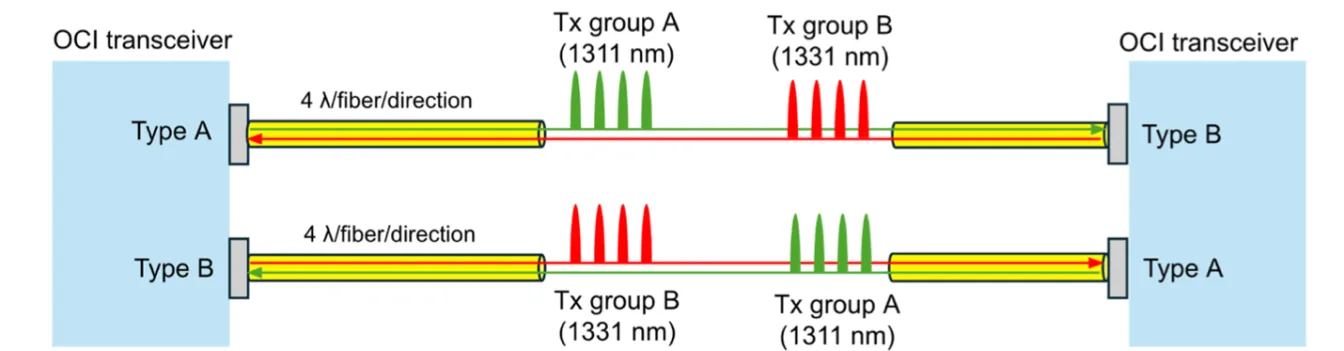
Fig. 1: OCI-MSA Gen 1 has 8 channels per fiber, 4 in each direction. Source: oci-msa.org
The OCI-MSA spec is 24 pages. The Optical specification provides for 8 wavelengths per fiber, with 4 in each direction. Each wavelength is 53.125Gbps NRZ. The wavelengths in the groups are spaced slightly more than 2nm apart. The reference optical fiber link model is based on 500m SMF-28 fiber with 2.5 dB total insertion loss, mainly driven by the connector losses in the link between transceivers. (The effective data rate is 50Gbps per wavelength after error correction and miscellaneous signaling.)
At OCP (Open Compute Project) in October, Rajiv Pancholy, director of hyperscale strategy & products for Broadcom, talked about how OCI-MSA compares at equal bandwidths to alternatives. (See figure 2, below)
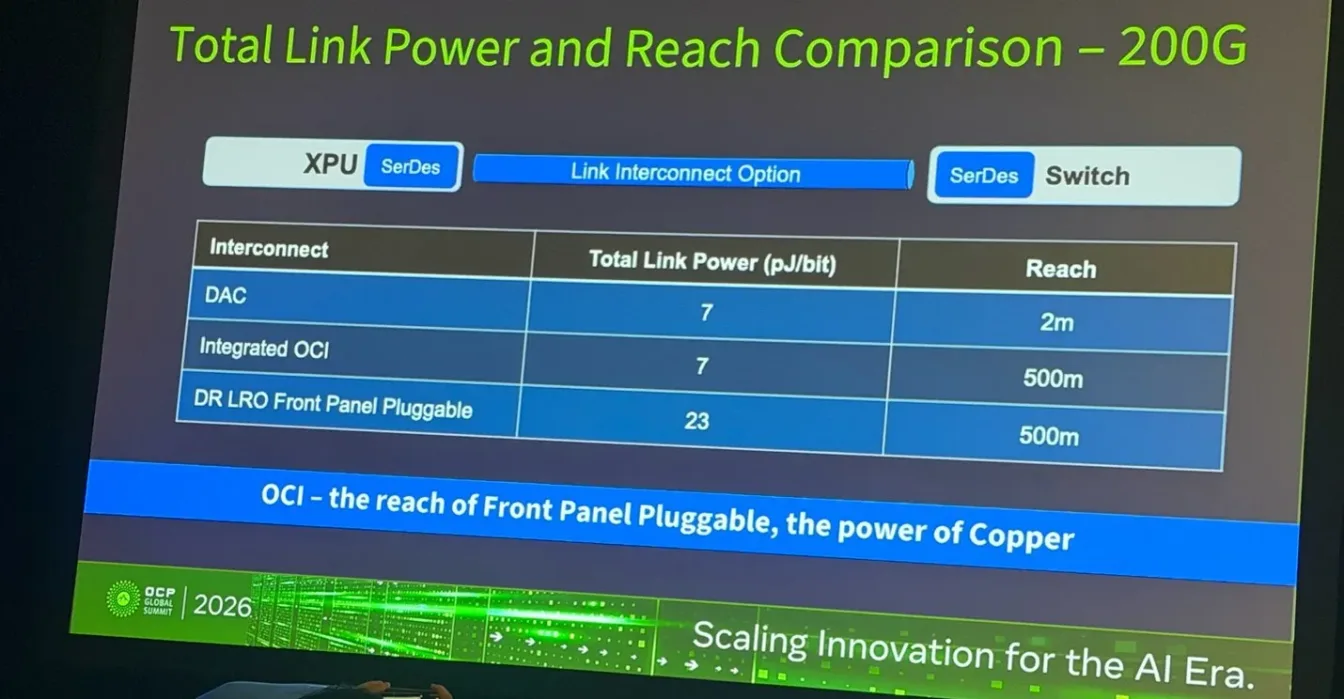
Fig. 2: Comparison of OCI power/reach versus alternatives. Source: Broadcom @ OCP
As the table above shows, for a 200G aggregate bandwidth (one direction), OCI in CPO format is the best combination of low link power per bit and long reach. OCI has the reach of pluggables at 1/3 the power of a pluggable transceiver. And OCI has a scalable bandwidth roadmap.
OCI-MSA Gen 2 and beyond
At PECC (Photonic Enabled Cloud Computing) 2026 in October, AMD explained that there are numerous ways to increase OCI bandwidth for future generations:
- 4 wavelengths → 8, 16, 32… (there is an upper limit given the width of the O band)
- 50 Gbps → 100, 200, 400, …
- 1 polarization → 2 polarizations
- NRZ → PAM/QAM-n (advanced signaling likely required for the highest Gbps)
The combination of all of these gives a scaling up of over 100×. If OCI doubles every 1 to 2 years, this gives decades of scalable runway. This is just the bandwidth per fiber. The number of fibers can increase, as well.
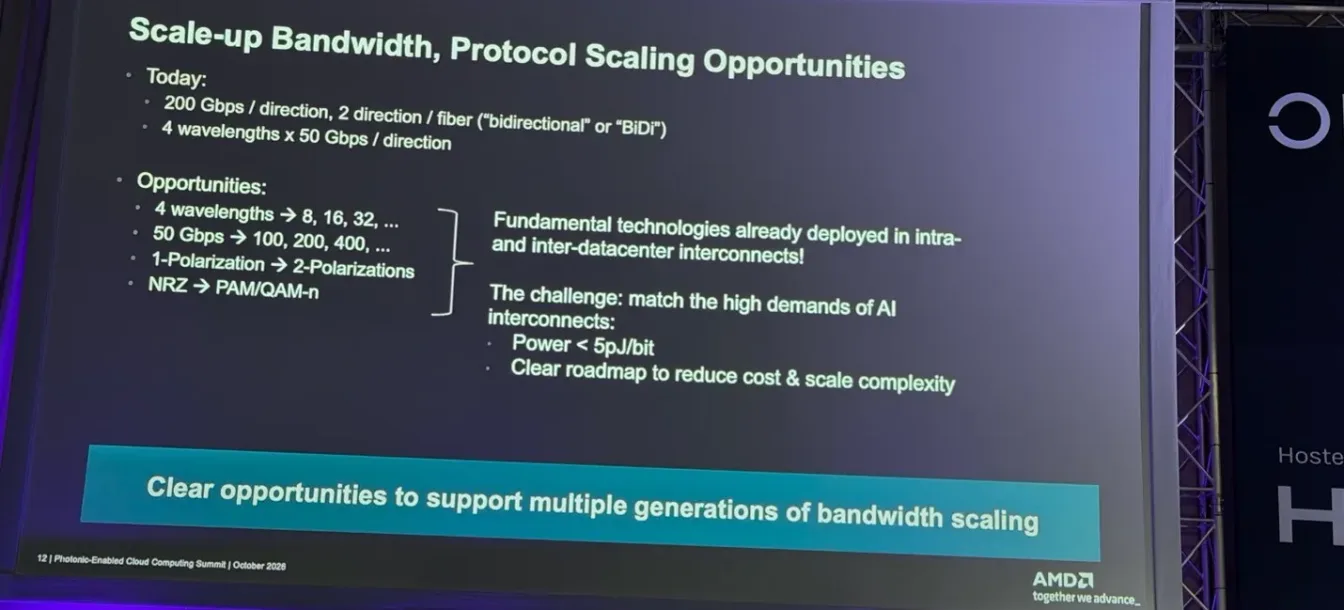
Fig. 3: OCI has numerous ways to continue to scale bandwidth. Source: AMD
Microsoft at PECC also discussed its plans for OCI and the need for a common standard.
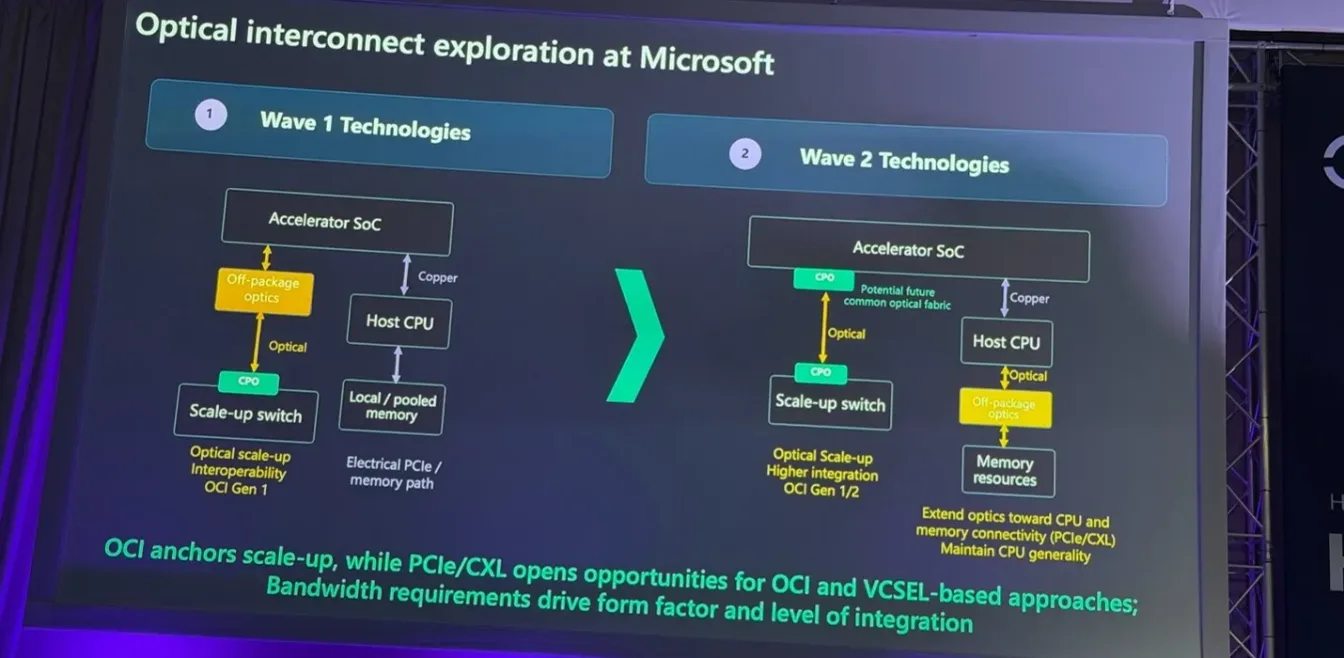
Fig. 4: Microsoft will use OCI in CPO+NPO, then just CPO. Source: Microsoft
Microsoft’s first wave of scale-up optical will use CPO on the switch and NPO with the accelerator. In the second wave, both ends will use CPO in scale-up.
Conclusion
So far, OCI-MSA is the only optical scale-up standard published and frequently discussed at multiple conferences (AI Infra/OCP/PECC) by multiple champions (AMD/Broadcom/Meta/Microsoft).
It seems likely that in 2027, we will see the first fully functional OCI Gen 1 implementations and perhaps interoperability demos between suppliers. If a “bandwagon” forms and multiple suppliers exist, OCI can become the Ethernet of optical interconnects, as Drew Alduino envisioned at AI Infra Summit.
Other standards could develop, or some players might choose to do a proprietary optical interconnect. But as of today, OCI-MSA is the frontrunner for the optical super highway for AI scale-up.