East Valley battleground: Latter-day Saints at the center of Arizona’s contentious race for governor
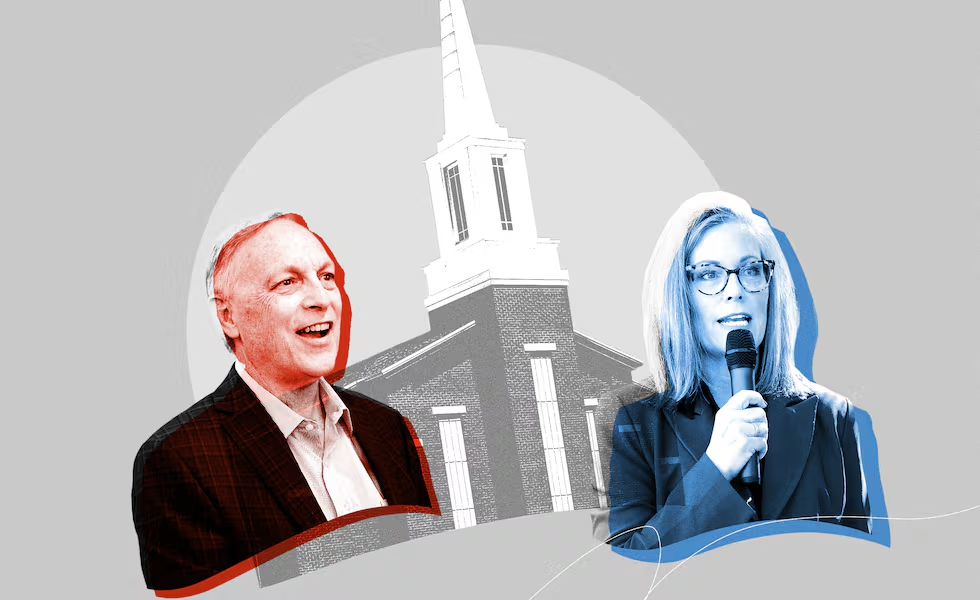
The Republican crusade to reclaim control of Arizona has come to a head this year amid the cul-de-sac sidewalks, manicured lawns and steepled churches of the East Valley.
Set in a suburban landscape surrounded by serrated desert peaks and stately saguaro cacti, the hubs of Gilbert and Mesa have traditionally been conservative enclaves.
In the 2026 race for governor, they have emerged as a microcosm of the ideological realignment that has reshaped Copper State politics over the past decade.
On one end of the valley is U.S. Rep. Andy Biggs: GOP primary voters’ overwhelming pick for governor.
Since 2017, he has represented Gilbert — his home for the past 40 years — as one of the most steadfast adherents to President Donald Trump’s “America First” vision.
On the other end is former Mesa mayor John Giles: Democratic Gov. Katie Hobbs’ choice of running mate.
Leading his native city from 2014 to 2025, Giles became the face of Arizona Republicans’ small but vocal “Never Trump” movement — until he officially ditched the party.
Coming from neighboring metros, Biggs and Giles represent competing campaigns and contrasting responses to the transformation of the Republican Party.
The candidates also reflect the nuanced political identities of one particular religious community that has found itself at the center of Arizona’s fight over statewide power.
Both Biggs and Giles are members of The Church of Jesus Christ of Latter-day Saints, having each attended Brigham Young University after serving two-year missions in Asia.
The head-to-head matchup has filled many East Valley living rooms, featuring identical devotional artwork, with discussions on how faith should inform a person’s vote.
For Joe and Debbie Tenney, fifth-generation Arizonans whose ancestors helped to build the Mesa Temple, it is impossible to divorce elections from eternal principles.
“This battle is between, I don’t call it right and left, I call it right and wrong,” Joe Tenney said in his Gilbert home. “There’s only really one way to look at any of the given issues.”
The black-and-white of their worldview places the Tenneys firmly on team Biggs, a close personal friend who was once their bishop. Political division, the Tenneys say, is nothing less than a prophesied sign of the times: wheat being separated from the tares.
But a similar reliance on scriptural values has pushed Gilbert elementary school teacher Suzanne Lunt out of the GOP. A lifelong Republican, Lunt disaffiliated with the party due to disappointment with what she saw as its lackluster answer to the Jan. 6 Capitol riot.
She has taken her convictions a step further as co-chair of “Arizonans Who Believe in Treating Others with Respect,” a political action committee mobilizing opposition to Biggs.
“As we’re leaving a party that is more hateful and cruel to those marginalized people, it makes me think I am being more like Jesus,” Lunt said from her house across town.
A voting bloc that has long punched above its weight, the Latter-day Saint electorate could play a pivotal role in deciding between two of their own at the top of the ticket.
While Latter-day Saints make up less than 6% of Arizona’s entire population, they have the most congregations of any denomination in the Phoenix-Mesa-Chandler area.
“The Church does not seek to elect government officials, support or oppose political parties, or, generally, take sides in global conflicts,” according to church policy.
Instead, Arizona’s race will give members a chance to practice what church President Dallin H. Oaks has taught about tolerating ideological diversity in difficult political environments.
Speaking as a member of the First Presidency during the April 2021 General Conference of the church, President Oaks said Latter-day Saints should strive to be “knowledgeable citizens who are active in making (their) influence felt in civic affairs.”
But this is not an easy process, he said. Members should seek “inspiration” based on their individual priorities.
“There are many political issues, and no party, platform, or individual candidate can satisfy all personal preferences,” President Oaks said. “Each citizen must therefore decide which issues are most important to him or her at any particular time.”
The influence of Latter-day Saint voters will be magnified in a swing state where Hobbs won by just 0.3% of the vote.
Recent polls find Hobbs’ double-digit advantage falling into the margin of error, backing up her claim to be the most vulnerable incumbent Democratic governor in America.
Turning Point Action, the political operation founded by slain conservative activist Charlie Kirk, has seized on the opportunity, deeming her removal their midterm priority.
Under the direction of Tyler Bowyer, who is also a Latter-day Saint, the Arizona-based group has spent $18.3 million in the past month on ads bashing Hobbs and boosting Biggs.
How 2 BYU grads ended up on the ballot in Arizona’s race for governor
The stakes are high: the gubernatorial victor will influence election certification in 2028, redistricting processes in 2030 and the agenda on growth, drought and polarization.
In exclusive comments to the Deseret News, Biggs, Hobbs and Giles outlined their style of governance and opined on the source of Arizona’s red-state-turned-purple status.
They recognized the race as more than a policy debate. It is a referendum on how parties win, keep or alienate a constituency as engaged as the one east of Phoenix.
A Biggs solution
Since 2018, the GOP has lost almost every statewide office in Arizona to Democrats — ceding the governorship and both Senate seats for the first time in 70 years.
The old-guard attributes the wipeout to a party that has sacrificed electability to nominate MAGA acolytes hyperfocused on election fraud, like Kari Lake, who trailed other Republicans in her unsuccessful tries for governor in 2022 and U.S. Senate in 2024.
The base, backed by Turning Point USA, faults “Republicans in Name Only” for fielding the relatively moderate Rep. Martha McSally for Senate, who lost to Kyrsten Sinema in 2018 and Mark Kelly in 2020 despite being appointed to finish Sen. John McCain’s term.
In June, Arizona Republicans picked one of the country’s most conservative congressmen to try to reverse the trend.
For many Arizona conservatives, Biggs is the dream candidate. He has made a name for himself in Washington, D.C., as one of the most uncompromising fiscal hawks in the nation, often opposing his own party leadership on budgets and surveillance.
He has also been an unyielding ally to Trump: repeating his stolen election claims in 2020, opposing his second impeachment in 2021, endorsing his comeback bid early on in 2022 and cheering on his “no exceptions” for mass deportations in 2025.
“To say his impact has been earth-shattering is to minimize the impact he’s had on the Republican Party,” Biggs said about Trump in a Deseret News interview.
The biggest legacy of Trump may not be his populist project, according to Biggs. It will be his proclamation of America as a “city on the hill” for the world, Biggs said.
But Biggs’ takeaway from serving in federal government has largely been disillusionment toward Congress.
Biggs sat down with the Deseret News following a business roundtable in his birthplace of Tucson, about half an hour west of where he went to high school. After 10 years of attempting to reform the House, Biggs returned to Arizona with the worry that it might be irreparable.
“It’s so locked in,” he said. “Even when we thought we were making wholesale changes, most were swallowed up within 3 to 6 months, and you were back where you were.”
Opinion: Stop giving your political party a blank check
As chair of the rebellious House Freedom Caucus from 2019 to 2022, Biggs led the charge to push his colleagues to adopt the proper appropriations process, employing brinkmanship tactics and working to oust the House speaker to rein in spending.
Efforts to change the “mechanics” and “personnel” of Congress ultimately produced little lasting fruit.
But one of Biggs’ congressional apprentices, Rep. Eli Crane of Arizona’s 2nd District, said he urged Biggs to run for governor because the “courage” he displayed by taking on the establishment in Congress is exactly what GOP voters want — and what Arizona needs.
Even before he was sworn in, Crane identified Biggs as his go-to mentor. Crane saw Biggs as the rare politician who would “put his political career in jeopardy” to do what he thought was right, all while maintaining the respectful disposition of a “happy warrior.”
“Unlike a lot of people in Washington who are political windsocks,” Crane said, “Andy Biggs is a principled man.”
Biggs believes his background has prepared him to buttress Arizona against the hardship sure to accompany a national debt over $40 trillion. States are the last hope for saving America, he said, and with him at the helm, Arizona will become “more like Florida, except for better.”
As state Senate president from 2013-2017 and a member of the state House beginning in 2003, Biggs proved himself a capable lawmaker, according to former state Rep. Trish Groe, being both “steady as a rock” and an astute bipartisan negotiator who “did his homework.”
To those who call him a “hard-liner,” Biggs brings up examples of finding “a common ground” with progressive House members like California Rep. Ro Khanna on limiting military authorization and New York Rep. Hakeem Jeffries on requiring lobbyist disclosures.
Biggs’ imperatives as governor are to clean up Medicaid fraud with a state-level “DOGE” program, reinstate a border security task force, phase out the individual income tax, protect school choice vouchers and “jawbone” cities to force an increase in housing supply.
Underlying these initiatives is an aim to “restore the American dream” — and to make the GOP a big tent again.
“Every election has people who feel alienated by personality, by policy,” he said. “My goal is to bridge that sense of alienation, that sense of ‘I don’t belong to this.’”
What’s at stake
Hobbs has found her stride, supporters say, as an understated unifier, infuriating Republicans with a record 541 vetoes and frustrating some Democrats for not going even further to counter the GOP majorities in both chambers of the state Capitol.
The governor has done her best in divided government, according to Democratic state Rep. Sarah Liguori. Despite “gotcha” moves from GOP lawmakers, Hobbs has pushed for solutions in water management and healthcare where the Legislature has failed to act, Liguori said.
While critics blame Hobbs for Arizona being hit hardest by federal cuts to the Lower Basin Colorado River allotment, totaling a 30% reduction, she has taken steps to expand state oversight of groundwater use through new active management areas.
Against the backdrop of federal reductions in medical research and funding, Hobbs has authorized more than $4 million in state money for Alzheimer’s studies and $30 million to partner with a nonprofit group to buy, and then forgive, more than $1 billion in medical debt.
In a second term, Hobbs promises to build on these public investments and to create more accountability for how taxpayer dollars are being used on school vouchers.
But mostly Hobbs’ reelection campaign has framed her candidacy as a bulwark against her opponent.
Unlike Biggs, who voted not to certify Arizona’s 2020 election results, Hobbs has positioned herself as a steady hand who will oversee a fair election in 2028, like she did in 2024, and 2020 as secretary of state, and who will oppose bills that restrict mail-in voting.
“I didn’t come to the governor’s office to veto bills,” Hobbs told the Deseret News. “I’ve signed over 900 bipartisan pieces of legislation into law. But I also said, ‘I’m going to be a backstop and I’m going to stop extreme legislation that would take away people’s rights.’”
As she did in her 2022 race, Hobbs turned down the opportunity to test her ideas in a televised debate with Biggs.
However, voters’ approval of the new constitutional office of lieutenant governor has given Hobbs the chance to demonstrate her intent to represent all Arizonans.
Hobbs announced her selection of Giles in August, characterizing it as a symbolic move to put people above parties and to encourage a less tribal form of politics.
Over the previous two elections, Giles had followed in the footsteps of former Sen. Jeff Flake, becoming the face of a GOP faction that declined to back their party’s nominee.
In 2022, Giles endorsed Hobbs and other Democratic candidates. Two years later, he launched “Republicans for Harris” and spoke at the Democratic National Convention.
Utah’s quality of life is slipping. Housing plays a role
Earlier this year, Giles, a self-described Reagan Republican, fully cut ties with the GOP of “Make America Great Again,” switching his voter status to “independent.”
This may not come as a surprise to those who watched Giles’ tenure as the nonpartisan executive of Mesa.
While mayor, he advocated for an LGBT nondiscrimination ordinance, praised Biden administration stimulus bills and doubled city expenditures with infrastructure projects.
During an event with the Arizona Alliance for Retired Americans in Casa Grande, Giles contrasted his approach with that of Biggs, calling Biggs “a slave to a far-right political extreme agenda” that has controlled his decisions in elected office at the expense of voters.
By tapping someone not of her party to run at her side, Hobbs is speaking to those tired of partisanship, Giles said, including those with his Latter-day Saint background.
“My experience in growing up in the LDS faith was always that I was taught by my parents and by church leaders to vote for the best candidate, and to not identify just kind of in a knee-jerk fashion with a political party,” Giles told the Deseret News following the campaign stop.
But Biggs sees the Hobbs-Giles ticket as signaling a much deeper shift than a simple preference for pragmatism.
Biggs points out that Giles told the Deseret News in August he had never had a single policy disagreement with the governor, and that he did not anticipate any in the future.
This would include Hobbs’ repeal of the state’s 1864 abortion ban, her order expanding state health plan coverage for gender-transition treatments and her veto of a bill that would prohibit diversity, equity and inclusion classes at state-sponsored universities.
Giles’ tolerance for these positions, Biggs said, implies defections from the GOP have more to do with liberalizing attitudes than anything done by the Republican Party.
Faith in politics
That diagnosis would have sounded foreign to the group of around 65 voters gathered at an elegant reception venue in Mesa earlier this month to support the “Arizonans Who Believe in Treating Others with Respect” PAC, founded and operated by Latter-day Saints.
Speaking to the ex-Republican attendees were six Democrats, including U.S. Rep. Greg Stanton; Elizabeth Lee, the Democratic hopeful vying for Biggs’ House seat; and Stephanie Walsh, a Democrat running for state Senate against Biggs’ 26-year-old daughter, Mylie.
The political committee was conceived in 2020 by Dan Barker, a retired Maricopa County superior court judge, as a way to pay for “Republicans for Biden” yard signs. Last week, their new billboard went up along highways, telling voters: “Be Independent Hobbs-Giles.”
This is the first midterm involvement from Barker’s PAC, which removed the word “Republicans” from its name this cycle because too many volunteers had left the party. Organizers at the event said they felt compelled to enter the race to support Giles, a local favorite.
But, according to Barker, “the driving impetus” for the initiative is distrust over what Biggs would do if he were the officeholder certifying state election results in 2028.
“Underlying all of that is the allegiance to Trump rather than to the Constitution,” he told the Deseret News. “Andy Biggs’ role has been one loyal trooper to Donald Trump.”
The group’s fundraising objective, unlikely to top six figures, is meager. But its mission is messaging: to give conservatives permission not to vote Republican if they believe personal character and pluralistic democracy outweigh things like abortion on the ballot.
Biggs’ election skepticism is also one of the main factors motivating Sage Millet to help promote Barker’s PAC. The 22-year-old Arizona State University law student recently flipped her party affiliation to “independent” after returning from a church mission to Mexico.
“Your vote should be based on the research you do,” she said. “Not just the party ... or the social issues, for example, that are generally paired with that party.”
Raised in the “mini-Utah” of Mesa, Millet told the Deseret News she shares many of the principles of the Republican platform. But immigration enforcement and institutional integrity have convinced some Latter-day Saints like her to set culture war topics to the side.
Moving to Gilbert after growing up in Utah, high school humanities instructor Nikki Park found that her “staunchly independent” voting record — Obama, Romney, McMullin, Biden — made her feel she does not “fit in” at church in a way that has been “very painful.”
“There’s a level of intimacy that has shifted because of politics, and that’s really sad,” she told the Deseret News.
Park plans to vote for Hobbs-Giles, not because she is a “Hobbs groupie,” but because she thinks they uphold a higher standard of “peacemaking” than Biggs. Having Giles in office could go a long way to softening the reaction people have to political differences, Park said.
Latter-day Saints remain the second most Republican religion in the United States. But this share has fallen 11 percentage points, from 68.5% to 57.5%, over the past 20 years, making Latter-day Saints the only faith group with growing Democratic Party identification.
From 2016 to 2024, the presidential vote margin in Gilbert and Mesa slid toward Democrats by more than 5 points.
Even then, Gilbert business owner Kay Clavijo feels the split has been overstated by a handful of people raising “a ruckus.” After all, “the squeaky wheel gets the grease.”
As a mother of four young children, Clavijo said there is still consensus around candidates who stand up for simple truths on gender issues. She is concerned policies like Giles’ ordinance allowing transgender access in sex-designated spaces will bleed into public education.
“If you stand for nothing, you’ll fall for anything,” Clavijo told the Deseret News. “You’re a wild card.”
Since bringing Turning Point to Phoenix in 2018, Bowyer has made Latter-day Saints like Giles his No. 1 target, helping to recall Giles’ fellow city council member Julie Spilsbury and oust state House Speaker Rusty Bowers who refused to intervene in the 2020 election.
In 2022, Bowyer turned his attention to Giles’ friend, Clint Smith, an independent running to unseat Biggs. Turning Point planted signs across Smith’s district, and in the neighborhoods of Giles and Flake, claiming all three were “exploiting the church for political gain.”
Bowyer has no problem with Latter-day Saints calling themselves Democrats, he said. The Mesa resident takes issue when so-called independents “confuse people” into thinking a “good member” must oppose Trump and endorse policies contrary to church teachings.
“You couldn’t have a bigger disparity,” he said. “Arizona is at a massive, massive crossroads with this election.”
Turning Point Action has dedicated more full-time “ballot chasers” to connect with low-propensity voters this year than in 2024 when Trump won Arizona by 6 points. The election will come down to turnout, Bowyer said, and that may depend on factors outside their control.
This puts a spotlight on Latter-day Saints in a way many are not accustomed to, according to BYU professor Quin Monson, co-author of a book on Latter-day Saint politics.
“Drawing on religious identity to justify political identity becomes problematic because then you see the other side as sinful,” he said. “People should be able to be in the same room, deeply disagree with each other, and still see each other as brothers and sisters in the gospel.”
Faith can instruct East Valley conversations on how voters engage in the process, Monson said; aside from that, political arguments should rely on “political merits.”