After the PKK Disarms, What Future Awaits Its Fighters?
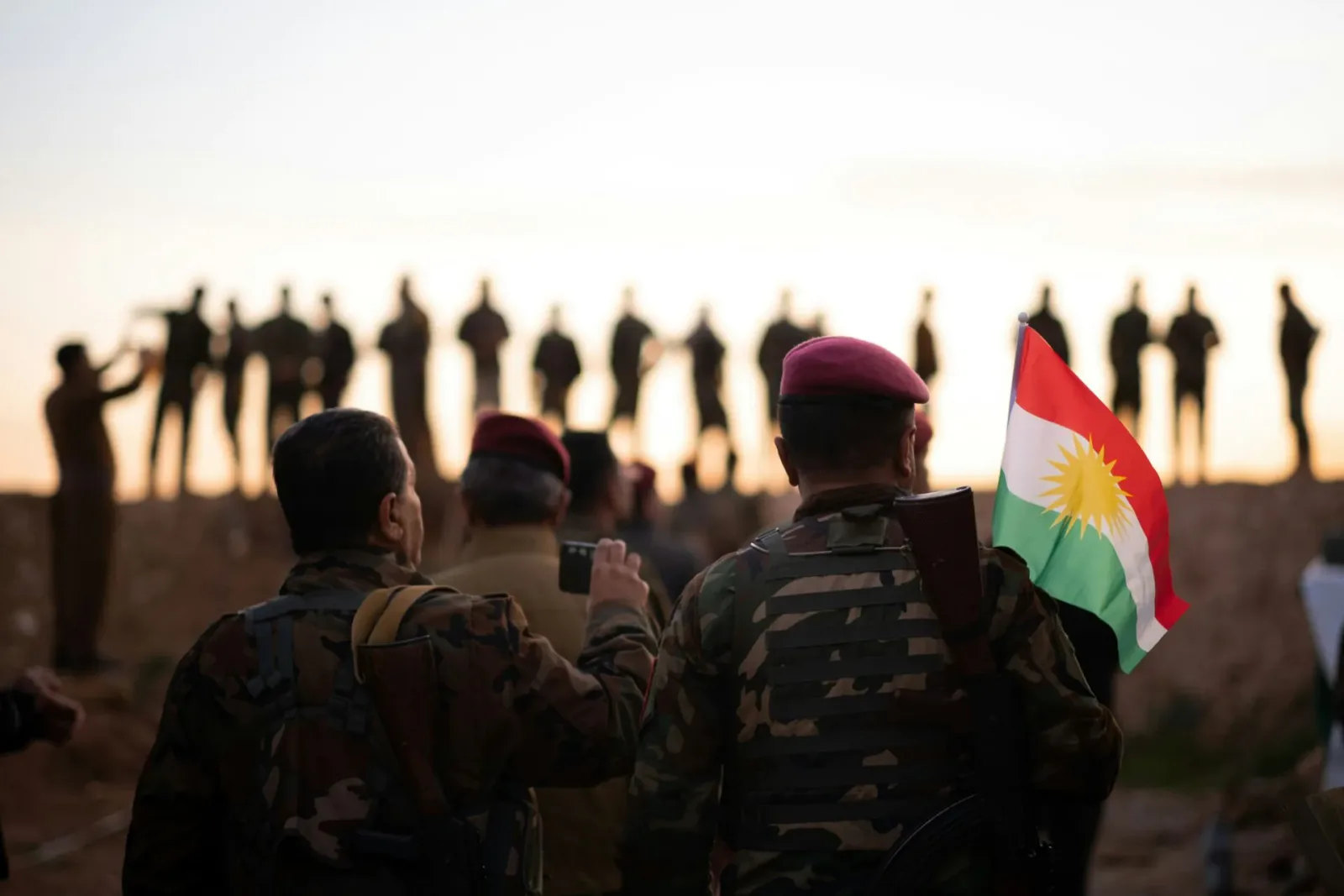
On July 11, 2025, near Lake Dukan in Sulaymaniyah, in the Kurdistan Region of northern Iraq, 30 fighters from the Kurdistan Worker’s Party (PKK) descended a long staircase from the entrance of Casene Cave.
A Kurdish Alevi woman fighter walked at the front. One by one the soldiers stepped off the platform and put their weapons into a large cauldron; the weapons burned and smoke rose. Slogans and applause were forbidden.
Ruken Ay Adın was among the observers present that day. The location was kept secret until the last moment, and phones and cameras were left outside the site. For the researcher, it was more than a ceremony to watch from stiff rows of plastic chairs. She wrote that witnessing the moment placed a historical responsibility on her.
The PKK fought an armed struggle against the Turkish state since 1984. The war, which lasted more than 40 years, killed close to 50,000 people. The PKK, for its part, has said it lost 27,000 fighters. The group originally set out to found a Kurdish state in southeastern Turkey. Over time the goal shifted to a struggle for autonomy and rights for Kurds inside Turkey.
The symbolic burning of the weapons was a goodwill gesture. The fighters said they would pursue their struggle from now on through democratic politics and legal means. After a war that cost this much, as the guns go quiet what remains is the question of what happens to the people who carried them. Where will the thirty at the site, and the others who disarm after them, go now?
This is not the first time the PKK has tried this route. Thirty-three years ago, in March 1993, PKK leader Abdullah Öcalan declared a unilateral ceasefire, saying: “I am looking for an interlocutor to solve the problems.” Nobody answered. Süleyman Demirel, then prime minister of Turkey, rejected negotiations. The ceasefire didn’t last two months, and the fighting resumed.
Today it looks as if an interlocutor has been found. From prison on Imrali island, where he has been confined since 1999, Öcalan called for the dissolution and disarmament of the PKK on Feb. 27, 2025. Soon after, the PKK held a congress and dissolved itself.
On Aug. 10 this year, Turkey’s parliament passed a framework law postponing the prosecution of those who disarm. But the real questions start now. Will those who lay down their weapons be able to find a meaningful place in political and social life? Under what legal and political guarantees? And what happens if that path doesn’t open?
I put these questions to journalist İrfan Aktan, who met with guerrillas in Kandil, the PKK’s mountain base in northern Iraq, in early August, and to Nisan Alıcı and Ruken Ay Adın of the DEMOS Research Collective, which works on conflict and resolution. I also looked at three places that have been down a similar road: Colombia, Northern Ireland and the Basque Country.
Aktan went to Kandil before the law passed parliament. He explains how the guerrillas were likely to see it: “When I later compared the Framework Law with the conversations I had there, I expected they would not be happy with it.”
Aktan sums up the two questions on the guerrillas’ minds: “One is whether the state will keep the promises it has made or will make. The other is how they can widen this narrow framework through democratic struggle.” On the first point, there is no trust. On the second, they are sure of themselves: “They say, ‘If the channels of politics open up, we will carry out the struggle that brings democratic gains.’ So in fact they trust themselves a great deal — not the state.”
This distrust has a history. The PKK’s withdrawal from Turkey began on May 8, 2013, but it did not lay down its weapons. Two years later, on July 24, 2015, the process collapsed and the fighting started again.
The picture looks different this time, Aktan explains. “This time, the armed struggle has been abandoned, and the way has largely been closed to provocations that could bring the process down. By all appearances, the state has also established control over its own armed forces and brought the de facto ceasefire into effect.”
Conflicts in other countries have faced similar issues. In Colombia, the government and the FARC guerrillas reached an agreement in 2016, and in 2017 the UN removed more than 8,000 weapons from 26 camps. “It is quite important for independent and international institutions to be involved in these processes, so that the disarmament can be confirmed securely,” Alıcı says.
A political route was opened, too: the former FARC party was guaranteed ten seats in Congress for two terms. That guarantee expired in 2026 and in the March 8 election, the first one the party contested without it, it failed to win a single seat. In early October, the National Electoral Council formally ruled that the party had lost its legal status, because it fell short of the minimum vote threshold.
In Northern Ireland, seven years after the 1998 Good Friday peace agreement, on Sept. 26, 2005, an independent commission confirmed that the entire arsenal of the Irish Republican Army (IRA) had been put beyond use. “The weapons of the IRA are gone. And they are gone in a manner which has been witnessed and verified,” then-Irish prime minister Bertie Ahern said. Michelle O’Neill of Sinn Féin, which is linked to the IRA, was appointed Northern Ireland’s first minister on Feb. 3, 2024. Twenty-six years after disarmament, she was the first Irish nationalist to hold the post.
In the Basque Country, the separatist group Basque Homeland and Liberty (ETA by its Basque acronym) had no single moment of disarmament. “Rather than a single ‘moment of disarmament,’ we are talking about a process spread over years: de-escalation, verification, disarmament and, finally, self-dissolution,” Ay Adın says. Madrid accepted neither an official verification mechanism nor a direct disarmament agreement. An informal international commission, whose members included figures from peace processes in other countries, filled the gap. On April 8, 2017, Basque civil society also made sure the locations of ETA’s weapons depots were handed to the French authorities and the commission. It was the state, though, that collected the weapons. On May 3, 2018, ETA announced that its journey was over.
In all three cases, trust was built either through an independent eye or through political guarantees. Where are those in Turkey?
For the Turkish law to take effect, the state must first determine that the PKK is effectively finished and that the weapons have been handed over. The Turkish National Security Council (MGK) will confirm that determination; it is made up of the president, ministers and senior military commanders. Once the decision is issued, investigations and prosecutions of those who disarm will be deferred for five or ten years, depending on the gravity of the offense, and if no new offense is committed in that time, the case will be closed. Not everyone is covered: crimes of “intentional killing committed within the framework of the organization’s activities” stay outside the deferral.
The law’s text also contains no provision on a truth commission, a compensation mechanism or participation in politics. “Silencing the guns is a necessary first step, and the framework law in hand focuses on it. In the part of the process so far, we have not seen the ruling bloc make a serious effort to go beyond that and achieve a lasting peace,”
The board that will monitor the law’s implementation also consists entirely of Turkey’s own institutions; no independent or international figure sits on it. Alıcı points to this difference too when she describes the role the UN took on in Colombia: “It also strengthens the sense that the international community is following the process. Because the Monitoring and Evaluation Board has no such independence or ‘outsider’ status, we cannot say that it serves as oversight at the same level or carries a similar responsibility toward international public opinion.”
The law settles the criminal status of a person who lays down their weapon, but what kind of life that person returns to afterward is left open. There is very little detail on reintegration into society. Alıcı points out that this will not be finished quickly: “This is a long process, and it shouldn’t be forgotten that the people who return will have different and varied needs.” She adds that women need a separate approach: “We know from Colombia and similar examples that after the transition to civilian life, women former fighters can face more stigma than men.”
Ay Adın, for her part, thinks the main gap is the political horizon. She is careful to stress that this does not mean promising posts to those who disarm: “A political horizon is not the promise of particular offices or privileges to former armed actors. It is that, once arms are laid down, it is foreseeable where, under what rights and guarantees, and through what democratic means the political demands expressed in the conflict so far can be voiced from here on.”
In her view, the framework law now in force in Turkey leaves this space open for now. Ay Adın’s warning points the same way: “But if this gap persists for long, I think the basic risk is that disarmament and political and social transformation come apart from one another.”
How that gap gets filled seems to depend largely on the state’s intent. I put one more question to Aktan: Will we one day see a former PKK cadre speaking from the floor of parliament, as in Colombia? His answer is cautious: “It’s too early to make a prediction about that. Does the state want peace right now, or a postponed conflict? We don’t know.”
According to Aktan, the uncertainty is not just in the text of the law. The state, he says, first has to face the last 50 years and the suffering that came with them. He sees small signs in the process, but argues that unless these get a legal and constitutional footing, what remains is a postponed conflict, or negative peace, rather than a real peace. That is one reason the guerrillas distrust the state: there is no lasting legal ground behind the promise made to them.
Laying down arms was the easy part. In Turkey, what we have for now is a law that postpones prosecution and an oversight board the state set up itself. There is no independent verification yet, and no legal outline of how those who disarm might return to politics. Nor is there a mechanism for victims. These gaps don’t mean the process will collapse. But what those who disarm are supposed to rely on remains, for now, unanswered.
Thirty-three years ago, the question was who the interlocutor would be. Today there is one. What will be tested is what that interlocutor has promised, and how it will keep that promise to the people who put down their weapons.