The money behind the midterms
This article was first published in the On the Hill newsletter. Sign up to receive the newsletter in your inbox on Friday mornings here.
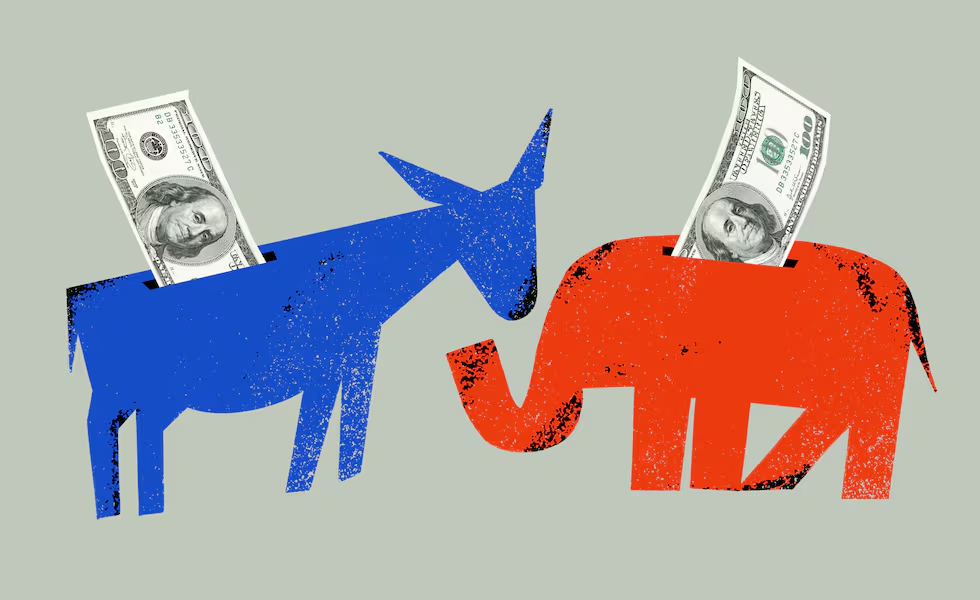
You’ve probably heard that this election cycle is going to be expensive. But we’re finally getting a somewhat final snapshot of how much the final price tag will be, and it’s a lot.
Ad spending for the 2026 cycle officially surpassed $10 billion this week, with final spending projected to reach $11.6 billion before all is said and done, according to the most recent data collected by AdImpact. If they reach that projected figure, that means this midterm cycle will have spent more on ads than the 2024 presidential cycle (which was about $11.2 billion).
That’s … staggering.
Putting into perspective how much that $10 billion in spending is so far: That’s more than the NFL booked in advertising during the 2025-26 football season.
So where is this money being spent? And for what?
That total figure includes midterm spending over all, including for statewide races that aren’t in the House or Senate. But even the fight for control of Congress is the most expensive it’s ever been.
As you’ve seen me report before, both the House and Senate are up for grabs this cycle. Races that were not previously considered competitive are now tight, and predictions about which way the chambers will lean change almost by the week.
Let’s start with the Senate, which has fewer competitive races. As of this week, Republicans have the advantage when it comes to ad spending, according to the report.
So far this general election cycle, after the primaries were over, Republicans have outspent Democrats by more than $297 million across the eight most competitive Senate elections. This is a change from previous election cycles as Democrats held leverage over Republicans in a majority of the competitive races in the 2022 and 2024 midterm elections.
Ohio is the most expensive Senate race on record right now, making up nearly a quarter (22%) of all Senate general election spending this cycle. The race is considered the most expensive non-presidential election on record.
Texas comes in second with $324.7 million in the general election so far, then Maine in third at $199 million. What may have popped up as a surprise is the fight for the Senate seat in Kansas currently held by GOP Sen. Roger Marshall.
That race has now attracted $44.3 million in spending after it surprisingly became a toss-up race.
Then there’s the House, which has several more competitive races. There are 21 seats considered toss-ups; more than $567 million have been spent on those races in the general election.
Democrats spent $288 million, higher than their Republican counterparts at $279 million.
But in races considered “lean Democrat,” which is one step shy from being a toss-up, Republicans outspent Democrats $160.8 million to $122.7 million. Instead, Democrats were pouring more of their money into “lean Republican” and “likely Republican districts.”
That’s a shift from the 2024 cycle when Republicans mainly stayed on the defense, according to data analysis from AdImpact.
The battleground could continue to change in the coming weeks. There’s outside spending that is not counted in advertising data, and there is still time for groups to pour millions of dollars into existing ad buys.
Stories Driving the Week
- Forest freeze: A federal judge issued a sweeping ruling on Tuesday blocking the reorganization of the U.S. Department of Agriculture, including a plan to relocate the Forest Service headquarters to Utah.
- Biden DOJ under scrutiny: The Biden administration allegedly obtained the personal data of at least 639,000 Republican voters and donors as part of an investigation into efforts to overturn the 2020 election, according to a new memo released on Wednesday.
- High inflation: Inflation rates rose faster than expected last month, with high gas prices accounting for much of the spike — a bad sign for congressional Republicans campaigning back home with the hopes of keeping their majorities in Congress.
Is Lauren Boebert’s Colorado seat safe?
As we get closer to the midterms, I’m going to bring in some of my colleagues who are closer to the ground on some of these races.
Being in Washington, D.C., gives me a front-row seat to all the governing and legislating — but right now, my colleagues are running all over to get you the latest on the run-up to the election. This week, my colleague Lauren Irwin did a deep dive into the race for Colorado’s 4th Congressional District, which is the reddest seat in the state.
But the incumbent has a history of close electoral challenges thanks to her at-times turbulent personal life. Here’s more from Lauren’s dispatch:
“After first winning election to Congress in 2020, Boebert made a name for herself as a strong supporter of President Donald Trump and one that fights back on Capitol Hill. She was first elected to the Colorado’s 3rd Congressional District and stood out in Washington as a working class gun rights activist who brought a confrontational style to her public service.
In a debate on Monday, Boebert highlighted her record in Congress, saying “you know me” and detailed how she’s delivered for farmers and ranchers in the district’s rural areas, secured water projects and worked across the aisle, particularly with Colorado’s two Democratic senators and four members in the House.
Laubacher hopes that voters have grown tired of the “cloud of chaos” that follows Boebert and opt to put a no-nonsense congresswoman in the seat. But she not only has to convince Republicans to vote for a Democrat, she also has to convince Democrats she’s really one of them.
Laubacher has maintained that she changed her party affiliation because she no longer felt represented by the Republican Party over things that mattered to her like small government and reining in federal spending.
Still, in an interview with the Deseret News, Laubacher said she became a Democrat because running as an independent doesn’t make sense.
“I think my view of the party has changed dramatically, and the things that they’ve said that they stand for are not, I believe, the things that they actually stand for,” she said. “And that is why I became an unaffiliated voter, and I did become a Democrat to run because … running as an independent just generally doesn’t work, right? This is the United States of America. We have a two-party system.”
Boebert benefits from both her name recognition and being the incumbent candidate in a historically conservative district, but she still might face a close contest against Laubacher come November.
Still, Boebert is confident that she will win her reelection bid. She said she still believes in the message that she and her now ex-husband had when she first decided to run.
“We wanted to secure our children’s future and our now-grandchild’s future, and that’s still the mission,” she said in an interview with the Deseret News. “There’s, you know, ups and downs along the way, and some of those challenges sometimes, you know, can get the better of relationships.”
Read the rest of her story here.
Quick Hits
From the Hill: Is Lauren Boebert’s Colorado seat safe? … Utah’s 2nd District candidates both want data center transparency after Stratos — but differ on MIDA. … Utah senators differ over Russian diesel deal — with one challenging Trump and the other questioning Zelenskyy.
From the White House: Execution of Fort Hood shooter will no longer be livestreamed, Trump says. … White House asks Kimberly Guilfoyle to resign from ambassador position amid misconduct allegations. …
From the courts: Federal agents conduct search of Minnesota Rep. Ilhan Omar’s home. … Should ‘enabling’ harm be a crime? A son of Holocaust survivors makes the case.