Thune prepares to navigate the minority — and an unpredictable Trump
The Scene
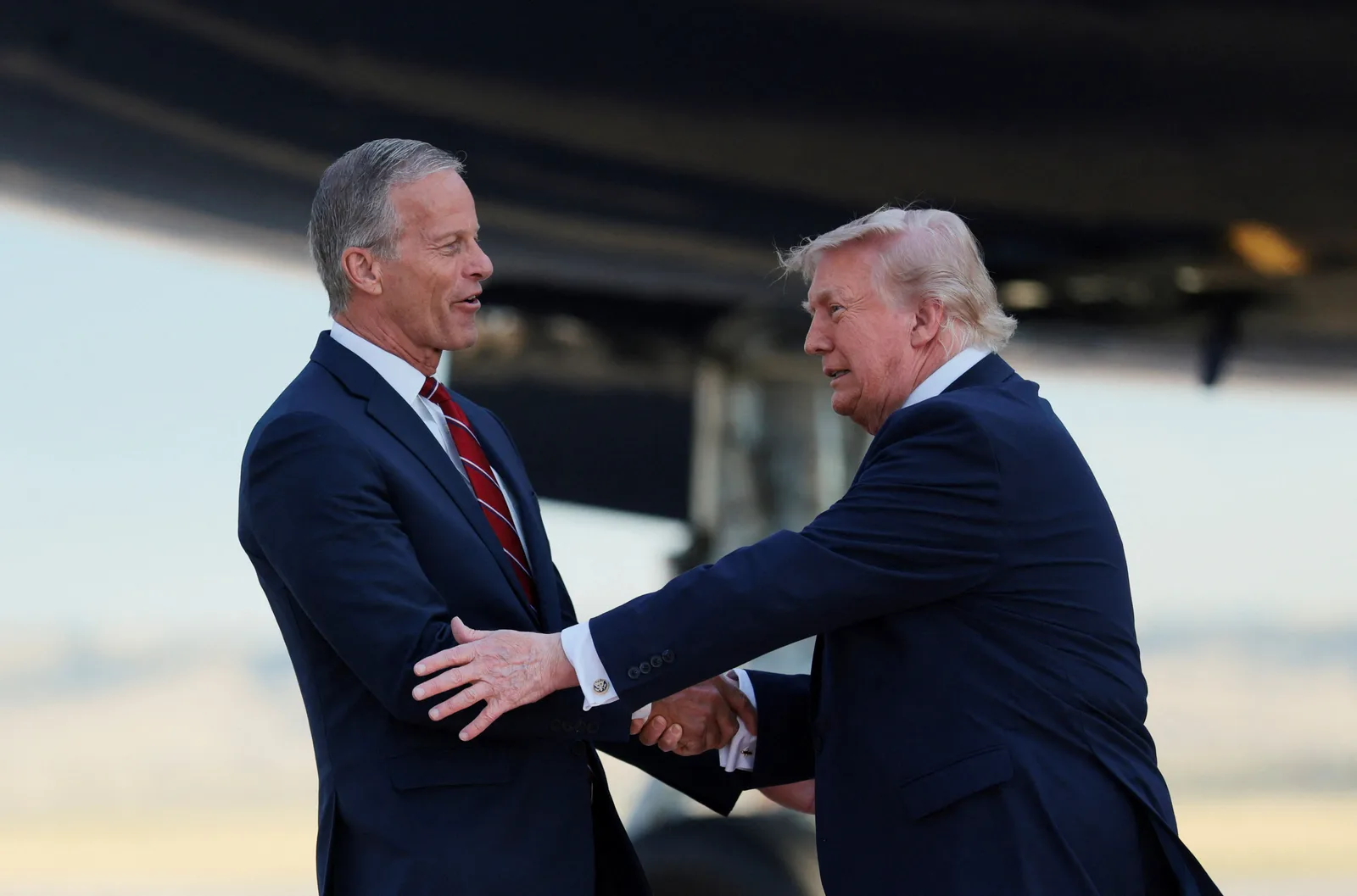
About 20 minutes into an interview about the future of the Republican Party, John Thune’s phone rang. The screen displayed two capital letters: “DT.”
“Let me take this real quick,” Thune said. By sheer coincidence, the call came mid-question about whether Thune’s Senate Republicans should exercise more independence from President Donald Trump.
Unlike some past phone calls between the president and the Republican Senate leader, this one was drama-free: Trump was flying back from China and wanted to talk about his meeting with Chinese and Russian leaders. Thune and the president chatted amiably for a few minutes before we resumed our interview.
The episode was nonetheless a reminder that Trump looms large as the Republican Party prepares to transition to a new national leader, its first non-Trump presidential nominee since 2012. Thune will have front-row seats to the transformation for at least two years — and probably many more.
Change is already underway. Thune’s wingman in the House for these past two years, Speaker Mike Johnson, is stepping down from his role. And after a midterm shellacking, Thune has to pick up at least six Senate seats in 2028 to get back his soon-to-be old job of majority leader.
Thune has a throwback, Reagan-era view of what makes the Republican Party tick: limited government, free markets, strong national security, and social conservatism. He also understands the party is now a hybrid of that view and Trumpism, which swayed working-class voters and wooed independent voters in 2016 and 2024.
But that coalition is in shambles after this year’s midterms. And Thune did not mince words about what happened in November, even as he insisted Republicans “have an opportunity to scratch our way back in” after Democrats filleted the GOP over cost-of-living issues.
“We got our butts kicked, and you’ve got to learn from that and rebuild and get better,” Thune told Semafor in an interview before lawmakers left town for the Thanksgiving break. “We’ve got a governing coalition out there waiting to happen, but we’ve got to start talking to them.”
Thune is already talking to his colleagues about their plans to run for reelection to avoid the sort of open-seat debacles the GOP just experienced in Iowa and North Carolina. He’s talked to an undecided Sen. Ron Johnson, R-Wis., about his plans, and has also made clear that 93-year-old incumbent Sen. Chuck Grassley, R-Iowa, controls his own destiny.
“It’s his call to make. He’s proven to be a very resilient vote-getter, and you know my assumption is if he runs, he wins,” Thune said. “We have to be prepared under any circumstance in a lot of these states that created challenges for us this last time to reassert what it is that we’re for, and to go out and win these people back.”
Thune is also figuring out his own political future, and is leaning toward running for another six-year term in 2028.
“We’ll be doing all the things here in the next few months to gear up,” Thune said. “I don’t take anything for granted. I think anybody can lose, but you know, in a primary or a general? I guess I like my chances.”
Trump threatened Thune with a primary challenge in 2022, when the South Dakota Republican thought long and hard about whether to run again. The two haven’t spoken specifically about Thune’s run in 2028, but Trump had kind words for Thune over the weekend, calling him a “good man” and blaming the GOP’s legislative morass on “bad Republicans.”
Thune’s closest allies are highly invested in his reelection.
“I would expect him to run,” said Sen. Katie Britt, R-Ala. She praised Thune for raising $800 million for GOP electoral efforts while remaining “so intentional about being home and making sure that South Dakota was first. I think he is well positioned to be successful.”
The majority leader has taken a lot of arrows for the Senate GOP after Trump’s pressure campaign to gut the filibuster for a voter ID bill failed. He spends a lot of time back in South Dakota and says it’s “always important to get outside of the algorithm.”
“John is a lot more popular in the public than he is on social media,” said Sen. Mike Rounds, R-S.D. He said he’d heard nothing about a primary challenge to Thune, including from former Homeland Security Secretary Kristi Noem.
Coming fights
Thune’s job is changing: Instead of holding the fractious Senate GOP together in support of Trump’s agenda, he now needs to keep them united against Democrats. He’s in a prime position to oversee the Republican Party’s transition away from the Trump era and toward something else.
In the short term, he’s not expecting perfect unity.
“If you represent a state and the administration is on a different page than you are on some stuff, you just got to occasionally find your own voice and be your own person,” Thune advised.
He foresees cooperating with Democrats on AI regulation and acknowledges that some of his GOP colleagues may work with Democrats on other issues. His hope is that “where we can, we’re going to want to hold the line.”
Thune is already bracing for Republican shifts on Trump’s tariff and the Iran war.
“Most of our members have tried to give the president a lot of latitude on managing the situation in Iran … but that’s I think an issue where people are probably going to be more inclined going forward to maybe have their own position on it,” Thune said.
But he’s not conceding anything on one of Democrats’ top priorities. He opposes Democratic efforts to roll back Medicaid work requirements and future cuts to the provider tax that were in last year’s GOP tax cut law.
Still, he faces the potentially tricky task of keeping his party united in a Senate where just four GOP defections could send bills to Trump’s desk next year.
“I hope that, in spite of Democrat efforts to try and undo all that, that our folks realize that these are changes that are long-term good for the country,” Thune said.
The View From skeptics
Some Republicans harbor lingering frustrations toward Thune, even if they’re on board with his reelection as GOP leader.
“I obviously had issues in terms of what we did and didn’t do for the last Congress,” Johnson, the senator, said. “But the conference has decided he’s our leader and I’ll try and support our conference.”
Burgess’s view
A longtime senior Republican hand told me in 2024 that Thune would have been the right transitional figure to steer the Republican Party had Trump had lost the election to Kamala Harris. Instead, Thune was thrust into probably the hardest job in Washington: managing a Senate majority that has grown less and less inclined to bend to Trump’s will.
Now, he has to navigate his 44-member Senate minority through Trump’s last two years. Thune wants to regain Senate control, but another poor political environment in 2028 could make it just as important to prevent a Democratic supermajority.
He’s also got the tricky job of figuring out when to stoke bipartisanship in the Senate and when to extinguish it. Trump is a wild card there, already driving Republicans nuts with entreaties to Democrats on healthcare and capping credit card interest.
Notable
- Thune also told Semafor that his party likely lacks the votes to raise the debt ceiling along party lines in either the House or Senate, which means the problem will be left to Democrats.