Prompt-to-Game Is Here. Which Platforms Are Positioned to Win?
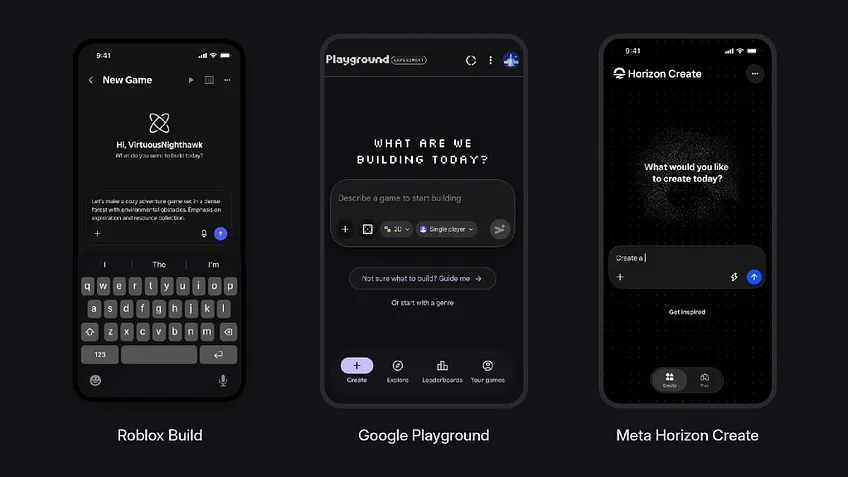
Between July and October 2026, Roblox, Meta, and Google each unveiled a product that lets users make a playable game from a text prompt: Roblox Build, Meta Horizon Create, and Google Playground. They join startups such as Astrocade, Rosebud, and Jabali in prompt-based game creation.
Today, we are examining why these companies are investing in prompt-based game creation now and what each stands to gain. We’ll look at how these tools connect to their existing products and audiences, and whether creators and players are showing early signs of traction. Finally, we’ll lay out where the ecosystem may be heading and which platforms appear best positioned to benefit.
From UGC to Prompt-to-Game
User-generated content (UGC) platforms, where players publish games for others to play, have never lacked games. Epic reported 325,000+ active games in Fortnite, and Super Mario Maker 2 players had uploaded more than 26M courses by May 2021. Until now, aspiring creators had two options. They could use a full tool, such as Roblox Studio or Unreal Editor for Fortnite, to make almost anything, but they needed to code and use a computer. Or they could use an in-game editor, such as Super Mario Maker, to easily build new levels, but they were constrained by the game’s rules and mechanics.
AI model improvements have largely removed that trade-off. From a single text prompt, users can create a complete game, including code, art, and sound, on a phone or in a browser, without the fixed rules of an in-game editor. Naavik covered these emerging prompt tools when Astrocade raised $56M in May. As of October 2026, every platform tested produced a playable game in under 20 minutes.
Even so, the games tend to be bite-sized experiences closer to hypercasual games. This largely reflects the limits of today’s models. Horizon lead Saxs Persson said AI generation starts to drift after the first ten or so prompts, which makes larger games hard to build through prompts alone. Until that changes, prompt-made games may struggle to become deep, content-heavy games that keep players returning.
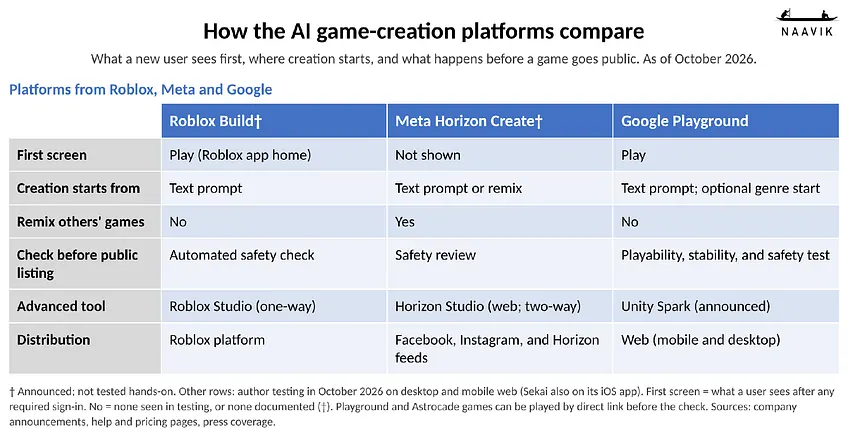
Each company behind these platforms has its own reason to invest. For Roblox and Meta, prompt tools give new, casual creators a way to make content for their current audiences. Roblox said any one of its 132M daily active users “could come up with the next hit game,” and Build games enter the same ranking as every other Roblox game. Meta’s Horizon Create will publish games directly into Facebook, Instagram, and Horizon feeds. Google labels Playground an experiment, hasn’t said how it would generate revenue, and lets players play its games only on Playground. For Astrocade, which counts Google’s AI Futures Fund among its investors, the platform is the core business, so it has to build its audience from scratch.
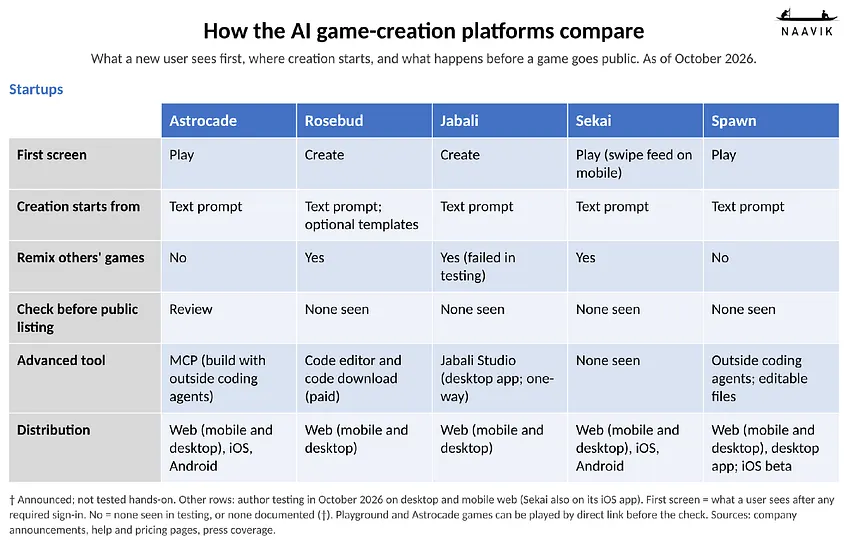
Every AI platform evaluated for this article offers blank-prompt creation, and most default to it. Some also offer templates or remix, letting players create a new game from another user’s game.
Creators Follow Players
Early evidence suggests these tools are reaching people outside the existing developer base. During Roblox Build’s New Zealand alpha, 71% of users who created a game had never used Roblox Studio. Most of these platforms also let people create games on a phone, opening UGC creation to mobile-first markets.
Reaching new creators is the first step, but keeping them requires incentives. Roblox Build creators can earn Robux through Roblox’s Creator Rewards program, which pays based on engagement from paying players. Astrocade offers payouts from a $10M creator fund, and Meta has announced a creator fund for Horizon. As more platforms seek new creators, they will compete to attract and retain the best creators, those who bring players back to their games. Creator funds help jumpstart creation, but over time players fund payouts through ads or in-app purchases. Roblox already funds payouts through ads, while Astrocade doesn’t yet support ads or in-app purchases.
More Games Don’t Mean More Play
While these platforms need to appeal to creators, the bigger test is winning over players, and most of the products evaluated lead with play. Google’s Playground opens on a feed of editors’ picks, Astrocade opens on its game feed, and Meta’s games are built to run in Facebook and Instagram feeds. The approach borrows from social media, where anyone can publish to a large audience and a feed decides what users see.
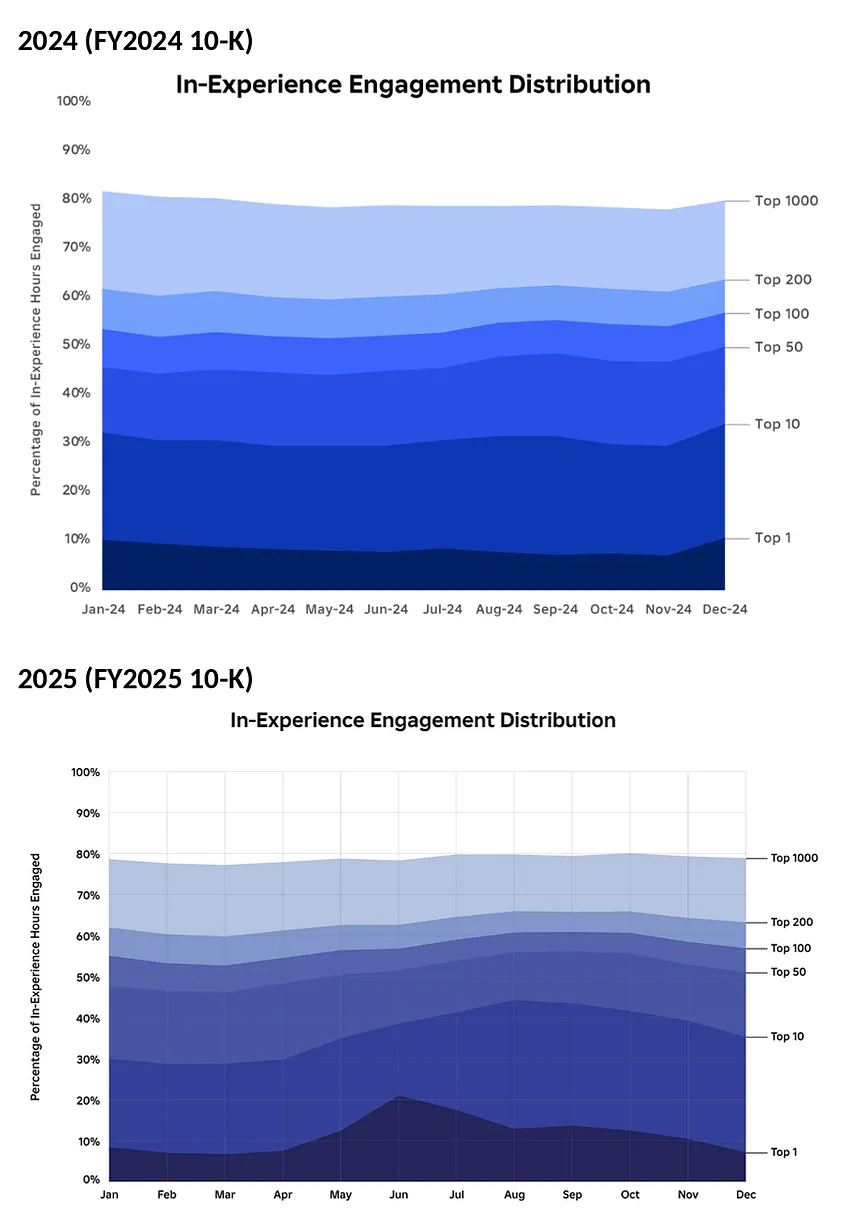
However, more games don’t necessarily mean more play, because UGC platforms concentrate play in hits. Roblox’s top 1,000 experiences accounted for roughly 80% of in-experience hours in 2024 and 2025, and visibility largely relies on its discovery algorithm.
AI-made games rely on the same kind of discovery systems to reach players. Roblox ranks games by retention, Meta says reach will depend on whether players come back, and Google’s Playground ranks games by plays and likes.
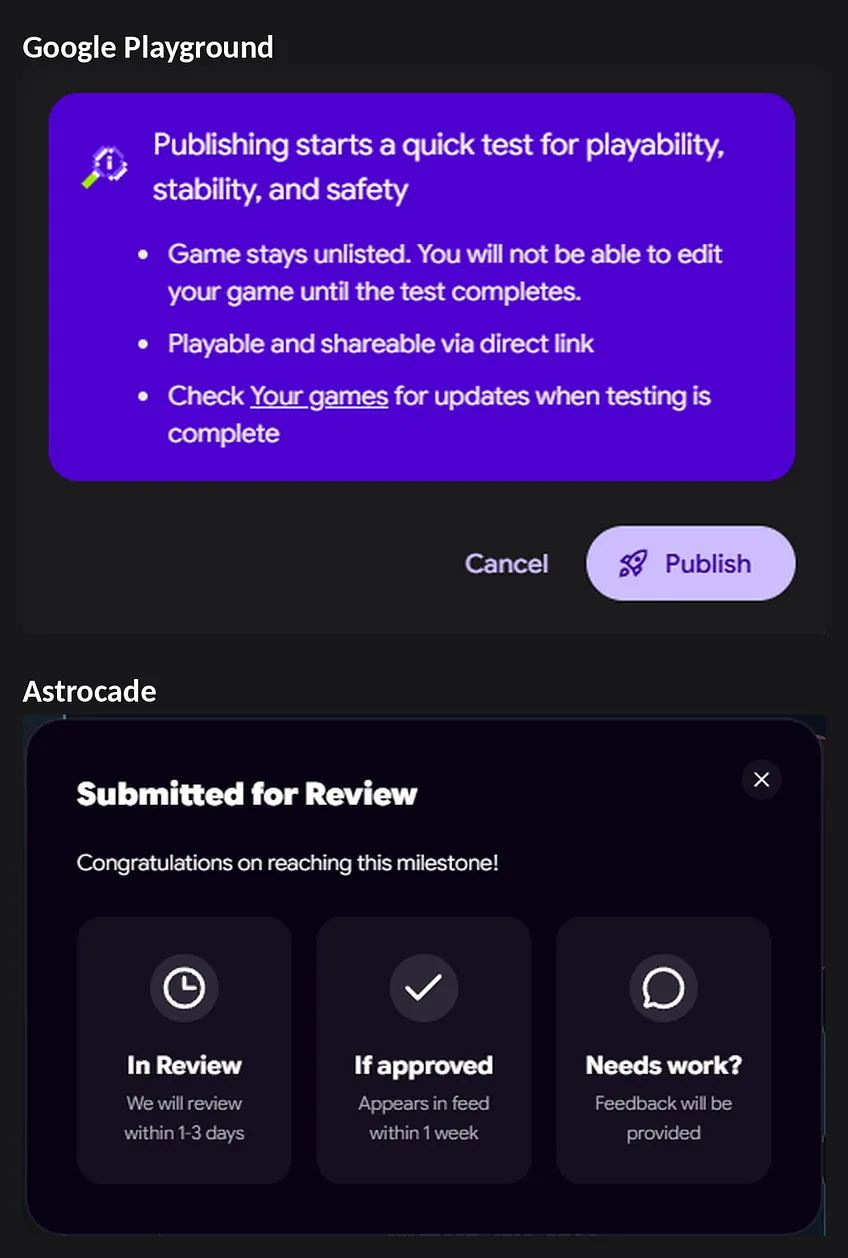
Quality is the other half of the problem. Fixed rules in in-game editors made quality checks possible. For example, Super Mario Maker and Geometry Dash require creators to beat their own level before publishing it. AI-made games have no such rules. Two of the new AI platforms check games before listing them publicly. Google’s Playground runs “a quick test for playability, stability, and safety,” and Astrocade’s team reviews games before they enter its feed. Roblox Build’s check covers safety, and Meta describes its review in safety terms. These checks evaluate whether games are safe and playable, not whether they’re worth replaying. Roblox’s own evaluation of Build highlights the gap. In one example from its engineering blog, a Build-generated obstacle course scored 100/100 on an automated playtest but received 31/100 from an automated design judge, including zero on replayability. In Roblox’s words, “it isn’t a game that anyone would choose to play twice.”
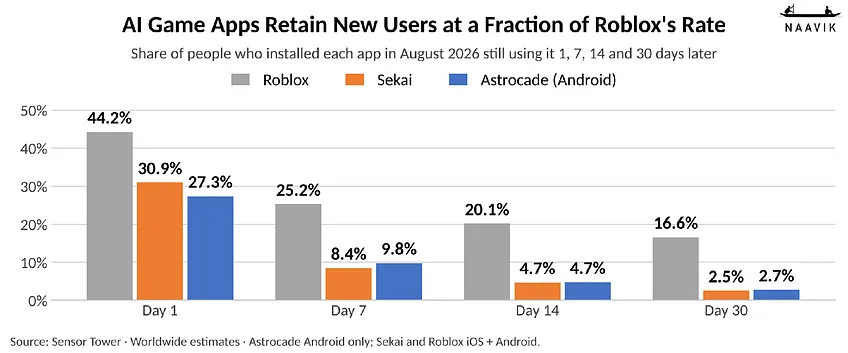
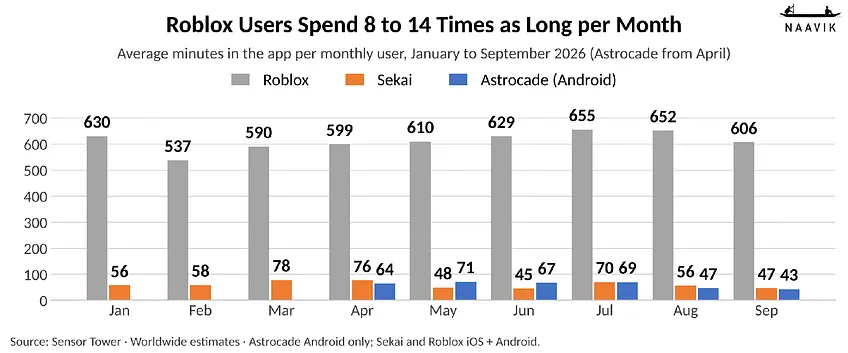
So far, the measurable player traction is limited. Sensor Tower estimates that about 3% of people who installed Astrocade’s Android app or Sekai’s app in August were still using it 30 days later, compared with about 17% for Roblox, a mature platform. Sensor Tower also estimates that, in September, the average Roblox user spent about 13 to 14 times as long in its app as the average Astrocade or Sekai user. For Roblox, Build is a feature added to an established platform. For the startups, prompt-based creation is the product, and the engagement gaps highlight how much work remains to find product-market fit.
Games as Posts
Alternatively, people may make games mainly to share with friends, as they do on social media. Sekai says its users have made 15M mini-apps, not all of them games, and Sensor Tower estimates that Sekai’s app reached about 2.9M monthly active users in September 2026, up from about 0.5M in January. Meta is testing the same idea with Pocket, a separate app from Horizon Create that lets people create, share, and remix small AI-generated experiences.
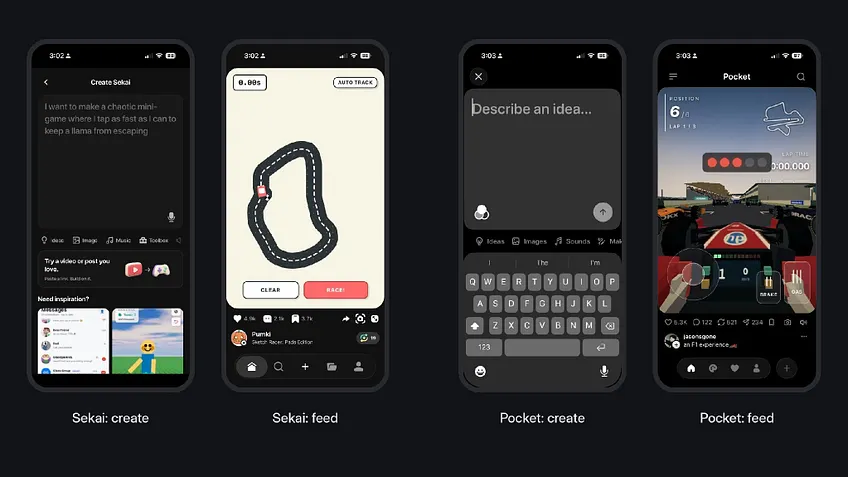
Even so, sharing only works if a creator’s friends are on the platform and play, like, and pass games on. That requires a large user base, which favors platforms that already have one, such as Meta. If sharing becomes the main reason to create, prompt-to-game platforms may look more like ad-supported social networks than like Roblox, which earns from in-app purchases.
Where Each Platform Stands
Each platform starts from a different position, largely defined by the audience it already has.
Roblox’s advantage is an audience that already plays UGC games, along with safeguards that limit the risk. Build games default to content review to reach younger players, and only rise in the rankings if players return, so weak games are unlikely to spread far. Its upside may depend on whether Build games resemble what Roblox players already play. Build currently makes only 2D and 2.5D games, while Roblox’s biggest hits are 3D. A key signal to watch is whether Build games gain traction and reach Roblox’s top rankings.
Meta’s challenge is engaging its audience with gaming content. Horizon Worlds, its earlier creation platform, asked people to come to a separate app and never found a mass audience. As Horizon lead Saxs Persson put it, the expectation that being part of Meta would bring scale “hasn’t happened.” Horizon Create takes a different approach, putting games directly in the Facebook and Instagram feeds people already use. While Meta’s apps reach about 3.6 billion people a day, there isn’t evidence yet that people scrolling those feeds want to stop and play UGC games.
Astrocade has grown quickly, but third-party audience estimates temper its headline numbers. Its CEO told GamesBeat in October that monthly active users had reached about 10M. Sensor Tower estimates Astrocade’s Android app had about 0.8M monthly active users in September; it was the company’s only mobile app then. Similarweb estimates about 2.1M website visits that month, not unique visitors. Estimates can miss play inside other apps, and Astrocade hasn’t said how it counts users; players can play without an account.
The audience composition matters too: Sensor Tower estimates that 58% of Astrocade’s Android downloads from April to September came from paid ads, and that India alone accounted for about 42% of the app’s September downloads. Neither the U.S. nor any Western European country was among its top nine markets. Its website’s audience is more mixed, with the U.S. accounting for about 13% of September visits, according to Similarweb. With 30-day retention at about 3%, the company will need significant funding to sustain paid user acquisition until retention improves.
What to Watch
It’s still early: Roblox, Meta, and Google have only unveiled their prompt-to-game products in the past few months. These platforms have shown that current AI tools can quickly produce playable games. The challenge now is to enable the creation of games that keep players coming back and get those games in front of an audience. On the second point, platforms with existing players have a head start in achieving the required network effects.
Roblox has a clear advantage, with an audience that already plays UGC games and a chance to turn more of its current players into creators. Meta has the largest reach but needs to show that people scrolling its feeds will stop to play, and Google hasn’t tied Playground to an existing game audience. Startups like Astrocade must accelerate to compete with incumbents’ scale. They must show that prompt-made games can attract and retain a large enough player base on their own, and Astrocade’s and Sekai’s retention suggest that may require significant product changes. As AI prompting tools become increasingly commoditized, the startups’ early lead in building them is likely to narrow.
For everyone involved, the potential upside is massive: building the next UGC platform that could rival Roblox. That is why we see so many investments in this space. For Roblox, Build is also a way to keep the next wave of AI creators within its ecosystem. The next few months will be essential for assessing traction on both the player and creator side and, in turn, identifying which platform is most likely to win the race.
Sponsor: Create Next Generation Game Experiences with AWS
AWS for Games gives you everything you need to build, run, and grow innovative games. Many studios rely on AWS’s 16 years of games experience to run the biggest games, including Fortnite, Roblox, and Apex Legends. You may be familiar with Amazon GameLift Servers for game server hosting or AWS solutions for game backends, analytics, playtesting, live-ops, and more. Now, AWS is applying that industry expertise to AI, leading with serverless, easy-to-operate solutions across the game lifecycle.
On AWS, you can use and customize many generative AI models, privately and securely, alongside your existing AWS cloud infrastructure and data. Amazon Bedrock is the one-stop service for governed model access, guardrails, fine-tuning, and agent deployment within any workflow. The Games industry team at AWS offers ready solutions that use Bedrock to solve game production and operations needs.
One way to build on AWS is using Kiro, Amazon’s agentic IDE that combines the flexibility and control of a visual IDE with spec-driven development and agentic integration with game engines, bug tracking, and cloud infrastructure to speed up development.
The AWS for Games team shows how these services are already used in games; do get in touch!
Learn MoreTop News Items
Epic Games Delays Disney Game and Tells Its Developers to Go "AI-First"
- Epic Games has delayed its upcoming Disney joint project, a Star Wars and Marvel extraction shooter, and told developers to adopt an “AI-first” production model. An internal email from the game’s director reportedly told the team that art should be “generated with full AI workflows” and that there should be “no more hand-written code.” The game release shifted from its March target to an unannounced later date. CEO Tim Sweeney followed the reporting with a public post on X, confirming a major internal pivot and describing it as aimed at enabling teams to build more and better content, not reduce headcount. Separately, Epic released a preview of a rebuilt Epic Games Launcher that it described as “vibe coded,” claiming it runs 46% faster than Steam on cold start.
- The delay itself could indicate that the remaining teams still need time to fully leverage AI after the layoffs. The indefinite release date makes it clear that there’s uncertainty about how much it will actually accelerate development. The reality is that retooling a studio mid-project introduces friction, training costs, and workflow disruption before any efficiency gains materialize. The launcher release aims to prove the benefits of AI development with a lower-stakes public product. If Epic ships a large-scale title built on AI-first principles and it meets quality expectations, it becomes an important case study for others. If quality suffers visibly, it becomes a cautionary tale for the rest of AAA.
Playgama Launches AI Agent Tools for Autonomous Game Iteration
- Playgama released a three-part toolset that lets AI agents publish, analyze, and iterate on HTML5 games without human intervention. Playgama MCP lets agents push builds directly from Claude Code or Codex to the platform, returning a live shareable link in minutes. Playgama Sandbox surfaces those games to players across a network claiming 450M+ monthly reach (including YouTube Playables). More importantly, the Bridge SDK feeds analytics back to the agent for automated iteration and optimization of the game itself. The intended loop is for an agent to build a game, publish it, read player behavior data, make changes, and upload a new version. Playgama’s founder framed the value proposition around second and third iterations, not first builds, arguing that real player data is the missing piece in the agentic development cycle.
- The bottleneck for AI-generated games has shifted from producing a first draft to turning that draft into something players will play for more than 5 minutes. By inserting an analytics-driven feedback loop between the agent and a live player audience, Playgama is attempting to solve the quality problem through automated iteration rather than better one-shot prompting. Data-driven iteration is useful, but it usually requires solid design thinking to interpret and use that information effectively. The HTML5 games market is more casual and has lower expectations for high-end graphics, making it a natural testing ground for this approach. If data-driven agent iteration produces even marginal retention improvements at scale, other developers will certainly at least test variations of this. The big risk is AI’s natural tendency to gravitate toward more generic, safer designs and fail to differentiate itself in the market.
Microsoft Formalizes "Xbox Labs" Team for Emerging Tech and AI Experiments
- Incoming Xbox CEO Asha Sharma formally launched Xbox Labs, a small internal team of engineers, game makers, and scientists tasked with exploring emerging technologies including backward compatibility, Apple Silicon ports, WebGL browser builds, and AI applications in gaming. The announcement directly referenced the recent wave of games being decompiled and rebuilt to run on hardware they were never designed for (as we covered recently), including the viral 128-player Halo project and browser-based ports of classic Xbox titles. In an internal memo, Sharma explained that the initiative centers on the concept that games and code share key characteristics when processed as AI agent workloads.
- Xbox Labs is ultimately structured as a response team, not a product team, an important distinction. Microsoft is trying to get ahead of bottom-up trends in AI-assisted decompilation and porting, whether or not the platform holder approves. By formalizing a group to study and potentially productize these capabilities, Microsoft is positioning itself to “embrace and extend” rather than simply push back. Given the previous “play anywhere” push, which included porting games to PlayStation in addition to Windows, exploring further expansion at least fits better with Xbox than with the other console companies. The team’s mandate to “build in the open” is unlikely to be fully realized, but it does help push back against Sony’s current predicaments from rampant jailbreaking and AI-assisted porting.
Bluesky's AI Tool Now Lets You Make Games and Apps to Share on Social
- Bluesky expanded its Attie AI tool from custom feed creation to a full site builder. Users can now describe a small social application (games, quizzes, AMAs, guestbooks, surveys) in a text prompt and receive a published, shareable page at its own attie.site URL. Bluesky CEO Toni Schneider called it “social vibe coding” or “vibe coding for your community.” Attie originally launched in March 2026 as a closed beta for building custom Bluesky feeds and has since expanded internationally. The tool builds on the AT Protocol, meaning apps are tied to users’ decentralized identities. Knowing some of its core audience might oppose the feature, Bluesky announced it on X rather than its own platform. Notably, over 150K Bluesky accounts have blocked Attie’s account, reflecting tension within a user base that partly migrated from X to escape AI-driven features.
- Bluesky’s move is less about game development and more about platform engagement strategy. Adding lightweight creation tools gives users a reason to stay and share within the network rather than linking out, something social networks often punish these days. The games and apps are simple (like Flappy Bird clones and personality quizzes), but the distribution mechanic, social sharing with built-in attribution and community feedback, is the interesting part. It wouldn’t be surprising to see something eventually show up on X, as many developers are already attempting to incorporate AI-coded games into a playable format within posts. With social discovery being potentially important for AI game development and staying on platform, multiple social networks have pushed in this direction, especially Meta and Google.
Clone Fear Goes Mainstream: Studios Pull Demos Over AI Replication Concerns
- Two studios pulled back public demos within the same week over fears of AI-assisted cloning. Alliance Arts canceled the planned Steam demo for Drunken Goddess Reflux, a horror drinking game sitting at #65 on Steam’s most-wishlisted chart, citing concerns that the demo’s content could be used to quickly replicate the game’s presentation and gameplay with AI tools before its December launch. Days later, Digital Sun (the studio behind Moonlighter) narrowed the playtest for its upcoming title ReVamp from a public Steam build to a limited Discord session, specifically naming the recent wave of games being reverse-engineered and cloned via LLMs as the reason. Both studios framed the decision as a risk calculation: the marketing upside of a public demo no longer outweighs the threat of a vibe-coded clone beating the original to market.
- The rise of AI cloning capabilities is becoming a major point of contention for indie developers already struggling to compete in a landscape of ever-increasing game releases. Public demos and Steam Next Fest appearances have long been core discovery and wishlisting tools for indie studios, especially as Valve continues to iterate on both. If perceived cloning risk makes developers hold back playable builds, studios with the fewest resources to absorb a copycat lose one of their most effective marketing channels. While Valve has been clear on AI disclosure policies, Steam’s current policies do not meaningfully penalize clone flooding. The recent Needle in a Haystack Simulator situation (where the original developer had to stamp “ORIGINAL” on their own store art to stand out from 14+ copycats) shows how difficult it has become for the platform to evaluate and moderate content. There has already been a significant increase in AI disclosure-marked game demos in the current Steam Next Fest, indicating this will likely continue to accelerate. Fortunately, smart indie developers can at least try and hold back enough detail to make game cloning require far more effort than a one-shot prompt.
Other News Items
- Steam Next Fest AI Usage Has Jumped From One In Five To One In Three
- Disney agrees to hire the majority of Character AI’s workforce
- Tencent ARC Open-Sources Multics: A Multiplayer World Model
- Nous Research Wants Hermes Agent Inside Game Studios
- Portal’s Gen8 Prompt-to-Game Maker Goes Fully Live, Funded by a Token Flywheel
- Xbox Manager Brandon Stirrup Deletes X Account After Saying Xbox Uses AI
- KRAFTON ships its own open model: Raon-1 mini
- Artificial Analysis launches AA-3D benchmark for AI-built interactive 3D scenes
- Amazon in Talks to Buy AI Startup Decart for Around $7 Billion
- Google publishes guide to building 3D games and worlds with Gemini 4 Argon
- Four Gemini 4 Argon agents beat Minecraft without any human help
- Rosebud AI goes from silent games to audio by default with Eleven Music API
- Meet the GameAnalytics AI Agent
- Google makes it easier to launch your vibe-coded apps
- Ludo.ai brings AI game asset creation into the developer terminal with new CLI
- Japan Actors Union announces guidelines addressing unauthorised use of generative AI to replicate voice performances
- Meta has some Wonder Full new AI models
- Anthropic takes on Muse with Claude Duet, its new AI agent
Content Worth Consuming
RuleSmith: Multi-Agent LLMs for Automated Game Balancing (arXiv): “As a proof of concept, we build CivMini, a simplified civilization-style game with two asymmetric factions governed by 12 tunable parameters. LLM agents interpret textual rulebooks and game states to propose actions that are validated by the game engine, yielding noisy estimates of faction win rates. Our primary implementation uses Gaussian-process Bayesian optimization with Expected-Improvement-based adaptive sampling to allocate more evaluation games to promising candidates. RuleSmith consistently finds near-balanced configurations: three independent optimization runs reach near-even empirical win rates in independent 200- and 300-game evaluations, and additional experiments with NTBEA and TPE show that the same self-play interface supports different search components.”
How Roblox Evaluates Build Game Creation (Roblox): “Tracking quality baselines across creation paradigms: We also use the framework to understand the current quality of build at different times with the most relevant evaluation set. These sets provide snapshots of increasingly broad, complex creation tasks. The earliest set consists of entirely 2D games with relatively simple mechanisms. The game logic was easy to build, therefore the playtest score tended to be higher; on the other hand, the content score remained low for the exact same reason. As we move the focus to 3D games, the score distribution shifts naturally: bug-free play becomes more challenging, reducing playtest scores.”
If AI Doesn’t Recommend Your Game Does It Even Exist? (Smart & Wright): “But I think if we do you as a gaming company and and gaming, I’ve not seen being particularly strong on sort of ChatGPT ads, bearing in mind it’s very early days and you know, it’s it’s kind of experimentation time, but it’s kind of do you drop everything to try and optimize the the where you sit in those results of, you know, I want to find another game that’s like, I like XCOM and I don’t know Midnight Suns. Do you try and optimize where you land in that now or do you think it will be way too early?”
AI Transformation Is Mostly Not About AI (Serge de Gosson de Varennes): “This is why I increasingly think that AI transformation is mostly not about AI. The models matter, the platforms matter and the technical choices absolutely matter, but most of the difficult work sits around them. It is about how the organisation operates, who owns what, how risk is handled, whether the data can be trusted, how workflows are redesigned and what the organisation is actually trying to achieve.”
The AI state of play: AI laws and game development (GamesIndustry.biz): “On one level, ownership of the output generated by an AI tool will depend on the relevant terms and conditions for that tool. But the ownership of AI-generated works is also subject to the laws of the relevant jurisdiction, which are evolving in different ways from country to country. In the US, for example, you cannot own the copyright for an image that is solely AI-generated. But you can own AI-generated works to the extent that they have been modified by a human, even if you do not own the underlying, unedited image.”