Viral Game Mash-ups: What AI Decompilation Capabilities Mean For Games
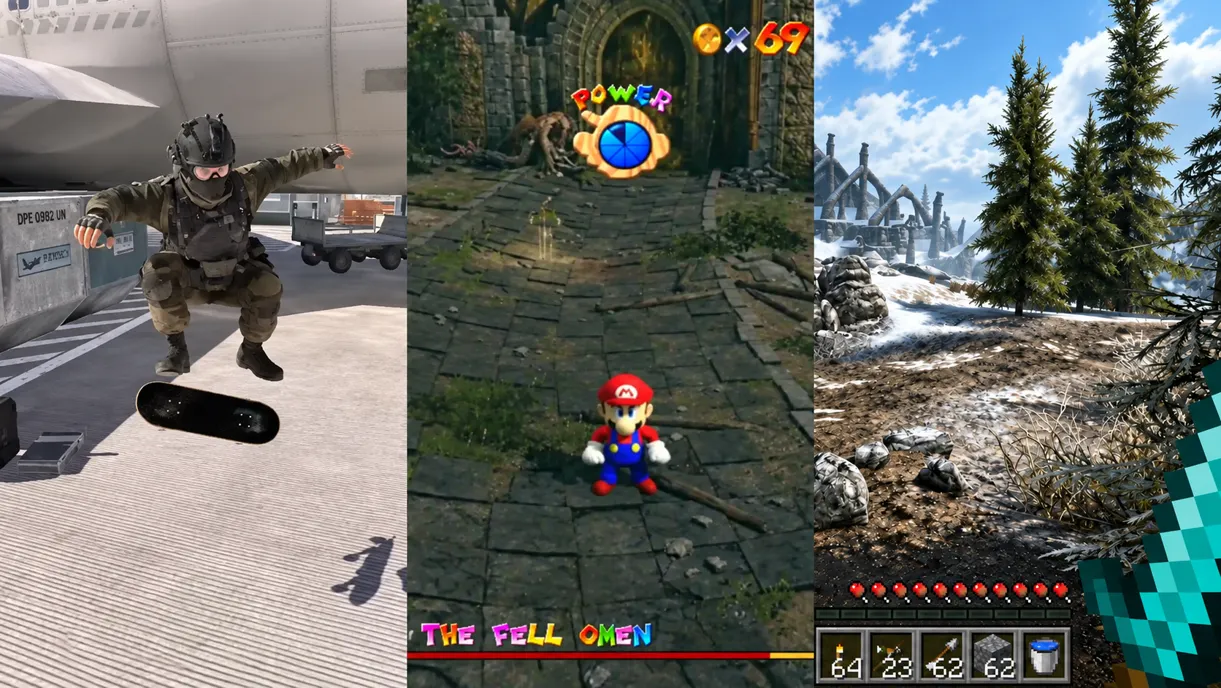
If you’ve spent any time on social media over the past two weeks, you’ve probably seen some crazy game mash-ups: a Modern Warfare operator landing a kickflip, a Minecraft creeper wandering the streets of Night City, or Mario fighting against Elden Ring bosses. These viral mash-ups racking up millions of views are coming from amateur coders who are using AI tools to decompile commercial games and stitch together characters and mechanics into playable Frankenstein experiences.
On the surface, it’s pure internet chaos. But behind the absurdity, these mods highlight some vertiginous implications for the future of games, and pretty much any software development. What happens when the barriers that used to protect source code start falling apart, with AI tools now able to reverse-engineer entire games? Let’s dig into what this new trend means, the technology behind it, and the implications for game studios.
How Did This Remix Trend Take Root? And Why Now?
To start, it’s worth noting that this trend has largely taken off on X, where users have been sharing short clips of their latest mash-up experiments. A skateboarding feature added to Modern Warfare pulled in 7.4M views, while a mod turning Minecraft into Elden Ring hit a staggering 23.3M. Further down the rabbit hole, we’ve seen monstrosities fusing multiple games together, from Mario 64 to Portal.
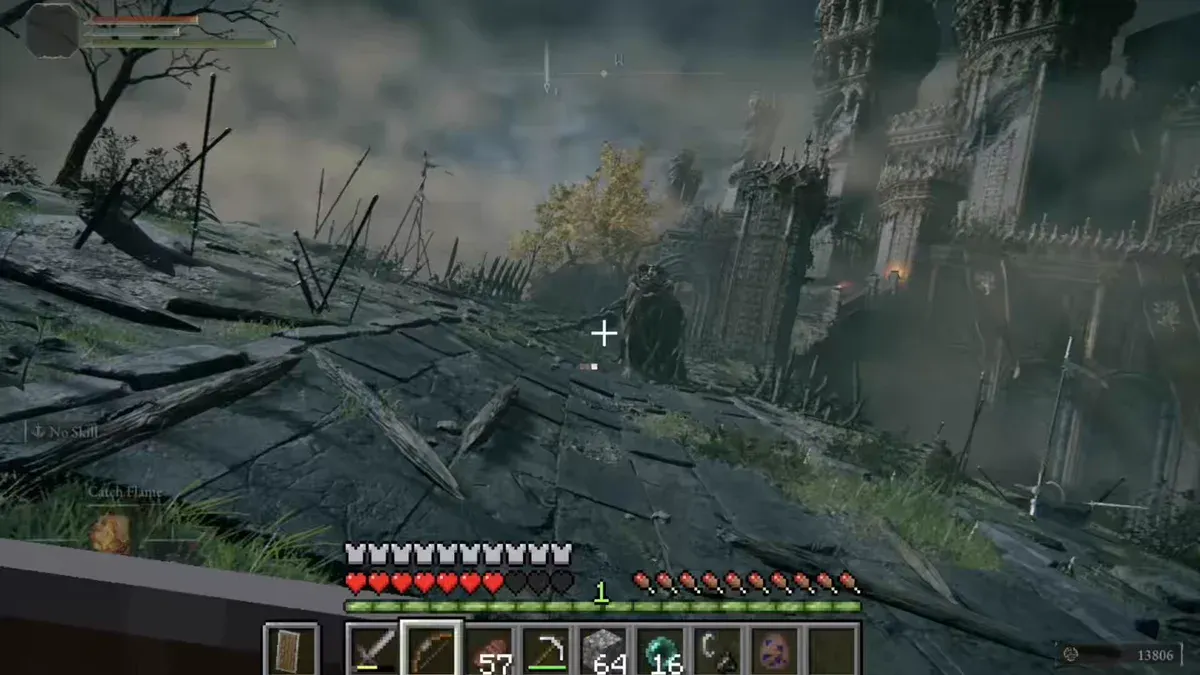
Many of these are rough prototypes, some are outright broken, and some are not even available to play. But dismissing them would be a mistake. The capabilities are broad (merging characters, gameplay loops, and beyond), and they’re accessible. Pretty much anyone with limited technical knowledge can take a swing using a simple AI prompt.
The game remixing trend quickly expanded beyond mash-ups. Users have rebuilt P.T. entirely, a PS4 game created by Kojima and originally released by Konami, making it natively playable on PC and positioning it as a game preservation initiative. Another user made GTA V playable in browser, yet another made a native port of Bloodborne on PC, fully bypassing PlayStation’s historic walled gardens.
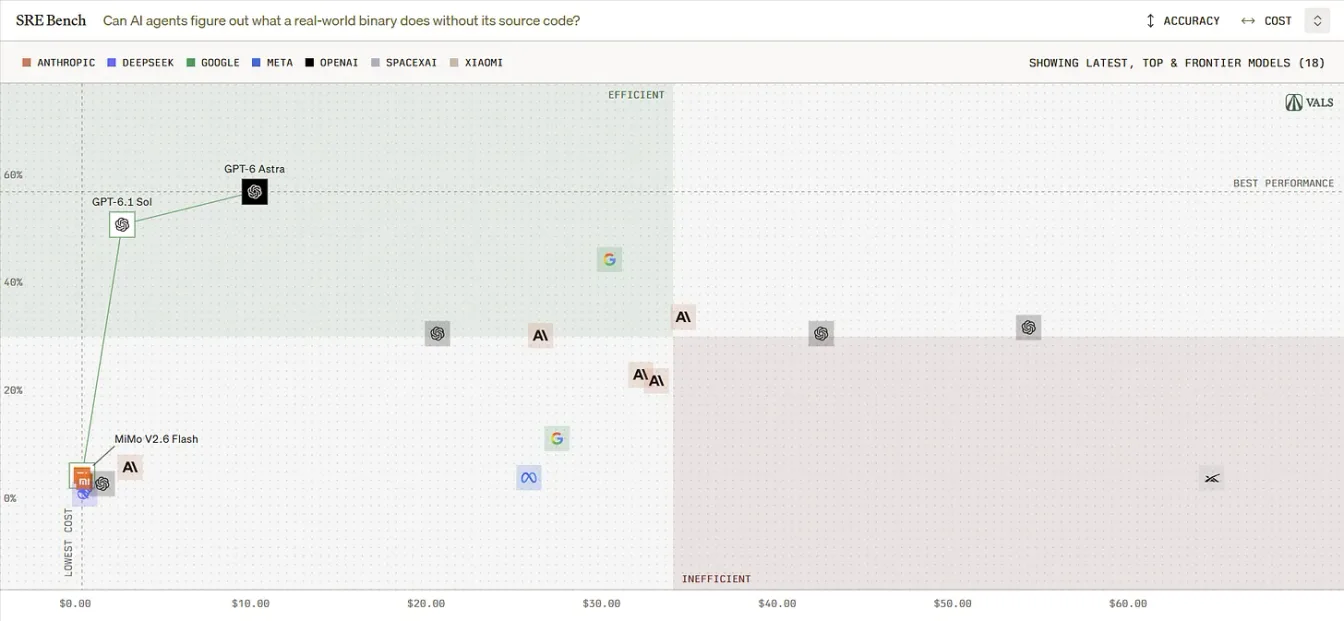
The trend has been fueled by a clear technical inflection point. First came GPT Astra in early September, which blew past competing models on the SRE benchmark, the go-to measure of a model’s ability to reverse-engineer software. Then, in late September, Anthropic’s Claude Opus 5.5 lowered the cost of entry with cheaper tokens and sharper coding performance. It has become the model that mash-up creators most often say they rely on.
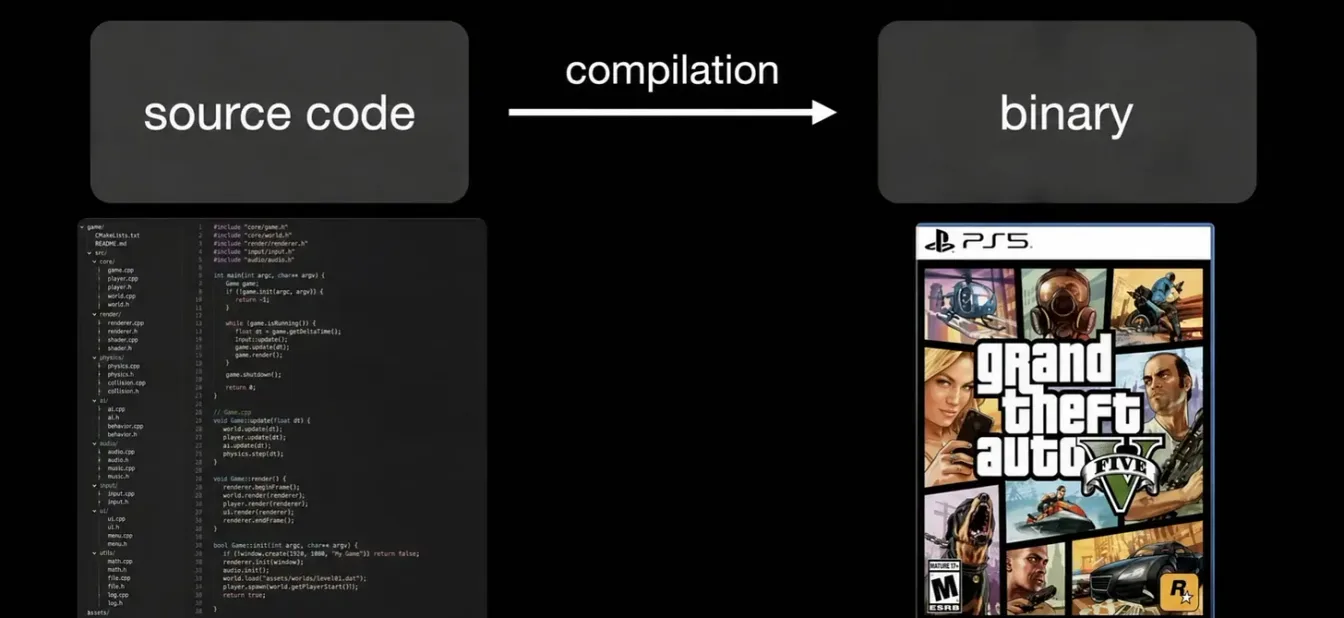
To further understand this technical unlock, it helps to step back and look at how games, and really most software, reach players in the first place. What a consumer downloads is never the game’s source code. It is a binary, the output of a process called compilation, which machines can execute easily but humans struggle to read. Think of source code as the recipe, the human-readable instructions developers write, and compilation as the baking that turns those instructions into something a computer can execute. Decompiling is like tasting a cake and trying to reverse-engineer a recipe that gets you the same result. It is possible, but historically it has been hard, slow, and expensive.
What the latest AI models do is radically accelerate the decompilation process. An agent drafts a plausible version of a function by analyzing the binary. The system then recompiles it with the original compiler and compares the resulting machine code byte by byte against the original. It then repeats the process until it finds a perfect match.
AI doesn’t change the method so much as it industrializes it: since most functions can be solved independently, multiple agents can run in parallel, turning years of effort into a matter of days. Ultimately, this erodes the protection between a shipped product and its source code. This website tracking game decompilation progress, which was previously driven by human effort, had marked 13 games as “Decomps” complete before September; since then, 24 more have already been completed. However, a full decompilation remains a tedious process. Maurice Heumann, who decompiled Modern Warfare 2 using Claude, reports using up to 17 agents and 235B tokens over 11 weeks.
From Decompilation to Pass-Through Remix and Game Ports
These emerging initiatives don’t rely solely on full decompilation; instead, they use a range of techniques. We recommend this video for a detailed overview, but in short, users rely on three main techniques:
- Pass-through mods: These mods don’t need to rebuild a game from the ground up. Instead, they translate actions and physics from one title into another. Think of a pass-through mod as a live interpreter sitting between two games running at the same time: it watches what happens in one and instructs the other to perform a matching action. Tools such as Universal Modder and Reverse Engineer Anything (REA) give Claude the ability to create pass-through mods end to end, including a dedicated “mashup-mods” skill. Both grew quickly in popularity, reaching 5.8K and 32.8K stars on GitHub, respectively, in just a handful of days.
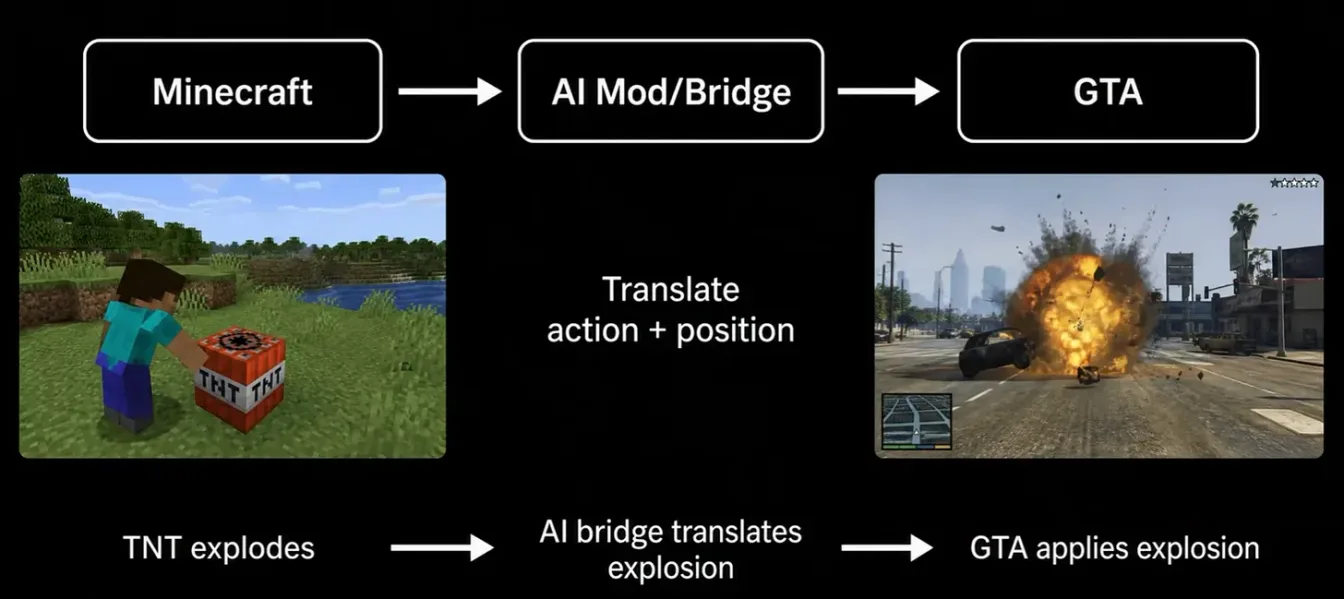
- Porting mechanics: Rather than decompiling a full game, AI can isolate specific mechanics (Mirror’s Edge’s parkour, a skateboarding game’s physics, etc.) and rebuild them inside an entirely different title, like Skyrim or Modern Warfare. Rather than running the original game in parallel, as pass-through approaches do, the destination game reproduces the behavior on its own. This approach is far more versatile, particularly for teams trying to understand what makes a competitor’s game tick and then replicate, remix, or improve on it in their own projects.
- Complete Decomps and Recomps: At the far end of the spectrum sits full decompilation, in which AI tools help reverse-engineer a game entirely and then rewrite it as a complete replacement codebase, often in Rust. This is a much more complex undertaking, but it gives developers far more control over how the game runs and lets them rework substantial portions of it. The process still starts with an original copy of the game, with tools such as Ghidra (originally developed by the NSA) supporting the reverse-engineering work. Once a game is decompiled, porting it to new platforms, such as web or VR, becomes easier, as shown by Mario Galaxy running in VR below and by the various projects working to bring PS5 titles to PC.
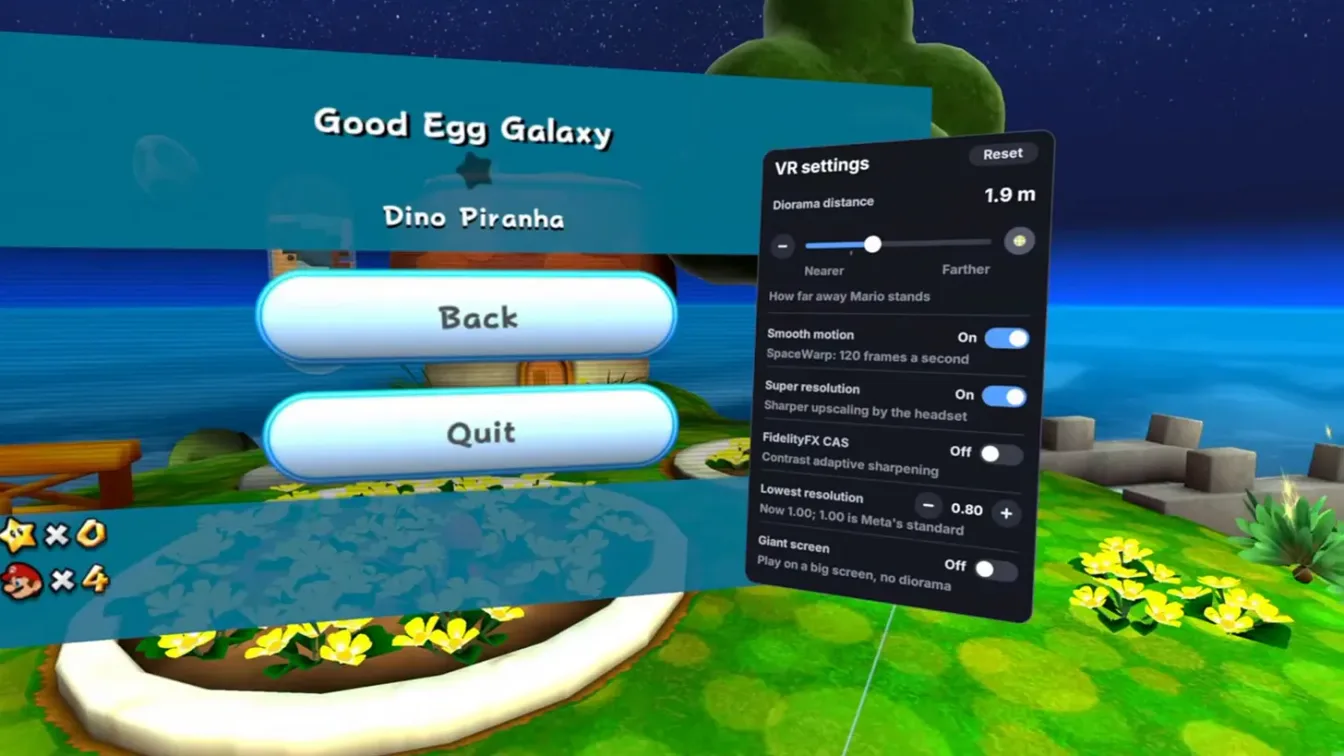
Remixing games is already as simple as entering a one-line prompt drawing on publicly available repositories. Melty takes this further by packaging the workflow into a no-code platform: an MCP that builds mash-up mods from games a player already owns, paired with a discovery layer for browsing what others have made. The barrier to entry for editing and remixing games is already minimal, paving the way for broad consumer adoption.

What’s the Actual Potential Behind These Remix Mods?
It’s easy to dismiss the trend by arguing that nobody actually wants to play these kinds of remixes. As Kotaku pointed out, combining two games doesn’t automatically make the result fun, especially when features lifted from one title don’t fit cohesively into the other. But beyond overlooking how much these experiments could improve over time, the quality argument largely underestimates the existing niche of players who already engage with mash-up and remix content or have their own ideas about what they want to play.
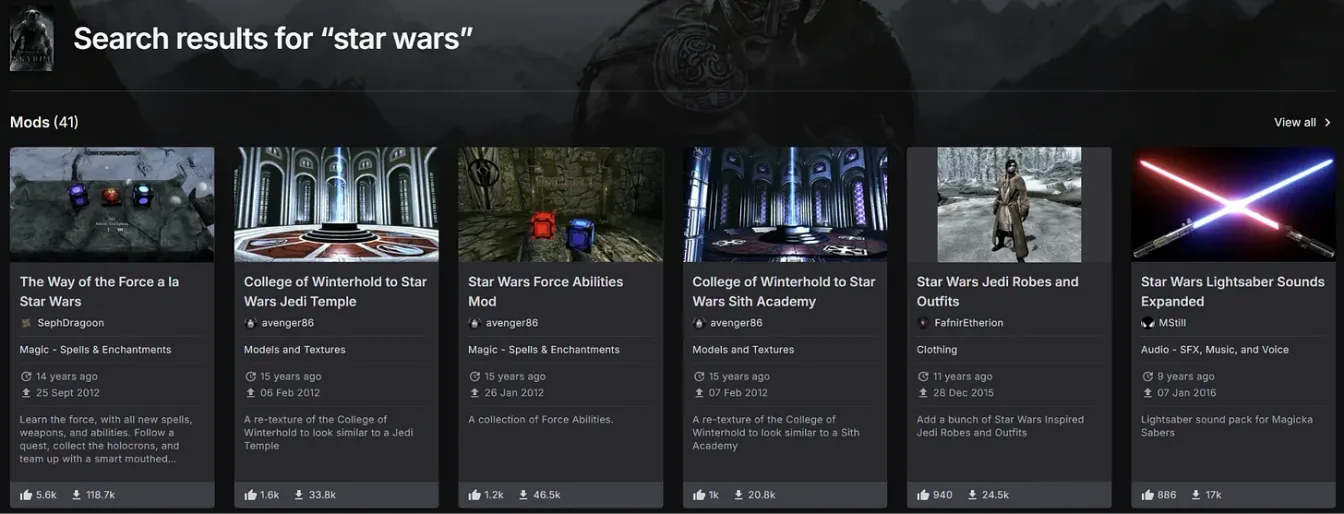
Swapping in assets from other IPs has been standard practice in modding for decades (Star Wars in Skyrim being one of many examples). The Pokémon community is another strong indication: ROM hacks and fangames sustain a subreddit of more than 261K followers, with breakout projects like Pokémon Uranium exceeding 1.6M downloads and PokeRogue nearing 50K PCCU. In that context, it is far from absurd to imagine that experiments like this Pokémon x Balatro mashup could find an audience, even if niche.
Then there’s the legal question. On the surface, this looks like an IP nightmare. Publishers have already moved: the MW2 decompilation tweet was taken down following a copyright claim, and a similar Fallout modding project got the same treatment.
The reality is more nuanced. Decompiling isn’t illegal in itself. Rulings such as Sega v. Accolade and Sony v. Connectix established that certain forms of reverse engineering can qualify as fair use. But that protection doesn’t automatically extend to distributing or selling a reconstructed copy of the game. Most game license agreements explicitly forbid reverse engineering. Private customization may attract less enforcement, but less enforcement isn’t the same as legality, and several questions remain genuinely unsettled. Publishers taking down mods isn’t new, and Nintendo has historically been quite reactive, but the pace might have just radically changed with these new AI-enabled capabilities. If decompilation barriers continue to diminish, we might reach a Napster moment for games, in which game software is widely available for free across ecosystems.
More immediately, though, the act of creating and experimenting with remixes could become a trend, independent of whether anyone ever plays the result. Just as DJing and mixing have long served as a gateway into music production, accessible remix tools could do the same for games. A low-stakes, highly gratifying entry point gives people their first taste of game creation and funnels them toward actual game development.
What Happens From Here?
This is another case where “this is only the beginning” applies, especially as efficiency keeps improving and barriers to entry are likely to collapse further in the months ahead. It’s also worth noting that games are just the tip of the iceberg. Nearly every category of software is exposed. We’ve already seen people replicating parts of the Adobe suite. Saying the software ecosystem is becoming entirely open-source is likely an overstatement, but at the very least, proprietary source code is becoming less of an obstacle.
In gaming, cloning is about to get cheap. How do you protect distribution advantages when production itself stops being a moat? Producing a credible knockoff used to take a lot of time and capital. NetEase’s Hyperfront and Tencent’s Light of Motiram, which drew heavily from Valorant and Horizon Zero Dawn, respectively, relied on large internal teams with deep technical and art pipelines. If a competitor can replicate your core loop and launch version 1.0 while you’re still tuning retention in a soft launch, does the soft launch still make sense? Should simultaneous launches across platforms and languages become the default, at risk of leaving money on the table for copycats?
Similarly, it means that players will be able to make their own ports, remasters, or even remakes. How do walled gardens stay walled when the walls can be climbed by anyone with a capable AI model? We can imagine techniques to slow reverse engineering, but ultimately this becomes a game of whack-a-mole, with publishers and platforms alike forced to constantly update their responses.
Takedowns alone won’t solve this either, especially at a time when publishers are increasingly embracing UGC and modding ecosystems as the way to build and sustain communities. Where exactly is the line between acceptable and unacceptable modding, and how do you communicate it without alienating players? Publishers will have to figure out how to capture the engagement opportunity while keeping it contained within their own ecosystem, with clearly stated boundaries.
This might be the closest we’ve been to the Ready Player One metaverse idea, where IPs and franchises coexist seamlessly. Historically, remix culture, piracy, and fan games have been accessible but have largely stayed on the sidelines. AI may or may not rewrite that history, and we’d caution against strong predictions either way. What seems far clearer is where defensibility migrates: away from proprietary code and gameplay loops and toward strong, recognizable IP and brands. Plus, in a world where the supply of games explodes because anyone can make anything, distribution advantages will remain more important than ever.
Sponsor: How is agentic AI reshaping the future of gaming?
At GDC 2026, leaders from EPAM, Xbox, SEGA, and PlayStation Studios discussed how agentic AI is moving from helping write code to delivering whole features, and from scripted dialogue to acting as a game director. Highlights:
- Faster prototyping: Xbox’s Haiyan Zhang describes agents that can take “a holistic end-to-end feature” and deliver it.
- Living worlds: Games that adapt to a player’s “personality, choice, even mood,” in the words of EPAM’s Vitalii Vashchuk.
- Craft still wins: PlayStation’s Ryan Valenza says a person “without taste or craft” using these tools “will never reach the bar” of a skilled creator.
- A new QA playbook: Treat player-facing generative AI “like an online service,” and load test it.
They also discuss a new genre of “AI games” and why text-based adventures and MUDs may be coming back.
Explore the Future of AI in GamingTop News Items
Google debuts new ‘experimental’ AI game platform named Google Playground alongside Unity Spark
- Google launched Playground, a browser-based platform where US users 18 and older can create, play, and share games by prompting. Unity also announced Spark, a browser creation tool running on the Unity runtime, which will allow for deployment to Google Playground in closed beta later this year, with a waitlist open now. The two companies are pursuing a form of cross-promotion as Google brings the AI models (Gemini, Nano Banana, Lyria), distribution with Play Games profiles, leaderboards, matchmaking, and promotion across its billion-user products. Unity brings the engine and a direct pipe into the Asset Store to allow for both 2D and 3D games. Unity CEO Matt Bromberg explicitly rejected “one-shotting,” positioning Spark as a tool for iterating toward real games.
- This platform targets AI-native UGC competitors like Astrocade, which just passed 10M monthly players. While the tools themselves are interesting, there’s the question of whether Google will surface creations in Search, YouTube, and Play. Some of this will also depend on whether actual games worth playing can be produced with the tool, as the initial wave is still primarily lightweight clones of existing concepts. Unity’s smartest move is the Asset Store tie-in, as AI-generated games still need art, and Spark turns Unity’s marketplace into the content layer, opening a new demand channel for asset sellers. A core missing piece is pricing and monetization. Pricing is unfinished (a free tier plus paid levels), and nothing has been said about creator payouts. Without a monetization path, Playground likely stays uncompetitive, but it’ll be interesting to see what games get made and to what extent the company flexes its distribution muscles.
Japanese Heavyweights Capcom and Sega Draw AI Lines
- Two of Japan’s biggest publishers both recently laid out their AI positions. At its RE:2026 conference, Capcom detailed REX, a staged overhaul of its RE Engine designed to make the codebase readable to AI tools. It includes an autonomous play AI for QA, LLM-assisted log search, and open-sourced components (RE:Dox, RE:Log) partly meant to give AI systems training material. RE Engine itself has powered more than 27 titles and is used by over 2,000 Capcom developers. Days later, Sega’s Tsuyoshi Saito told Nikkei that Sega uses AI for publishing, corporate work, and business ideas, but it’s “very cautious” in development and won’t hand creative work to AI. Both companies say no AI-generated assets will ship in their games.
- The companies are taking different approaches, however. Capcom delivered an engineering plan aimed at its biggest cost centers (QA, debugging, data handling). If it works, shorter development cycles could make its franchise-revival strategy more profitable. Sega, on the other hand, was a bit more vague in its current and future use of AI in games. Its Crazy Taxi: World Tour team said AI was used only for early reference, and fans still treated that as crossing the line. In general, Japanese developers have put a lot of emphasis on AI not existing in the end product for players. This contrasts with Chinese developers that seem to be open to exploring where AI can make sense in the pipeline, which can include creative content. Given the scrutiny from the general gaming community, it’s likely that clarifying statements from Japanese developers will continue as necessary to ease into some level of inevitable use.
Dreamlands and Thrixel Launch New AI 3D Tools
- Two AI 3D platforms launched this week with different angles on using AI for 3D asset and world generation. Dreamlands opened its 1.0 platform on Google Cloud Marketplace, offering one-click restyling, automatic material detection and swapping, procedural building and city generation, mesh cleanup, LODs, and plugins for Unity, Unreal, UEFN, Roblox, Blender, and Maya. Its showcase is a three-person studio, co-founded by Neal Stephenson, that rebuilt a Regency-era estate in Fortnite from photographs. Thrixel, from UChicago researcher Rana Hanocka (MeshCNN, Text2Mesh), raised $3M and generates 3D assets in the form of multiple hierarchical parts instead of single fixed objects, such as a car with separate wheels, doors, and chassis. The goal is to allow AI agents to work with these pieces more interactively for real-time assembly, animation, and scripting in Roblox, Unity, Unreal, or Three.js.
- Both companies aim to offer tools that are more useful in the development pipeline than simple 3D assets to import. Dreamlands is selling cheap iterations, or as Stephenson put it, when an edit costs a dime, teams keep polishing instead of shipping “good enough.” Thrixel, on the other hand, is providing smart structure, betting that in the near future agents are more likely to be implementing assets than artists. Both companies are also drifting toward platforms (Dreamlands wants its own play experience; Thrixel has Build World), putting them in competition with the engines they plug into. The company is also up against well-funded and constantly evolving AI 3D asset creation rivals like Meshy, Tripo, and Tencent’s Hunyuan3D to build a moat around a pipeline-specific approach.
Ubisoft’s ‘Motherbrain’ Gen-AI Now Serves as a ‘Global Entity’ Across Ubisoft
- Ubisoft detailed its recent “Motherbrain” trademark filings as part of a real push across the company to integrate AI. Motherbrain will supposedly operate as a group-wide entity that pushes generative AI into Ubisoft’s games, building proprietary middleware for generative gameplay that each of its studios will build on. The goal is to integrate various forms of generative AI in as many games as possible where it makes sense. Ubisoft is in its “third and final” restructuring phase, seeking another €180M in savings. This initiative is likely intended both to cut costs and to share resources across the company. Developers already say generative AI is being used at every stage of production, although specific details aren’t shared.
- It’s TBD how exactly Ubisoft will deploy AI across its games. It’s a noteworthy zag from a Western developer, as many of its peers are more conservative in how they voice AI usage publicly, as it can lead to player backlash. We’ve also seen with companies like Take-Two Interactive that centralized approaches to AI deployment are tough to make work, but perhaps the shared technology approach could lead to more productive outcomes. Ubisoft also has a long history of trying out new technologies (whether VR games or blockchain integrations) that ultimately go nowhere and cost the company focus. Ultimately, as much as AI can help reduce staffing needs, Ubisoft needs to focus the restructuring on streamlining its existing talent. Unfortunately, management hasn’t shown its ability to make those decisions unless tied to further investment, destroying massive value in the process. Any gains from AI will be needed, but Ubisoft must carefully navigate the risk of player rejection.
Other News Items
- AMD acquires Fei-Fei Li’s World Labs for $8.2B
- AI-built unofficial GTA V WebAssembly port taken down within hours
- Sony Patent Describes Bosses That Learn From Your Reaction Times and Retries
- General Intuition raises another $220M at $6.2B valuation for training models with game data
- Rémy Portelas leaves Ubisoft LaForge for imec AI Lab in Paris
- Sony introduces AI upscaling to base PS5; Marvel’s Wolverine and Ghost of Yōtei are first games to implement new tech
- Wizards of the Coast union expands, protests generative AI usage
- Astrocade hits 10M monthly players for its AI-assisted UGC casual games platform
- Engram is a sampler that turns broken AI hallucinations into music
- AI short film The Gifted wins $3.5M Xprize and chance to become feature movie
- Modulate raises $25M for native AI-based frontier audio
- Meta open sources code to let you make Muse AI gadgets
- The AI Tamagotchis are coming
- Audible will soon let you talk to audiobook characters with new AI feature
- ChatGPT’s ‘Intelligent UI’ update fills its responses with pictures, charts, and buttons
- Google announces Gemini 4 and says it’s so capable that only ‘trusted cyber defenders’ can have it right now
Content Worth Consuming
Learnings from coding AI games under 13 KB (Chainsaw Team): “This is an even bigger problem with AI development, which increases our ability to add things simply by asking agents to implement more features that seem fun in our heads but are not really fun once played.In this case, however, the size constraint forced us to start with streamlined and elegant designs. We got playable MVPs that already provided a vision of the final content less than an hour after starting the jam. Furthermore, feature creep was much easier to spot when everything had a size cost and the limit was so small.”
How a 3-person team is using AI to recreate Pride and Prejudice in Fortnite (Gamesbeat): “In Whenere’s vision for this next chapter in the world of fan fiction, creators are able to write a scene in a web-based editor, then watch characters perform it live in Fortnite. The studio leaned on Dreamlands, an AI startup built on Google’s Gemini models and largely hosted on Google Cloud, to generate much of the furniture and décor and maintain historical accuracy. Laur described her and Stephenson’s vision behind the studio’s mission. “We started Whenere because we wanted to shorten the distance between imagining a story and seeing it come to life in a 3D world,” she said. In the game, creators will get to set the scene, place the characters and write the dialogue themselves, then publish their custom-built Pride and Prejudice fan fiction.”
A Business That Turns RMB 2M into 50M Is On Fire — But AI Games Are Still Doing Token Labor (Unique Research): “Model capability is now adding leverage to this business. Sun’s judgment: as text and video models get stronger and production cost falls, ordinary people’s creative energy will be unleashed. On his own platform, there are already many non-professional creators—”maybe stay-at-home moms.” His endgame: original authors build the rules and framework; the audience enters that content world, makes derivative creations within the framework, tunes plot branches, and forms their own version. The consumer is simultaneously the creator. The more they participate, the deeper the emotional projection—and that participation itself is consumption value. This balances the interactive movie-game ledger on another level: users are not just consuming content; they are producing it.”
Can AI Generate a Real 3D Game? What I Learned in Four Months at Microsoft Copilot (LinkedIn): “Building with AI doesn’t mean taking every suggestion it gives you. It means using what it gives you to make your own calls — on architecture, on product direction, on what’s worth building and what isn’t. AI is leverage on your judgment. It is not a substitute for having any. And one thought about OPE itself: I think the model matters more than my project. As AI lets one person do what used to take a team, the bottleneck shifts — from how many people you can hire to how clearly you can think. OPE is the first structure I’ve worked in that’s built around that reality. It’s lonely, it’s exhilarating, and I’d do it again immediately.”
What happens when players love an AI-Made game? (Gamesbeat): “Gaming won’t settle this debate by deciding whether AI belongs in development. That question is becoming less useful as adoption grows. Players will settle it by deciding which uses they find acceptable, and they will make that call about a specific game they already like, on a storefront, in the middle of a release week. Not on a panel. The industry has a narrow window to define those boundaries while the conversation is still theoretical. Studios, platforms, and players need clearer distinctions around consent, disclosure, and acceptable production use before commercial success starts defining those boundaries for them. Once the first genuinely great AI-heavy game is sitting at the top of the charts, those distinctions will be much harder to draw in the middle of a hit.”