Discord’s Path to IPO Needs Game Developers
In January, Discord confidentially filed for an IPO, making it the most important gaming-related listing since Roblox. The company heading toward its public-market debut looks quite different from the one that last raised money in 2021 at a $15B valuation: co-founder Jason Citron stepped down as CEO last year and was replaced by Humam Sakhnini, a former vice chairman of Activision Blizzard, while its new chief business officer, Jules Shumaker, led advertising at EA, Zynga, and Unity.
That reshaped leadership team reflects a shift in who Discord thinks its customer is and where the growth to propel it through IPO will come from. For most of its history, Discord focused on serving and monetizing gamers themselves, primarily through Nitro subscriptions. Now, as CTO Stan Vishnevskiy recently put it, the company has “made developers into a second primary customer” through ads, game commerce, and a social SDK. Discord has courted game developers as customers to varying degrees in the past; what is different this time, and what does it mean for Discord as a public company?
Discord’s User Base: The Product to Sell to Game Developers
Discord reports more than 90M daily active users, with over 90% playing games. But the composition of that gaming audience matters as much as its size. Among the 100 largest public servers on the platform, 38 are dedicated to Roblox games, accounting for 35% of the total audience across the top 100. The Steal a Brainrot server (7.4M members) is nearly twice the size of Marvel Rivals (4.1M) and considerably larger than Valorant (3.0M). Most of the remaining top 100 servers are PC and console titles, with a notable cluster from Chinese publishers operating games in international markets. NetEase, HoYoverse, Kuro, and Tencent all run servers in the top 100.
Approximately 20% of the combined audience across the top 500 servers belongs to communities that are not directly gaming-related. This includes social hangouts, AI tools (Midjourney was widely used through Discord in 2022–23), and communities centered on popular IPs and streamers. Many of these “non-gaming” categories significantly overlap with gaming, echoing Discord’s own statement that 90% of its users play games.
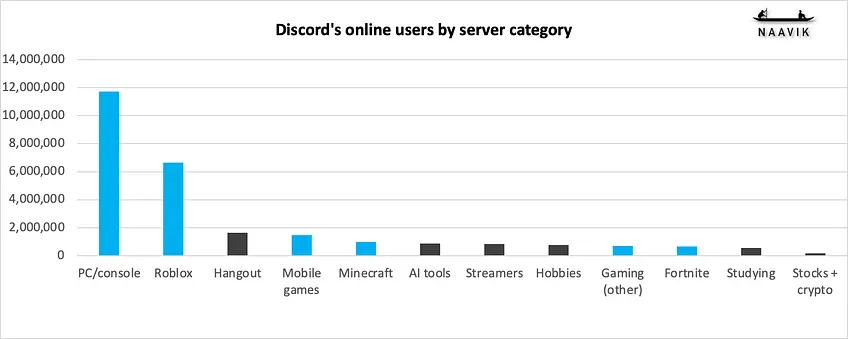
It’s worth noting that public servers are only a slice of Discord’s overall activity, as much of it takes place in small, private friend groups. These membership counts are also cumulative, not measures of active users. Still, the picture is clear enough: Discord’s audience is young and highly engaged, with a strong concentration around Roblox and live-service PC and console games. Beyond gaming, it also serves as a community platform resembling a communication service like WhatsApp. That audience is the constant in Discord’s story. What is changing is how Discord monetizes it.
A Decade of Monetizing Gamers
Discord’s monetization story began with the Nitro subscription. Launched nearly a decade ago, the $9.99-per-month plan (with a $2.99 Basic tier) offers a combination of status and utility: larger file uploads, higher-quality video streaming, custom emoji usable across servers, profile customization, and “boosts” that upgrade a favorite server. According to Discord’s SVP of Product, the strongest predictors of a user subscribing are time spent in the app, time in voice chat, and the number of friends who already have Nitro.
Every product Discord has launched since has built on top of Nitro, rather than attempting to replace it. In 2018, Discord began selling PC games through its own store and shortly afterward allowed developers to sell games directly through their servers. It also bundled a game catalog into Nitro, but removed it a year later because few subscribers played the titles. The broader sales effort faded as well.
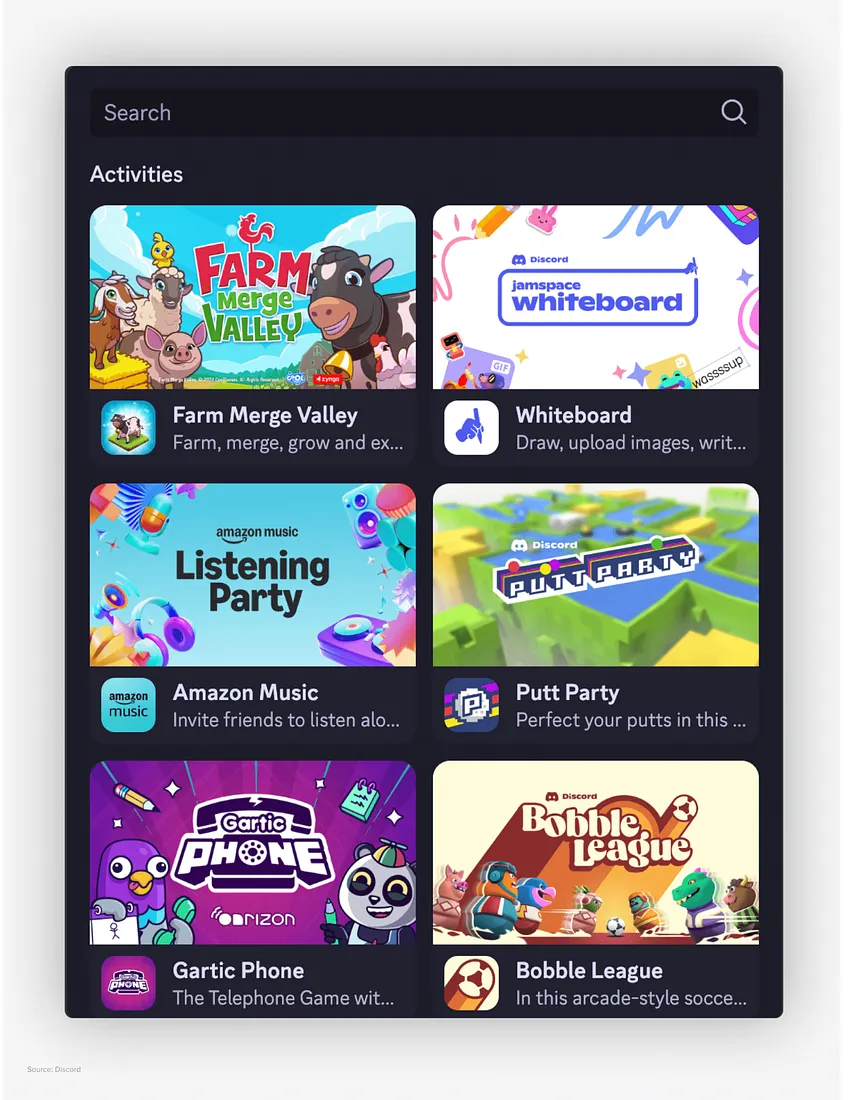
Discord’s second attempt to court developers came with Activities, which launched in 2022 as a handful of first-party games playable within voice calls before opening to all developers in 2024. The pitch, prominently described by Discord investor a16z, evoked Facebook-era social gaming: instant distribution for casual games across Discord’s social graph. Some games have found audiences: Playroom’s Death by AI reportedly peaked at 700K daily players, ScoreSpace’s Blackjack claims 1.2M monthly players, and a licensed version of Wordle is also available.
These games share three characteristics: they are short, social, and work well with friends on a call. Activities has yet to produce lasting hits or games with meaningful depth or monetization. Discord also appears to have deprioritized the product, judging by its limited presence in developer marketing materials over the past year. Today, Activities looks less like the next Facebook platform and more like a venue better suited to small studios with limited commercial ambitions. For example, Distinct Possibility Studios’ five-person team launched a card game there last month after its AAA shooter failed.
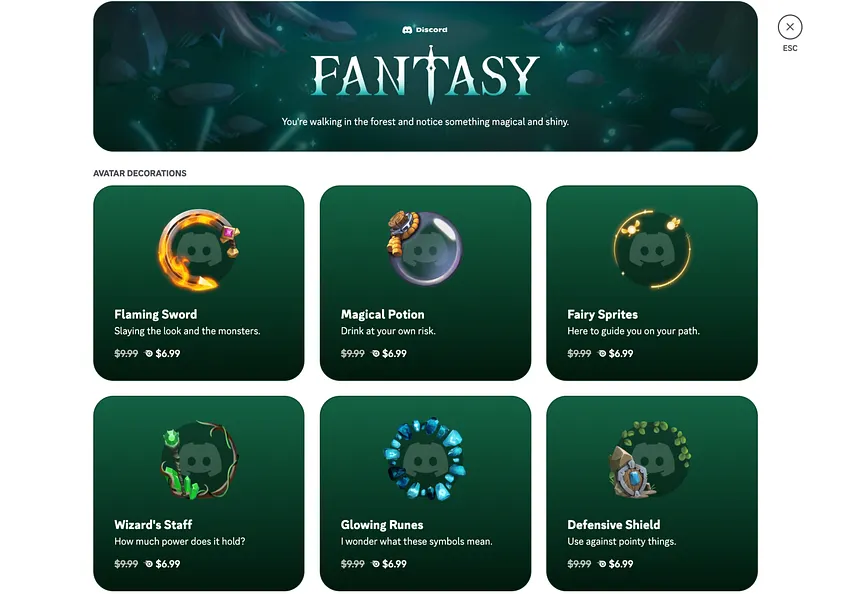
What has stuck is anything that deepens Nitro. The Shop, added in 2023, sells profile cosmetics like avatar decorations and nameplates, with Nitro subscribers as its main customers. Introduced last year, Orbs are a currency that users earn by completing sponsored “Quests” and can be spent in the Shop or on short Nitro subscriptions. This May, Nitro Rewards bundled in a starter tier of Xbox Game Pass and hardware discounts, with the stated goal of making Nitro “the must-have gaming membership.”
The New Pitch to Game Developers
Discord now offers three new developer-facing products. Most importantly, the Social SDK underpins the other two. Launched in March 2025, the SDK is free to integrate and lets developers bring Discord’s friends list, presence, invites, and voice chat directly into their games. Players must also link their game accounts to their Discord accounts. Discord claims that linked players demonstrate a median 34% increase in retention across more than 15 games. Marvel Rivals, Rust, ARC Raiders, and Battlefield have integrated the SDK. In May, Discord extended it to Roblox games like Steal a Brainrot and Grow a Garden, though the move prompted some pushback from Roblox. This data is valuable to Discord: account linking lets it know what users play, when they stop playing, and which friends they play with.
That engagement data also helps power Discord’s ads business. Launched in 2024, Quests are opt-in rewarded ads that offer players cosmetics or Orbs in exchange for playing a game for a few minutes or watching a trailer. In September, Discord also announced an auction-based Ads Manager and a mobile-first, 15-second Video Quest, with self-serve buying planned for early 2027. The advertisers so far are mostly PC and console launches (DOOM, Diablo IV, Street Fighter 6), with established mobile publishers like Scopely and Supercell also testing the waters. Film studios, Wendy’s, Walmart, Mountain Dew, and e.l.f. have also bought Quests.
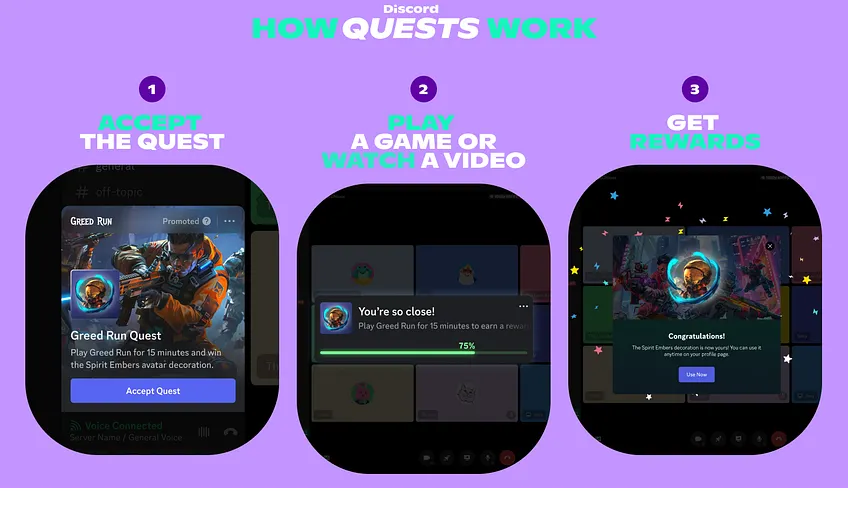
Mechanically, this puts Discord in the same category as rewarded UA platforms like Mistplay. These platforms pay players for hitting in-game milestones and, according to one vendor, now account for 25% of some mobile studios’ UA spend. However, Discord’s rewards are status items that cost it almost nothing, not gift cards that eat into the margin of mobile-focused rewarded UA, and its users are younger core gamers rather than older, mobile-heavy social casino or 4X players.
Because Discord can easily target lapsed players, about half of campaigns focus on reactivation instead of driving installs. Early results appear encouraging: AppsFlyer reported a 30% drop in CPI for a Marvel Snap campaign. Discord describes the channel as high-performing, but with relatively limited reach. Even as the business scales, it is likely to remain highly effective at reaching engaged, valuable players, but its reach will remain inherently limited by the size of that audience.
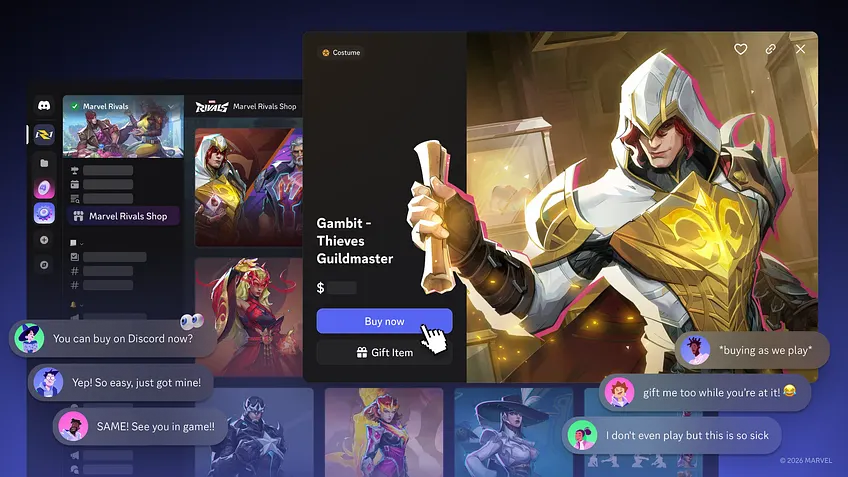
The third product is commerce. Select developers can sell in-game items through their official Discord servers, allowing players to wishlist items and gift them to friends. In the Marvel Rivals pilot, Discord says 41% of purchases were gifts, with a quarter of those gifts going to lapsed or non-players. The pilot ran over the holidays, and Discord did not disclose sales volumes.
There are several ways to interpret Discord’s strategy. Most obviously, it is a way around platform fees, much like any other web shop. Discord’s social graph, particularly its gifting feature, gives developers a powerful way to reactivate lapsed players and reach new ones at higher margins. This is compounded by the fact that Discord is often home to the most engaged and valuable players a developer can reach.
This may explain how Discord’s stated “zero take rate” could work: the company treats Nitro like a shopping membership, selling a subscription that provides access to discounted goods. Game studios effectively fund these discounts using the margin they would otherwise surrender to Steam or console platforms, while Discord benefits from the resulting subscription growth. Discord could eventually charge developers for visibility through sponsored shop placement or Quests that lead directly to purchases, while still taking a smaller cut than competing platforms.
What Kind of Public Company Is Discord Becoming?
The obvious comparison is Reddit, another community-driven social platform. Reddit has 130M daily users and generated $895M last quarter alone, 95% of which came from advertising, with an adjusted EBITDA margin of 45%. Discord’s last reported annual revenue was roughly $890M in 2024, with most of it coming from consumer subscriptions. Its revenue per user was also well under half of Reddit’s. Reddit’s $19–20B market cap is approximately twice Discord’s implied secondary valuation of $8.5–10B.
In that respect, Discord looks more like Twitch, the other gaming-native audience business. A decade into its life inside Amazon, Twitch reportedly still derives about two-thirds of its revenue from viewers and only a third from ads. Its viewership has been shrinking. In some ways, Discord’s product is less exposed to the distribution risks facing Reddit or Twitch. Most of Reddit’s daily users are logged out, and a significant portion of its web traffic comes from search — a source increasingly exposed to declining referrals in the era of AI chatbots. Discord’s usage, by contrast, centers on logged-in friends communicating directly. This makes it less dependent on search traffic and potentially stickier than the engagement patterns seen on Reddit or Twitch.
How big could ads get? Reddit monetizes search-driven intent to a broad range of advertiser categories. Discord primarily sells access to a gaming audience to gaming advertisers, and that market is not growing quickly. AppsFlyer estimates global gaming app UA spend reached $25B in 2025, up less than 4%, with U.S. budgets actually declining. Each percentage point represents $250M, meaning Discord would need to capture roughly 3–4% of global mobile gaming UA spend to match its existing consumer revenue. Alternatively, it could expand into PC and console advertising or attract non-gaming advertisers. That is achievable over time, but it describes a gamer-oriented subscription business with a growing ads line, not a Reddit.
Riding a Flat Industry
The larger question for investors is whether Discord’s fortunes can be separated from those of a games industry that is barely growing outside of Roblox and China. However, Discord is well positioned in a number of ways: Roblox communities fill its largest servers, while Chinese publishers are among its first commerce partners and most active SDK adopters.
The bigger opportunity for Discord is whether it can truly position itself as gaming’s most valuable marketing and community channel in an era of effectively infinite game supply. In that environment, the channels that coordinate demand are better positioned than ever. Giving developers access to Discord’s social graph could be one of the most effective ways to connect an effectively infinite supply of games with finite, increasingly valuable player demand. Discord’s early efforts to become a growth channel appear promising, and ecosystem companies like Levellr have already found success here too.
For a decade, Discord has successfully monetized gamers without making them feel like the product. If Discord can establish itself as a premier growth and commerce channel for games, while building on a highly successful consumer subscription business and the engagement of a utility-like social app, its future could be very promising indeed.
Sponsor: 15M Players Use Medal to Share Gaming Moments and Discover New Games
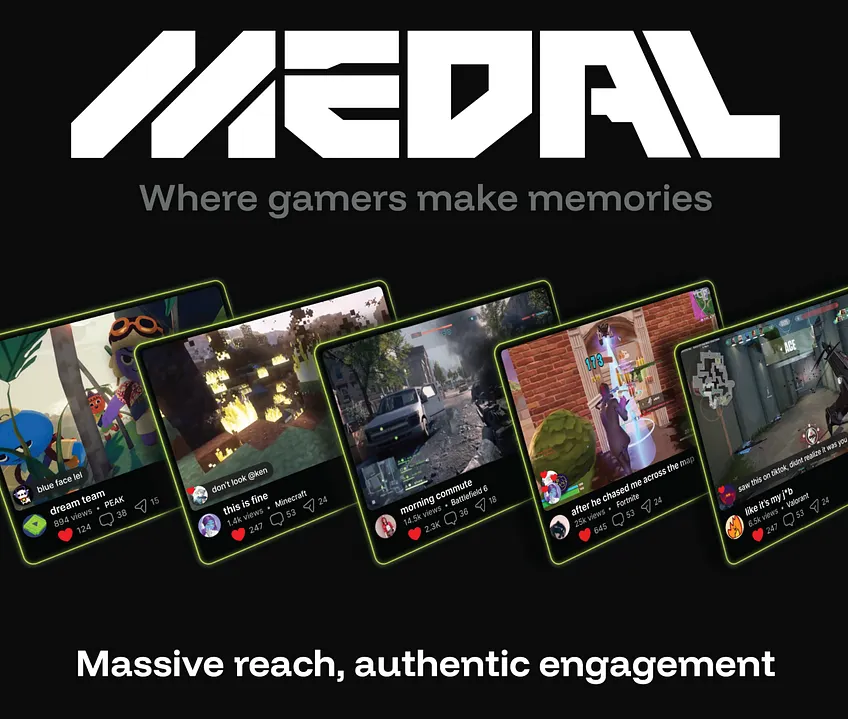
Medal is the fastest way to clip, save, and share gameplay on PC with 15M+ MAU. With 3M+ players sharing clips weekly, Medal is the world’s best place to reach high-quality gamers. Medal’s network isn’t just uniquely gamer, but uniquely primed to amplify those games. Players come to Medal to discover new gaming content; they clip, post, and share, turning your game’s moments into word-of-mouth at internet scale. Every week, millions of clips are shared, quietly driving your game’s discovery across all genres and studio sizes, from micro indie to AAA. These moments last forever and are sincere, scalable, and shareable.
Medal is a team of fast and scrappy gamers tackling one of the biggest problems in the industry — discovery. If you are ambitious, love games, and want to help define how the next generation of players find and share the games they love, Medal is hiring.
Learn MoreIn Other News
Funding and M&A:
- India-based AI-native media and entertainment company EloElo Group has raised $80M
- Japan-based fandom infrastructure company OPENREC has raised $8.8M
- Lego Digital Play has acquired ForthStar, a Manchester-based mobile game studio founded by the creators of Golf Clash to expand its presence in the mobile games market
- China approves Savvy Games Group’s Moonton acquisition
- Games developer and publisher My.Games has signed a definitive agreement towards a management buyout from its sole shareholder, Alexander Chachava
- South Korean game company DoubleU Games has agreed to launch a cash tender offer to acquire the remaining shares of DoubleDown Interactive that it does not already own
Business & Product:
- Krafton Q3 revenue rises 11.6% despite decreases in PC and console segments
- Skydance announces layoffs to games division following $111B merger
- Bandai Namco closes Reflector Entertainment, expects to post €21M loss in Q3 as a result
- Take-Two Q2 net bookings fall 18% to $1.6B as NBA 2K27 misses forecast but GTA 6 pre-orders are “tracking far in excess” of expectations
- Playtika rules out sale and will continue as independent company
- Apple’s new iOS terms in the EU are live: What alternative app stores now mean for game studios
Miscellaneous:
- Layer launches Motion Designer Agent: Game studios can now create campaign-ready UA videos just by chatting
- What the Digital Fairness Act means for the games industry
- UKIE CEO Nick Poole bullish on games industry’s investment prospects
- The PlayStation Plus PC app is shutting down next month
- Aream & Co’s Kartik Prabhakara: Mobile gaming has shifted East
- PlayStation ends development of Ratchet & Clank: Ranger Rumble mobile game
Content Worth Consuming
“There’s No Such Thing as Easy Money in Our Business” – Strauss Zelnick on GTA 6, BioShock, Take-Two’s Acquisition Plans, and Reviving Old IP (gamesindustry.biz): “Take-Two Interactive reported the earnings for its second quarter today, and GamesIndustry.biz had a chance to talk with CEO Strauss Zelnick about the results, as well as where the company is headed. Naturally, all eyes are on Grand Theft Auto 6 right now, the launch of which next week could be not only the biggest game launch of all time, but the biggest entertainment product launch of all time in terms of revenue. Pre-orders are currently at nearly 8 million, according to Sensor Tower.”
Why Minecraft Is a Genre, Not a Game (ft. Stampy & 4J Studios) (The Game Business): “This week we’re joined by Dundee-based game developer 4J, the creators of the Minecraft: Console Edition, to discuss its new Minecraft-rival: Reforj. The team, which includes legendary Minecraft YouTuber Joseph Garrett (aka Stampy), believe that Minecraft is a genre, and that there’s room for another one built for modern audiences. We also chat the arrival of AI prompt-based platforms like Meta Horizon, the state of video game financing, going from YouTube to game design, when to listen (and not listen) to the community, and a whole lot more.”
How Star Wars: Galactic Racer Was Built (The AIAS Game Maker’s Notebook): “Adam Orth chats with Matt Webster, Co-Founder & CEO of Fuse Games and Craig Derrick, Executive Producer at Lucasfilm Games. Together they discuss how the Star Wars license allowed them to create a racing game not tied to tires on asphalt; why and how they implemented roguelike elements into the game design; track design and making each race feel like a roller coaster; and creating game feel with both mechanics and atmosphere.”
The Bing Gordon Episode (Gamecraft): “Bing Gordon — legendary co-founder of EA and venture capitalist at Kleiner, Perkins — stops by to talk to us about the new book he has written with his daughter Chlöe: Everybody Wins. The book is a master class on gamification, with relevance to both a gaming and general business audience. Bing is our first-ever guest on the podcast, and it was an absolute delight to interview one of our game industry heroes. Mitch and Blake have a wide-ranging, candid conversation with Bing about the big ideas in his book, and in the process discuss EA, Zynga, Duolingo, AI, the current state of the games business, and many, many other topics.”
Block Blast Exposed: The 45M DAU Game That Prices YOU Before You Even Play! (two & a half gamers): “Block Blast is one of the biggest games on mobile: ~45–50M DAU (peaking around 60M), 100% ad revenue, built by Hungry Studio with a team of ~200 people, many of them on ML. A viral teardown by an independent researcher (briefly taken down) claimed to show what happens server-side, and enough of you sent it to us that we had to talk about it. According to the teardown, your Block Blast isn’t the same game as the one on the phone next to you. Hundreds of traits from a pool of 700+ get downloaded after install, outside what app review ever sees. Then an on-device model reads 27 inputs (country, recent ad prices, RAM, install source, even your first high score) and prices you. In the example, the same phone was worth a $25 eCPM in the U.S. and $8 in Brazil.”
Discord: A New Public ‘Hot Spot’ for Game Discovery? (GameDiscoverCo): “We talk about an important discoverability change for Discord servers, why average wishlist count increases in October’s streaming showcases were slower than earlier in the year, the significance of a game citing dev costs in increasing its post-launch default price, and what Roblox’s latest results say about the platform.”