Online Blackjack in Australia: Real Money Games, Rules and Casino Guide
Casino Brand
Welcome Offer
Play Now
WildTokyo
250% up to €5,300 + 600 FS
Betninja
Welcome Package of A$4,000 and 100 free spins in Big Bass Bonanza
HellSpin
100% up to AU$300 + 100 Free Spins
Spirit Casino
100% up to $3,000 + 200 FS
Slotsgem
120% up to 5,000 AUD + 250 FS
Winshark
A$4,100 + 300 FS
We have not independently verified these advertised offers. Currency, eligibility, wagering requirements and withdrawal terms must be checked against current operator documentation.
Why Blackjack Strategy Matters More Than Pokies Luck
Online blackjack Australia attracts players who want to understand the rules of 21, compare casino games and learn how blackjack strategy affects the house edge. Unlike pokies, blackjack involves decisions that influence the mathematical outcome of each hand. The rules of the dealer, number of decks and blackjack payout ratio can all affect the expected return.
This guide covers blackjack online Australia, including real money game formats, live dealer tables, basic strategy, RTP, casino bonuses, payment methods and withdrawal restrictions. It also compares nine casino brands selected by our team and explains the Australian legal framework.
For anyone who wants to play blackjack online in Australia, there is one important legal distinction: Australian law prohibits operators from providing online casino blackjack to people physically present in Australia. The casino comparisons below are informational and do not establish that any operator is legally authorised to provide this service.
Real Money Online Blackjack Australia: What Should You Know?
Blackjack is a casino card game where the player competes against the dealer. The aim is to finish with a hand closer to 21 than the dealer’s total without exceeding 21.
Numbered cards count at face value. Jacks, queens and kings count as 10, while an ace can count as either 1 or 11. A natural blackjack consists of an ace and a ten-value card as the first two cards.
Blackjack Rules and Player Actions
Whether you study online casino blackjack or use a free practice game, the main player decisions are the same.
Blackjack Action
What It Means
Example
Hit
Take another card
A total of 12 against a dealer’s 10
Stand
Keep your current total
A hard 17 against a dealer’s 6
Double Down
Double the initial bet and receive one more card
A total of 11 against a dealer’s 6
Split
Divide an eligible pair into two separate hands
Two 8s
Surrender
Forfeit half the original bet, if permitted
A hard 16 against a dealer’s 10
Bust
Exceed 21
Drawing a 9 with a total of 15
Blackjack
Receive an ace and ten-value card as the first two cards
Ace + king
These examples illustrate the actions rather than prescribe the best decision in every situation. The correct choice depends on the game’s rules and the dealer’s visible card.
How Does a Blackjack Round Work?
A standard blackjack round follows five steps.
-
Place a bet. The table has minimum and maximum wager limits.
-
Receive two cards. The dealer also receives cards according to the game rules.
-
Choose an action. Hit, stand, double down, split or surrender where available.
-
Complete the dealer’s hand. The dealer follows fixed rules, usually drawing on 16 or lower.
-
Compare totals. The winning hand is determined by the final totals and blackjack rules.
The dealer normally stands on a hard 17. However, the treatment of a soft 17, such as an ace and a six, varies between tables.
Blackjack Payouts: 3:2 vs 6:5
A natural blackjack traditionally pays 3:2. Some casino tables instead offer 6:5, which reduces the payout for the same winning hand.
The difference is easy to see with the following examples.
Initial Bet
Profit at 3:2
Profit at 6:5
Difference
A$5
A$7.50
A$6
A$1.50
A$10
A$15
A$12
A$3
A$25
A$37.50
A$30
A$7.50
A$100
A$150
A$120
A$30
These figures represent the profit on a natural blackjack, excluding the return of the original stake.
Changing a table from 3:2 to 6:5 increases the house edge by approximately 1.39 percentage points when the other rules remain identical. That is a substantial difference in a game where the house edge under favourable rules and correct basic strategy may be around 0.5%.
Online Blackjack Real Money Australia
Players who search for online blackjack real money Australia will encounter several variants. Although the objective remains the same, deck count, dealer rules, splitting options and special payouts can differ.
The following table compares common blackjack formats.
Blackjack Variant
Typical Rules
Main Difference
Classic Blackjack
Standard hit, stand, double and split options
Traditional blackjack format
European Blackjack
Dealer initially receives one card
Different dealer-card procedure
Vegas Strip Blackjack
Commonly four decks with 3:2 payouts
Specific dealer and splitting rules
Atlantic City Blackjack
Commonly eight decks with late surrender
Additional surrender option
Spanish 21
Removes the four ten-spot cards from each deck
Special player rules and bonus payouts
Multi-Hand Blackjack
Multiple hands in one round
Several simultaneous wagers
Progressive Blackjack
Standard blackjack plus optional jackpot side bet
Separate progressive jackpot feature
Live Dealer Blackjack
Physical cards and a dealer on video
Real-time table presentation
The exact rules vary by provider and table. A game labelled Classic Blackjack does not automatically offer the same RTP as another game with that name.
Classic, European and Vegas Strip Blackjack
Classic Blackjack uses familiar player actions and dealer rules. European Blackjack typically starts with the dealer holding one card rather than a face-down hole card. This can affect how certain doubles and splits are resolved when the dealer later completes a blackjack.
Vegas Strip Blackjack is commonly associated with four decks, 3:2 natural blackjack payouts and dealer rules that stand on soft 17. However, individual software versions may differ.
Atlantic City and Spanish 21
Atlantic City Blackjack commonly uses eight decks and allows late surrender. This gives players an additional option to forfeit half a wager in eligible situations.
Spanish 21 removes the four ten-spot cards from each deck but introduces special rules and bonus payouts. Standard blackjack strategy charts are not suitable for Spanish 21 without adjustments.
Multi-Hand and Progressive Blackjack
Multi-Hand Blackjack allows several hands in the same round. Each additional hand creates another wager, so the total amount at risk increases.
Progressive Blackjack adds an optional jackpot side bet. The jackpot feature has its own probability and house edge, separate from the main blackjack game.
Live Blackjack Casino Online
A live blackjack casino online uses a real dealer, physical cards and video streaming. Players can observe the dealer shuffle, deal and settle hands in real time.
Live tables may use traditional shoes or continuous shuffling machines. They can also differ in minimum stakes, maximum bets, dealer rules and the number of seats.
The visual presentation does not determine the mathematical value of a table. The rules remain the most important factor.
Online Blackjack Casino Comparison
A useful online blackjack casino comparison should consider more than welcome bonuses. Blackjack payout ratios, deck count, dealer rules, game contribution, withdrawal limits and verification procedures can affect the overall experience.
Our team compares nine casino brands based on their advertised offers, blackjack rules and withdrawal conditions. Their inclusion is not an endorsement, and the listed terms do not establish current Australian availability.
Lizaro Casino: Large Advertised Welcome Package

Lizaro advertises a welcome offer of 250% up to €3,000 plus 350 free spins. The headline amount is substantial, but the percentage and maximum bonus do not establish its practical value for blackjack.
Before assessing this offer, the relevant questions are whether blackjack contributes towards wagering, whether table games are excluded and whether bonus funds are subject to maximum bet restrictions.
We have not confirmed Lizaro’s current blackjack table rules, withdrawal performance or eligibility for Australian residents.
OnlySpins Casino: Deposit Bonus and Extra Rewards
OnlySpins advertises 100% up to A$750 plus 250 free spins and one Bonus Crab.
Each component may have separate terms. Free spins are generally associated with pokies rather than blackjack, while other bonus features may have specific game eligibility or withdrawal restrictions.
The advertised package does not establish the quality of OnlySpins’ blackjack games or its payment processing.
Spirit Casino: VIP Blackjack and Enhanced KYC
Our team examines Spirit Casino for its VIP blackjack options, promotional terms and withdrawal conditions.
Spirit Casino advertises a welcome offer of 100% up to $3,000 plus 200 free spins. Available descriptions also mention VIP live tables, including Salon Privé-style games, and possible withdrawal limits of up to $20,000 per month; we have not verified these conditions.
From a mathematical perspective, the key question is whether an individual VIP table uses S17 rather than H17. All else equal, S17 generally reduces the house edge by approximately 0.2 percentage points.
We also examine surrender availability and enhanced verification for larger withdrawals. Claims about notarised documents, proof of wealth or delayed payments remain unconfirmed and should not be treated as established operator practices.
Our assessment focuses on compare the specific VIP table rules and the current source-of-funds and withdrawal policies.
Asino Casino: Smaller Advertised Welcome Cap
Asino advertises 100% up to A$500 plus 200 free spins.
A smaller maximum bonus is not necessarily worse than a larger one. The practical value depends on the qualifying deposit, wagering requirement, eligible games, expiry date and maximum withdrawal.
We have not confirmed Asino’s current blackjack availability, live table rules or payout performance.
WildTokyo Casino: Live Software and Withdrawal Restrictions
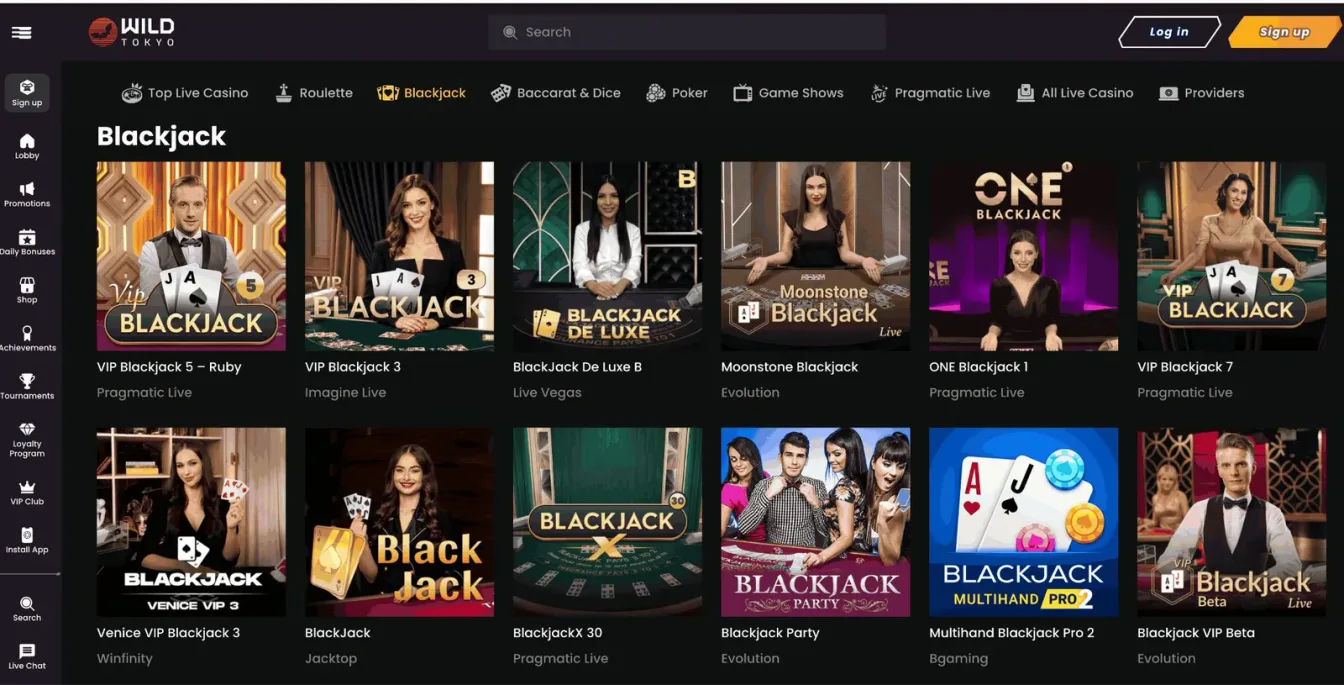
WildTokyo is described as offering live casino content from Evolution, Pragmatic Play and Ezugi. These providers operate blackjack games with different deck counts, dealer procedures and betting limits.
We consider eight-deck shoes, H17 rules and approximately 50% shoe penetration when assessing individual blackjack tables. We cannot assign these characteristics to every WildTokyo game without checking its rules.
Available terms suggest a possible basic-account daily withdrawal limit of approximately $800 or €500 and a 50x welcome bonus wagering requirement. We have not confirmed these figures. Blackjack may contribute only 5% or nothing towards that requirement.
For example, a $10,000 balance subject to an $800 daily limit would require at least 13 daily withdrawals, assuming no other restrictions. If withdrawals are processed only on business days, the total period could be longer.
Our assessment focuses on the actual table rules, cashout limits and blackjack bonus contribution.
Winshark Casino: Free Bet Blackjack and Payment Rules
Our team focuses on Winshark’s Free Bet Blackjack rules and payment restrictions.
Free Bet Blackjack allows certain free doubles and splits. However, the game compensates for these benefits through the Push 22 rule. If the dealer finishes on 22, most remaining player hands push rather than win, except natural blackjack.
The exact house edge depends on the complete Free Bet Blackjack rules. The effect cannot be reduced to a single universal percentage.
Available descriptions indicate a possible daily withdrawal cap of approximately A$900 or €500 for some accounts, plus restrictions that favour the original deposit method for withdrawals. We have not independently confirmed these conditions.
For example, a card deposit followed by a crypto withdrawal request may trigger additional checks if the operator requires payment-method matching.
Our assessment focuses on free Bet Blackjack rules, withdrawal limits and payment ownership requirements.
HellSpin Casino: Bonus Bet Limits and Blackjack Payouts
Our team examines HellSpin’s blackjack payout ratios and potential bonus maximum-bet restrictions.
The mathematical issue is the difference between 3:2 and 6:5 natural blackjack payouts. Under otherwise identical rules, 6:5 increases the house edge by approximately 1.39 percentage points.
Available promotional descriptions indicate a possible maximum bet restriction of A$8 or €5 during certain bonuses. The exact application of this restriction to doubles and splits must be checked in the relevant promotion terms.
For example, a $5 initial bet followed by a split creates $10 in total wagers. Whether that breaches a maximum-bet clause depends on how the operator defines the limit.
It would be inaccurate to claim that every split automatically violates the bonus terms or results in confiscation.
Our assessment focuses on the precise maximum-bet wording, game contribution and actual blackjack payout ratio.
Slotsgem Casino: Deposit Turnover Requirements
Our team examines a possible 3x deposit turnover requirement at Slotsgem, potentially applicable even without an active bonus. We have not confirmed whether this condition currently applies.
If such a rule applies to a $1,000 deposit, the required betting turnover would be $3,000 before an unrestricted withdrawal.
At a theoretical house edge of 0.5%, the expected loss across $3,000 in total wagers is:
$3,000 × 0.005 = $15
This is a mathematical expectation over repeated play, not a guaranteed loss for one player or session.
We also consider possible early-withdrawal fees, but their percentage and current applicability remain unverified.
Our assessment focuses on whether deposit turnover applies to ordinary cash balances and what happens if a withdrawal is requested before the requirement is met.
Betninja Casino: Table Restrictions and Minimum Withdrawals
Our team examines possible restrictions on Double After Split, surrender and resplitting aces at Betninja.
Under otherwise comparable blackjack rules, removing Double After Split typically increases the house edge by approximately 0.12-0.14 percentage points.
Available operator descriptions indicate a possible €100 minimum withdrawal. Such a threshold would matter to players with smaller balances because funds below the minimum could remain unavailable for cashout.
We have not confirmed the exact live table catalogue, current withdrawal threshold or applicable bonus restrictions.
Our assessment focuses on the complete table rules and minimum cashout requirements.
Blackjack House Edge: Which Rules Matter Most?
For online blackjack real money, the mathematical value of a table depends on more than its advertised RTP. Deck count, dealer rules, blackjack payouts and permitted player actions all contribute to the house edge.
The following figures illustrate the approximate effects of individual rule changes.
Blackjack Rule
Approximate Effect on House Edge
6:5 instead of 3:2 payout
+1.39 percentage points
H17 instead of S17
Around +0.2 percentage points
No Double After Split
Around +0.12-0.14 percentage points
Late surrender available
Can reduce the edge by roughly 0.07 percentage points
Fewer decks
Often improves theoretical returns, all else equal
Resplitting aces permitted
Can slightly reduce the house edge
These figures assume comparable rules and suitable basic strategy. They are not exact predictions for every blackjack variant.
S17 vs H17: Why the Dealer’s Rules Matter
S17 means the dealer stands on all totals of 17, including soft 17. H17 means the dealer must hit on soft 17.
For example, a dealer holding an ace and a six has a soft 17. At an S17 table, the dealer stands. At an H17 table, the dealer takes another card.
H17 generally favours the casino because the dealer has an additional opportunity to improve the hand.
Double After Split and Surrender
Double After Split allows a player to double a wager on an eligible hand created by splitting a pair.
Without DAS, some mathematically favourable actions are unavailable. This generally increases the house edge.
Late surrender allows a player to give up half the original wager after the dealer has checked for blackjack, where the game procedure permits it. It can be useful in certain difficult hands, but the correct decision depends on the rules.
Deck Count and Shoe Penetration
Blackjack tables may use one, two, four, six or eight decks. Fewer decks often reduce the house edge when other rules remain equal.
Shoe penetration describes how much of a shoe is dealt before reshuffling. A table that reshuffles after roughly half the cards have been dealt provides less information from previously exposed cards than one with deeper penetration.
Continuous shuffling machines also change the conditions for card-counting analysis.
These factors are relevant to the mathematical study of blackjack, but they do not guarantee a positive return.
Blackjack RTP and Expected Cost per 100 Hands
Return to Player (RTP) represents the theoretical percentage of total wagers returned over a very large number of rounds. It is not the percentage of sessions a player will win.
For example, a blackjack game with a 0.5% house edge has a theoretical RTP of approximately 99.5%, assuming the stated strategy and rules.
The following table illustrates expected losses over 100 hands at different average initial stakes. It assumes a simplified fixed wager amount per hand and excludes additional exposure from doubles, splits and side bets.
Average Initial Bet
Total Initial Stakes Across 100 Hands
Expected Loss at 0.5%
Expected Loss at 1.9%
A$5
A$500
A$2.50
A$9.50
A$10
A$1,000
A$5
A$19
A$25
A$2,500
A$12.50
A$47.50
A$100
A$10,000
A$50
A$190
The 1.9% example illustrates a game with a house edge approximately 1.4 percentage points higher than a 0.5% reference game. The calculation is illustrative, not an exact model of a particular blackjack table.
Actual results can vary significantly because blackjack outcomes have variance. A player can win or lose much more than the theoretical expected amount in a short session.
Blackjack Strategy
Blackjack involves chance, but player decisions affect the mathematical expectation of each hand. Basic strategy uses probabilities to identify the action with the best expected outcome for a given hand and dealer upcard.
The correct strategy changes with deck count, dealer rules and the availability of doubling, splitting and surrender.
Basic Blackjack Strategy Examples
The following examples illustrate common decisions under typical multi-deck blackjack rules.
Player Hand
Dealer Upcard
Common Basic Strategy Action
Hard 11
6
Double Down
Hard 17
10
Stand
Hard 16
10
Surrender if permitted; otherwise follow the applicable strategy chart
Pair of 8s
6
Split
Pair of aces
10
Split
Pair of 10s
6
Stand
Hard 12
4
Stand
These examples are not a complete strategy chart. The correct move for some hands changes with H17/S17, surrender rules and other conditions.
Should You Split Aces and Eights?
Basic strategy commonly recommends splitting aces and eights.
Two aces create a soft total of 12, while separate aces give each hand an opportunity to improve. A pair of eights totals 16, which is generally a weak hard hand.
However, split-ace rules can restrict additional cards, doubling or resplitting.
Does Card Counting Work in Online Blackjack?
Card counting tracks the composition of previously dealt cards to estimate how the remaining cards may affect future probabilities.
Traditional card-counting systems rely on a finite shoe and meaningful penetration. Continuous shuffling machines and frequent reshuffles reduce the usefulness of this information.
Random-number-generator blackjack does not offer the same observable shoe conditions as a traditional physical-card game.
Card counting is not a guaranteed winning method, and operators may restrict advantage-play practices under their terms.
Do Betting Systems Improve Blackjack Odds?
Martingale, Oscar’s Grind and other betting progressions change wager sizes according to previous outcomes.
They do not change the probability of the next card or eliminate the house edge.
For example, doubling a losing wager repeatedly can create rapidly increasing financial exposure. Table limits and available funds eventually prevent unlimited progression.
The mathematical value of blackjack comes from the rules and decisions, not from a staking pattern that promises recovery of previous losses.
Online Blackjack Bonuses
A blackjack bonus may have restrictions that make it unsuitable for table games. Some casino promotions exclude blackjack completely, while others count only a small percentage of blackjack wagers towards the wagering requirement.
The following conditions are particularly important.
Bonus Condition
Why It Matters
Wagering requirement
Determines the amount of qualifying bets required
Blackjack contribution
Table games may count less than pokies
Maximum bet
Large wagers, doubles or splits may be restricted
Eligible games
Some promotions exclude blackjack entirely
Expiry date
Bonus funds may expire before requirements are completed
Maximum cashout
Winnings from bonuses may be capped
Payment restrictions
Some deposit methods may not qualify
Verification
Documents may be required before withdrawal
These terms should be evaluated together. A large bonus with a low blackjack contribution may require far more betting turnover than its headline amount suggests.
Welcome Deposit Bonuses
A welcome deposit bonus adds promotional funds to a qualifying first deposit.
For example, Lizaro advertises a 250% bonus up to €3,000 plus 350 free spins. However, the current offer, Australian eligibility and blackjack contribution are not verified.
If a hypothetical €100 bonus has a 40x wagering requirement and blackjack contributes only 5%, the amount of blackjack betting needed to meet the requirement would be:
€100 × 40 ÷ 0.05 = €80,000
This demonstrates how low contribution rates can make blackjack an impractical way to clear a bonus.
Free Spins Bonuses
Free spins provide a set number of spins on eligible pokie games.
OnlySpins advertises 250 free spins, while Asino advertises 200. We have not confirmed the current availability of either promotion.
Free spins generally cannot be used directly on blackjack tables. Winnings from free spins may also have separate wagering and withdrawal restrictions.
Reload Bonuses
Reload bonuses apply to deposits made after the initial welcome promotion.
Some reload offers exclude table games or assign blackjack a reduced contribution rate. We have not confirmed a current blackjack-eligible reload bonus among the reviewed operators.
Cashback Bonuses
Cashback returns a stated percentage of qualifying losses under the promotion’s rules.
The practical value depends on whether cashback is paid as cash or bonus funds, whether wagering applies and whether table games qualify.
A 10% cashback offer with restrictive wagering requirements is not equivalent to receiving 10% of losses as immediately withdrawable cash.
No Deposit Bonuses
No deposit bonuses provide promotional funds or free spins without a qualifying initial deposit.
They may still have identity verification requirements, maximum cashout limits and game restrictions.
We have not confirmed a current no-deposit blackjack offer for any of the nine reviewed brands.
Blackjack Casino Terms and Conditions
For blackjack casino comparisons, withdrawal conditions and bonus restrictions can be as important as the game rules.
Five terms deserve particular attention:
-
Maximum bet during bonuses: Check whether the limit applies to the initial wager or the total amount after doubles and splits.
-
Deposit turnover: Determine whether ordinary deposits must be wagered before withdrawal.
-
Daily and monthly cashout limits: Large balances may require multiple withdrawal requests.
-
Payment-method matching: Some operators require withdrawals through the original deposit method.
-
Enhanced KYC: Larger transactions may trigger source-of-funds checks or additional documentation.
These rules can affect the amount and timing of a withdrawal. A casino with favourable blackjack mathematics may still have restrictive financial terms.
Blackjack Payments and Withdrawals
For real-money blackjack, players often compare card payments, bank transfers, e-wallets and cryptocurrency. However, a method available for deposits may not be available for withdrawals.
The following table shows general payment characteristics rather than verified options at the reviewed casinos.
Payment Method
Typical Consideration
Possible Delay
Visa / Mastercard
Card issuer and payment network support
Several business days
Bank Transfer
International banking and currency conversion
1-5 business days or longer
Skrill
Wallet eligibility and verification
Often faster after approval
Neteller
Wallet limits and account checks
Often faster after approval
Bitcoin
Network confirmations and exchange costs
Minutes to hours after approval
Litecoin
Network fees and wallet compatibility
Minutes to hours after approval
Actual cashout time includes casino processing, identity verification and the payment transfer.
Why Withdrawal Limits Matter
Suppose a casino imposes a daily withdrawal limit of A800andaplayerhasaneligiblebalanceofA8,000.
At that limit, the balance would require at least ten daily withdrawals, assuming no other restrictions.
If transactions are processed only on business days, the total period may be longer.
What Is Deposit Turnover?
Deposit turnover is the amount that must be wagered before a deposit can be withdrawn without additional restrictions.
A 3x requirement on a A500depositmeansA1,500 in qualifying bets.
This is different from bonus wagering because the requirement may apply to deposited funds rather than promotional funds.
What Can Delay KYC?
KYC checks may require identity documents, proof of address, payment ownership or evidence of the source of funds.
Large withdrawals can trigger additional checks. However, the existence of KYC requirements does not by itself establish misconduct or deliberate delay.
Before sharing financial documents, verify the operator’s identity, privacy policy and secure submission process.
Blackjack and Australian Gambling Laws
Australian law makes an important distinction between land-based casino blackjack and online casino services.
Under the Interactive Gambling Act 2001, operators are prohibited from providing online casino-style gambling services, including blackjack, to people physically present in Australia.
The prohibition applies to domestic and offshore providers. An offshore gambling licence does not make an online blackjack service legally authorised for Australian customers.
Are Online Blackjack Casinos Legal in Australia?
Australian-licensed operators cannot legally provide online casino blackjack to people in Australia.
The Australian Communications and Media Authority (ACMA) enforces the Interactive Gambling Act and can request internet service providers to block illegal offshore gambling websites.
The legislation primarily targets service providers. However, consumers may face practical risks when using prohibited offshore services, including limited assistance with disputed deposits or withheld winnings.
Can Australians Play Blackjack at Land-Based Casinos?
Land-based casinos operate under separate state and territory licensing arrangements.
Blackjack may be available at licensed physical casino venues, subject to local regulations, venue rules and age restrictions.
This does not mean that the same venue is authorised to provide online casino blackjack.
Where Can Australian Players Check Gambling Laws?
Official government resources provide the most reliable information about current legal restrictions.
-
Australian Government: Interactive Gambling Act and gambling regulation
-
ACMA: About the Interactive Gambling Act
-
ACMA: Check if a gambling operator is legal
These sources should be consulted before relying on claims that an offshore blackjack site is licensed or legally available in Australia.
How to Compare Online Blackjack Games
A practical australia online blackjack comparison should focus on the rules and the operator’s legal status rather than promotional claims.
Use the following checklist when studying a blackjack game:
-
Check the blackjack payout. Compare 3:2 and 6:5.
-
Identify the dealer rule. Determine whether the dealer stands or hits on soft 17.
-
Check deck count. Single-deck, double-deck and multi-deck games have different mathematics.
-
Review splitting and doubling. Confirm DAS, resplitting and split-ace restrictions.
-
Check surrender availability. Early and late surrender are different rules.
-
Review side bets. Perfect Pairs, 21+3 and insurance have separate house edges.
-
Read the financial terms. Identify withdrawal limits, bonus restrictions and deposit turnover.
-
Check legal authorisation. An international licence does not establish Australian legality.
For free practice, a blackjack simulator with configurable rules can help demonstrate how these factors change basic strategy.
Online Blackjack Australia FAQ
These answers cover common questions about blackjack rules, real money games, strategy and Australian gambling law.
What Is Blackjack?
Blackjack is a card game where players aim to finish closer to 21 than the dealer without going over. A natural blackjack consists of an ace and a ten-value card as the first two cards.
Can I Play Blackjack Online Australia for Real Money?
The Interactive Gambling Act prohibits operators from providing online casino blackjack to people physically present in Australia. Offshore websites may still be accessible, but accessibility does not establish legal authorisation.
What Is the Best Online Blackjack Real Money Game?
There is no universally best game. The mathematical house edge depends on the payout ratio, dealer rules, deck count, splitting options and strategy. A 3:2 payout is generally more favourable than 6:5 when the other rules are identical.
What Is the Difference Between Live Blackjack and RNG Blackjack?
Live blackjack uses physical cards and a dealer on video. RNG blackjack uses software-generated random outcomes. Both can have different rules and theoretical returns.
Does Blackjack Strategy Guarantee a Win?
No. Basic strategy can reduce avoidable decision errors and help achieve the theoretical return associated with a particular ruleset, but it cannot guarantee a profit.
Is 3:2 Blackjack Better Than 6:5?
Under otherwise identical rules, yes. A 3:2 payout provides a larger profit on a natural blackjack and reduces the house edge by approximately 1.39 percentage points compared with 6:5.
What Does S17 Mean in Blackjack?
S17 means the dealer stands on soft 17, such as an ace and a six. H17 means the dealer hits on soft 17. S17 is generally more favourable to the player when the other rules remain unchanged.
What Is Double After Split?
Double After Split, or DAS, allows a player to double an eligible hand created by splitting a pair. Removing this option generally increases the house edge.
Can Blackjack Count Towards Bonus Wagering?
It depends on the promotion. Some bonuses exclude blackjack, while others assign table games a reduced contribution percentage. Check the exact terms.
Which Blackjack Casino Has the Fastest Withdrawals?
Our team has not identified a verified fastest operator. Withdrawal speed depends on casino approval, KYC, payment method and transaction limits.
Is Card Counting Possible in Live Blackjack?
Traditional card counting depends on observable cards, a finite shoe and sufficient penetration. Frequent reshuffles and continuous shuffling machines reduce its usefulness. It does not guarantee winnings.
Are Blackjack Side Bets Worth It?
Side bets such as Perfect Pairs and 21+3 offer separate payouts but often have a higher house edge than the main blackjack game. Their expected return depends on the exact paytable.
Conclusion
Online blackjack Australia is best understood through the mathematics of the game rather than casino advertising. Blackjack payout ratios, S17/H17 rules, deck count, Double After Split and surrender can all affect the theoretical house edge.
The nine casino brands in our comparison illustrate different promotional and operational considerations, from welcome bonuses to withdrawal limits, deposit turnover and KYC. However, the brand-specific conditions require current verification and do not establish legal availability in Australia.
For players who want to learn blackjack without financial risk, free practice games and strategy simulators can help explain the rules and decisions. Real money online casino blackjack remains subject to Australian legal restrictions, and no betting strategy guarantees a profit.
Blackjack Glossary: Key Terms Explained
This short glossary covers the main terms used in blackjack rules, strategy and casino comparisons.
Term
Meaning
Blackjack
An ace and a ten-value card as the first two cards
Hit
Take another card
Stand
Keep the current hand
Bust
Exceed 21
Push
A tie where the wager is returned
Double Down
Double the bet and receive one more card
Split
Divide an eligible pair into two hands
Surrender
Give up half the original wager where permitted
Soft Hand
A hand with an ace counted as 11
Hard Hand
A hand without an ace counted as 11
S17
Dealer stands on soft 17
H17
Dealer hits on soft 17
DAS
Double After Split
RTP
Return to Player, the theoretical long-term return
House Edge
The casino’s mathematical advantage
Shoe
Device that holds multiple decks
Penetration
Percentage of a shoe dealt before reshuffling
Basic Strategy
Mathematically calculated decisions for each hand
Side Bet
Optional wager separate from the main blackjack bet
Insurance
Side bet against the dealer having blackjack
3:2
Natural blackjack pays 1.5 times the original stake as profit
6:5
Natural blackjack pays 1.2 times the original stake as profit
KYC
Know Your Customer identity checks
Wagering Requirement
Qualifying betting turnover required under bonus terms
Deposit Turnover
Required betting turnover based on deposited funds
Cashout Limit
Maximum amount permitted for withdrawal
RNG
Random Number Generator
Live Dealer
A real dealer shown through a video stream
18+ | Gamble responsibly. Blackjack involves financial risk. For gambling support in Australia, contact Gambling Help Online on 1800 858 858.