The State of AI Voices in Games
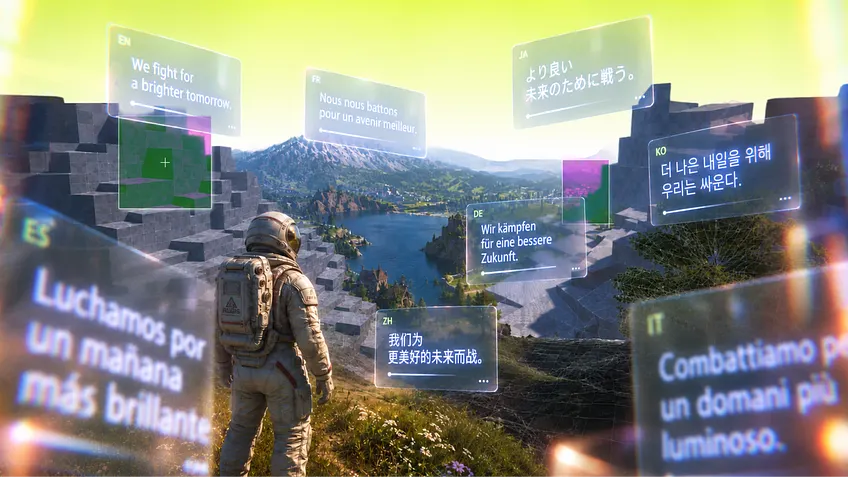
AI voice for games has grown well past basic speech synthesis and is already live in several AAA games. For NHL 27, EA confirmed it used AI to expand on more than 50 recording sessions, with the consent and continued involvement of commentators John Buccigross and Darren Pang. In Fortnite, AI-generated Darth Vader dialogue prompted SAG-AFTRA’s unfair labor practice charge against Epic Games subsidiary Llama Productions, alleging replacement of performers’ work without notice or bargaining.
Choosing a provider now means deciding where the models run, how generated lines fit into production, what consent and union agreements require, and whether new capabilities justify the risks to player trust and performer relationships. So where is AI voice gaining ground? How mature are its different applications? And which companies are positioned to benefit?
The Case for AI Voice
AI voice gives studios a powerful economic incentive to replace paid recording work. SAG-AFTRA’s standard session minimum is $1,169 for up to four hours, while ElevenLabs’ published v4 API rate works out to about $4.80 per hour of generated speech, based on ElevenLabs’ estimated audio duration. The session fee pays an actor to perform under direction, while the API rate covers raw generated audio, which still needs direction, editing, review and voice licensing at extra cost.
Lower-cost speech generation gives studios more flexibility in allocating voice budgets. They can reduce repetitive recording, extend spoken dialogue to more languages, or test lines before paying for final performances.
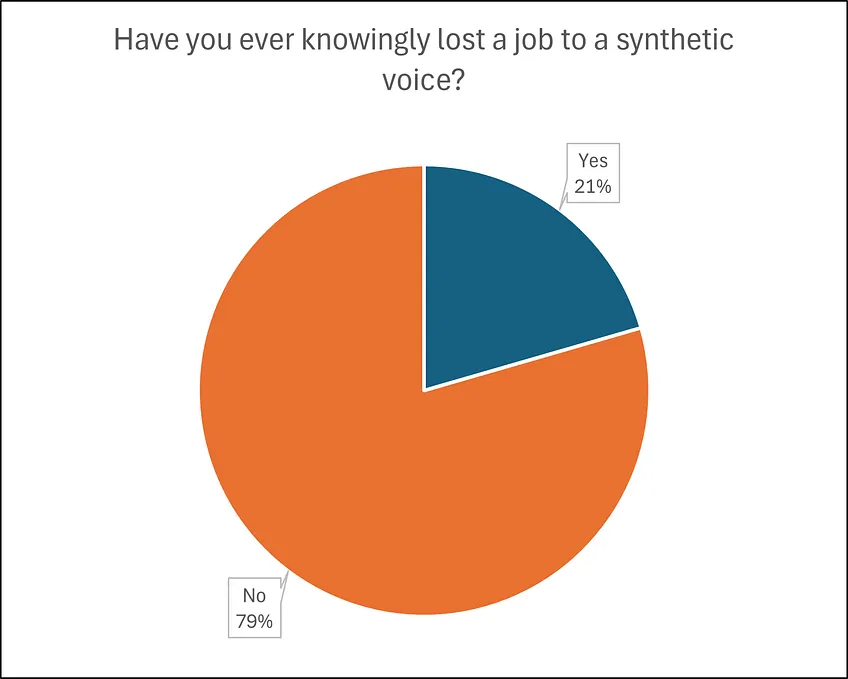
However, when generated speech meets a game's requirements, studios can substitute synthesis for recording sessions they would otherwise commission, putting performers’ current and future work at risk. Across the wider voiceover industry, 21% of respondents said they had knowingly lost a job to a synthetic voice. Respondents described clients explicitly telling them they were being replaced because synthetic voices were “faster and cheaper.” Hollywood voice actors are split over AI voice cloning: many report declining opportunities and worry about training their own replacements.
Practical Application
Extending Recorded Performances
AI can supplement a performer’s recordings when a game needs large volumes of predictable variations. In sports commentary, for example, player names must be delivered with different levels of excitement and woven into commentary recorded across multiple sessions.
For EA Sports FC, commentator Guy Mowbray authorized an AI recreation of his voice to replace months of tedious recording work generating names from the game’s roster of more than 20,000 players. The AI extends an agreed performance across repetitive material, while the rest still comes from Mowbray’s own recordings.
This flexibility becomes more valuable as games evolve into live services. New content and seasonal updates create an ongoing need for dialogue, while last-minute script changes can force teams to rebook actors. With the performer’s permission, studios can generate additions and revisions from existing recordings and keep voice production in step with updates.
Localization
AI voice localization spans text-to-speech, speech-to-speech conversion, and AI dubbing that uses voice cloning to keep an actor’s voice across languages. Companies such as ElevenLabs develop the underlying models, offering dubbing tools that combine translation, voice cloning and synchronization across more than 90 languages. Localization providers increasingly license that technology or partner with its developers to build it into their workflows and connect it to the engines studios use.
- Gridly, whose plugins sync translated text into Unity and Unreal Engine, uses Amazon’s text-to-speech voices to generate voice-over for each character next to every translated line so teams can check timing in each language before recording.
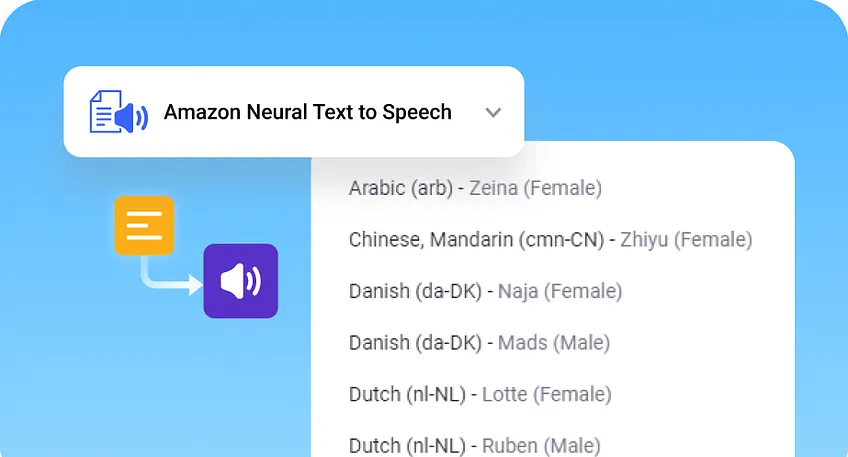
- Altagram’s Alocai takes localization requests from Unity through the Dialogue System for Unity add-on and checks the recordings that come back, transcribing each take and flagging mismatches against the script.
- Other providers include Side, which combines its casting and recording studios with a Synthetic Voice Design service, while BLEND offers 1,300 contracted voice actors in 120 languages alongside AI voice production.
Prototyping
Studios have long relied on “scratch tracks,” often recorded by developers themselves, so writers, animators, and level and cinematic designers can test pacing, timing, and triggers before booking actors. With AI, a rewritten line can be regenerated in seconds, in a consistent character voice, while scenes are still changing. Among game audio professionals who have adopted generative AI, 43% use it for placeholder dialogue. Players are comparatively accepting as well. In GameDiscoverCo’s July 2026 survey of Steam players, prototyping and placeholder assets drew mentions as an acceptable use of AI, behind only coding tools.
For The Blood of Dawnwalker, CEO and game director Konrad Tomaszkiewicz said “the recordings are one of the biggest costs when you’re doing a story-driven RPG.” The studio used AI-generated voices to iterate on the story, then replaced them with actors once the scenes were locked.
The risk is that generated voice lines reach players. Embark shipped licensed text-to-speech voices for less essential lines in Arc Raiders, then re-recorded some of them with professional actors after player criticism. CEO Patrick Söderlund conceded that “there is a quality difference.” In Tomb Raider IV–VI Remastered, Aspyr removed all AI voiceover content in a hotfix after Françoise Cadol, the French voice of Lara Croft, accused the studio of replicating her voice without consent and took legal action.
Studios need clear AI governance in their voice production pipelines, tracking every generated line and its clearance status until it is replaced or approved for release.
AI Companions and NPCs
Conversational characters give players a way to ask questions, issue instructions and receive responses beyond a fixed dialogue tree. Their usefulness depends on the NPC’s ability to understand what is happening in the game and turn the conversation into relevant responses and actions.
In the June 2026 PUBG Ally beta, players could give an AI teammate voice or text instructions, ranging from casual comments to tactical requests. Speech recognition, a language model and speech synthesis ran locally alongside systems controlling movement and combat.
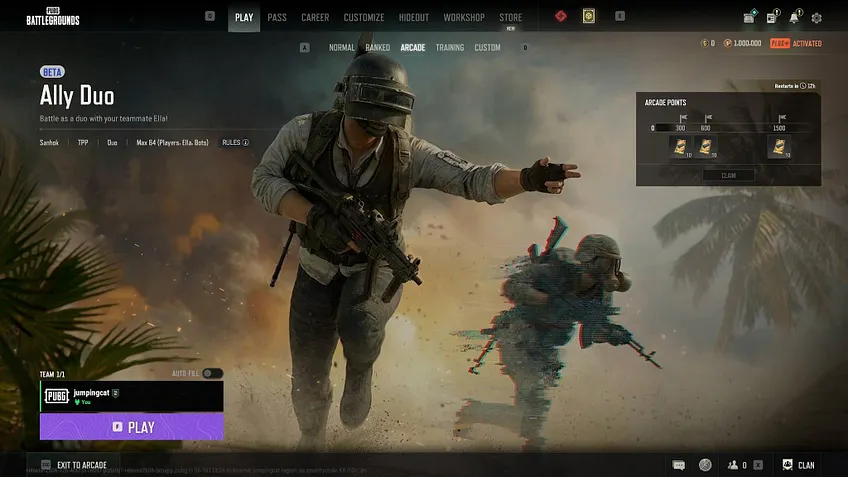
The beta, however, exposed the gap between speaking convincingly and acting effectively. Player feedback included complaints that Ally acknowledged instructions without executing them and continued talking during combat when players needed to hear footsteps.
Epic gives Fortnite creators 36 characters with AI-generated voices and personas, developed with consenting actors. For the early 2027 single-player mode of the XR game Dimensional Double Shift, Artificial Agency’s AI teammates interpret player requests but respond only with lines written by people and recorded by actors.
These applications are still at an early stage, and studios need guardrails for both gameplay and dialogue. NPCs need to act on what players ask, stay quiet when players need to hear the game, and keep to content limits that suit the game and its audience.
Adaptive Commentary
During play, speech generation can make a game acknowledge events and combinations that would be difficult to cover entirely with prerecorded lines. The Finals’ Dynamic Commentary beta generates lines from match context and mixes them with existing commentary. Announcer Scotty can recognize a contestant by name after events such as a revive streak or a successful long-distance cashbox throw.
Because player names become material for the announcer to read aloud, it similarly needed proper guardrails such as name protections and controls.
Content Moderation
Speech analysis addresses another studio need: managing communication between players. Modulate, which recently raised $25M, supplies ToxMod for voice-chat moderation in Call of Duty, helping detect potentially harmful conversations. Rainbow Six Siege used the tool to reduce the most severe voice-chat toxicity by 50%. Rockstar similarly said ToxMod helped it reduce toxicity in GTA Online.
Mapping the AI Voice Ecosystem
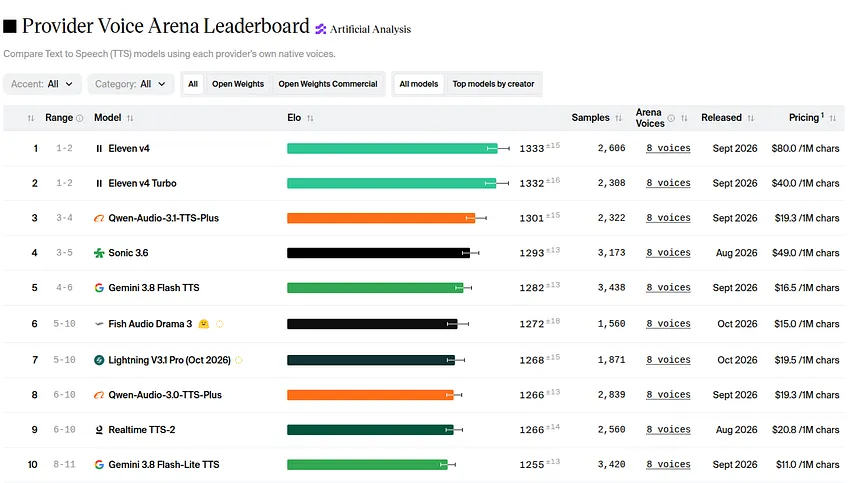
The leading speech models come from a mix of specialist providers and large technology companies. The top ten entries on Artificial Analysis’s current Voice Arena leaderboard span seven providers: ElevenLabs, Alibaba, Cartesia, Google, Fish Audio, Inworld, and Smallest.ai. The ranking measures listener preferences for speech naturalness in blind comparisons.
It is worth noting that gaming is one market among many for these suppliers. ElevenLabs’ September employee tender valued the company at $22B, with enterprise customers accounting for 55% of revenue. Cartesia markets its speech models and voice agents for applications including customer support and appointment scheduling, while Google’s Gemini speech models offer voice design and performance controls across games, audiobooks, and conversational products. Even Inworld has broadened its positioning from its Xbox partnership focused on game dialogue and narrative tools. Today, it positions itself as a provider of models and inference infrastructure for consumer applications.
Game platforms are building their own audio capabilities as well. Roblox brought the Audioscape team in-house to develop audio discovery and production tools within its creator ecosystem. Tencent’s GVoice toolkit combines voice communication, AI noise reduction, and real-time speech translation.
Publishers can also evolve toward model development. Krafton’s broader AI transformation includes building the speech-generation component for PUBG Ally’s locally running voice system and releasing its own Raon-Speech model. Developing these capabilities internally gives the publisher a route to tailor technology to its games and reduce dependence on external speech services.
On-device execution creates an opening for game-focused suppliers. For instance, Studio Atelico’s AI Engine integrates local language, speech, and character-behavior systems with Unity, Unreal Engine, and Godot.
Running models on players’ devices avoids inference charges but requires customization for the specific hardware shared with the game. For suppliers, the opportunity includes helping studios deploy and maintain those systems, alongside selling access to cloud models.
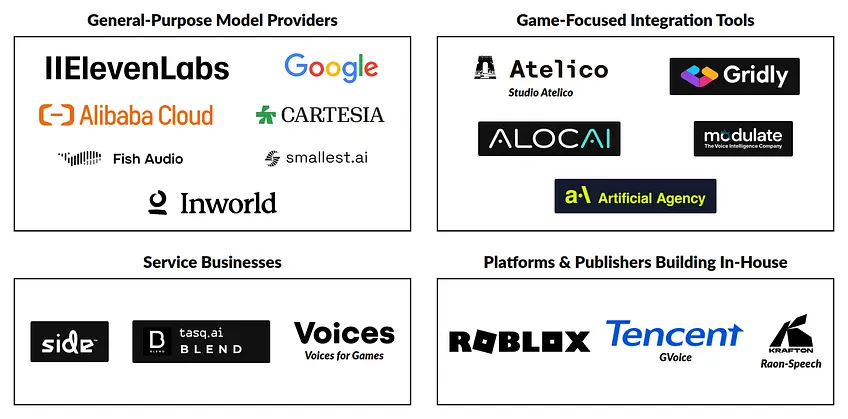
Overall, game studios must decide which technology to buy, which capabilities to build, and which production and operational responsibilities to retain. That leaves room for general-purpose model providers, game-focused integration tools, and service businesses to compete for different parts of a studio’s audio production and operations.
Who Sets the Terms
In the U.S., the union contract for video game performers establishes rules for licensed AI voice use. For covered productions, SAG-AFTRA’s 2025 video game agreement generally requires written, separately signed or initialed consent to create and use a performer’s digital replica, with a specific description of its intended use. It also establishes compensation requirements and separate terms for real-time dialogue generation. Publishers therefore have a clear framework within which to operate, with permissions and payments that need to be addressed during production.
Courts are also defining protections against unauthorized use. The Tokyo District Court recognized that a person’s voice can fall under publicity rights in voice actor Kenjiro Tsuda’s suit against TikTok’s operator over AI imitations of his voice. In Shanghai, a court ordered an AI service to pay miHoYo RMB 750,000 after it sold voice packs imitating 63 Genshin Impact characters and used game imagery to promote them.
Suppliers are responding with licensing models.
- Hasbro uses CharacterOS to run character interactions that cover personality, canon, voice, and guardrails, with performer participation and time-bound licensing pilots.
- Voices for Games, the AI arm of the casting platform Voices, licenses actors’ voices with consent, and has already been adopted by gaming companies such as Supercell.
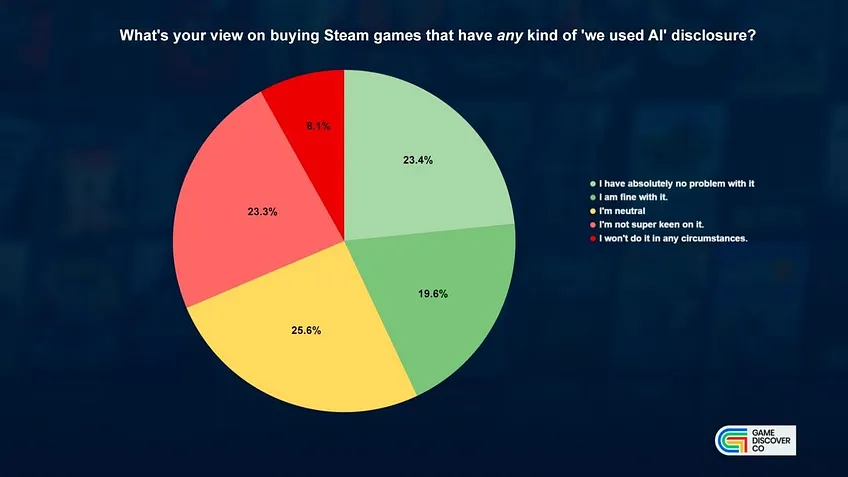
Legal permission, however, does not guarantee player acceptance. GameDiscoverCo’s Steam survey found that about 31% of respondents viewed AI-disclosed games negatively, while G2A’s research found voice acting more sensitive than production-support applications. Some studios now treat human performance as part of a game’s appeal: Wolf Haus Games explicitly chose human actors for Join Us to preserve its humor and tone.
For publishers and studios adopting AI voice, practical priorities include documenting voice use, agreeing on permitted uses and compensation, checking relevant character rights, and testing performances with the intended audience. Wider acceptance will depend on what individual games deliver and how publishers defend the choices they make to players.
Future Outlook
The next competitive advantage in AI speech is likely to come from the production workflows surrounding voice generation and the efficiencies they unlock. As Roblox builds AI into its creator tools, platforms can bring generation, translation and testing closer to where developers already work. That could make standalone speech services harder to differentiate as the technology gets increasingly commoditized. Specialist providers will need to justify their place through expressive performances, dependable human-in-the-loop localization processes, reliable conversational experiences, clear permissions, and proper customer support.
Local inference is a promising path to improve the economics of player-facing voice AI by reducing recurring costs. Early initiatives such as Fortnite’s conversational characters and PUBG Ally still need to demonstrate sustained player interest. The larger opportunity could come from games built around voice interaction as a core gameplay element, or paid experiences that let players engage with characters they already care about.
Rights holders may capture another part of the opportunity. Experiments with licensing character behavior suggest future agreements could cover a character’s voice, personality and permitted interactions across multiple experiences. As convincing synthetic speech becomes more common, recognizable performances and trusted IP could help set a game apart. Publishers will still need to distinguish permission to use a character from permission to reproduce a performer’s voice.
The immediate questions are commercial: whether studios expand voice coverage at lower total cost, whether players keep using conversational features, and whether suppliers retain customers as generation becomes easier to obtain. We expect some of today’s savings to become tomorrow’s production expectations: more dialogue, more languages, and more frequent updates for the same budget.
Sponsor: Ship the Next Playable Before the Last One Dies.
Genie Playable. Playables built from your live game, by the marketer, without a dev queue.
Ask a UA team where playable time goes. Not the idea. The build. Three developers who are also on the game update, one designer per playable, an export that clears AppLovin and bounces on Unity, an agency round for a one-line fix. By the time v2 lands, v1 is tired.
The shortcut is worse: a template in your colours that converts, then churns, because it showed a game that isn’t there.
Genie Playable moves the build to the people who own the UA number. Start from your game, a creative that’s already winning, another game’s format, or a trend, and make it yours. Ship every version to every network you run. The next playable is an edit, not a ticket.
What’s in the launch:
- No developer, no designer. The creative manager builds and changes the playable, code included, through the agent.
- Start from what works. A creative that performs, a mechanic from another game, a format trending outside gaming. Their format, your game.
- Your game, every version. Lead-in, difficulty, end card, theme. Ten versions later it still looks and plays like the game they are about to install.
- Every network from one source. Package the set for AppLovin, Unity, Mintegral and Google without a fourth rebuild.
Top News Items
Anthropic Adds Rule to Stop Claude from Remaking Existing Games
- Anthropic updated Claude Code’s system prompt with a new rule: “Do build original games, games in a genre, and games from the user’s own designs and assets. Do not build a recreation of a specific existing game, even if it is renamed or called original.” This follows OpenAI’s widely discussed decision to ban the developer who reverse-engineered his TV and the blocking of the REA (Reverse Engineer Anything) library. Shortly after making the change, Anthropic noticed issues with legitimate usage; according to staff member Addy Osmani, “We’d added a short rule to the Opus 5.5 prompt to steer Claude away from recreating specific existing games, but it was also kicking in when you referenced one just to describe the mechanics you wanted. We’ve updated that rule in 2.1.317. You can name a game to describe what you want, and Claude should now build an original game in that genre. If you ask for a copy of the original, it’ll offer to build something similar instead.”
- The rule will deter the most casual copycats, but it’s unlikely to stop the determined ones. Researchers have repeatedly shown that AI safety guardrails can be bypassed with simple rhetorical tricks, and open-weight models have no such restrictions at all. ArtCraft, known for its Adobe suite clones, even released its own reverse engineering harness, Craft Anything, as a response to the move. Realistically, the rise of cloning will remain an issue that neither developers nor storefronts are prepared to deal with, and it will continue to unleash a wild west of creativity around the web.
Epic VP Says AI Code Tools Have Stomped Out Decade-Old Unreal Engine Bugs
- Epic Games EVP of Development Marcus Wassmer confirmed that AI coding tools like Claude and Codex are now actively used to develop Unreal Engine itself. Wassmer claimed AI tools eliminated “non-deterministic cooking bugs” that the team had been unable to fix for a decade. AI is also being used to automate PC stability monitoring in Fortnite, flagging driver/hardware combinations that cause crashes faster than manual testing could. Wassmer stated that almost all current development is happening in streams tied to Fortnite, UEFN, and UE6, and that any potential UE 5.9 update would include AI-developed changes.
- Wassmer put it bluntly “We are more concerned about the risks of moving too slowly than we are about AI skepticism.” Epic isn’t hedging or experimenting cautiously, backing up CEO Tim Sweeney’s claims around AI being an inescapable future. It rebuilt the Epic Games Launcher using AI coding tools, and Wassmer says engineers control scope but aren’t writing most of the code. This means thousands of studios building on Unreal will depend on an engine increasingly developed with AI-assisted code, regardless of their own adoption policies. Quality control and transparency will remain important concern, but both Unity and Epic have made it clear that AI is here to stay in mainstream game engines.
Nexus Mods Rules Out Full AI Ban Despite Community Backlash
- Nexus Mods, the largest PC game modding platform, rolled out a new AI policy that requires mod authors to publicly disclose how they used AI in their creations. Users can now filter out AI-tagged mods from their feeds. Existing mod authors have a 60-day grace period to comply. The platform, however, explicitly ruled out a full ban on AI-generated mods, with site owner Foledinho writing that “AI-generated mods are welcome on our platform provided that they meet certain criteria regarding permissions, transparency, presentation, and conduct.” The comment section predictably split between modders who want an outright ban and those who argue AI tools have made modding accessible to more people.
- This transparency-first approach mirrors the broader industry. Full bans are difficult to enforce and risk inciting witch hunts while encouraging AI hiding behavior. As with itch.io and Steam implementations, moderation and verification cannot realistically scale beyond self-attestation and user reporting. If most game development, including modding, eventually incorporates AI in some form, this type of labeling and filtering may become relatively meaningless. Given that mods are generally free, there is also less risk here of lost income or reputational damage. As with other parts of the industry, AI usage will inevitably permeate modding, and the community will eventually catch up to reality.
Roblox Says More Than 80% of Its Top 100 Games Used AI to Accelerate Creation
- Roblox’s Q3 2026 earnings report revealed that over 80% of its top 100 games by hours engaged used AI tools in their development during October 2026. Time spent using AI tools among top creators tripled since Q2, and daily usage of Roblox’s MCP server (which connects external AI models like Claude and Codex into Roblox Studio) grew nearly fivefold. Two games built almost entirely with AI, “Break and Steal an Egg” and “Huss Valley,” broke into the platform’s top 20 by concurrent players. Roblox has also published over 70,000 games through its Build tool, a prompt-to-game creation feature launched earlier this year.
- The fact that 40% of the weekly top 100 recommended games by impressions were created within the last three months also hints at how dramatically AI is reducing development timelines. For Roblox, this increased content volume reinforces the value of its recommendation engine, which seems to be working well.
Other News Items
- Unity reports “strongest ever” Q3 results driven by its AI-powered ad network Vector
- An AR mixed reality version of Mario 64 made with Opus 5.5 for PICO headsets
- Valve weighs in on Next Fest AI cloning phenomenon
- Valve warns of slower Steam approvals, possibly due to AI game surge
- Playgama Launches AI Game Index to Rank Coding Agents by Real Player Engagement
- Remix launches platform for anyone to build their own game on desktop, web or mobile
- Studio Atelico Launches Atelico AI Engine into Early Access
- Perplexity launches its own take on AI agents for work
- Ramen launches Aura Autopilot, an Open-Source Autonomous Game Tester for Unreal Engine, Unity and Godot
- Xsolla acquires GamePix to build platform for web and AI-created games
- Google DeepMind launched Genie 4
- Meta has a new AI pet app called Waddle World
- India’s EloElo raises $80M for AI microdramas
- Krafton makes socially intelligent AI that understands people
- Akai is embracing vibe-coded music gear mods with an open-source MPC
- Apple is adding an AI chatbot to Pages, Keynote, and Numbers
Content Worth Consuming
The October inflection point for vibe game development (Simon Willison): “Once it was all working (and I’d iterated through some gameplay bugs), I played it through from start to finish and found myself emotionally affected by the ending! I’m somewhat embarrassed by this, because everything in this game—the graphics, the plot, the characters, the music, the dialog—came from the model. My creative input was pretty much just ‘it’s a fantasy village and there’s a troll asleep in a cave.’”
I gave my website a boss fight (Paul Bakaus): “The games carry the same subjects as the pages around them. They’re a way to share a frustration and have a laugh about it together. You get to know something about me by playing. This was the feeling I wanted to bring back: you click something because it looks interesting, and discover that someone cared enough to make it do something delightful.”
Shigeru Miyamoto weighs in on AI and the difference between productivity and creativity (GamesBeat): “AI could expose this problem by making execution faster and easier, forcing creators to focus more closely on the quality of their ideas. Rather than viewing this development negatively, Miyamoto sees an opportunity for people to reconsider what creativity involves. ‘The more AI comes to handle various kinds of work for us, the more it becomes an opportunity for everyone to seriously and sincerely think about what ‘really creating’ actually means.’”
Nine engineers, 1,211 pull requests in a day: Lessons from building Copilot Cowork (Microsoft): “Some of these practices are especially useful when you can define what “done” means, changes arrive faster than people can review them, or you can compare a replacement system with one that is still running. But the broader lesson applies beyond those conditions: engineers didn’t step out of the process. They spent more time deciding what the boundaries are, where human review was essential, and what was ready for production. We’re exploring how agents can handle more of the routine merge workflow while preserving explicit human checkpoints for higher-stakes changes.”
I built an AI Tamagotchi before Meta could (The Verge): “asked Claude to make a whole batch of different avatars like the ones Meta showed off during Meta Connect, and to add a Tamagotchi-like minigame where they need food, play, sleep, and a bath. When the game seemed too simple to capture any attention, I had it add four different levels of hunger, boredom, and dirt. I decided treats should make a crunchy mess and get avatars dirtier when they eat them, and that too much play should tire out a pet. My wish was Claude’s command.”