What Went Wrong at Fortis Games?

On November 10, Fortis Games shut down after its owner, Las Vegas Sands, ended its funding, according to employees. More than 400 people lost their jobs. Six days earlier, Fortis had announced the closure of Twilight Towers, its first soft-launch title, because the game wasn’t retaining enough players.
Startups fail all the time, but Fortis was not just any startup. Wholly owned by Sands, it debuted in March 2022 with more than 150 employees, assembled by acquiring three studios, and nearly tripled in size from there. Yet it never brought a game to global launch.
That makes the closure worth examining beyond the layoffs. Fortis had money, talent, and an ambitious plan. What it couldn’t establish was a successful product. The changing games market and Sands’ shifting priorities help explain the timing of the shutdown, but the more basic question is whether Fortis’ strategy gave it a good chance of finding a hit in the first place.
The Promise of Patient Capital
In 2021, Las Vegas Sands (NYSE: LVS) was in a peculiar place. The pandemic had gutted its casino business, yet the company was about to come into a fortune, as it had agreed to sell its Las Vegas properties, including the Venetian, the Palazzo, and the Sands Expo convention center, for $6.25B. Alongside large resort projects in Asia, Sands began looking for digital businesses to put that money into.
Fortis was one of those bets. Patrick Dumont, then Sands’ president and COO (and married into the Adelson family that controls it), promised to invest “at scale for the long-term.” Fortis president (later CEO) Steven Chiang, in turn, said Fortis would create deeply social games that span different platforms and genres, but steer clear of casino games.
Fortis leadership had substantial industry experience. Chiang had run worldwide studios at WB Games, co-founded EA Tiburon, and served as president of studios at Zynga, while COO Shawn Foust was a former WB Games executive. Fortis acquired three studios to kickstart its operations: Doppio in Portugal, Oktagon in Brazil, and Metagame in Romania.
Rather than leaving them as independent teams, Fortis folded the studios into one distributed organization spanning North America, Europe, and Latin America. By August 2023, it had just over 300 employees, with roughly half a dozen game teams alongside central publishing, analytics, user acquisition, and community functions. By 2025, it was also talking about third-party publishing and further acquisitions.
Fortis set out from the start to build a company capable of making and running multiple games. In its pitch to recruits, it emphasized turning design innovation into a competitive advantage. In Fortis’ own language, its games would build “digital societies” and relationships that lasted for years.
There was something refreshing about the ambition. Mobile games typically stick to proven formulas, and for good reason. Free-to-play design templates are the result of years of survival-of-the-fittest evolution, and creating something genuinely new is a risky way to pursue a hit. Sands’ patient capital gave Fortis an unusual opportunity to try. But Fortis wasn’t just betting on design innovation. It was also building a large organization long before it was clear whether its games would work.
What Fortis Actually Built
Twilight Towers, a free-to-play game combining merge mechanics with tower defense, was the title that got the furthest. It was soft-launched in the Philippines and Mexico in September 2025, three and a half years after Fortis’ public debut. Over the following year, Fortis iterated on the game, reworking and adding features. On November 4, Fortis pulled the game from the stores. Its retention had not been strong enough to justify ongoing development.
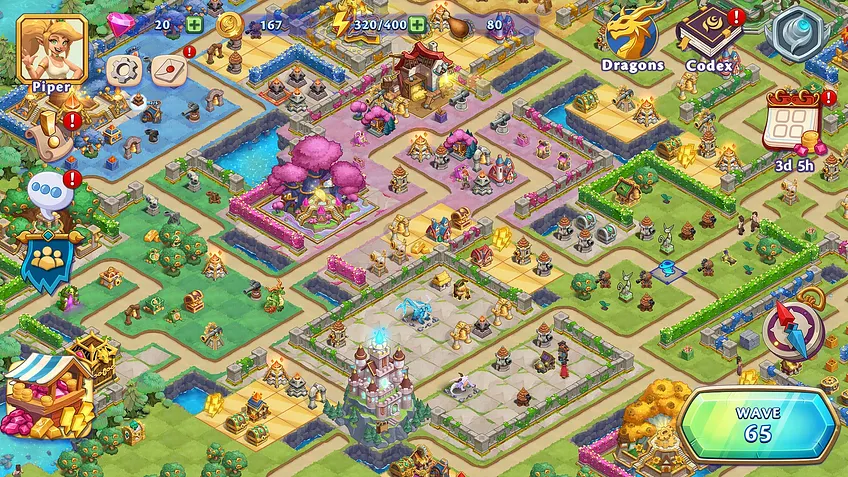
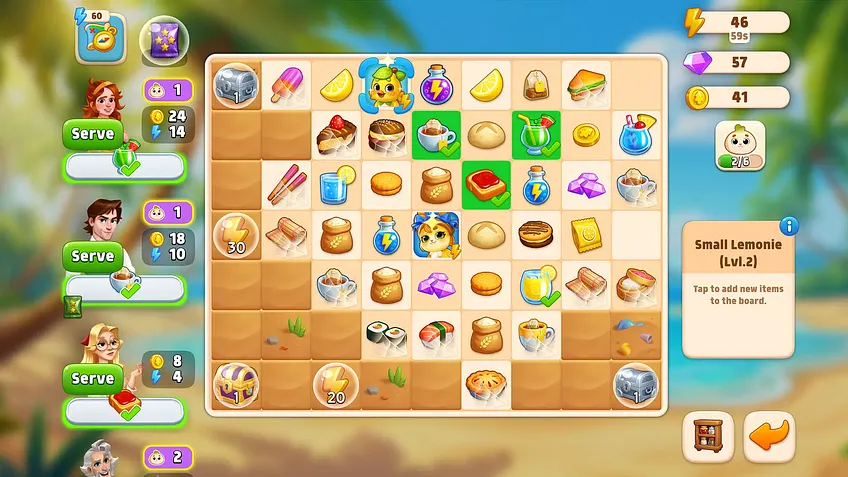
Fortis’ other in-development titles included Bloom & Breakfast, a cozy merge game about running a bed and breakfast, which was soft-launched in the UK, the Philippines, and Canada, according to Sensor Tower. Another title, Mergemon Wilds, a creature-collection and merging game, was also in early soft launch. A fourth title, Havoc Crew, a cooperative multiplayer dungeon crawler, never reached soft launch.
Set against Fortis’ launch pitch, the portfolio is telling. The company promised deeply social games spanning platforms and genres. By the time it closed, three of its four known titles were mobile merge games, a typically single-player genre and one of the most crowded corners of casual mobile. The one game that fit the original pitch, the cooperative multiplayer Havoc Crew, never reached soft launch. There may have been others: after the closure, a Fortis lead posted that her team had soft-launched two games in four months, without naming them.
From the outside, it looks like a retreat. Patient capital was meant to free Fortis from proven formulas; the games we saw ended up in one of the most proven of all — and one where it had no particular edge.
Scale Before Product Validation
We have no visibility into the internal decision-making of Fortis, but the numbers are clear enough.
Fortis had 150 people at launch in 2022, just over 300 eighteen months later, and up to 440 at the time of closure. All without a single game reaching global launch. Each hire can make sense for a company that plans to run several live games. Each hire also adds to an ever-increasing overhead of fixed costs.
Sands has not disclosed how much it spent on Fortis, but with some back-of-the-napkin math, we can conservatively assume total investment in the low nine figures since 2022. Assuming an average workforce of 300 for four years at $120,000 a year per employee, we arrive at $144M in personnel costs alone.
The Turkish playbook provides a stark contrast. When Royal Match launched globally in 2021, Dream Games had about 30 employees. Dream had raised $7.5M in 2019, then $50M in March 2021 as Royal Match went global. Larger rounds followed as the game proved its return on ad spend. Later, companies such as Grand Games and Loom Games repeated Dream’s lean team model.
Fortis didn’t have to raise successive funding rounds. That was, in fact, the whole point of patient capital: freedom from venture investors’ short timelines. However, freedom can be both a blessing and a curse. With no funding round to pass, nothing forced Fortis to prove a game worked before hiring for a portfolio of them. But dependence on a single backer also meant Sands could end the experiment whenever it chose.
Why Sands Walked Away
The market did Fortis no favors. Mobile gaming slowed down after the pandemic boom, Apple’s privacy changes made user acquisition harder, and investment in game companies fell sharply. According to Sensor Tower, mobile game in-app purchase revenue reached about $82B in 2025, a third straight year of growth but only by 1.4%, while downloads fell 7%. The revenue figure excludes purchases through web stores, which have been growing. A flat market with fewer new players rewards games that retain and monetize the audiences they already have, which is precisely the test Twilight Towers failed. Those requirements were not new, though; mobile games needed strong retention before 2022 too. Fortis’ problems cannot be blamed on timing alone.
Sands, meanwhile, changed its priorities. Fortis was not its only digital bet. Sands Digital Services, an online casino venture built around live-dealer games, was set up in 2021 and closed in October 2025. In a letter to staff, Dumont said the investment had been made with periodic reviews built in to find “the most pragmatic path forward,” and that the business no longer fit the company’s core objectives. Fortis followed 13 months later.
Both closures came as Sands’ Macao and Singapore resorts recovered and capital flowed back into what it knows best, including an $8B luxury development in Singapore that broke ground in July 2025. Dumont, who became chairman and CEO in March 2026, had a hand in both: he endorsed Fortis’ long-term funding in 2022, signed off on closing Sands Digital Services as president, and was running the company when Fortis’ funding ended. Sands, it seems, treated its digital ventures as options rather than long-term investments. When the options stopped looking valuable, it let them go.
Sands has not given a detailed public explanation for ending Fortis, nor released its financial results separately. The most plausible interpretation is that Fortis’ continuing costs became difficult to justify when its games remained unproven, and Sands had better-established places to invest.
Sands is not the only gambling company rethinking a big bet on mobile games. Slot-machine maker Aristocrat spent heavily to expand into free-to-play, buying Product Madness in 2012, then Plarium and Big Fish in 2017–18; Big Fish alone cost $990M. Last year, it sold Plarium and stopped new development at Big Fish, and by early 2026, it had sold off Big Fish’s casual games, keeping only social casino titles close to its slot-machine roots. Sands had no such fallback. Its casino-adjacent bet, Sands Digital Services, was gone a year before Fortis, and Fortis itself had been built from the start to stay out of the casino genre.
Fortis’ closure also comes amid a difficult year for games industry employment. According to Amir Satvat’s layoff tracker, an estimated 12,400 industry jobs had been cut by November 10, already surpassing the roughly 9,200 recorded in all of 2025 and 10,500 in 2023. Only 2024 saw more layoffs. And the pressure may not ease anytime soon. Fortis shows that even deep-pocketed investors can pull the plug. Meanwhile, AI is already allowing studios to do more with fewer people. A recovering games market may not necessarily mean a recovering jobs market.
Fortis assembled many of the inputs associated with a successful games company: capital, experienced people, studios, and publishing infrastructure. It never established the output that would justify them. Patient capital is not an exemption from product economics, and even patient investors eventually run out of patience.
Sponsor: Nitro: The Web Game Ad Monetization Benchmark Report
Most ad networks aren’t built with independent gaming publishers in mind. Low-quality demand drags down CPMs, and intrusive ads hurt the experience players came for. Payments can take months to land, and support usually means being one more account on someone’s spreadsheet.
Nitro by Overwolf is built for exactly that audience. More than 500+ premium gaming and entertainment websites trust it to monetize their web games and gaming content, because it understands gaming audiences and what independent publishers need.
Its relationships with premium advertisers and major ad exchanges bring high-quality demand and competitive CPMs, with relevant ads that protect the player experience. Publishers get paid on Net seven-day terms, see exactly how their ads and revenue are performing in a customizable, fully transparent dashboard, and work with a fully hands-on support team.
Nitro’s first Web Game Ad Monetization Benchmark Report covers 4.17 billion sessions across 806 publisher domains, and web games stand out: 4.1% of sessions but 9.7% of earnings. Download the report to see what web games earn by genre, ad format, and market.
Download the reportIn Other News
Funding and M&A:
- UK-based interactive generative video company Anorak has raised $5M in a pre-Seed round
- Saudi Arabia-based indie games developer Lambda Studios has raised $1.3M
- Germany-based action and platform games developer Black Forest Games is going through a management buyout from THQ Nordic, part of Embracer Group, for an undisclosed sum
- Sweden-based games developer and publisher Coffee Stain acquires Chronicles: Medieval IP from bankrupt Raw Power Games
- Unity acquires 3D asset creator Synty Studios; artist-created content to be integrated into AI game-creation platform Unity Spark
Business & Product:
- Appcharge launches Checkout Experimentation Lab for D2C sales
- GTA 6 pre-orders exceed $1.4B, with 87% for the Ultimate Edition
- Monster Hunter Outlanders passes $10.2M in IAP revenue in two weeks
- Console shipments drop 36.5% to 6.4M units during Q3 in run-up to major releases
- Inside SayGames’ Barbie collaboration and the live ops strategy behind My Perfect Hotel
Miscellaneous:
- GTA 6 leads The Game Awards 2026 with eight nominations
- Roblox opens applications for second Incubator cohort focused on 18+ games
- Unity launches $50K grant for indie developers with no equity or repayment
- GDC survey: 70% of mobile studio workers use generative AI
- Pikmin Bloom soundtrack waltzes onto Nintendo Music as first mobile game featured
Content Worth Consuming

Supersonic CEO Igor Bereslavski: Why Hybrid-Casual is Back to Hyper-Casual (Unpredictable Hits): “Hybrid casual is starting to behave exactly like hyper-casual did five years ago, and Igor Bereslavski has run a studio through both cycles from the inside. Igor is CEO at Supersonic Studios, part of the founding team that launched it in January 2020 and grew it from 15 people and 3 games to 60 people and 13 games inside a single lockdown, and he is now taking the studio into its next chapter under Tripledot. Talking with Amit, Igor explains why the past few months of hybrid launches look like the old hyper-casual rhythm, games going from zero to 100 on aggressive UA and most of them declining within months, and why the top charts are moving again after two flat years.”
How PlayStation Became the Home of Grand Theft Auto (The Game Business): “To mark the launch of Grand Theft Auto 6, we dive into the business history of the series with former industry leaders Kelly Sumner, Shuhei Yoshida, Chris Deering, Shawn Layden and Peter Moore. We discuss that big PS2 deal for GTA 3, how Xbox swooped in for GTA 4, and we look at the impact the franchise has had, and is having, on the wider business.”
The Critical Path of Mass Effect’s Casey Hudson (The Fourth Curtain): “We were fortunate to sit down with Casey Hudson, former GM of BioWare and Game Director on Mass Effect. He founded a new studio Arcanaut where they are working on Fate of the Old Republic, a spiritual successor to the hit KOTOR. We discuss his framework for making games and even SCTV.”
One Friend Beats a Million Ads | BisectHosting Founders Max Podkidkin & Andrew Blatchford (GameMakers): “The full conversation with BisectHosting co-founders Max Podkidkin (CEO) and Andrew Blatchford (CTO). Two Minecraft players turned a market gap, unreliable game hosting and support, into a bootstrapped business. We cover how they started, why they never raised outside money, how two co-founders who barely spoke made it work, and what they see across thousands of game communities: why players keep adding multiplayer to single-player games, what studios leave on the table, when to stay single-player, cheap ways to test demand, common mistakes, and how they use AI without cutting their support team.”
Creating a Vampire RPG with Blood of Dawnwalker Narrative Director Jakub Szamalek (The AIAS GameMaker’s Notebook): “Alexa Ray Corriea chats with Jakub Szamalek, Narrative Director at Rebel Wolves. Together they discuss their debut title The Blood of Dawnwalker including how the team came together after departing from CD PROJEKT RED; deciding to create a vampire RPG and the narrative baggage associated with the genre; writing within a popular genre while creating something new and original; the historical and mythological inspirations they used to create their own version; and embracing failure to find the fun.”
Meet the Company That Finds Chinese Game Developers to Work on Western IP (gamesindustry.biz): “Earlier this month, Yodo1 Games announced a strategic digital licensing partnership with the American firm AMC Global Media, which is behind television series such as The Walking Dead and Anne Rice’s Interview with the Vampire. Yodo1 is tasked with finding and supporting Chinese game developers and publishers in order to create video games based on AMC’s franchises. There has been much talk in recent years of how Chinese games are starting to make huge inroads into the North American and European markets, through blockbuster titles like Genshin Impact. But the opportunity also goes the other way: Human: Fall Flat, for example, which has now reached 60 million players, owes a large part of its success to its popularity in China.”