Love and Deepspace: The Price of Losing Trust

Love and Deepspace (L&D) entered the mobile market with a bang, combining otome romance, RPG elements and action combat, wrapped in stunning visuals. Launched in January 2024 by Chinese publisher Papergames, it netted $265M in mobile revenue that year and $382M (+44% YoY) in 2025, despite falling downloads. This performance came while the broader RPG genre was declining.
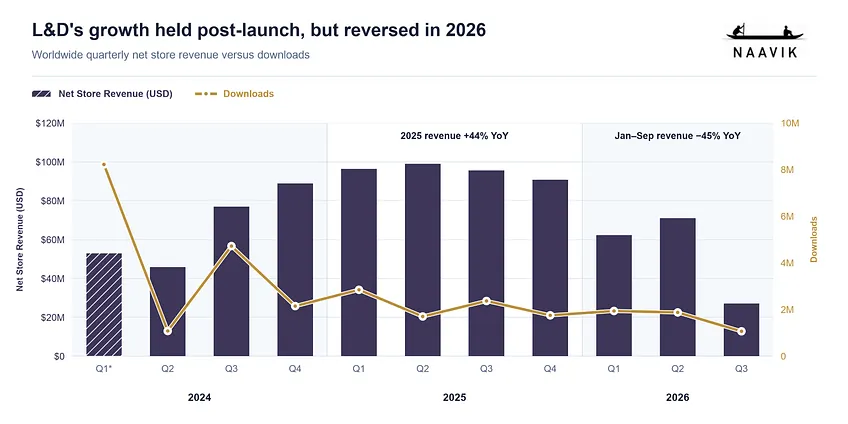
In 2026, however, L&D’s commercial momentum reversed sharply. From January to October 2026, revenue fell -47% YoY with average MAU dropping -10%. In other words, while L&D’s first two years tend to showcase how it turned high-fidelity RPG romance into a daily habit and great business, its third year exposes a divide between player needs and developer decisions.
In this article, we’ll explore how the game established itself as a juggernaut during its launch year, sustained its initial success the following year, why its growth engine weakened over 2026, and where the game’s trajectory might go from here. The data showcased excludes DTC, China Android, and ad revenue.
The Team and the Product
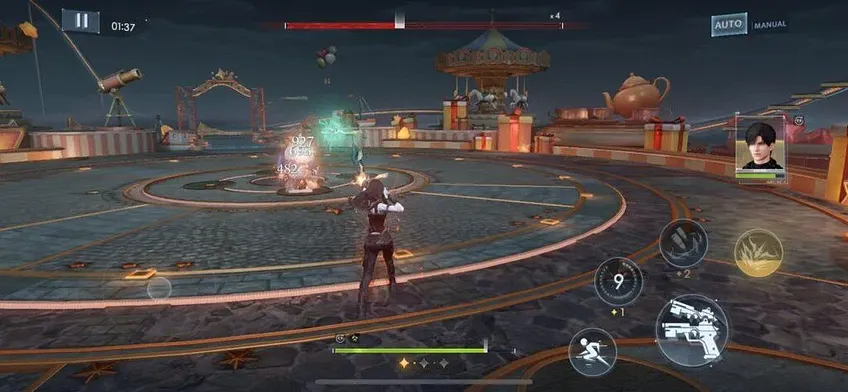
L&D was built on Papergames’ previous experience in developing games for women, from the Nikki dress-up series to 2017’s Mr Love: Queen’s Choice. The team’s ambition was to make relationships feel more immediate through first-person 3D interaction and shared adventures. Introducing combat was one interpretation of shared adventures and reflected a particular view of romance: the heroine and her partner should face challenges as equals, building trust through mutual support. Fighting together was therefore part of the relationship itself, alongside everyday companionship. Delivering that vision required new capabilities. Lizi Cheng (producer) recalls that the original team lacked combat-development expertise and repeatedly rebuilt the system over four to five years.
Ultimately, that vision came together. Set in a future where hostile Wanderers threaten humanity after a mysterious message from Deepspace, L&D casts the player as a superpowered hunter who fights alongside men with whom she can develop romantic relationships.
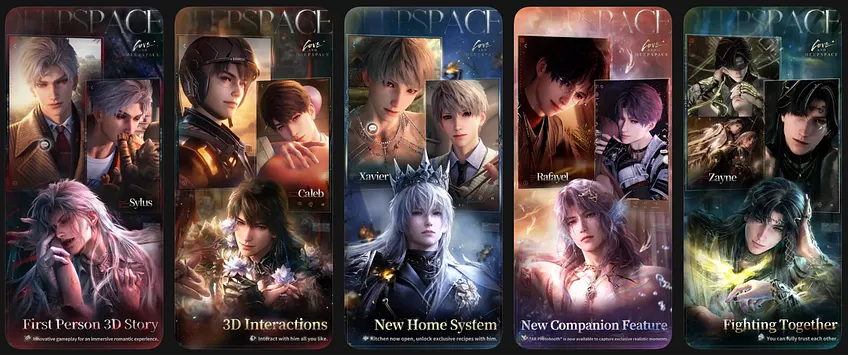
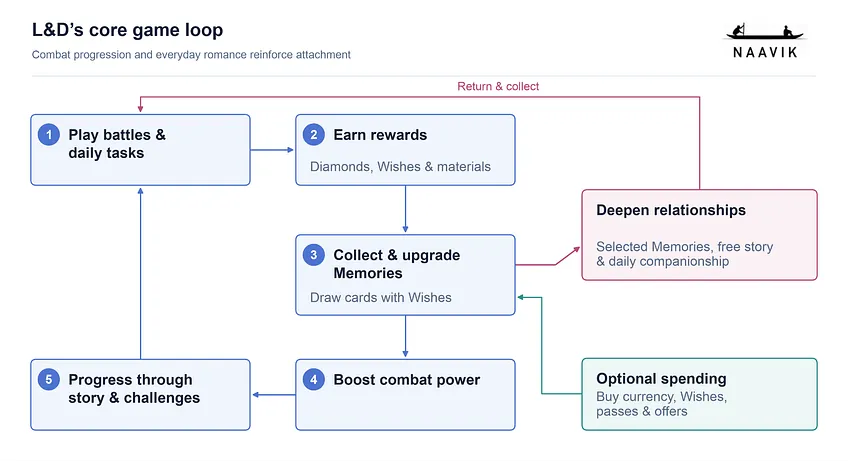
The story, real-time battles and everyday companionship build relationships with a relatively small cast, supported by recurring content for favorite characters. Conversations, phone messages and date activities make those characters accessible between story releases, so attachment can develop through ordinary shared moments as well as major plot events. Story gates give combat development a purpose beyond harder challenges, while daily tasks help structure return visits.
L&D monetizes through a gacha system, where players draw collectible cards called Memories, each featuring a particular love interest. Memories strengthen combat teams, while some also unlock audio stories, interactive romantic scenes or chapters of longer Myth narratives. A desirable card can therefore appeal to players as both another experience with their favorite character and a useful addition to their team. Limited-time banners then concentrate that demand into short purchasing windows. Cosmetics, passes and resource purchases provide additional monetization.
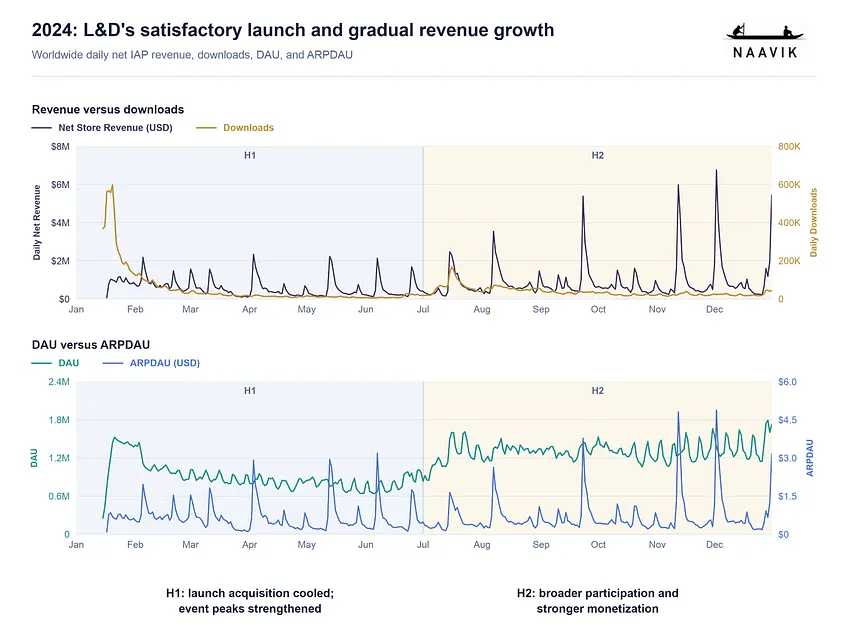
L&D’s $265M launch year unfolded in two stages: a launch surge that cooled through H1, followed by a second audience breakthrough and slightly improved monetization in H2. China supplied 63% of the year’s revenue, followed by the US and Japan at roughly 10% each.
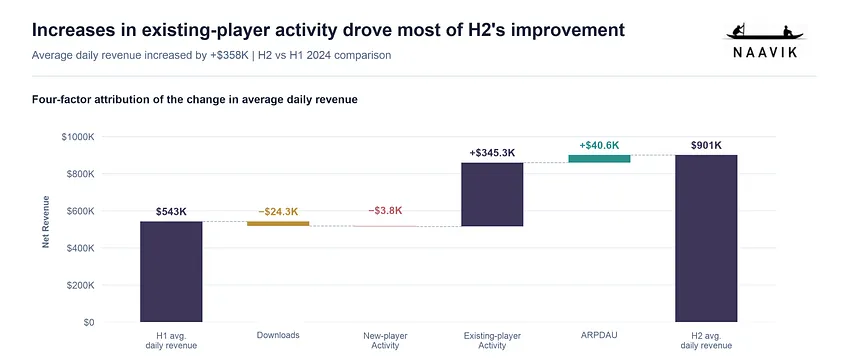
H2 generated $166M, up +$67M (+68%) versus H1, with China supplying 66% of the increase and the US 17%. That translates into a +$358K/day improvement mainly driven by increases in existing-player activity (96%) and ARPDAU (11%), offset by a decrease in downloads (-7%).
H1: A satisfactory launch, followed by cooling. Papergames launched with an audience cultivated through Nikki and Mr Love, preregistration campaigns, and localized promotion. Beyond 15M preregistrations, launch marketing efforts included Sarah Brightman’s theme song, regional creator activations, a global PR push, and rewarded fan-content campaigns. It also seems like significant UA spend was committed to launch, as Q1 downloads were 48% paid. That said, the game saw only 5.4M January downloads, equivalent to 36% of worldwide preregistrations. While accounting for China Android installs would push this ratio up, we’d guess less than optimal preregistration campaign performance since roughly half of the launch month downloads came from paid UA too.
By Q2, downloads settled around 360K monthly, while average MAU fell an additional -22% versus Q1 to 3.5M. Even though some banner events like Rafayel’s When Tides Echo, Xavier’s Shimmering Moonlight and Zayne’s Trace of Divinity drove opening day ARPDAU peaks of around $3 (versus Q1’s $2 maximum), quarterly average ARPDAU was slightly lower at $0.63 (vs $0.67). Quarterly revenue reached $45.8M (-14% QoQ), driven by lower download volume.
H2: A second audience breakthrough, followed by stronger monetization. July 15’s major v2.0 release introduced Sylus, a fourth love interest whose outlaw persona broadened the romantic cast, alongside more story, roguelike combat, and higher progression caps. Marketing efforts included a July 6 preview broadcast, a Mozart, l’opéra rock theme-song collaboration and IRL pop-up events. July downloads rebounded to 2.0M versus Q2’s monthly baseline of roughly 360K, while Q3’s average MAU grew +38% to 4.8M. Since paid UA supplied 29% of July’s and 25% of Q3’s downloads versus 48% in Q1, it’s likely that Sylus’ arrival gave lapsed players a plausible reason to return alongside organically acquired newcomers.
By Q4, downloads stabilized around 720K monthly, roughly twice Q2’s baseline, while average MAU continued to hold +30% above Q2’s baseline. So Q3’s elevated audience largely persisted over Q4, and some of the game’s event-driven ARPDAU peaks were more intense too.
As noted previously, the larger audience and its participation lifted existing-player activity, which explained 96% of H2’s +$358K/day increase in average daily revenue (+66% versus H1). A broader, more sustained content offering plausibly helped establish this higher audience baseline while gradually improving mid- and long-term retention to sustain it:
- Before v2.0, the team acknowledged insufficient production capacity as its biggest challenge since launch, positioning the update as an initial step toward richer experiences. H2 went on to deliver four main-story updates (Sylus’ July arc and branches for Zayne in September, Rafayel in November and Xavier in December) versus none in H1.
- Main-story access also expanded, allowing more players to engage with the narrative. For example, Sylus’ story was accessible without completing all previous chapters, giving newcomers and existing players more ways to participate.
H2’s average ARPDAU also increased +6%, contributing 11% of the rise in average daily revenue. While minor, it coincided with changes in the game’s banner sales strategy. Comparing H2 with H1 across 2024’s 25 five-star banner campaigns:
Beyond the above, H2’s banner sales strategy also saw broader character coverage, a wider variety of romantic Memory themes, more cosmetics, and a flurry of other purchase incentives.
- Solo campaign (one new limited-time five-star Memory for one love interest) volume stayed at seven per half. Average launch-day ARPDAU for these campaigns remained flat ($1.07 to $1.11, +3%).
- Multi-character campaign (new limited-time five-star Memories for several love interests at once) volume increased from three to four between the halves. More importantly, the number of 5-star Memories per campaign increased from 3 to 4 (or 9 to 16 in total across campaigns), which improved average launch-day ARPDAU from $1.84 to $3.59 (+95%).
- Myth/companion campaign (a pair of limited-time five-star Memories offering a Myth story and, when both are collected, a combat companion) volume dropped from three to one, with no change to the number of 5-star Memories offered per campaign. We’re omitting the average launch-day ARPDAU results here since H2 only had one campaign of this nature, making a half-over-half comparison invalid.
Overall, we believe $265M represented a satisfactory launch year, although the spring cooling left room for a stronger H1. The question entering 2025 was whether ongoing content could sustain audience participation and spending as acquisition slowed.
2025: Turning the Breakthrough into a Bigger BusinessIn 2025, L&D turned its H2 2024 breakthrough into a larger business: revenue rose +44% YoY to $382M despite downloads falling -46% to 8.7M. Average MAU increased +19% to 5.1M, while ARPDAU fell -10% to $0.61. More participation supported growth, but spending was already becoming a weaker part of the engine.
Existing-player activity drove all of the +$117M YoY growth, partly offset by ARPDAU and downloads. In other words, L&D did a great job over 2025 of retaining the increased existing player base that rolled in from H2 2024. However, they could’ve been monetized better.
On the retention side, L&D continued to see healthy gains in mid- and long-term retention, likely supported by the following:
- January’s v3.0 update made Caleb, the heroine’s childhood friend, the fifth love interest, adding story and a new relationship to develop.
- July 3’s v4.0 update paired five wedding-themed Memories with personalized outfits and rings, deepening relationship milestones alongside more daily interactions and repeatable activities.
- New features, including Remind Me (personalized reminders and care), expanded roguelike combat and exploration, Sleep (bedtime companionship), AR companionship, and a personal journal for shared memories, likely gave players more reasons to explore and return.
On the monetization side, banner strategy shifted more towards broader Memory collections, more Myths, and back-catalogue purchasing opportunities. However, blended ARPDAU and the average new-banner opening peak both fell about -10% YoY. While a portion of this decline is likely driven by an expanding active user audience, some structural changes in L&D’s banner strategy likely played a role too:
- New limited-time five-star supply was flat to slightly positive: 51 Memories in 2025 versus 47 in 2024, or 4.25 versus 3.92 per month.
- Myth campaigns, which combine narrative with combat-companion collection, increased from four in 2024 to five in 2025 (+25%). However, these campaigns never consistently performed for the game. Their average opening-week peak ARPDAU fell -12% in 2025.
- Multi-character events fell from seven in 2024 to six in 2025 (−14%). But each 2025 event featured five Memories, versus three in H1 2024 and four in H2 2024. New multi-banner Memories therefore increased from 25 to 30 (+20%), despite fewer events. Their average opening-week peak ARPDAU fell -26% too.
- Reruns added 11 five-star campaigns featuring 17 existing-card opportunities in 2025. Including reruns, five-star campaign starts rose from 25 in 2024 (2.08 per month) to 33 in 2025 (2.75 per month), up +32%. However, since these are reruns, they naturally monetize existing and highly invested players at a lower intensity.
By 2026, L&D’s growth had reversed. January–October revenue reached $169M, down -47% YoY, while downloads fell -32% and average MAU declined -10%. The year split into two phases: weakening monetization before June’s Valko controversy, followed by a much sharper spending contraction and audience losses.
Across these ten months, lower ARPDAU explained 77% of the -$152M revenue decline. Existing-player activity contributed another 21%. The attachment engine was clearly losing commercial strength.
Before Valko: Content continued, but spending weakened. January–May revenue fell -32% YoY to $111M, despite average MAU holding near 5M. ARPDAU fell -29%, explaining 89% of the revenue loss. China was central, where ARPDAU fell -43%, while other major revenue territories showed similar weakness. Two factors may help explain this weakness.
First, main-story delivery slowed. By June, L&D had delivered one four-chapter update, versus two updates totaling six chapters in the same 2025 period. In other words, half the release frequency and one-third fewer chapters. Reception was unfortunately mixed too: January’s Xavier/Rafayel arc drew praise for its emotional payoff and cinematics, while Chinese feedback criticized slow progression and the disconnect with card relationships. Reduced content volume and mixed reception may have weakened the attachment engine, contributing to retention declines. Players had already been complaining about Papergames not releasing narrative content fast enough.
Second, premium banner output held steady, but the broader offer continued to shift toward back-catalogue sales. January–May brought eight first-run limited campaigns and 17 new five-star Memories in each year, with the same solo/multi/Myth banner mix. Yet 2025 also had Caleb’s debut and five permanent five-stars; 2026 had no equivalent new-character catalogue. Meanwhile, reruns grew from four campaigns featuring seven returning-card opportunities to seven campaigns featuring 13. That meant more back-catalogue offers without a new relationship to build, plausibly reducing novelty for established collectors. Average new-banner opening-week peak ARPDAU fell -30%. Even excluding January’s campaigns and both Caleb Myths, the remaining six campaigns’ mean peak still fell -22%.
After Valko: A divided audience and deeper commercial damage. The surprise June reveal of Valko, L&D’s sixth main protagonist, exposed overlapping problems with character appeal and faith in the game’s live-ops. Some players disliked Valko’s werewolf design or found his introduction insufficiently prepared in the story. Others feared a sixth relationship would divert production from the existing five, whose story delivery already felt inadequate. These objections coexisted with fans who welcomed him.
Developer communication widened the divide. Some critics found early playful official replies dismissive. Papergames’ June 27–28 letter acknowledged capacity concerns but defended Valko’s place in the plan, reinforcing concerns that the team was not listening. Further escalation occurred due to disputes over an experimental-record identifier (A-0731, which some players linked to Unit 731) and questionable marketing messaging (“letting a wolf into the house,” alongside bedroom-entry imagery, attracted accusations of romanticizing trespassing and threats to women’s safety). Papergames denied the alleged historical and violence-related meanings and changed the material.
Papergames ultimately decided to cancel Valko permanently on June 30 and promised no further love interests. However, the reversal alienated supporters without repairing the older grievances. Some said they had topped up in anticipation, but Valko was never obtainable: his planned July launch had not happened. The June 30 compensation statement offered Wishes and free items without announcing cash refunds. Some existing spenders pledged to stop paying.
Clearly, removing the character did not remove the controversy. It created another reason to withdraw support. The decision disappointed both supporters and opponents of Valko, while leaving v6.0 without major planned content. There was little time to replace that content, putting further pressure on spending.
The fallout showed up in both ratings and revenue. Net one-star additions rose from ~600 in May to 432K+ during the controversy period in June. Unfortunately, revenue deterioration outlasted the daily ratings surge. July–October revenue fell -72% YoY to $36M, with ARPDAU declining -61% and average MAU -22%. The crisis coincided with a deeper spending break in China and a broader participation retreat overseas.
In other words, L&D’s revenue recovery remained far from complete post-controversy. Alongside August’s Rafayel Myth and September’s story update, revenue rose from $7M in July to $11M in September, but slipped again to $9M in October, still -71% below the prior year.
Where Does L&D Go From HereL&D is Papergames’ most successful game, with lifetime mobile revenue at $816M through October 2026 and accounting for 45% of the covered portfolio. Even after 2026’s contraction, its January–October revenue of $169M contributed 74% of the portfolio’s total. That gives Papergames a strong commercial incentive to invest in the game’s recovery.
The developer’s stated direction is to deepen the relationships already in the game. In its June 30 letter, Papergames committed the team to the existing five love interests, better stories and long-term companionship, and steadier main-story production and updates. Caleb’s September 17 branch delivered one promised milestone; Sylus’s branch remains scheduled for November.
L&D’s key current challenge is to turn those commitments into a dependable content cadence that restores players’ confidence and willingness to spend. Public player discussions still looked fractured by October 2026: English players described both continued enjoyment and spending withdrawals, while Chinese posts mixed praise for new stories with continuing demands over Valko. His cancellation resurfaced in complaints about October’s Blade Runner crossover, suggesting that renewed content had not yet repaired trust among these fans. Further, the game’s store rating has significantly tanked since the controversy, and it will take L&D serious time and player commitment to dig itself out of that hole.
In our eyes, a key lesson from L&D’s 2026 fiasco is that emotional attachment significantly heightens developers’ obligation to nurture what players value. L&D turned relationships with digital characters into a substantial business, but an ill-timed character reveal, an abrupt cancellation, and unresolved concerns about content delivery promises exposed the fragility of that trust. While evolving banner strategies can still prompt concentrated spending events, a durable revenue recovery requires L&D’s players to believe their relationships with their digital escapes will keep developing. We hope Papergames takes that lesson to heart and brings L&D back stronger.
Partner Spotlight: Four in 13,204 videos: how Meowdoku finds the ads that carry 58 million downloads
Sensor Tower had Meowdoku past 57.8 million downloads by October 30. Of the 13,204 video ads seen from May to September, only four took a tenth of a month’s video impressions, and September’s two winners sat at about 1% in August. Now imagine a kill rule that judges a batch on its first month and cuts both.
Jonathan Fishman of Sett analyzed the ad machine from the outside. The piece covers what the other 13,200 videos were for, why nine out of ten September video impressions went to ads already running, and three experiments any puzzle team can run this quarter.
Read the teardownTop News Items
#1: App-store pressure builds across Australia, South Korea and Taiwan
- App-store economics are shifting across three Asia-Pacific markets. Australia’s Federal Court has ordered Apple to permit alternative app stores, direct downloads and payment methods, with implementation scheduled for March 2027, subject to further proceedings. In South Korea, the Korea Media and Communications Commission fined Google KRW42.9 billion and Apple KRW20.81 billion and ordered changes to payment choice and commission policies. Implementation plans are due within one month and improvements within three; the order does not ban separate external-payment fees. In Taiwan, Apple announced that its standard iOS and iPadOS commission on paid apps and IAP will fall from 30% to 26% on October 31. Together, these developments mark further cracks in Apple’s and Google’s walled payment gardens, as regulatory pressure gradually expands publishers’ options and challenges platform fees. Progress remains piecemeal, but changes in major mobile markets such as South Korea and Taiwan are encouraging. The major market to unlock remains the U.S., where the outcome will help determine how far this shift can go.
#2: Garena relaunches Free Fire India on Android and iOS, after a 4 year hiatus
- Garena launched Free Fire India on October 28, following years of delays after the original game’s 2022 ban. Available on Android and iOS, the standalone release includes locally tailored content, Indian data hosting, parental consent for minors, playtime limits and spending caps. Garena also says the game is optimized for lower-specification smartphones, broadening accessibility alongside Free Fire MAX, which targets higher-specification devices. Free Fire MAX remained available throughout the ban and will continue operating alongside the new release, so the launch builds on an existing Indian player base while strengthening Garena’s local product offering. This is another step in Garena’s efforts to strengthen its already substantial foothold in India through hyperlocalized initiatives. While the Free Fire IP is firmly established locally, a more complete product offering could help address the evolving needs of Indian players and put Garena on a more equal footing with Krafton’s localized PUBG offering, Battlegrounds Mobile India.
#3: Nazara reports record quarterly revenue as mobile games lead growth
- Nazara reported record quarterly revenue of INR803 crore (US$84.6 million) for the three months ended September 30, up approximately +53% YoY. Mobile gaming generated INR550 crore (US$58.0 million), up +167%, representing about 68% of group revenue and 84% of gaming revenue. Its gaming segment overall generated INR656 crore (US$69.1 million), up +122%. The results include Bluetile (Barcelona-based casual mobile gaming studio) and BestPlay (Brighton-based tabletop gaming company) from August 1; excluding those acquisitions, gaming revenue grew organically by +11%. Even amid a major leadership transition, Nazara is cementing its position as a global gaming group, well past its homegrown success story status, through acquisitions and deeper operational integration. What remains to be seen is whether Nazara can fully realize the planned operational synergies from its recently acquired entities and translate its growing portfolio into consistently stronger organic growth.
#4: Century Huatong reports CNY33.3 billion in nine-month revenue
- Century Huatong, the parent of Century Games, reported consolidated group revenue of CNY33.3 billion (US$5.0 billion) for the first nine months of 2026, up +22% YoY. Growth was supported by core portfolio titles, including Kingshot (4X), Tasty Travels (merge), and Whiteout Survival (4X). Operating cash flow also increased +21% to CNY7.62 billion (US$1.1 billion), suggesting that higher earnings are translating into cash to support further development and marketing. To sustain growth, the group is expanding its overseas portfolio with games including Lordrush (4X), Top Force (4X) and Hotel Legacy (merge), while preparing further domestic releases. It’s interesting to note how the company’s next wave of new releases mirrors its current portfolio split of two 4X titles and one merge title. This could indicate that Century Games is doubling down on its genre expertise while preparing replacement titles as its existing games age.
Other News Items
Product & Marketing
- Pokémon Unite to end service on mobile and Nintendo Switch on March 23, 2027
- Monster Hunter Outlanders launches on iOS and Android
- No Man’s Sky launches on iPhone and iPad with a free trial and paid unlock
- Netmarble launches VAMPIR in additional global markets across mobile and PC
- Saints Row: The Third Remastered launches on iOS and Android for $19.99
- Dispatch heads to mobile on December 9 with its first four episodes free
- Roco Kingdom begins an international closed beta with cosmetics-led monetisation plans
- Clash of Critters passes $50 million in estimated store spending in under five months
- Bandai opens pre-registration for Digimon Alysion
- Azra Games dates UnGodly’s mobile launch for November 11
- Love and Deepspace launches Blade Runner 2049 crossover amid player backlash
- Azur Promilia dates its mobile and PC launch for November 26 in four Asian markets
- Honkai: Star Rail announces Affinitive Eidolon progression system for Version 4.7
- Aniimo passes 15 million players worldwide across mobile, PC and consoles
- Whiteout Survival adds player gifting and popularity features
Companies & Capital
- Xsolla acquires GamePix to expand browser-game distribution and payments
- Mika Games raises $10 million to fund mobile studios between soft launch and scaling
- Stillfront appoints Marcus Jacobs as new President and Group CEO
- Google selects ten African studios for its $1 million Indie Games Fund
- Supercell has completed its acquisition of Merge Mansion developer Metacore
- Unity and PvX have announced a programme offering eligible studios non-dilutive financing for user acquisition
- Nexon to take over Blue Archive publishing in Japan in January 2027
- Monster Strike drives 22% growth in MIXI’s first-half Digital Entertainment revenue
- Konami raises guidance as eFootball and mobile baseball titles perform well
- Neverness to Everness lifts Perfect World’s games revenue despite lower group results
- 37 Interactive’s nine-month revenue and net profit decline
- Atari has appointed Crossy Road co-creator and Hipster Whale co-founder Matt Hall as executive vice president of mobile
Platform, Technology & Tools
- Existing mobile games receive PEGI 16 ratings for paid random items
- Developers report longer App Store review waits as submission volumes rise
- GameMaker makes GMRT free for commercial use from January 2027
- Ofcom finds weaknesses in app-store age assurance
- China approves 183 domestic and 12 imported games in October
Miscellaneous
- Supercell discloses breach of its internal video platform.
- ASA bans Last Light: Rebirth ad over harmful stereotypes and violence
Sponsor: Retention in a Post-IDFA World: Case Gram Games
Gram Games used Heroic Labs to tailor offers and events by player cohort, calling it “critical” in a post-IDFA world where retention is everything. Read how Gram merged personalization and advanced social features into a core system of their live operations.
Learn MoreContent Worth Consuming
“We are very eager to learn from the real veterans” – How Tencent’s TiMi Studio Group collaborated with Capcom on Monster Hunter Outlanders (GamesIndustry.biz): “At the very beginning of the project, the team spent a lot of time identifying what could be the sweet balance between maintaining a very truthful and authentic Monster Hunter experience, and yet at the same time make sure it feels very visceral and very native to mobile devices.”
The Road To Hell Is Paved With Ad SDKs (Mobile Ad Revenue): “The road to hell is paved with good intentions, and it looks like hell is February 2027. Google wants faster, leaner Android apps, and that’s when Google Play starts penalizing games that aren’t. The new rule is an Android vitals check called DEX code optimization, and it kicks in once your game has more than 50 MB of code.”
The AppsFlyer Performance Index — 2026 Edition (AppsFlyer): “A view of the media landscape in 2026 shows a healthy picture. A rise in both attributed conversions and the cost of media drove 9 of the top 10 media sources, and 17 of the top 20, to a year-over-year increase in ad spend. While Apple Ads and AppLovin take the lead in iOS, Android rankings are dominated by Google Ads, with Meta Ads leading remarketing.”
Ludia CEO Jimmy Gendron weighs in on acquisitions, life after Jam City and mobile’s new reality (Gamesindustry.biz): “Jam City acquired Ludia in late 2021, and the three years that followed were difficult for the entire gaming industry,” CEO Jimmy Gendron says. “Changes to privacy on mobile made user acquisition harder and more expensive and player engagement normalised after Covid.”
Bing Gordon on why EA missed mobile—and what Zynga got right (Mobilegamer.biz): “What struck Gordon most about joining Zynga’s board, right as social gaming was exploding on Facebook, was the pace of growth. ‘I was used to packaged goods, where we thought about games a year at a time,’ he said. ‘When I met Zynga’s founder Mark Pincus, I was trying to convince EA that the future of games was mobile, social, freemium and instrumented.’”
Discord’s Growth Pitch to Game Studios: What’s Proven and What to Ask For (Deconstructor of Fun) “User acquisition for games keeps getting harder. Discord says it has an answer: 90 million daily and 200 million monthly users, more than 90% of whom played a game in the past month, by its own count. Jules Shumaker, Discord’s Chief Business Officer, made the case to me on Deconstructor of Fun.”