Investigating the Collapse of Mobile MMORPGs
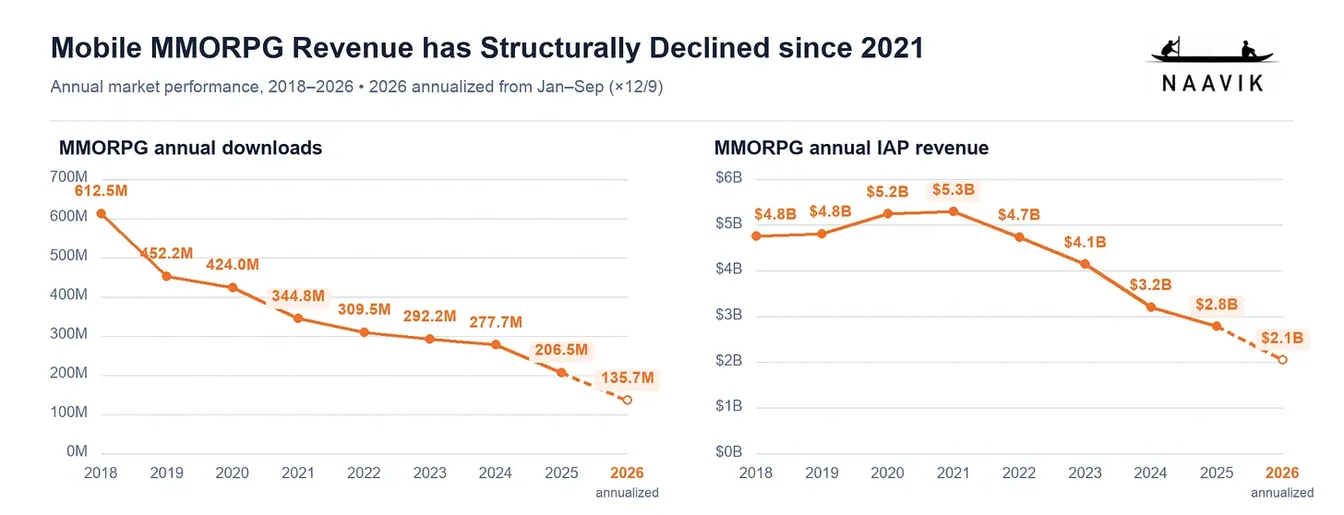
In 2021, the mobile MMORPG subgenre was the top subgenre by revenue. Today, it has fallen to number six – and the decline continues. The mobile MMORPG subgenre has not merely slowed down – it has collapsed. Subgenre IAP revenue fell from $5.3B in 2021 to $2.8B in 2025, a decline of -$2.5B or -47%, which is a significantly larger decline than in both the RPG genre (-38%) and the wider mobile games market (-1%) during the same timeframe. The collapse is also evident within MMORPG downloads, which fell from 345M in 2021 to 206M in 2025, a significant decline of -40%, compared with -13% for RPGs and -12% across all mobile games. This erosion continued in 2026. Between January and September, MMORPG revenue fell another -27% YoY, while downloads also dipped -37% YoY.
Taken together, the poor performance versus RPGs and the wider mobile market suggests that the MMORPG subgenre’s decline is more than a simple post-pandemic correction. This article examines where this structural, long-term collapse came from, why it happened, and whether recovery is even possible at this point. Let’s jump in!
Data caveat: Throughout this article, data excludes DTC, China Android, and ad revenue, while market size figures come from Sensor Tower’s “Market Size” feature.
Where the Revenue Collapse Came FromThe Regional Collapse
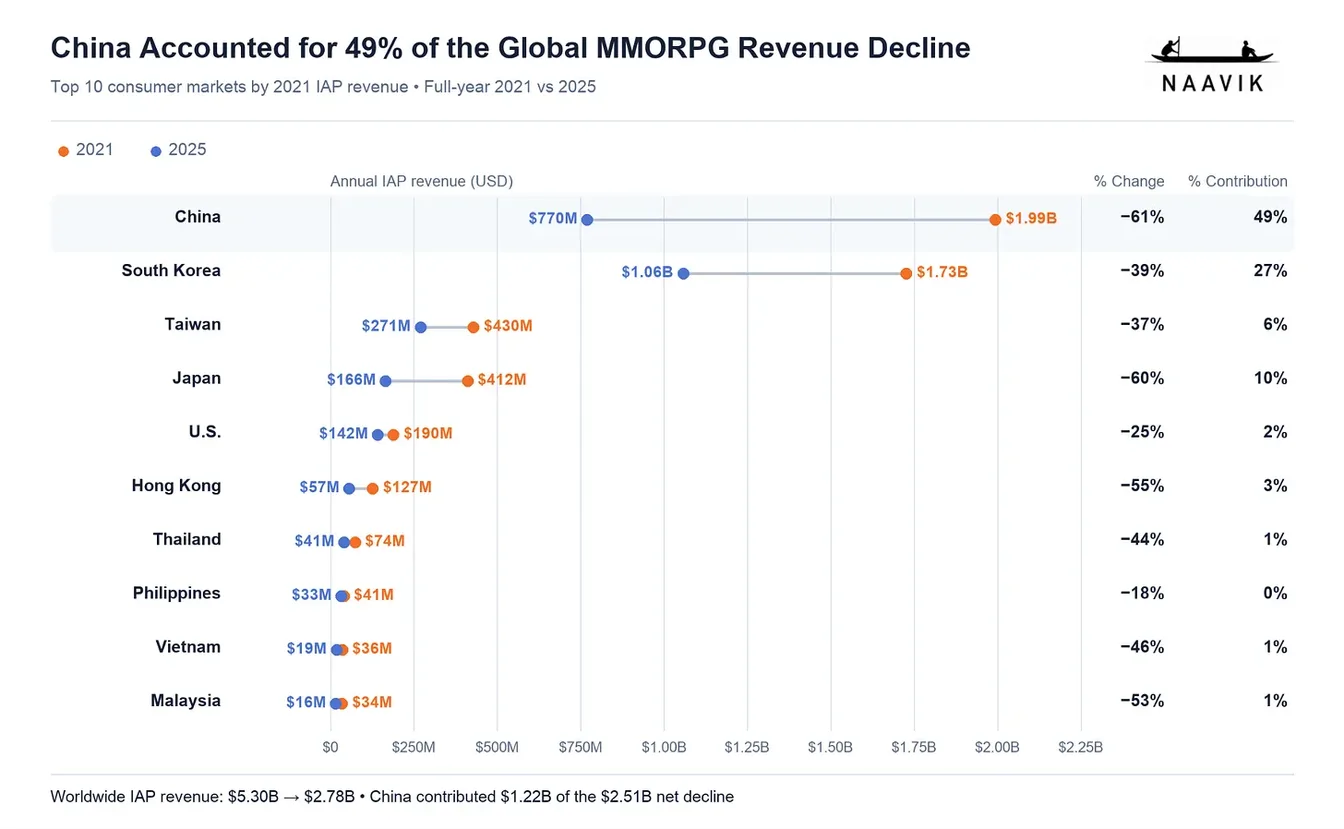
In 2021, nine of the ten largest MMORPG revenue markets were in Asia, generating $4.9B (92%) of the $5.3B worldwide total. China was the largest consumer market at $2.0B (38% share), followed by South Korea at $1.7B (33%), Taiwan at $430M (8%), and the U.S. at $190M (4%).
By 2025, Asia still dominated, but China fell by -$1.2B (-61%), accounting for close to half of the total worldwide MMORPG revenue decline since 2021. In turn, South Korea had become the largest consumer market at $1.1B, despite revenue declining by -$670M (-39%) and contributing to 27% of the subgenre’s revenue decline over the same time period. Taiwan remained at third place ($271M, -37%), followed by Japan ($166M, -60%), and the U.S. ($142M, -25%), the only non-Asian market in the top 10. Together, these three territories contributed to an additional 18% of the subgenre’s revenue decline – with all five territories explaining 95% of the subgenre’s decline.
The audience showed the same concentration. In 2021, eight of the ten largest download markets were in Asia, with the only non-Asian territories being Brazil (8th) and the U.S. (9th). China generated 120M (35%) downloads, followed by Vietnam at 48M (14%) and South Korea at 25M (7%). By 2025, China downloads were down by a significant -88M (-74%), accounting for a sizable 64% of the worldwide loss. During the same timeframe Vietnam fell by -17M (-36%) and South Korea by -7M (-29%), together making up for an additional 18% of the global loss.
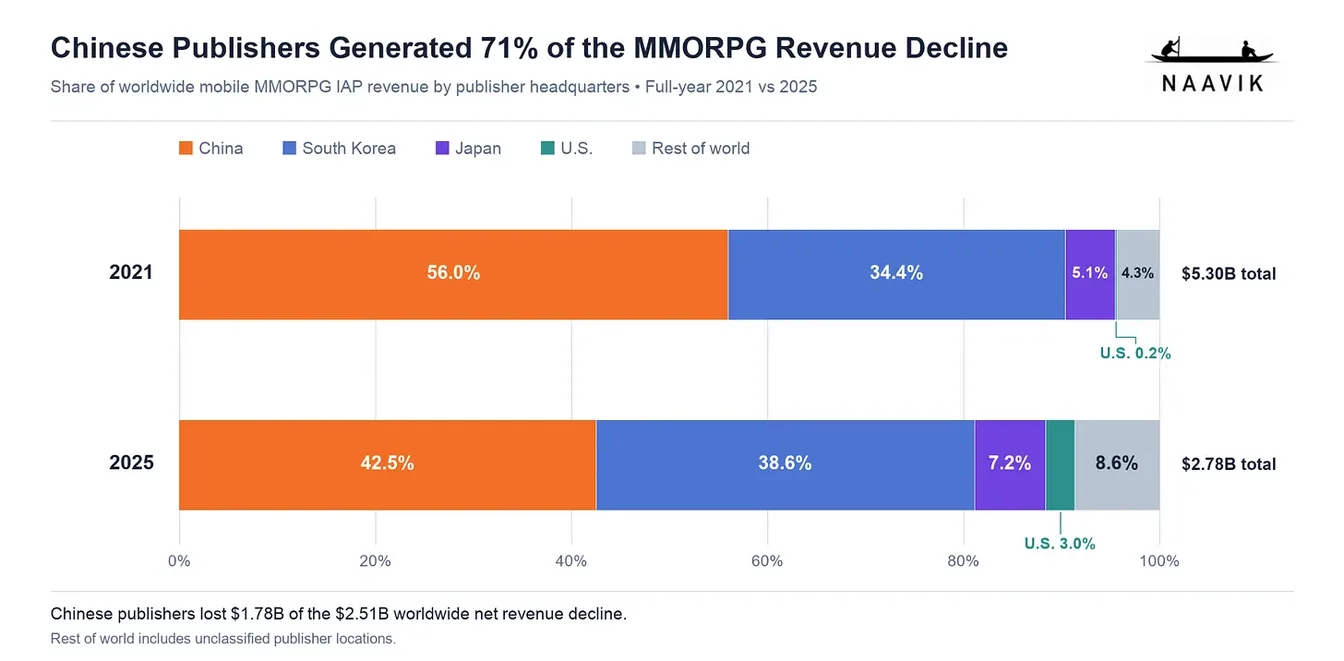
The publisher side was even more concentrated in Asia. In 2021, the three biggest publisher locations accounted for 95.5% of the revenue market – Chinese publishers generated $3.0B (56%) of worldwide mobile MMORPG revenue, followed by South Korean publishers at $1.8B (34%) and Japanese publishers at $268M (5%). By 2025, publishers in these three countries had collectively lost -$2.6B in revenue, explaining all of the subgenre’s worldwide decline. However, the losses were concentrated among a relatively small number of established and globally relevant publishers:
- In China, Tencent and NetEase lost a combined -$897M between 2021 and 2025, equivalent to approximately 51% of the country’s publisher decline.
- In South Korea, NCSOFT alone lost -$456M, or 62% of the country’s total decline, while NCSOFT, Kakao Games and WEBZEN collectively accounted for approximately 90%.
- Japan’s smaller contraction was led by Nexon, ASOBIMO, and Marvelous, which together accounted for approximately 64% of the loss.
Publisher downloads were also concentrated in Asia, albeit not to the same extent as revenue. In 2021, the three biggest publisher locations accounted for 64% of worldwide downloads. China generated 165M (48%) of worldwide mobile MMORPG downloads, followed by South Korea at 46M (13%) and Japan at 9M (3%). By 2025, those three countries still generated 54% of all MMORPG downloads, but had experienced sizable declines. Chinese-published titles alone lost -85M (-52%) downloads, accounting for 61% of the worldwide decline.
Putting everything together, mobile MMORPGs were not merely popular in Asia – their player base, spending, and publishing capacity were all concentrated there, with China holding a large position on both sides of the market. The combination of that concentration, China’s decline, and further amplification from other top 5 markets drove a disproportionate share of the subgenre’s global contraction.In other words, such high concentration across multiple vectors exposed the subgenre to major risks around evolving player preferences, cutthroat intra-subgenre competition, unforeseen external competition, formulaic product fatigue, and more. Further, with so much of the decline concentrated among established publishers, an interesting question can be asked around whether they continued investing in MMORPGs or shifted their attention towards other subgenres. We explore these topics later in the article.
The Metric Collapse
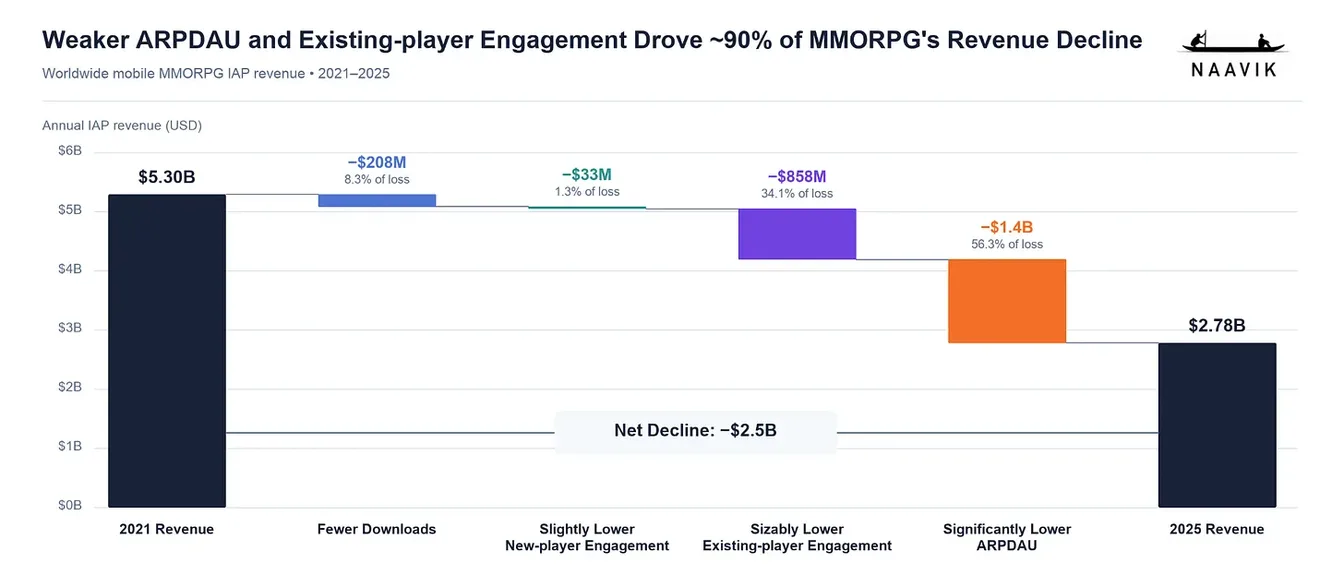
As a reminder, the MMORPG subgenre declined by -$2.5B between 2021 and 2025. Lower ARPDAU accounted for -$1.4B (56.3%) of the measured loss, while declining existing-player engagement accounted for -$858M (34.1%). Fewer downloads and weaker new-player engagement explained the rest. In short, mobile MMORPG publishers faced pressure from multiple angles: fewer new downloads entered the top of the funnel, existing users played less frequently, and monetization intensity dropped across both cohorts.
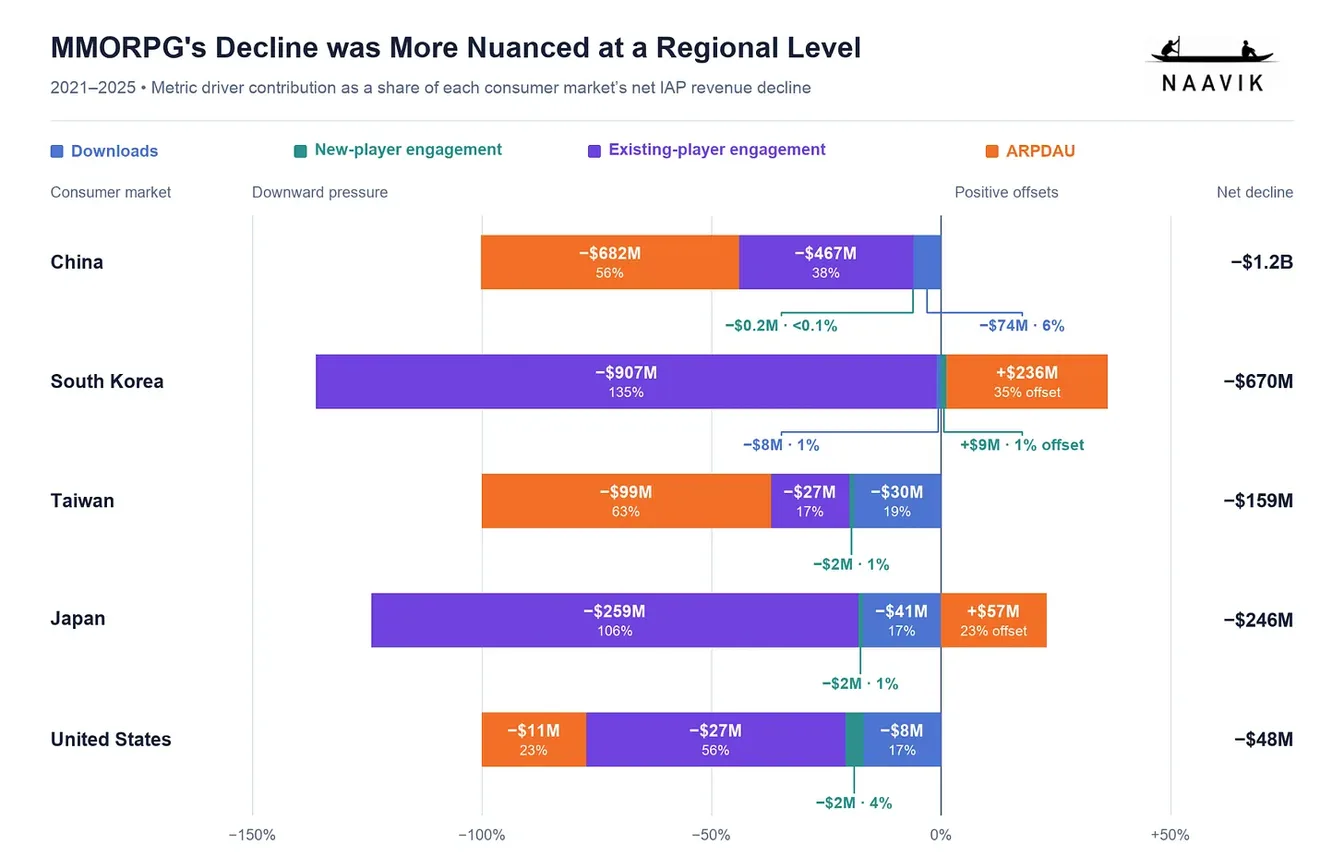
While this was the global pattern, regional differences reveal player and payer behavior nuances:
- China: Lower ARPDAU accounted for 56% of the measured decline, followed by weaker existing-player engagement at 38% – suggesting a rapid hollowing of the core player and payer base.
- South Korea and Japan: In South Korea, weaker existing-player engagement contributed 135% of the net decline, while higher ARPDAU offset 35%. This suggests lower-intent players left faster than core payers, lifting average monetization as the remaining audience became more payer-heavy. Japan showed a similar pattern, compounded by fewer downloads.
- Taiwan: Lower ARPDAU accounted for 63% of the decline, followed by fewer downloads at 19% and weaker existing-player engagement at 17%. This suggests erosion similar to China’s, alongside greater difficulty replenishing the player base.
- US: Weaker existing-player engagement accounted for 57% of the decline, followed by lower ARPDAU at 23% and fewer downloads at 17%. This suggests both lower-intent players and higher-spending payers moved on, while acquisition weakened – contrasting with the relative resilience of core payers in South Korea and Japan. Existing-player engagement losses also outweighed monetization pressure, reversing the pattern seen in China and Taiwan.
Overall, the MMORPG revenue collapse was concentrated in a handful of major consumer markets and established Asian publishers, with China playing a particularly large role. The problem also extended beyond attracting new players, wherein lower ARPDAU and weaker existing-player engagement explained roughly 90% of the measured revenue loss. Even though the metric contributors for the global revenue decline differed across key regions, the bottom line is that mobile MMORPGs faced downward pressure from multiple angles, making the subgenre’s decline deeply structural. The next question is why these markets struggled to sustain participation, spending, and player replenishment – and how the traditional MMORPG proposition became less compelling as alternatives evolved.
What Drove the Revenue CollapseThough macro factors, such as post-COVID corrections, the post-IDFA privacy landscape, and attention wars with short-form video platforms like TikTok and bilibili, likely exerted downward pressure on the subgenre, this section digs specifically into the structural revenue drivers unique to mobile MMORPGs. To unpack these dynamics, our literature review and data analysis focusses mainly on the subgenre’s top five revenue regions (China, South Korea, Taiwan, Japan, and the U.S.), which collectively account for almost all of the subgenre’s global contraction since 2021.
#1: The MMORPG Bargain Became Less Compelling
Traditional mobile MMORPGs offered a powerful bargain: invest time and money in a character’s development to feel a great sense of continual progression, status evolution, and social belonging in a lasting shared world. But, as with any mobile F2P subgenre, sustaining such a bargain (one that is rooted in a subgenre’s core player motivations) required the traditional MMORPG experience to keep renewing its demand justifications in fresh ways — not simply giving players more progression goals to meet, maintain, and monetize on.
Based on a multilingual literature review we performed, three recurring themes emerged for why that bargain weakened over time across mobile MMORPG experiences:
- Engagement fatigue: Many standardized mobile MMORPG systems (daily tasks, scheduled guild activities, various progression requirements, etc.) seem to have turned participation into an obligation – a concern confirmed by the communications and actions observed from key MMORPG publishers. For example, NetEase’s Justice Mobile rejected repetitive daily and weekly chores that make gaming feel like work, NCSoft cited reducing player fatigue as a goal of changes to Lineage2M’s boss and dungeon activity schedules, and Tencent’s Moonlight Blade removed compulsory daily tasks and selected scheduled events. Further, satisfying these obligations demanded significant amounts of players’ daily time. And as can be seen in the data below, average playtimes for key RPG subgenres have converged over time and across territories. Our interpretation is that the typical engagement commitment of traditional mobile MMORPGs became increasingly harder to justify as other mobile gaming experiences, especially those from other RPG subgenres, offered different ways to satisfy similar player motivations without organizing as much of a player’s day around one game.
Spending fatigue: The financial side of the bargain also weakened as players started to feel their recurring microtransactions were more about preserving their in-game position and less about multiplying in-game enjoyment. This concern was reflected in Kakao Ventures’ assessment of spending (and engagement) fatigue among South Korean MMORPG players, NetEase’s Justice Mobile team identifying large paid-power gaps and poor non-paying experiences as reasons players feel forced to spend, and NCSoft acknowledging that Lineage’s recurring paid-buff systems had left users unable to enjoy their benefits. Specific cases around monetization fairness and trust further compounded that tension — Taiwan’s Fair Trade Commission fined Lineage M over misleading crafting-probability claims. In a sense, experiences looking to steal MMORPG market share did not have to be cheaper to weaken the MMORPG proposition: if players perceived greater satisfaction per dollar alongside a lighter daily commitment, their gaming budgets would theoretically have more attractive places to go.
Gameplay homogeneity fatigue: Compounding the impacts of the previous two points was an increasing sense of gameplay homogeneity, reflected in recurring formulas across Chinese wuxia MMORPG experiences and South Korean Lineage-likes. In other words, changing the setting or adding content around familiar systems was not always enough to renew the appeal of incumbents or newcomers. We believe that fresher non-MMORPG experiences made the negative impact of MMORPG product homogeneity more consequential, as they offered new routes to satisfying familiar MMORPG player motivations.
Taken together, the above suggests that the problem was not the disappearance of the player motivations MMORPGs served, but a weakening relationship between the demands they placed on players and the rewards they provided. Players likely still wanted immersive worlds, meaningful progression, community belonging, and memorable experiences – the rise of open-world RPGs made the satisfaction of that evolving bargain particularly clear.
#2: Open World Adventure RPGs Raised the Bar
Genshin Impact’s September 2020 launch marked the emergence of a substantially new subgenre that could directly compete for MMORPG’s audience and revenue volumes across major Asian territories. As seen in the data above, once Genshin Impact launched and more Open World Adventure RPG titles followed, MMORPG’s decline in subgenre revenue clearly accelerated. Today, Open World Adventure RPG quarterly revenue is very close to meeting (and potentially exceeding) that of MMORPG’s.
Similarly, Open World Adventure RPG’s download share within the RPG genre has grown over time, slowly eating away at MMORPG’s audience share. This is especially clear to see in China, and extends to other major Asian markets too.
Based on a review of player commentary during the time of Genshin Impact’s launch, it starts to become clear that Open World Adventure RPGs satisfied several core player motivations traditionally associated with MMORPGs. Furthermore, it delivered those motivations with genuinely fresh gameplay, a significantly higher production value, integrated cinematic storytelling, and a smooth cross-platform experience. Lastly, in large part due to them entering mobile F2P much later than other mobile RPG subgenres, Open World Adventure RPGs were more attuned to evolving player preferences around daily engagement and spending limits from the get-go, diffusing MMORPG’s growing issues around engagement and spending fatigue. The player accounts below illustrate how these factors combined to result in players moving their time and money from existing MMORPGs (Toram Online, Ragnarok Online, Dragon Raja, etc.) toward Open World Adventure RPGs (Genshin Impact in particular).
Simply said, with the rise of Open World Adventure RPGs, MMORPGs no longer had exclusive claim to the progression, immersion, competition, and social connection their players valued. As Genshin Impact and other similar titles offered compelling ways to satisfy core MMORPG player motivations, retaining existing players became harder. But keeping players was only one side of the coin: MMORPGs also needed to attract enough new and returning players to replace those leaving.
#3: The MMORPG Audience Became Harder to Replenish
Beyond Open World Adventure RPGs raising the bar, mobile MMORPGs faced another challenge: successfully replacing departing existing players with new players willing to sign up for the same engagement and spending commitments. Within the context of declining RPG genre downloads, MMORPG downloads lost significant share versus other RPG subgenres. New releases in these other RPG subgenres, such as Honkai: Star Rail, AFK Journey, and Legend of Mushroom, likely offered fresh ways to satisfy familiar player motivations and evolving needs. They may also have drawn engagement away from MMORPGs – a possibility consistent with the converging playtime data shown earlier. Revenue share followed.
This likely played out due to three distinct reasons:
- Established worlds became harder to join or return to as elements like widening player power gaps and rising player catch-up tax (due to increasingly complex game systems) gained ground. Key examples of major MMORPG publishers acknowledging this reality and taking action include:
- In 2023, Pearl Abyss described Black Desert Mobile’s new “Season Character” system as lowering entry barriers for new and returning players. The system offered rapid combat-power progression and growth-focused quests and rewards to accelerate progression and make an established MMORPG more accessible.
- In 2024, NetEase acknowledged that Justice Mobile’s volume of content and playstyles made onboarding difficult, and described improved guidance and catch-up rewards designed to help newcomers quickly play alongside established friends. Their introduction of an “annual season reset” to the game encapsulates how replenishing the audience of an established MMORPG world required significant (and likely high investment) product changes – not simply more user acquisition.
- In 2025, Netmarble acknowledged that starting Blade & Soul Revolution with a boosted “jumping character” could overwhelm newcomers. Its proposed “Boost World” combined accelerated leveling with gradual content unlocks, dedicated progression guidance, and fewer quest requirements – explicitly addressing complexity and differences in progression speed for new players.
- The traditional MMORPG proposition had uneven appeal among incoming younger audiences: Based on Sensor Tower’s demographic data, during January to September 2026, MMORPGs’ 18-24 audience share averaged approximately 14% in South Korea, 19% in Taiwan, and 19% in the U.S., versus 28%, 29%, and 30% for Turn-based RPGs. Similar differences were seen for other key RPG subgenres, depending on the market. Within the context of a declining RPG audience, the pressure to attract new-to-the-funnel younger audiences only increases, and the data does not suggest that MMORPGs were outperforming other RPG subgenres in that regard.
- Global expansion was not an automatic solution: Kakao Ventures’ assessment argued that South Korean MMORPG developers’ reliance on a narrow, high-spending domestic audience created challenges in both overseas product fit and user acquisition. Major MMORPG publishers like NC America and Pearl Abyss made similar acknowledgements, followed by a set of actions that tuned various aspects of the game experience to better fit specific regional expectations. For those publishers, reaching a broader audience required reconsidering gameplay, monetization, and acquisition strategies – not simply localizing the domestic formula.
As our “metric collapse” analysis showed, weaker existing-player engagement and monetization accounted for most of the subgenre’s revenue decline, while download volumes and new-player engagement contributed less directly. The barriers above likely made attracting new players and bringing back lapsed players harder, limiting the subgenre’s ability to replace lost engagement and spending. Even though some major MMORPG publishers did take steps to combat these barriers, it might’ve been a case of “too little, too late”, especially in an environment where other RPG subgenres were releasing titles that better and more immediately served MMORPG player needs at the time.
This dynamic naturally put pressure on new MMORPG releases to shore up the subgenre’s overall performance by offering a fresh start and attracting the audiences established worlds were struggling to recruit, retain, and monetize. So the next question is – did these new releases generate enough engagement and spending to offset the value erosion being experienced by incumbents?
#4: New Releases Couldn’t Make Up for Declining Incumbents
If established MMORPGs were losing their appeal and struggling to replenish their audiences, new MMORPG releases offered established MMORPG publishers a potential route back to growth. However, our analysis below suggests that the attempted replacement process fell short. Older titles lost $3.9B in annual revenue between 2021 and 2025, while newer titles generated $1.4B in 2025, offsetting ~35% of that erosion.
Established MMORPG publishers also broadened their search for growth within other RPG subgenres that were showing increasing market traction. Across the 20 leading MMORPG publishers in the subgenre’s top five revenue markets, other RPG subgenres accounted for a growing share of new RPG releases – rising from 25% to 52% in South Korea and from 28% to 64% in the US. A rebalancing toward alternative RPG experiences rather than a wholesale exit from MMORPGs was clearly at play, and Idle RPGs were a particularly prominent destination.
All the evidence above suggests that mobile MMORPG subgenre recovery will require more than another wave of “the same”. But that does not mean everything the subgenre offered has become obsolete. It raises a question around how both existing and new MMORPGs can offer a more compelling bargain for players’ time and money while remaining commercially viable. In a sense, reinvention could start by identifying what is still worth preserving.
Mabinogi Mobile offers a recent example of a differentiated MMORPG proposition finding commercial traction. Released on PC and mobile in South Korea in March 2025, and underneath its Genshin-like visual wrapper, it carries forward the franchise’s lifestyle-led positioning, double downs on everyday social interaction, and holds everything together with a MMORPG economic structure – all alongside combat and power progression. Nexon subsequently reported that the launch drove fourfold year-over-year revenue growth for the Mabinogi franchise in 2025. That does not establish which design choices drove its success, but it demonstrates that the wider subgenre’s decline does not preclude successful, differentiated releases.
That said, subgenre reinvention may not always be the best investment for every publisher. The increasing traction seen in other RPG subgenres is undeniable – some of which seem to successfully cater to the next generation of RPG players, satisfy multiple MMORPG player motivations, and efficiently monetize their various needs. Publishers with established MMORPG IPs can ask whether their characters, worlds, and communities would travel better into these formats (or across platforms) than into another conventional MMORPG (even if reinvented).
Nexon’s MapleStory: Idle RPG illustrates this alternative route, supported by a robust IP expansion framework. Launched in November 2025, it repackaged familiar characters and progression into shorter, more accessible gameplay loops. Nexon reported that 54% of its players had no previous MapleStory PC or mobile experience, younger audiences made up a majority of their new players, while MapleStory: Idle RPG and MapleStory Worlds helped drive 42% YoY franchise revenue growth in Q1 2026.
For existing MMORPG incumbents, the priority is likely different: extend profitable product lifetimes through carefully chosen live-ops investments. There clearly still is a market for traditional MMORPGs, even though it is not as big as it once was. Hence, existing incumbents are likely best served by maximizing retention and monetization of their existing player base. However, finding the best balance between catering to their evolving veteran’s needs and protecting broader community wants will be key.
NCSOFT’s Lineage M provides evidence that participation-focused renewal can accompany commercial improvement. Following its Reboot World initiative, the company reported strong user metrics and a 49% quarter-on-quarter sales increase in Q3 2024. It continued developing the approach through initiatives such as 2025’s HOMECOMING update, which offered accelerated growth and expanded progression rewards. While these results do not prove that catch-up measures alone caused growth, they show that an aging incumbent can still generate renewed participation and revenue. Lineage M’s revenue stability in a rapidly declining MMORPG market is particularly notable.
If nothing changes, our expectation is that the mobile MMORPG subgenre will continue contracting, potentially settling around a smaller, committed audience. Stabilization would be more convincing if download volumes, sustained engagement, and monetisation stopped eroding. Recovery, however, would require something more: a Genshin Impact moment of the subgenre’s own, renewing its appeal rather than repeating its established formula. The opportunity is not simply to build another shared world, but to make players feel that inhabiting one is worth their time and money again. That is the comeback we’d love to see.
Partner Spotlight: Mobile gaming’s OGs in one closed room, recorded
Mobile UA got its biggest update in a decade, the old meta is dying, and nobody has the full picture yet.
UATOPIA is the closed room in Barcelona where UA leaders from 30+ studios, including Supercell, Zynga, Playtika, Voodoo, Fanatee, SuperPlay, and many more, decode the new meta together: what changed, what’s already dead, and how to play it from here.
On the table: where AI helps UA and where it wastes a quarter, how the top studios launch games and spot a potential winner, how a UA team runs when agents do the tasks, where the edge lives when everyone has the same AI, and what everyone is doing with playables, from real data.
Seats are invite-only, and every recorded session goes free to anyone who signs up, straight to their inbox within days of each session.
Send me the tapesTop News Items
#1: EU consumer authorities examine major publishers over virtual currencies
- Europe’s Consumer Protection Cooperation Network has opened actions against 11 coordinated enforcement actions involving major games publishers, including King and Supercell, over their use of virtual currencies. The investigation does not establish that the publishers have broken the law. The authorities want prices clearly shown in real money, without pushing players to buy more currency than they need, in line with the CPC’s principles on virtual currencies. This follows an earlier enforcement action against Star Stable Online, where the CPC found direct purchase appeals to children, time-limited pressure selling, unclear currency information that could encourage overspending, and inadequate advertising disclosures by influencers. Applying the same standards more widely could force major mobile publishers to make their stores and purchasing flows more transparent. This may reduce spending caused by unclear prices or mismatched currency bundles, although the effect on total spending is unknown. Targeted changes to pricing and purchasing flows appear more likely than a broad decline in virtual-currency monetization, but their scope and timing remain uncertain, and publishers may contest the CPC’s interpretation.
#2: U.S. government challenges part of Apple contempt finding in Epic case
- The U.S. government is asking the Supreme Court to overturn the finding that Apple violated an injunction by charging a 27% commission on purchases made outside its App Store by using links. The government argues that the injunction did not specifically prohibit Apple from charging a commission, and thus, charging the fee should not have resulted in a contempt finding. Still, the government supports the finding that Apple broke the injunction by restricting developers to “plain buttons” that were effectively text links, even though the injunction required Apple to permit genuine buttons as well as links. For publishers, though, the commission likely matters more, since Apple’s 27% commission left publishers little room to save compared with its standard 30% rate, and payment-processing fees could wipe out that saving. Lifting that part of the contempt ruling on commission would not automatically bring back Apple’s 27% fee. What Apple could charge would depend on the Supreme Court’s decision and any further rulings by the lower courts. The brief supports Epic on the button restriction but challenges the commission-related contempt finding, so it is not a clear step toward a final U.S. victory. It is an amicus filing rather than a ruling, and the Supreme Court has not yet issued its decision.
#3: AppLovin and Unity dispute ad-data collection
- AppLovin has accused Unity’s Ad Quality SDK of improperly collecting information from ads served by AppLovin, including data on creatives, users, devices, impression revenue, and auction prices. It asked a San Francisco court to stop Unity from collecting and using this information, disable the relevant collection within five business days, and modify the SDK within 30 days. The court denied AppLovin’s temporary restraining-order request on October 1, but that decision did not resolve the underlying claims, and the wider dispute will continue in arbitration. Unity denies the allegations, arguing that Ad Quality helps publishers prevent harmful ads and that the product is not responsible for improving advertising performance. That performance is nevertheless adding competitive pressure: Unity attributed the growth of its ad network to Vector in Q2. AppLovin says a network’s history of which ads it served, to whom, and at what price is an important competitive advantage. Protecting that data may therefore help AppLovin defend its lead as Vector improves, making this dispute partly a contest over the information used to sharpen rival advertising models. That is a plausible strategic incentive, not evidence that Unity unlawfully trained Vector using AppLovin’s data — at least for now.
#4: mo.co goes back to beta as Supercell rethinks its approach
- Supercell is returning mo.co to beta while rethinking the game’s appeal and development approach. The studio said that while mo.co was working well for a niche audience, it had not met expectations and was not ready to scale to a mass audience. The existing game will now move into lower maintenance with a reorganised beta team that is going to test experimental features and use early feedback to make changes more quickly. Data from Sensor Tower does point to weakening acquisition and monetisation performance ahead of the announcement from Supercell. While the data does support a reset decision aimed at broader appeal, what remains to be seen is whether Supercell can turn this game back around like it did with Brawl Stars many years ago.
Other News Items
Product & Marketing
- Clash of Critters reaches an estimated $45.6 million in gross player spending, according to AppMagic
- Mario Kart Tour closes after seven years
- Monster Hunter Outlanders gets an October 29 launch date
- Minion Rush ends online service on January 29, 2027
- Minecraft Blast returns to soft launch, downloadable in Malaysia on Google Play
- MONOPOLY GO! announces its KPop Demon Hunters and Ghostbusters season
- Microsoft Jewel launches as a free, ad-supported standalone mobile app
- Pokémon Masters EX to end service in Türkiye on December 22
- MY.GAMES says Hunting Rivals has passed $3m revenue, 3m installs and 1m monthly active users
Companies & Capital
- Trophy Games agrees to acquire Playrion from Paradox
- Tencent leads Circle Games’ $25 million Series A
- King takes responsibility for Microsoft Casual Games as Xbox restructures
- King signs Swedish collective agreement, averting strikes
- Scopely reportedly takes a stake in Bokura
- Leus launches cohort-purchasing platform for mobile-game UA financing
Platform, Technology & Tools
- Zynga Ads+ brings 100 mobile games to advertising offering
- YouTube expands Playables to more than 50 markets
- AppsFlyer adds AI answer-engine referral attribution
- NetEase Games Club adds local payments in Latin America
- Heroic Labs launches player-specific LiveOps Journeys in Satori
- Layer launches HTML5 playable-ad generation for mobile UA
Sponsor: Lifting Every Core KPI at Launch: Case Gray Zone Warfare
When MADFINGER expanded from mobile to PC, it used Heroic Labs to build a preview mode with full progress carryover. Read how the work increased every core KPI, from CCU to DAU/MAU, retention, and session length, at launch.
Learn MoreContent Worth Consuming
Talking Tom Had Billions of Downloads, But AI Couldn’t Find It: How Outfit7 Rebuilt Its Discovery Strategy in Six Months (GamingOnPhone): “We started by asking ourselves: ‘What are our users actually looking for?’ We then combed through social media, app store reviews, customer support emails, Google Trends, and Google’s ‘People also search for’ results.”
Adam Foroughi, AppLovin CEO: Surviving a 92% Drawdown, Ads as ML 1.0 & the $50B Game Ad Market (All-in Podcast): “Adam is probably the best founder no one’s ever heard of. There’s an ad platform hiding inside 100,000 mobile games and is quietly outperforming Facebook ads for e-commerce brands.”
Zynga Founder Mark Pincus: Why Your Favourite Ideas Are Almost Always Wrong (Deconstructor of Fun): “The usual story is that success changes a person. They get cautious. They start protecting what they built instead of building what they believe in. With founders, I think it works the other way. Success doesn’t change them. It removes the last excuse for impersonating a professional executive.”
A pocket guide to the EU Kids Act (PocketGamer.biz): “The new draft legislation is a response to the increasing calls to keep kids safe in online spaces. Member States such as France, Italy, Norway and Greece have already been working on their own laws, while advocating for measures at the EU level. While obligations are very likely to change during the legislative process, the proposal sets the direction.”
How OneState maker ChillBase is meeting demand for GTA-like games (mobilegamer.biz): “The way we do monetisation is closer in spirit to how real-life luxury goods work than to the mobile game standard,” he explained. “Take a luxury watch, for example: such an item is bought for the status it carries, not for its timekeeping. The same goes for OneState’s monetisation.”
AI in Mobile Ad Creatives: What Actually Works (Rovio / Gamigion): “AI is supposed to replace half the creative team. In practice, it has become just another tool, one that saves hours on some tasks and creates more work than it saves on others.”