How Royal Match is Changing Candy Crush Saga
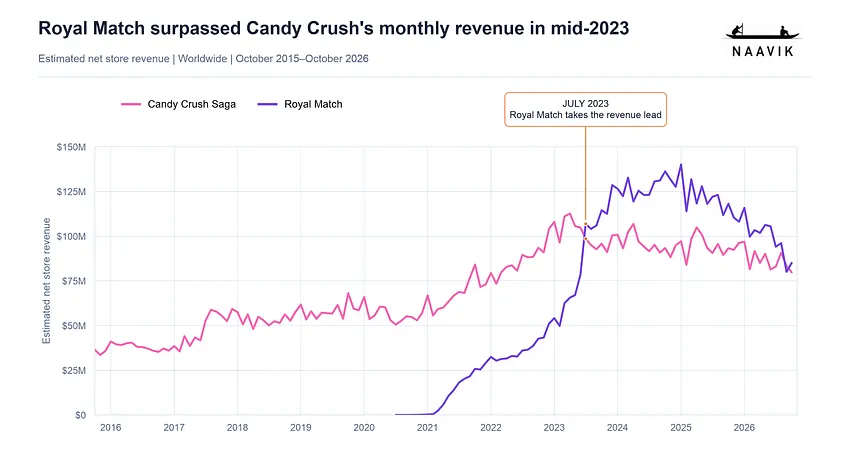
In mobile F2P, the match-3 puzzle sub-genre is as lucrative as it is fiercely competitive. For over a decade, King’s Candy Crush Saga (CCS) was the sub-genre’s top-grossing game. However, the arrival of Royal Match (RM) fundamentally disrupted the market. The shift culminated in mid-2023 when RM surpassed CCS in monthly revenue — kicking off RM’s three-year reign.
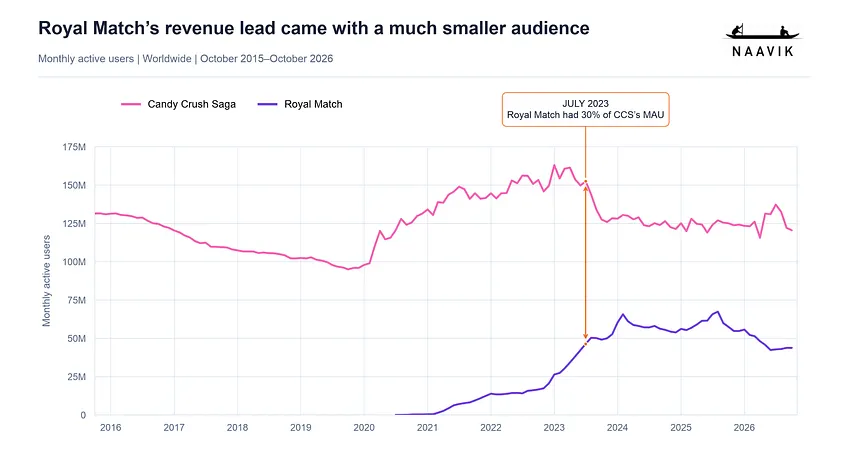
This changing of the guard was not simply a result of RM chipping away at CCS’s massive casual audience. Instead, RM redefined the economics of the match-3 sub-genre by maximizing engagement and monetization efficiency with a smaller user base. We’ve previously covered how RM redefined the Match-3 economy, the challenges of copying its blueprint, and the areas where the game continues to experiment.
In our eyes, one of the most significant shifts RM has brought to match-3 is related to resetting and evolving what players expect from the subgenre. In response, CCS has accelerated various product updates, drawing cues from the new market leader to modernize legacy systems. This digest examines three broad ways CCS is evolving its product playbook — and what those shifts signal for a subgenre where even the biggest incumbents can’t afford to stand still.
#1: Casualizing its Core Gameplay
Since its inception, CCS has relied on a ‘match-to-activate’ gameplay rule for triggering its special pieces like rockets (line clear) and bombs (area clear). These special pieces could only trigger if matched with two or more candies of the same color, or swiped with another special piece. This naturally required players to plan their moves strategically while considering the board state.
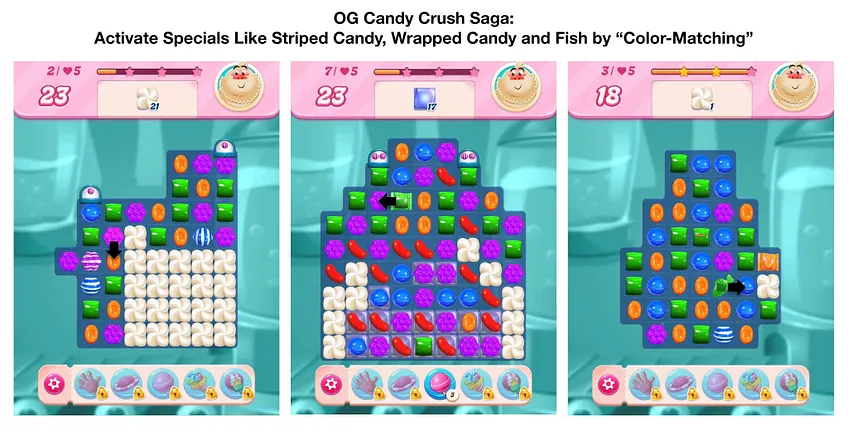
Conversely, RM was built on frictionless gratification: players could activate special pieces by simply tapping them or swiping them in any direction, bypassing CCS’s ‘match-to-activate’ requirement. However, note that this faster, more explosive, and more casual core action was not a novel implementation by RM – it was previously popularized by Playrix’s Scapes titles. RM was quick to recognize its value and adopt it.
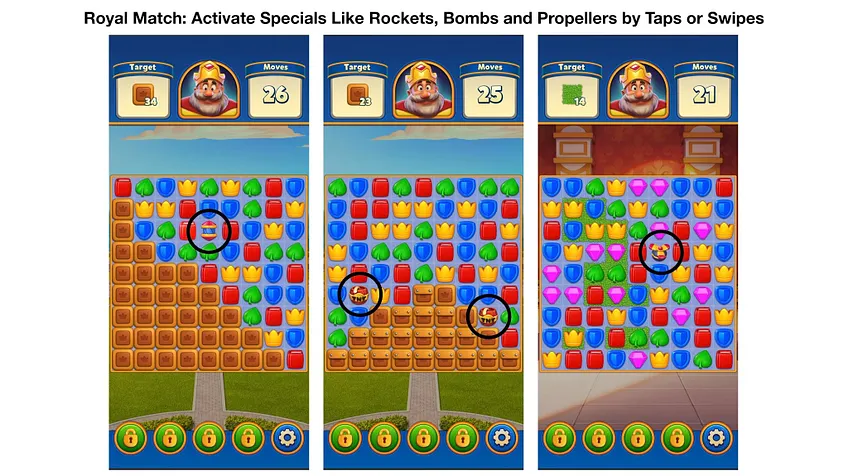
CCS is finally catching up – it began rolling out a ‘tap & swipe’ feature for special pieces over June 2026. Players can now activate all special pieces by simply tapping them or swiping them in any direction, bypassing the game’s long-standing ‘match-to-activate’ gameplay rule.
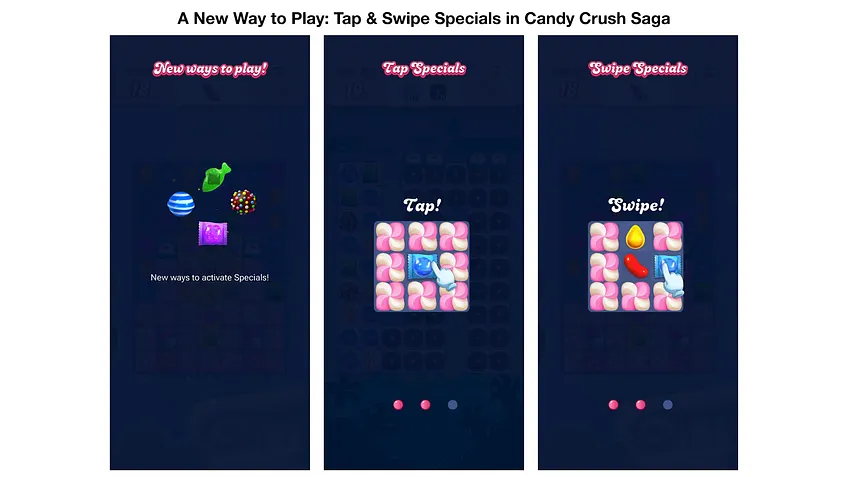
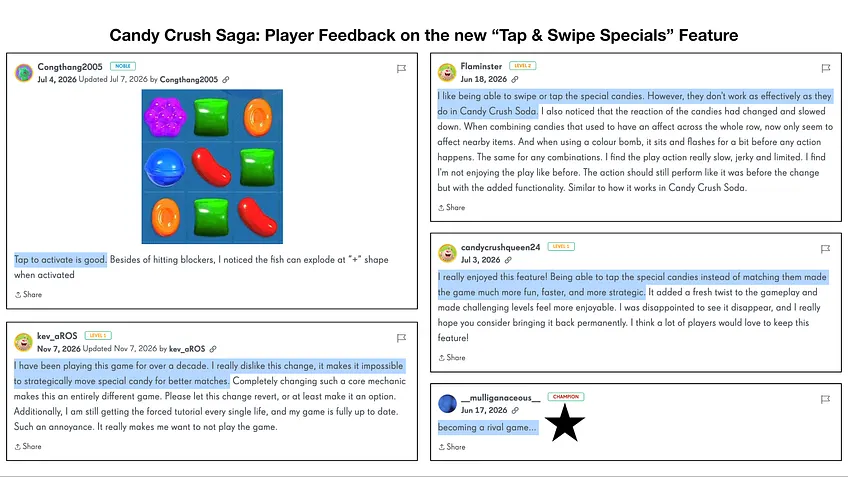
As one can imagine, this represents a major shift for veteran CCS players. Casualizing such a core action can offer various product and marketing benefits to both new and existing players. However, the change also challenges the muscle memory of CCS’s most loyal players and payers while shifting the game’s identity away from traditional puzzle-solving toward the more kinetic match-3 experience. This tension is reflected in the official community thread on the topic, where the ‘tap & swipe’ feature has received a polarizing reception. Some players cite accidental activations and reduced strategy as their biggest pain points. Others strongly prefer the new mechanics and would be upset if they’re excluded from the feature’s broader rollout.
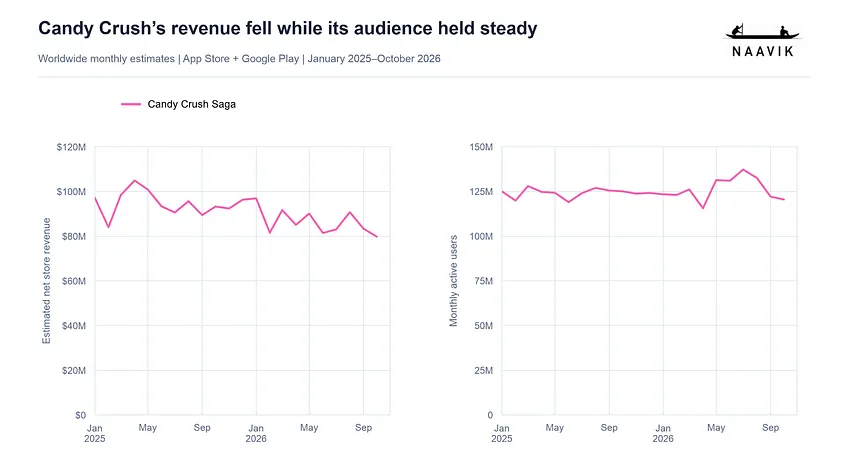
With over 23,000 live levels and a long-standing fanbase, sweeping core gameplay changes like this are not only notoriously difficult to tune without breaking level-difficulty balance curves, but also complicated to sell to a large and established player base. However, since King’s Candy Crush Soda Saga globally rolled out this core gameplay change last year, there is a chance CCS follows suit within the coming year too. Ultimately, King’s intentions with such changes are likely not about generating short-term revenue spikes. It is likely betting that modernizing the core gameplay experience to meet today’s player expectations will sustain retention and revenue over the next decade. As the worldwide data below shows, CCS’s revenue is declining despite a resilient player base, so King needs to revive monetization while protecting the loyal customers keeping the lights on today – a bird in the hand may still be worth two in the bush.
#2: Modernizing its Live-Ops Cadence
RM achieved its staggering financial success in part through a masterclass in live-ops — running constant, overlapping tournaments, collection events, and seasonal challenges that compel players to play and pay multiple times a day.
According to AppMagic, RM runs 150+ live-ops events every month. That intensity likely helps explain why RM’s U.S. players average ~75 sessions and ~600 minutes per month. By comparison, CCS’s U.S. players average ~45 sessions and ~300 minutes per month, which is roughly half of RM’s monthly playtime. Reconstructing CCS’s full live-ops calendar was beyond this article’s scope, so we used Sensor Tower’s App Store-promoted event listings for a like-for-like comparison of the two games’ live-ops intensity. From January to October 2026, CCS recorded an average of 1.0 US App Store-promoted event listings per month, roughly 80% fewer than RM’s 4.9. That gap likely reflects a broader difference in live-ops intensity across the two games.
That said, CCS has been taking steps since 2021 to step up their live-ops cadence. It reached a monthly cadence of seasonal content in Q2 2021, and King reported further increases in seasonal frequency and depth across the Candy Crush franchise in Q2 2022. Today, the game has evolved from the classic saga-map progression puzzle into a live-ops ecosystem with seasonal albums, time-limited events, high-stakes competitions and mini-games. There is also a tab dedicated to events, pop-up reminders and feedback loops between levels to ensure players are always aware of active countdowns and ongoing tournaments.
These changes likely aim to narrow the engagement gap with RM, which was smaller in 2021. However, players frequently express frustration when unskippable live-ops pop-ups block them from simply playing the next level. Many also feel slow transition animations eat into the time remaining on their limited-duration boosters. Redistributing rewards across more events also leads to complaints that payouts are stretched too thin.
Polishing these UX flows and rebalancing rewards could ease the immediate friction. The harder task is adapting CCS, a 10+ year old game, to a more modern baseline that RM helped set: constant reasons to return, more rewards to chase, and a faster rhythm between levels. Those same systems can frustrate loyal players and payers whose habits were built around a simpler experience. King’s challenge is a tough one: make a decade-old game feel current while protecting the familiarity that keeps its core audience engaged. Or in other words: evolving with what today’s players expect while preserving what long-time players still value.
#3: Evolving its Premium Currency to a Hybrid One
Perhaps the most significant structural change in CCS is the evolution of its premium currency: Gold Bars. Historically, Gold Bars were strictly a premium commodity. Aside from a small starting batch, they were exclusively obtained through IAPs — serving as rare, highly guarded assets used to buy extra moves and boosters.
RM then popularized a hybrid model (previously introduced by Playrix’s Scapes games), by integrating its premium currency, Coins, into the game’s core loop. Players can buy Coins with IAPs, but they can also earn them consistently by winning levels and participating in live-ops. This hybrid currency keeps non-paying players engaged while normalizing the use of Coins for extra moves and boosters, potentially driving higher conversion when players exhaust their free balances.
Across 2021–2023, CCS broadened and reworked its existing Gold Bar economy, expanding the reward routes linking currency to progression and repeat play. It is important to note that this was an expansion, not a new introduction. For example, events like Episode Race awarded Gold Bars for first place back in 2019 itself. However, the number of features and events that do this in CCS has increased over time – the upgraded Chocolate Box and Gold Rush events in 2021, Candy Royale solo-events and Pot of Gold community-events in 2022, larger Candy Royale jackpot variants in 2023, Gold Club and Top That! events in 2024, collection-based Candy Pin events and leaderboard-based Prize Palooza events in 2025, and most recently Deep Dive Dash timed-leaderboard events in 2026. This was largely a necessity: an always-on event ecosystem only works if the underlying economy is tuned to support it.
Together, these changes have made Gold Bars a more active part of CCS’s live-ops-driven hybrid economy. This shifts how players view one of the game’s most important resources. Earning Gold Bars through gameplay gives players another reason to engage with live-ops. Spending those rewards on extra moves and boosters to overcome difficult levels creates a recurring loop of earning and spending. CCS periodically adjusts event payouts to tune that loop, but the broader aim appears to be making Gold Bars a routine part of play, much as RM does with Coins.
Needless to say, this was more than a welcome change by CCS’s community. After all, who doesn’t want free Gold Bars for the time they’re investing into the game. The reactions below suggest that not every effort to modernize a 10+ year old game creates the same tension between meeting today’s player expectations and preserving the product familiarity its core audience values.
It’s Not About Being Like Royal Match
The dynamic between CCS and RM goes beyond legacy titans evolving to maintain their moat. Further, viewing these moves simply as these incumbents “copying RM” misses the bigger picture.
A new market reality is shaping match-3 business strategy. Looking at the broader match-3 subgenre, total monthly downloads are near their lowest levels since 2014, while total playtime has more than halved since 2021. At the same time, over the past decade, revenue and RPD have risen substantially, despite recent pullbacks.
While the rising UA costs and intensifying competition between increasingly similar products make it harder to attract new players, growth increasingly depends on retaining and monetizing existing audiences. Crucially, CCS isn’t alone in adapting its product to this reality. Other long-running match-3 incumbents, such as Playrix’s Homescapes and Gardenscapes, have followed similar paths in recent years, layering on denser live-ops calendars, more generous progression loops, and modernized reward economies. New competitors are naturally trying to one-up RM, but starting from RM’s baseline.
RM’s rise also brought a higher baseline for player expectations into focus. Modern puzzle players have grown accustomed to smoother onboarding, forgiving failure states, constant live-ops feedback loops, and friction-free access to core features. Meeting those expectations helps explain why incumbents undertake very difficult and highly risky core gameplay and economy backbone reworks. The aim is to meet that baseline while preserving what makes an incumbent worth choosing every time.
That said, transforming a 10+ year old game to meet new market realities or player expectations requires walking a treacherous tightrope between alienating veteran players and ceding market share. An aging game like CCS owes much of its revenue to longtime players and high spenders who have mastered its traditional mechanics. Changing core gameplay, live-ops intensity, or currency dynamics carries a very real risk of alienating that loyal base. Here, CCS benefits from a luxury few competitors enjoy: massive scale. With tens of millions of active users, King can test changes with selected player groups, segment by player age, track their effects on retention and monetization over time, and refine them before rolling them out to the broader player base.
Yet moving too cautiously carries its own cost. Every quarter spent validating changes is another quarter where a rising competitor, like RM, captures mindshare, pulling away players and revenue — a percentage of which will never come back. Ultimately, that is the defining challenge for a franchise like CCS today: iterating carefully enough to protect the core audience that built the business, while moving fast enough to stay relevant as player expectations continue to evolve.
Sponsor: The Payments Infrastructure That Nets You More Revenue
Every failed transaction, false decline, and unresolved dispute is revenue a studio never sees. Appcharge closes those gaps — both on Web Stores and Payment Links that move IAPs off app store rails.
Playstudios’ MGM Slots Live saw DTC Payment Links reach 39% of their overall game revenue within weeks — and top-grossing titles across genres are seeing similar results.
That performance runs at scale across $1BN annually, with multi-PSP architecture, local acquiring across 10+ regions, and a smart routing engine that produces a 96% Order Success Rate and a dispute rate of 0.1%, against an industry standard of 0.83%. Add full Merchant of Record coverage, and partners are left with more net revenue from every DTC transaction, at scale.
Payments optimized for mobile games are where the real margin lives.
See the payments dataTop News Items
#1: EU proposes new rules for games’ monetization and purchases by minors
- The European Commission’s November 11 proposal for a Digital Fairness Act would require monetary-value displays for items bought with paid-for virtual currency. For products directed at minors, or known with reasonable certainty to be used by minors, paid-for virtual currency would be disabled by default for minors and require parent or guardian approval to activate. The proposal would also prohibit offering minors paid-for variable rewards and pay-to-progress or pay-to-win mechanics. These requirements remain proposed rather than enacted law. For mobile F2P developers, adoption could require substantial changes to store design, purchase flows and monetization. Naturally, developer response has been critical towards this proposal. However, maintaining a pulse early and intermittently assessing exposure would help teams identify dependencies and potential redesign work while preserving flexibility as the legislation develops.
#2: LEGO Digital Play acquires ForthStar to expand its mobile games capabilities
- On November 9th, LEGO Digital Play announced its acquisition of ForthStar, the Manchester studio founded by former Playdemic leaders Paul Gouge and Alex Rigby. The deal brings a team of around 30 into LEGO’s games operation, with financial terms undisclosed. Gouge will lead LEGO’s games business, while Rigby will continue leading ForthStar. The founders previously helped build Playdemic, the developer behind Golf Clash, giving LEGO access to experienced mobile development leadership alongside the studio’s wider team. While LEGO is buying development experience as well as studio capacity, it is also a serious attempt at firming up LEGO’s mobile strategy. However, the value of this move will likely come down to how good LEGO’s mobile game experience turn out to be.
#3: Unity’s Vector growth helps drive its first GAAP-profitable quarter
- Unity reported third-quarter revenue of $622M, up +32% YoY, and net income of $122M in its first GAAP-profitable quarter since its IPO. Vector revenue rose +126% YoY and +40% sequentially. Separately, Reuters reported that Silver Lake and Saudi Arabia’s Public Investment Fund had held recent talks about acquiring Unity, with an approximately $25B reported valuation discussed before the earnings announcement. Reuters cautioned that no deal was certain; Unity declined to comment. From a healthy market competition standpoint, Vector’s growth is encouraging to see alongside Axon’s (AppLovin) continued market dominance. Other competitors like Mintegral and Liftoff are working on their AI-based competitors too. While how long AppLovin’s lead will last is a fair question to ask, the practical opportunity for mobile developers is to continue testing whether increasing competition also improves acquisition performance.
Other News Items
Product & Marketing
- PUBG MOBILE launches lightweight FLASH app
- AMC Global Media and Yodo1 partner on IP licensing for Chinese developers’ worldwide collaborations
- Call of Duty: Mobile’s seventh-anniversary season brings Verdansk
- Hustle Castle reports $525 million in lifetime revenue and 87 million installs
- Ratchet & Clank: Ranger Rumble ceases development before global launch
- Pokémon GO expands Explorer Gadget automation into active play
- Clash of Clans previews Town Hall 19 and one-tap Squads
- ASA bans misleading mobile-game ads from King, Scopely and other publishers
- Kabam reveals WB All-Star Mayhem ahead of limited regional testing
Companies & Capital
- Fortis Games has closed with over 400 staff impacted
- MY.GAMES announces management buyout agreement
- Playtika ends strategic review and remains independent
- e2vc launches growth fund targeting $150 million
- Rovio cuts around 20 roles at Ruby Games
- Take-Two reports 13.5% year-over-year decline in Q2 mobile net bookings
- Garena reports 28.6% year-over-year revenue growth in Q3
- Ten Square Games grows bookings alongside higher marketing investment
- Embracer reports growth in its mobile business
- MTG’s direct-to-consumer share reaches 42% as payment economics evolve
- DECA discloses Island Hoppers acquisition for $4.5 million upfront
- China clears Savvy’s proposed Moonton acquisition
- DeNA’s first-half game revenue falls 28.8%
- DoubleDown’s DTC share reaches 58% as social-casino revenue declines
- DoubleU Games agrees $16.25-per-ADS cash tender for DoubleDown
- Shift Up reports a 20.6% year-over-year decline in NIKKE revenue
- Playnest ceases operations after four years of mobile development
Platform, Technology & Tools
- AppLovin reports 55% year-over-year revenue growth in Q3
- Google releases open-source Sign in with Google plugin for Unity
- Google Play adds game-detail highlights and AI prompts on LiveOps event pages
- Liftoff grows Q3 revenue 32% and raises full-year guidance
Content Worth Consuming
Migrating terabytes of player data for a live game across cloud providers (Heroic Labs): “Moving a database is usually a routine job, but as you’ve seen, Pixel Flow is no ordinary game. Normally, a game would put up a maintenance screen, copy its database, and then switch over within the hour. Pixel Flow needed to move a few terabytes of player data, far too much to copy in the few minutes Loom could afford to be offline. So the copy had to happen while the game was running.”
What are game publishers missing in Vietnam? (Gamigion): “A familiar theme makes it easier for players to connect with a game. But when almost everyone picks the same direction, standing out stops being optional. The report shows that only Tam Quốc Tứ Thời Ca and Anh Hùng Tiến Lên earned an A on both launch strength and durability (week-2 vs week-1 downloads).”
Why Duolingo and Brawl Stars collaboration shouldn’t surprise you — It was just the start (GameRefinery): “Games often partner with films, anime, and other games. A leading midcore game handing its stage to a learning app is more unusual. Because Liftoff tracks games through GameRefinery and apps through AppRefinery, we could see the conditions for this kind of crossover taking shape.”
How Monopoly Go stays fresh with seasonal mechanics (pocketgamer.biz): “We speak with Monopoly Go’s VP of product roadmap Christian Kurlemann to find out more about Scopely’s approach to seasons, the ideation model for new mechanics and the overall impact on Monopoly Go’s identity.”
Best mobile ad networks in 2026: The AppsFlyer Performance Index (AppsFlyer): “The media market looks healthy in 2026. With attributed conversions and media costs both rising, 9 of the top 10 media sources saw increased ad spend year over year. So did 17 of the top 20, with the pattern holding on iOS and Android, and in gaming and non-gaming alike.”