Intel Nova Lake guide: all the latest specs and release date rumours about Core Ultra Series 4
Intel has a brand new desktop CPU architecture in the works, and all the evidence points to a launch coming very soon. The reportedly forthcoming Intel Core Ultra Series 4 is expected to finally introduce the company’s answer to AMD’s 3D V-Cache tech, and there’s word that top-end chips in the range will even sport 52 cores.
In this guide, we’ll take you through everything that Intel has already revealed, as well as all the latest leaks and rumours. We’ve spotted numerous Nova Lake parts appearing in customs records ourselves at Club386, and several of the usual online leakers have also shared some enticing goodies with the world.
There are still a fair few gaps to fill in, and we’ll only know all the details for sure when Intel finally lifts the curtain, but we can already paint a pretty good picture of how we think these new CPUs are going to shape up.
Nova Lake release date leaks
When will Nova Lake come out? Intel has promised more information about the architecture in January 2027, but hasn’t announced an official release date yet. During Intel’s Q3 2026 earnings call, CEO Lip Bu Tan said, “We look forward to sharing more at CES in January,” while discussing the new architecture. Earlier, Lip By Tan had said that “Nova Lake, our first Intel 18A-P client product, is tracking ahead of schedule, with design wins expected to be twice those of Panther Lake at launch.”
Intel released Panther Lake for mobile in a big way at CES 2026, and it’s quite possible the company will bring similar fanfare in 2027 for Nova Lake. A flurry of activity among motherboard makers also points to an incoming launch. In fact, Gigabyte even had a Z990 board on display at Computex in June this year, and database filings point to several other Gigabyte Z990 boards in the pipeline. It looks very much as though the industry is building up for launch.
If we were betting people, we’d say it’s likely that Intel will unveil Nova Lake at CES in early January 2027, with retail availability coming later, perhaps at the end of January or beginning of February. The good news for gamers is that Intel has specifically stated that its “new core” is coming to desktop first, rather than servers, unlike AMD’s recent Zen 6 launch for EPYC, with no desktop Ryzen CPUs in sight yet.

Nova Lake model name leaks
Intel is widely rumoured to be launching Nova Lake with a new four-digit model number scheme. Unlike Arrow Lake’s Core Ultra 200-series chips, and Panther Lake’s Core Ultra 300 numbering, it looks as though Intel is calling its Nova Lake lineup the Core Ultra 4000 series. Confusingly, this means the leaked model numbers share a resemblance to the ones Intel used for its Haswell CPUs back in 2013.
Several Nova Lake CPU names have leaked, as have a few specs details. We’ve listed what’s been leaked so far in the table below, which includes details of core configurations, TDP, and cache. Regarding the latter, Nova Lake is widely rumoured to be introducing what Intel is apparently calling a “big last level cache,” abbreviated to bLLC. Meanwhile, tech site Videocardz claims to have received a leak of the Core Ultra 9 Series 4 logo from one of its sources, pictured below.
Nova Lake specs rumours
12x E-Core
4x LP E-CoreNo27MB125W099DN0JCore Ultra 5 4650K6x P-Core
12x E-Core
4x LPE-CoreNo27MB125W3299DN0HCore Ultra 7 4850K8x P-Core
12x E-Core
4x LPE-CoreNo33MB125W3299DN0KCore Ultra 9 4950K8x P-Core
16x E-Core
4x LPE-CoreNo36MB125W3299DN0LCore Ultra 7 4870K BFC8x P-Core
12x E-Core
4x LPE-CoreYes132MB125W3299DN4VCore Ultra 9 4900 BFC6x P-Core
12x E-Core
4x LPE-CoreYes108MB65W3299DN4TCore Ultra 9 4970K BFC8x P-Core
16x E-Core
4x LPE-CoreYes144MB125W3299DN4R
Intel takes on X3D with BFC
According to several sources, Intel is using the initialism BFC in its product names to distinguish CPUs with extra cache from those without it, like AMD does with “X3D” on its chips with 3D V-Cache. Three BFC chips have appeared in leaks for the first round of Nova Lake CPUs.
The top-end model is reportedly the Core Ultra 9 4970K BFC, with eight P-Cores, 16 E-Cores, four LPE-Cores, and a whopping 144MB of L3 cache. The equivalent non-BFC chip that’s appeared in leaks is the Core Ultra 9 4950K, with the same core configuration, but just 36MB of L3 cache. If that’s correct, it looks as though BFC tile adds 108MB of L3 cache to this chip – a fair bit more than the 64MB you get from 3D V-Cache.
The next BFC chip down appears to have a curious mix of specs. The Core Ultra 9 4900 BFC apparently only has six P-Cores, rather than eight, and only 12 E-Cores. However, it does have a much lower TDP of 65W. According to leaks, this chip will have a 108MB total of L3 cache, thanks to Intel’s bLLC tech.
Intel’s forthcoming BFC lineup reportedly has one other model at launch, the Core Ultra 7 4870K BFC, which looks a bit like a cached up Core i7-14700K in terms of core config. There are eight P-Cores and 12 E-Cores, plus a 125W TDP, meaning this chip is likely to be considerably more powerful than the Core Ultra 9 4900 BFC, despite its branding.
This chip apparently has 132MB of L3 cache at its disposal, just 12MB less than the 4970K BFC. A non-BFC chip with the same core configuration is rumoured to be joining the club, called the Core Ultra 7 4850K with 33MB of L3 cache.
No BFC for Core Ultra 5?
Finally, it looks as though there won’t be a BFC Core 5 chip, but there will apparently be both a Core Ultra 5 4650K and a Core Ultra 5 4650KF, with the latter chip being cheaper and not having an integrated GPU. These CPUs reportedly have six P-Cores and 12 E-Cores, like the Core Ultra 5 250K Plus, along with four LPE-Cores.
On the subject of GPUs, leaks we’ve seen so far suggest that Nova Lake uses Intel’s Xe3 graphics core. This is the same architecture used in its Panther Lake chips, and it’s remarkably capable, even in games. However, according to rumours so far, Intel’s desktop Nova Lake CPUs only feature four Xe3 cores, rather than the 12 featured in some Intel Panther Lake GPUs.
Next wave – up to 52 cores
This isn’t where the Nova Lake lineup is likely to end, though. Intel is expected to drop Nova Lake in two stages, with the CPUs listed in the table above coming first, and a second range incorporating dual compute tiles coming in mid 2027. It’s the latter range that’s likely to include the rumoured monster 52-core CPU.
16+32 288MB
— Jaykihn (@jaykihn0) April 18, 2026
16+24 264MB
8+16 144MB
8+12 132MB
6+12 108MB
According to regular, and often-accurate, Intel leaker jaykihn0 on X, two of these chips will feature bLLC tech. There’s no indication of the names of these CPUs yet, but they suggest that the 52-core model will have 16 P-Cores, 32, E-Cores, and four LPE-Cores, while coming with a colossal 288MB of L3 cache. Meanwhile, the second chip in command looks set to be a 44-core model, with 16 P-Cores, 24 E-Cores, and four LPE-Cores, joined by a similarly huge 264MB L3 cache.
What are LPE-Cores?
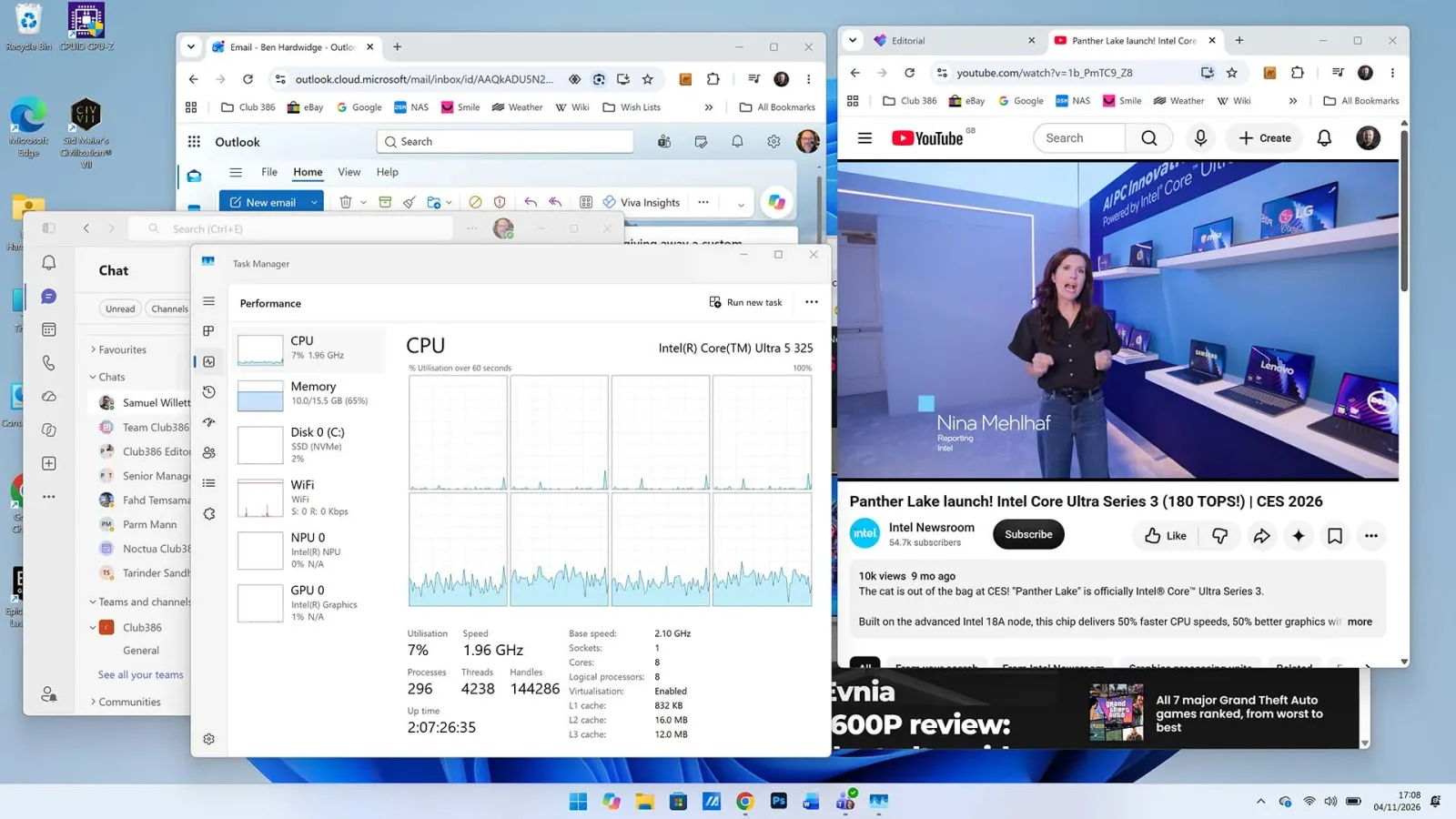
Unlike Intel’s older desktop CPUs, Nova Lake is also expected to introduce four LPE-Cores to each CPU. Intel first introduced this idea in its Panther Lake CPUs, and they work really well when it comes to improving power efficiency and battery life. In the screenshot below, taken from an Asus Zenbook 14, I have a YouTube video playing, as well as Teams, my Outlook email in a browser, plus another browser tab open in Chrome.
As you can see, the P-Cores at the top are largely idle, with all this work being handled fine by the four LPE-Cores. If I then start actively working on something, or open up another app, the P-Cores will momentarily kick into action. It’s clever stuff.
Nova Lake clock speeds
Ever since the fiasco with Raptor Lake instability, requiring a raft of BIOS updates and fixes, Intel has taken a more conservative approach to clock speeds and power management with its desktop CPUs. The Core Ultra 9 285K tops out at 5.7GHz, rather than the 6GHz+ speeds we saw on Raptor Lake, and we expect this approach to continue on Nova Lake.
In fact, according to Intel leaker jaykihn0 on X, if a Nova Lake core CPU temperature gets above 90°C, it will automatically throttle clock speed to 5.1GHz as a matter of course. This limit apparently applies across the lineup, and users won’t be able to adjust it themselves.
An early leak concerning a Nova Lake-H mobile CPU has also shown a top boost clock of 4.8GHz, but this is on a chip with a TDP that reportedly tops out at 25W. We’re likely to see higher clock speeds on desktop CPUs.
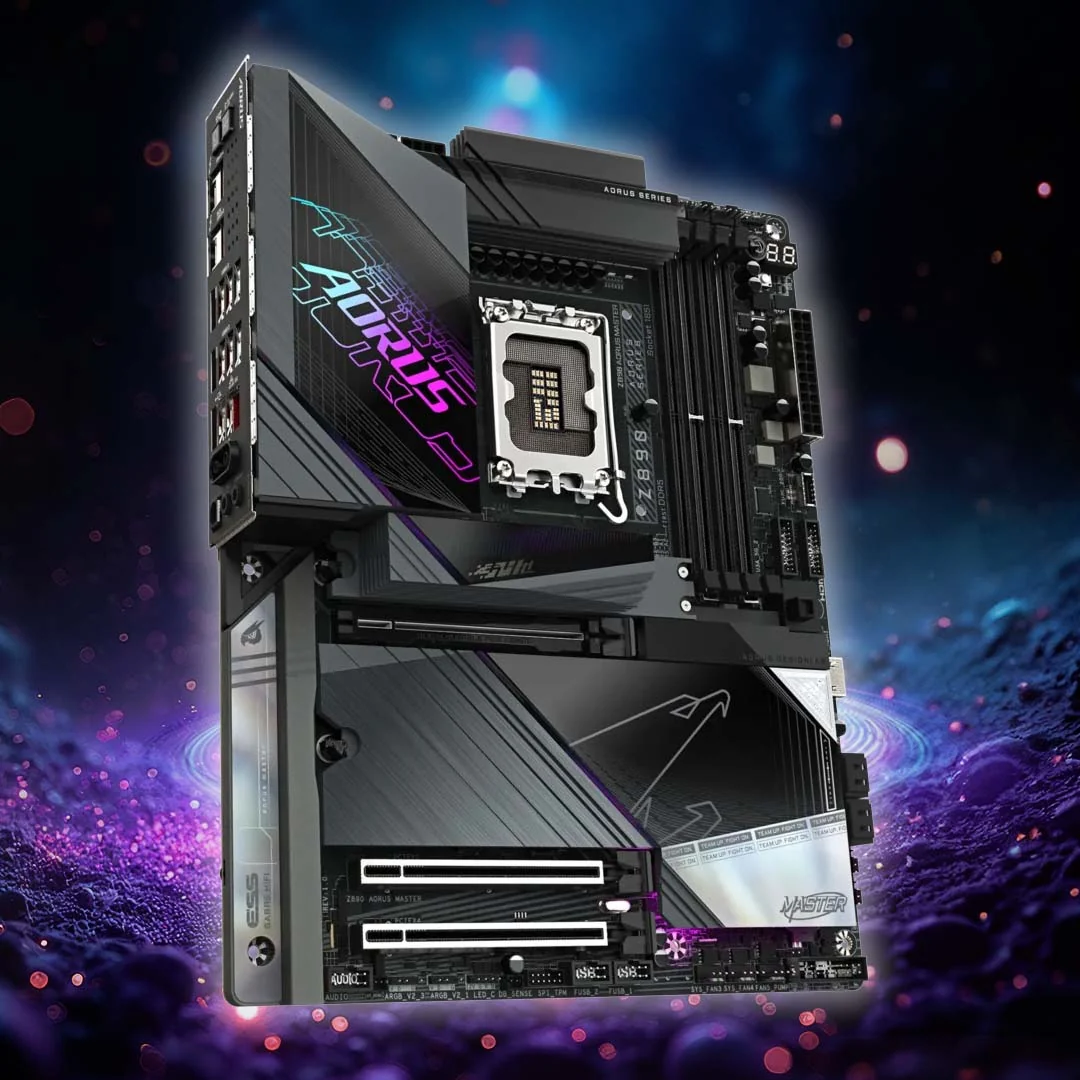
Nova Lake motherboards
You will need a new motherboard to run a Nova Lake CPU, as this generation sees Intel moving to yet another socket, called LGA1954. On the plus side, it looks as though Intel could be taking a leaf out of AMD’s book with this socket, and making it last through several CPU generations, much like AMD’s AM4 and AM5 sockets.
We interviewed Robert Hallock, Intel’s VP and GM of its enthusiast channel, earlier in 2026, and asked whether he saw a future where Intel sockets support more CPU generations. “I do. That’s it – I do,” was the reply.
New chipsets
That’s good for the future, but in the immediate short term you’re going to need a new motherboard. It looks as though Intel is shaking up the formula here a bit as well. Intel’s recent motherboard chipset generations have generally been divided into one Z-series model that unlocks CPU multiplier and base clock overclocking, one B-series model that allows memory overclocking and use of XMP profiles, but disables all CPU overclocking, and cheaper chipsets that don’t allow any clock tweaking at all.
This time, however, Intel is rumoured to be bringing in two Z-series chipsets, rather than just one, much like AMD’s X870 and X870E chipsets. In addition to the top-end Z990 chipset, there will reportedly also be a Z970 chipset. Motherboards based on this chipset will apparently have access to Intel multiplier overclocking on K-series CPUs, but not base clock tweaking. According to Intel tech leaker jaykihn0, Z970 is intended to replace B860 in terms of product lineups, suggesting that Intel is hoping to open up overclocking to a wider audience.
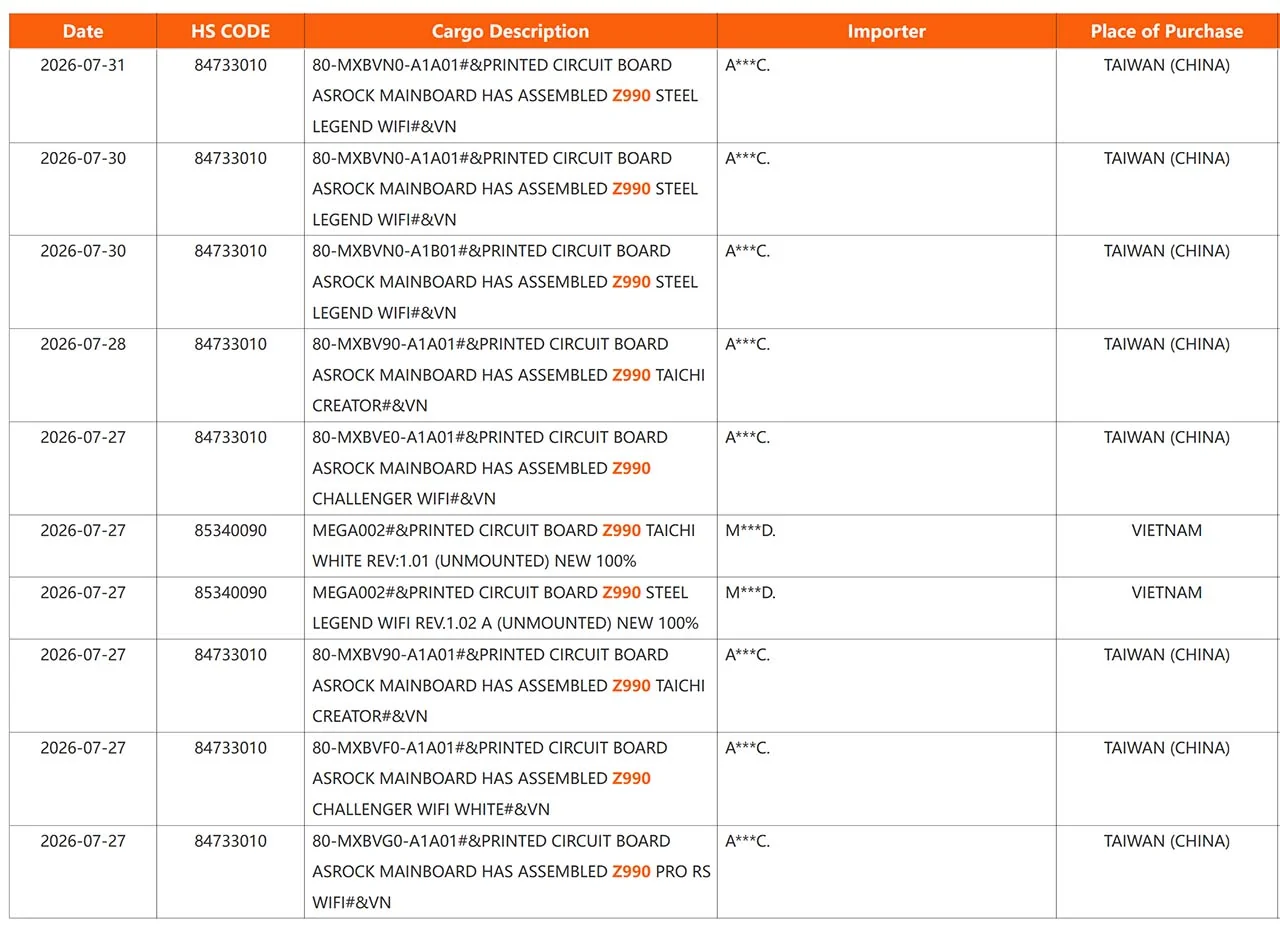
An Intel B960 chipset has also appeared in leaks, again with memory overclocking but no CPU frequency tweaking tools. We’ve seen several shipments of ASRock Z990 motherboards already appearing in the NBD customs database, as well as Z970 boards from the same manufacturer. These include the following models:
- ASRock Z990 Challenger WiFi
- ASRock Z990 Pro RS WiFi
- ASRock Z990 Steel Legend WiFi
- ASRock Z990 Taichi White
- ASRock Z990 Taichi Creator
- ASRock Z970 LiveMixer WiFi
- ASRock Z970 Pro-A WiFi

Nova Lake performance
Early Nova Lake benchmark leaks point to Intel’s new CPU architecture having strong single-threaded performance, with a score of 5,210 in PassMark, beating Intel Arrow Lake and Raptor Lake chips, as well as AMD Zen 5 X3D CPUs in the same test. However, multi-threaded performance of the 28-core chips falls behind that of the Core Ultra 9 285K and Ryzen 9 9950X3D in the same PassMark leak.
These test results must be taken with a hefty pinch of salt, though. Assuming they’re legitimate, they will have been run with early hardware and drivers, and Intel will be doing a lot of work on this front in the build up to launch. We’ll only know for sure how these chips perform when we can run our own benchmarks on the finished silicon and drivers.
Other leakers have hinted at performance elsewhere. For example, regular and often-reliable tech leaker kopite7kimi on X says that Nova Lake gaming performance is “quite similar” to that of Arrow Lake when comparing the regular non-BFC chips to those of the previous generation.
Intel’s Arrow Lake CPUs had disappointing gaming performance when we first conducted our Core Ultra 9 285K review. However, this massively improved with the launch of Arrow Lake Refresh chips, such as the Core Ultra 7 270K Plus, thanks to a substantial increase in the die-to-die interconnect frequency.
Even then, though, while we’ve found that AMD’s X3D CPUs with 3D V-Cache are still the gaming performance leaders. It looks as though Intel is hoping to plug that gap with its new big last level cache, but there may not be a big difference in gaming pace between Arrow Lake and Nova Lake on non-BFC chips.
That brings us to the end of our roundup of Nova Lake gossip – hopefully there won’t be long to wait until the official launch. In the meantime, if you need a new processor now, check out our full guide to buying the best CPU for your needs and budget.