Turkey’s Mobile Puzzle Portfolio Playbook
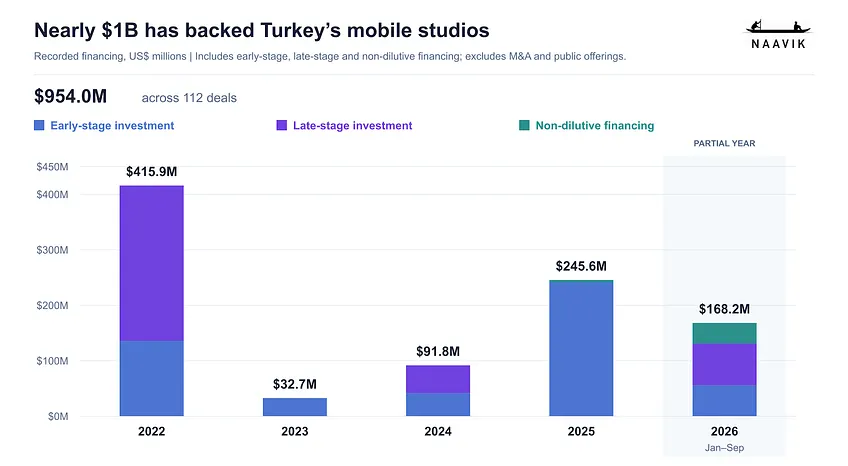
Since 2022, nearly $1B has backed Turkey’s mobile gaming ecosystem. InvestGame’s newly released platform records $954M in disclosed financing across 112 early-stage, late-stage, and non-dilutive deals from January 2022 through September 2026. Its separate mobile-specific analysis puts private funding for Turkish mobile studios at approximately $400M from January 2025 to mid-October 2026, close to 40% of the global total over that period. While this clearly shows investors’ sustained appetite for the teams behind Turkey’s puzzle plethora, the stakes for turning breakout puzzle games into durable portfolios and businesses are likely rising as well.
Some teams have delivered major exits remarkably quickly. In February 2026, Scopely announced an agreement to acquire a majority stake in Loom Games, founded the previous year and valued at over $1B. The studio’s breakout game, Pixel Flow, was also approaching a monthly net IAP revenue peak of $23M in March 2026, according to Sensor Tower. By Q3, however, Pixel Flow’s average daily IAP was approximately -32% below Q1, and continues to decline.
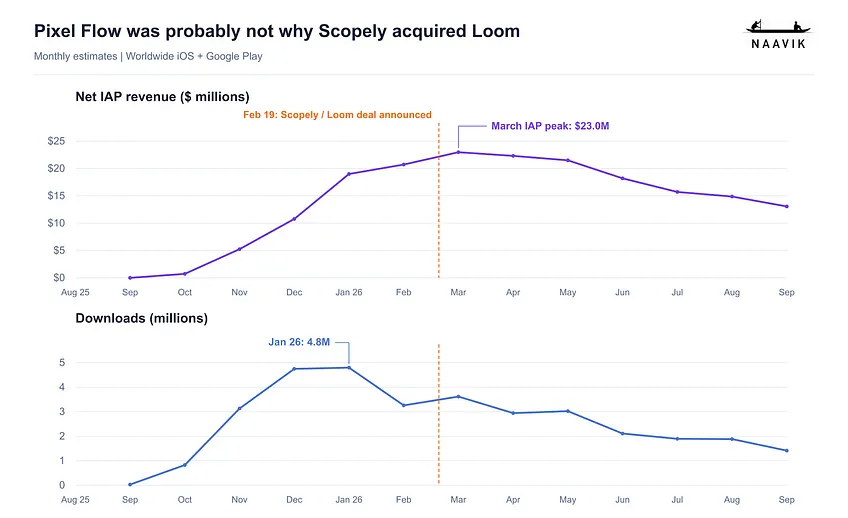
While it’s premature to tie Loom’s $1B+ valuation to the performance of just one game (read Scopely’s announcement to learn more about their broader motivations), the juxtaposition raised a broader question: what portfolio strategies are recently well-funded Turkish mobile F2P studios pursuing to build durable businesses?
The rest of this article explores this question, focusing on the mobile F2P casual puzzle cohort where this Turkish investment wave is especially visible. Throughout, revenue refers to estimated net IAP revenue. The data showcased excludes DTC, China Android, and ad revenue.
Forever Franchises vs. Shooting StarsWithin Turkey’s mobile ecosystem, noteworthy casual puzzle game revenue trajectories generally seem to fall into one of two buckets:
- Forever Franchises are characterized by rapid scaling, followed by sustaining their commercial scale over many years. For example, Dream Games’ Royal Match launched globally in Q1 2021 and saw Q3 2026 revenue of about $270M, -32% lower than its lifetime peak quarterly revenue in Q4 2024.
- Shooting Stars also scale rapidly, but they also decline faster than their Forever Franchise counterparts. For example, Spyke Games’ Tile Busters launched globally in Q4 2022 and saw Q3 2026 revenue of about $0.68M, -95% lower than its lifetime peak quarterly revenue in Q4 2023.
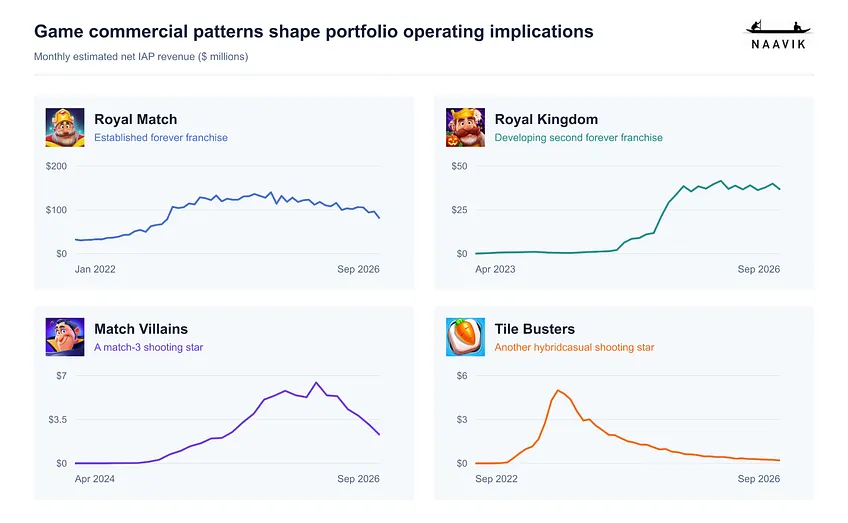
While these two groups clearly show different commercial patterns for games, they also have different implications for portfolio operations. Studying the latter supports the idea that one commercial pattern isn’t necessarily better than the other when building a durable mobile casual puzzle portfolio and business.
Four Ways to Build a PortfolioTo understand the different portfolio evolution routes from a well-funded studio to a durable business, we studied nine Turkish mobile studios that have attracted substantial funding since 2022 and built commercially meaningful game portfolios with it: Dream Games, Loom Games, Grand Games, Spyke Games, Good Job Games, Flow Games, Circle Games, Cypher Games, and Paxie Games.
The portfolio structure matrix below is designed on two axes:
- Revenue concentration captures how heavily each studio depends on one game, using a 75% share of Q3 2026 net IAP revenue as the cutoff.
- New release velocity captures how actively it is creating further opportunities, using an average of two distinct new games per year as the cutoff.
Together, the axes distinguish a small number of carefully developed games from a broader release pipeline, and a business anchored by one flagship from one supported by multiple revenue engines.
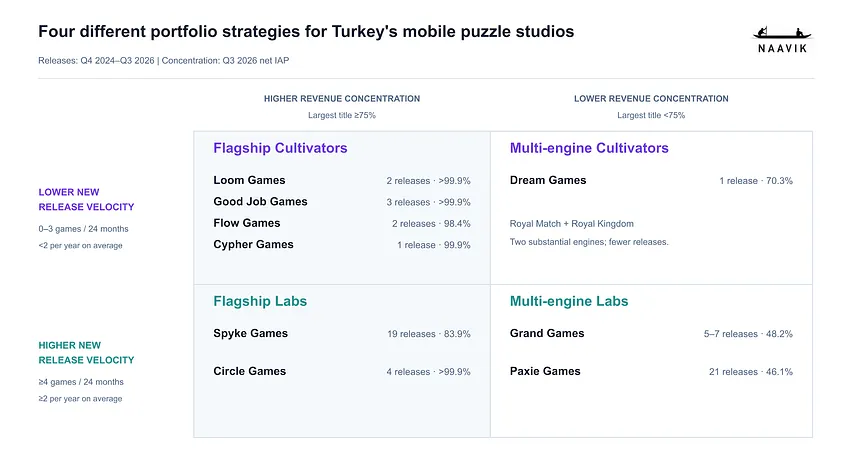
The matrix reveals four portfolio strategies:
- Flagship Cultivators combine higher revenue concentration with lower release velocity. Loom, Good Job, Flow and Cypher currently sit here: each depends heavily on one game while releasing relatively few new titles. While concentrating resources can help a team scale and improve its breakout game, it naturally leaves little protection if that game weakens. The challenge for this group is to extend the flagship’s earning life while developing another meaningful contributor. Cypher seems to want to stay in this group as it tests a Coin Master / Monopoly Go competitor with a match-3 twist named Match Squad, that could become Cypher’s new flagship if successful. Loom, Flow, and Good Job are showing signs of moving into the Flagship Labs group, with Good Job being particularly notable as it reduces UA intensity on Match Villains while testing Police Escape, a new hybridcasual title with the same IP.
- Multi-engine Cultivators combine lower revenue concentration with lower release velocity. Rather than replenishing the portfolio through frequent releases, this structure relies on developing a small number of substantial games. The challenge is sustaining the quality and commercial scale of each engine while preparing the next, and controlling portfolio cannibalization from a tendency to pursue similar genre follow-ups. Only Dream occupies this group at the moment: Royal Match supplied approximately 70% of its Q3 2026 IAP revenue, with Royal Kingdom supplying 30% and stabilizing there. However, Dream’s portfolio revenue trends show signs of cross-game cannibalization.
- Flagship Labs combine higher release velocity with continued revenue dependence on one game. Frequent releases create more opportunities to discover a hit and apply what the team learns. However, the challenge is balancing that activity to turn it into another substantial revenue engine before the current anchor fades. Spyke and Circle sit here now, likely want to stay for a bit, but can move into either the Multi-engine Labs or Multi-engine Cultivators groups over time. Yarn Loop supplied approximately 84% of Spyke’s Q3 2026 IAP revenue, while Tile Busters (the studio’s first flagship) continues its steep descent. At the same time, Spyke continues to show impressive broader release activity, justifying its “Labs” status: 19 new games released, in testing, or killed over the past 2 years. Circle, on the other hand, is just getting started, with Sort Express currently scaling and supplying more than 99% of the studio’s revenue, while some hybridcasual titles are currently in testing.
- Multi-engine Labs combine higher release velocity with a more distributed revenue base. This creates options to add revenue or replace aging hits, but it also requires the team to manage development and live operations across more products. Their key challenge is to keep new contributions ahead of portfolio decay while also creating an opportunity to move into the Multi-engine Cultivators group. Grand and Paxie have several contributing games and continue to bring new ones to market. Grand specifically has scaled and continues to live-operate three titles — Magic Sort (42% of Q3 2026 IAP revenue), Block Out (48%), and Car Match (9%) — and is currently starting on its fourth, Maze Out. However, and as we will study later, Grand’s revenue expansion and Paxie’s revenue contraction show why the same structure can produce very different outcomes.
While the four strategies above describe how a portfolio is assembled, they don’t show how well it performs. Concentration can fall because another game grows or because the flagship shrinks, while frequent releases can still fail to replace lost revenue. To understand which portfolio strategies sustain commercial scale, we tested the same nine studios on how well their portfolios retain revenue performance over 2026.
The portfolio health matrix below is defined by two axes:
- Portfolio revenue health compares Q3’s average daily revenue with each studio’s best quarterly average in 2026. Retaining at least 75% indicates a healthier trajectory.
- New release velocity retains the previous matrix’s definition.
Together, the axes show whether a studio is maintaining its revenue base alongside a selective or broader release pipeline. A 100% score means Q3 was the strongest quarter.
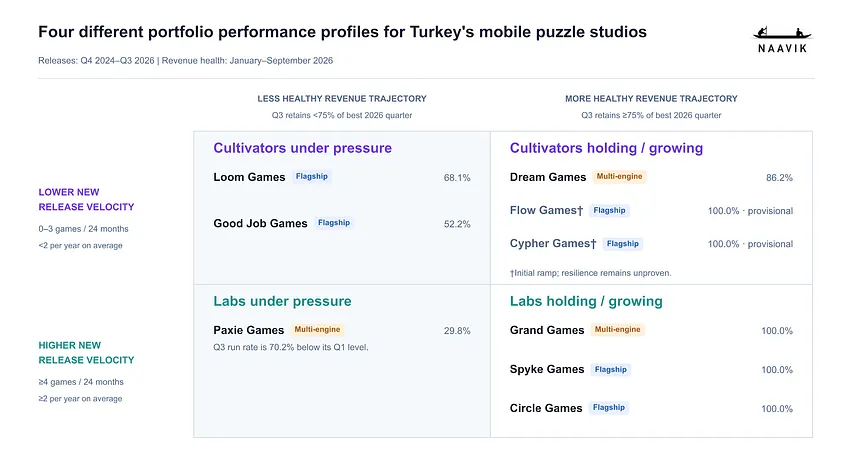
The matrix reveals four portfolio health positions:
- Cultivators under pressure combine lower release velocity with a less healthy revenue trajectory. Their revenue contractions expose the risk of relying on one game without another substantial contributor. Their challenge is to preserve the flagship’s earning potential while developing the next engine. For example, Loom retained 68% of its strongest 2026 quarterly run rate, primarily because Pixel Flow declined over the year. Good Job retained 52% because Match Villains declined significantly. Neither studio has yet made up for its declining revenue trend with a substantial new release.
- Cultivators holding / growing combine lower release velocity with a healthier revenue trajectory. Dream retained 86% of its strongest 2026 quarterly run rate, with Royal Kingdom providing a second substantial engine that partially offset Royal Match’s decline. Flow and Cypher provisionally score 100%. Both have only one complete revenue quarter, and Smash Fest and Royal Smash are currently scaling. Both must still demonstrate that their scaling efforts can endure.
- Labs under pressure combine higher release velocity with a less healthy revenue trajectory. Their key challenge is to improve how effectively new games replenish revenue, while sustaining the existing contributors. Paxie retained just 30% of its strongest 2026 quarterly run rate despite 21 observed new game tests or releases during Q4 2024–Q3 2026. Although the studio is a Multi-engine Lab in the portfolio structure matrix, it received Multi-engine status because its flagship title, Merge Studio, declined sharply, increasing the contribution share of other live titles. In other words, several contributing titles and frequent new game tests have not prevented Paxie from experiencing portfolio performance contraction.
- Labs holding / growing combine higher release velocity with a healthier revenue trajectory. Grand, Spyke and Circle each score 100%, with Q3 being their strongest quarter. However, their routes differ. Grand added a substantial second engine, Block Out, alongside Magic Sort, and its current scaling pace is improving the studio’s portfolio revenue outlook. Spyke’s Yarn Loop more than offset declines in its older games, especially Tile Busters, making Q3 2026 the studio’s best quarter yet. Circle continues to scale Sort Express successfully, with Q3 2026 performance the best in the studio’s history. All three studios are now likely focused on sustaining their current gains while developing further contributors.
Note that the above measures IAP revenue health in 2026; it does not establish profitability or long-term durability, especially when advertising is a meaningful revenue source.
Resulting Lessons for Portfolio DurabilityWhile the two matrices show where each studio stands, bringing those views together reveals a few interesting points. For example, Grand and Paxie share a portfolio structure quadrant but face different revenue outcomes. Similarly, Dream and Loom show that a slower release pace can accompany either revenue resilience or contraction. The following five lessons show how studios can balance operating today’s hits with developing tomorrow’s.
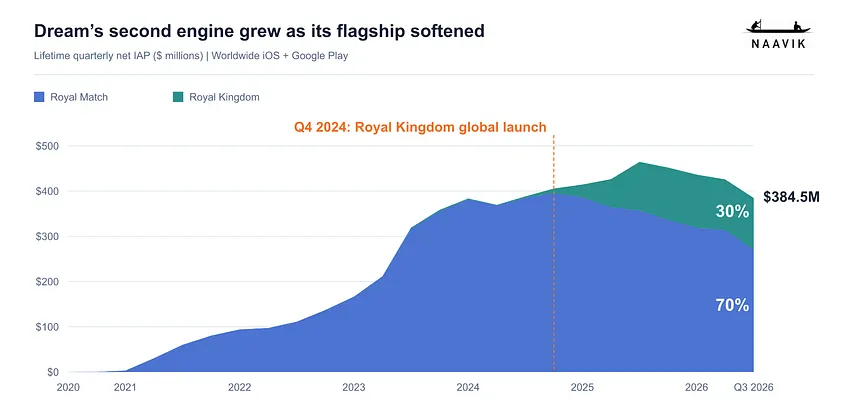
#1 – Extending the flagship buys time to build the next engine: Dream illustrates the room an enduring franchise can provide. Royal Match generated approximately $319M in Q1 2026 and $270M in Q3, while Royal Kingdom contributed another $114M in Q3. The latter has become a substantial revenue engine alongside the first, supporting Dream’s transition into a Multi-engine Cultivator while maintaining its revenue performance today. However, Royal Match and Royal Kingdom share IP and similar gameplay, likely meaning overlapping audiences. Their revenue histories also seem consistent with cannibalization. In other words, even though Dream might look like the healthiest of our nine-studio lot, using the runway a successful flagship provides to carefully decide how the next engine can diversify risk and revenue to maximize long-term portfolio health is critical.
#2 – Expected flagship longevity should set the pace of experimentation: This is important to keep in mind even when current portfolio revenue looks healthy. Dream’s established match-3 franchise gave it years to develop a second engine, while Loom’s hybridcasual model calls for faster replenishment. Pixel Flow is already declining, with Ropeland (its only observed follow-up) in testing. The renewal clock includes development, testing, and scaling. In a sense, Loom’s immediate priority is likely to test more candidates (and quickly) while its flagship can still help fund development, although Scopely’s backing probably gives it additional resources.
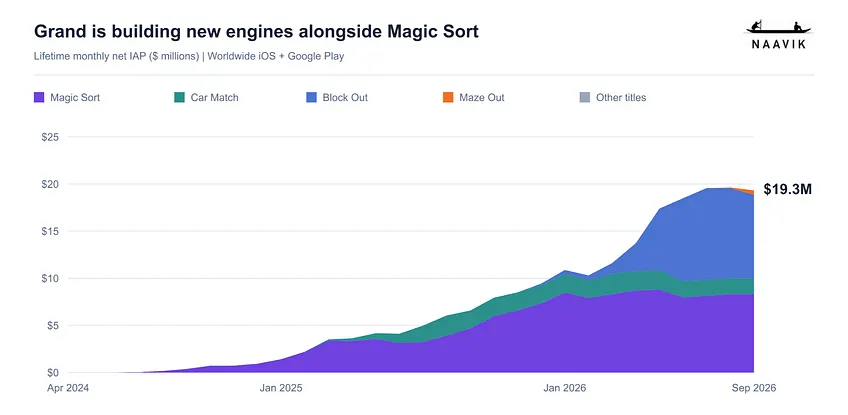
#3 – Chasing multi-engine status isn’t always necessary for revenue durability: Grand illustrates one route to revenue durability: building several engines that contribute at the same time. Magic Sort generated approximately $25M in both Q1 and Q3 2026, while Block Out grew from $2M to $28M over the same time period. Car Match contributed a further $5M in Q3. Together, those contributions lifted quarterly portfolio revenue from approximately $33M to $59M (+79%). In short, Grand’s Multi-engine Labs structure currently supports expansion because newer contributions more than offset weakening games.
Spyke, on the other hand, shows how a portfolio can grow while remaining flagship-led. Tile Busters, Blitz Busters and Cube Busters all declined between Q1 and Q3 2026. But Yarn Loop grew from $6M to $21M, and Knock Out added $2M in Q3. Average daily portfolio revenue increased +156%. That said, Yarn Loop drove 96% of the quarterly revenue increase and supplied 84% of Q3 revenue, keeping Spyke in the Flagship Lab category. But even excluding Yarn Loop, Spyke’s quarterly revenue rose +17%, as Knock Out and other new releases more than offset declines in the older Busters games.
The contrast above is between revenue engines operating together and successive hits taking over from one another. Multi-engine status can reduce dependence on any one title, but it is not a prerequisite for sustained portfolio revenue if a studio can repeatedly replenish its flagship. However, that route carries a different risk: renewal must arrive before the current hit fades. Spyke’s 2026 performance shows successful replenishment so far, but it needs more time to determine whether it can repeat that process fast enough to build lasting portfolio revenue durability.
#4 – Revenue renewal requires solving the right bottleneck: Paxie shows why diversification and release volume do not guarantee revenue renewal. In terms of diversification, Merge Studio, Glow Tales and Color Shooter all declined between Q1 and Q3 2026. Quarterly portfolio revenue fell from $2.4M to $0.7M (-71%), despite 21 observed new tests or releases in two years. As Grand’s revenue base grew with newer engines scaling, Paxie’s became less concentrated, partly because Merge Studio shrank. Both studios are Multi-engine Labs, but their diversified revenue paths within that category yield very different renewal outcomes.
In terms of release volume, Loom’s limited follow-up pipeline raises the question of whether it is creating enough opportunities. Paxie raises a different question: whether its many releases can become large enough to be lasting contributors. Good Job’s Police Escape asks a third question: whether entering a different genre with existing IP can succeed.
Clearly, there are different bottlenecks on the path to revenue renewal. But these bottlenecks also show that diversification and new-release velocity alone aren’t the answer, as elements like product quality, UA proficiency, and live-ops excellence all shape portfolio revenue trajectories.
#5 – Successful experimentation can justify a more selective release pace: Grand’s success also changes its next resource allocation decision. With Magic Sort, Block Out, and Car Match contributing meaningful revenue, a theoretical question studios in a similar position could ask is: How much should we keep investing in further discovery and experimentation versus sustaining and improving existing engines? More releases need not remain the objective indefinitely. Moving from Multi-engine Labs toward Multi-engine Cultivators can make sense when existing games offer stronger reinvestment opportunities. However, whether that move is right depends on each game’s opportunities and the resources required to pursue them.
Overall, Turkey’s well-funded puzzle studios have several routes to building durable portfolios, with none of the approaches showcased above being inherently superior. The right strategy can change as the studio and its games mature. Switching strategies can strengthen a business when it fits the studio’s lifecycle, capabilities, and economics. However, what’s true across the studio universe studied in this analysis is: scaling a first hit establishes an opportunity, but sustaining the business requires showing that initial success can be extended, supplemented, or replenished over time. The challenge is to keep adapting the balance between operating today’s engines and discovering or scaling tomorrow’s.
Sponsor: Ship the Next Playable Before the Last One Dies
Genie Playable. Playables built from your live game by the marketer, without a dev queue.
Ask a UA team where playable time goes. Not the idea. The build: three developers who are also on the game update, one designer per playable, an export that clears AppLovin and bounces on Unity, and an agency round for a one-line fix. By the time v2 lands, v1 is tired.
The shortcut is worse: a template in your colors that converts, then churns, because it showed a game that isn’t there.
Genie Playable moves the build to the people who own the UA number. Start with your game, a winning creative, another game’s format, or a trend, and make it yours. Ship every version to every network you run. The next playable is an edit, not a ticket.
What’s in the launch:
- No developer, no designer. The creative manager builds and changes the playable, code included, through the agent.
- Start from what works. A creative that performs, a mechanic from another game, a format trending outside gaming. Their format, your game.
- Your game, every version. Lead-in, difficulty, end card, theme. Ten versions later, it still looks and plays like the game they are about to install.
- Every network from one source. Package the set for AppLovin, Unity, Mintegral, and Google without a fourth rebuild.
Top News Items
#1: Google Play expands personalized discovery and player engagement
- Google has announced a slew of updates to Google Play to help users find the games they like and give them reasons to keep playing. First, Google’s new Game Finder recommends titles based on player habits and preferences users can adjust, as well as what people with similar tastes are playing. Google is also introducing Sprints, which are 48-hour competitions between small groups of players, and expanding Quests to reward in-game objectives with items such as skins and virtual currency. Other additions include community discussions on game pages and 30-second gameplay recordings through the Sidekick overlay. For developers, another route to discovery is likely the most valuable. However, to take advantage of this, developers must integrate with Google’s services, making Play a more active partner in how participating games attract and retain players.
#2: Miniclip launches standalone advertising platform AdSurge
- Miniclip has launched AdSurge, a mobile advertising network covering user acquisition and ad monetization, initially targeting games that earn most of their revenue from advertising. Building its own network lets Miniclip keep some of the margin that would otherwise go to external advertising companies. Miniclip says AdSurge is already producing a double-digit margin within its portfolio, though that doesn’t show how well it will perform for outside publishers. The launch follows a similar move by Voodoo with Helix and others, suggesting that large game portfolios are becoming a foundation for advertising businesses as well as publishing businesses. It will be interesting to keep an eye on how this increasing trend develops.
#3: Flow Games reportedly secures $46 million funding package led by Tencent
- Istanbul-based Flow Games has reportedly secured a $46 million funding package, with Tencent providing approximately three-quarters of the total. Flow Games makes Smash Fest, a physics-based mobile shooter that has currently netted ~$6.5M over ~25M downloads, according to Sensor Tower. However, the revenue number excludes advertising, which likely generates most of Smash Fest’s revenue. Tencent’s reported involvement comes shortly after it led Turkish puzzle developer Circle Games’ $25 million Series A in September. If confirmed, the Flow Games deal would represent another substantial commitment to Türkiye’s casual-games sector, backing a developer with an existing audience. Neither Flow Games nor Tencent has publicly confirmed the package, however, and its structure and intended use remain undisclosed.
#4: Ubisoft to sunset Rainbow Six Mobile
- Ubisoft will shut down Rainbow Six Mobile on January 15, 2027, ending the tactical shooter’s worldwide service less than a year after it launched in February 2026. Ubisoft Montreal developed the game with help from ten other Ubisoft studios, making this a substantial attempt to bring Rainbow Six to mobile. Despite these efforts, the game did not take off commercially. Sensor Tower estimates lifetime revenue at ~$5M over ~12M downloads (including the soft-launch period), suggesting the game attracted players without building a comparably substantial spending base. While most of the development team will move to other long-term strategic projects, Ubisoft has proposed closing RedLynx, putting up to 52 jobs at risk, though the closure remains subject to employee negotiations.
Other News Items
Product & Marketing
- Naruto Mobile confirmed for worldwide release
- Kakao Games Officially Launches New Title ‘Dokkaebi’s World’ on October 8
- Minecraft Blast testing phase expands
- No Man’s Sky heads to iPhone and iPad with a free trial and paid unlock
- Seven acclaimed indie games, including Sif and Vampire Crawlers, make their App Store debut
- Supercell reveals Squad Busters’ final timeline
- Fingersoft ends development of free-to-play LEGO Hill Climb
- MONOPOLY GO! returns to McDonald’s US Monopoly promotion
- Solitaire Grand Harvest launches six-month campaign with Kevin Bacon
- Fire Emblem Shadows makes $892,000 in first year, just 0.3% of Heroes’ initial success
- PLAYSTUDIOS to close Tetris Block Party in October.
Companies & Capital
- MTG postpones PlaySimple’s potential IPO
- Paramount and Warner become Skydance, here’s what its mobile catalogue looks like
- Spill Games has raised $10.5 million to Scale AI-Led Mobile Gaming Studio
- Devsisters teams up with Big Shot Pictures for potential CookieRun movie
- East Side Games secures new credit facilities to support user-acquisition investment
Platform, Technology & Tools
- San Diego sues AppLovin over explicit ads shown to kids’ devices
- Google defends Play Store commissions in £1 billion UK class action
- Brazil president signs decree implementing Legal Framework for the Games Industry
- Mastercard and Tamatem level up gaming payments in Middle East and Africa
- Google launches Playground with a planned Unity Spark integration
- Defold 1.14.0 released with improved iOS lifecycle handling and mobile layouts
Miscellaneous
Sponsor: The Payments Infrastructure That Nets You More Revenue
Every failed transaction, false decline, and unresolved dispute is revenue a studio never sees. Appcharge closes those gaps – both on Web Stores and Payment Links that move IAPs off app store rails.
Playstudios’ MGM Slots Live saw DTC Payment Links alone reach 39% of overall game revenue within weeks, and top-grossing titles across genres are seeing similar results.
That performance scales to $1BN annually, with multi-PSP architecture, local acquiring across 10+ regions, and a smart routing engine that delivers a 96% Order Success Rate and a 0.1% dispute rate, versus an industry standard of 0.83%. Add full Merchant of Record coverage, and partners keep more net revenue from every DTC transaction, at scale.
Payments optimized for mobile games are where the real margin lives.
See the payments dataContent Worth Consuming
How a Toon Blast side-event became its own genre (GameRefinery): “Cloning a mechanic is a bet. Cloning one that a top-grossing puzzle game has run weekly for a year and a half is a much smaller bet, because the hard question, do players enjoy this, is already answered in public.”
Rovio’s rebuild means refocusing on Angry Birds, Sonic and picking new projects carefully (Mobilegamer.biz): “Alexandre Pelletier-Normand was appointed Sega West Studios COO in July, on top of his previous role as Rovio CEO. His expanded brief now takes in Sports Interactive, Creative Assembly, Two Point Studio and assorted other tasks at Sega West. But when we set down to chat at Gamescom this summer the topic of the day was Rovio, and what exactly the company means when it says it is rebuilding.”
To Block or Not to Block (Mobile Ad Revenue): “If you monetize with mobile ads, you get paid when users click ads and convert. That’s the trade-off. Some users will leave through an ad. The real question is how many is too many. I want to show you what I think is the healthiest way to look at blocking on mobile. Spoiler: it’s based on data.”
Wooga’s Holger Wurst on designing June’s Journey: Player research, AI and the UX rule you can’t break (Pocketgamer.biz): “Holger Wurst joined Wooga in 2015 and now leads the UI/UX department on June’s Journey, the 1920s hidden object mystery that has passed $1 billion in revenue in 2023 and has been live for close to a decade. We caught up with him ahead of his appearance at PGC Nordics to talk about all things June’s Journey, including collaborations with Wicked and Agatha Christie, AI’s possibilities and limitations, and never underestimating players.”
Can Game Publishers Build the Next AppLovin? Tencent, Voodoo, and more are building (Mobile Signal): “Josh Chandley, Warren Woodward and Vincent Tessier examine whether publisher-built ad networks can grow beyond cross-promotion. They explore targeting breadth, intermediary fees, competitor trust and what would persuade other publishers to adopt another SDK—useful context for Miniclip’s AdSurge launch.”