← Technology, Science & Infrastructure
▣ Distilled locally
The Solution to Expensive Storage May Be Tape Drives at Home
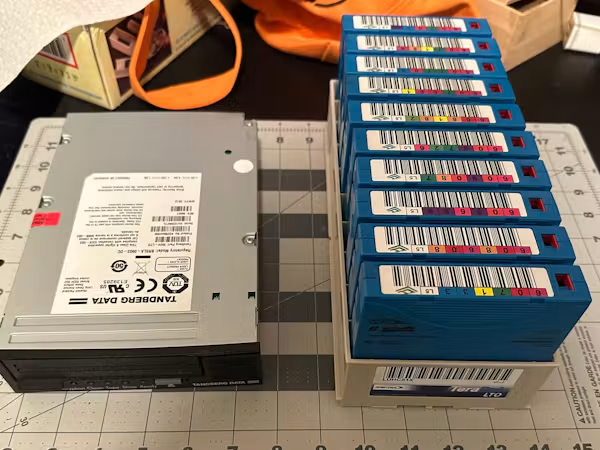
You may have noticed that HDDs and SSDs, alongside GPUs and RAM, are getting very expensive. For most of history, storage prices have steadily and consistently declined. But over the past couple of years, that came to a screeching halt and the price-per-gigabyte has actually gone back up. Many of us are now desperately searching for affordable options, including used hard drives (gross). But Ben Pettis found an interesting alternative for his home lab: tape drives . Tape drives were the go-to choice for decades when it came to mass storage on the enterprise level. They never really went away, but HDDs and even SSDs took a significant portion of that market, because they were just so cheap in the past. In any case, tape drives were never really a thing on the consumer level—not unless you count cassette tapes back in the 8-bit era. Here’s the good news: tapes are very affordable. Right now, even in very large (12TB+) capacities, new HDDs bottom out at around $26 per TB. Used HDDs are barely any cheaper. In comparison, new tapes start at about $6 per TB. So, less than a quarter of the price per TB. But there’s a catch: you need the appropriate hardware to use those tapes. As Pettis explains, that hardware can be pretty expensive. He went with an option at the more affordable end of the market: a Tandberg 3524 LTO-5 Drive (a fiber channel model). The tapes themselves were very cheap, coming out to about $2 per TB for a used set of 10. The only other piece of the puzzle was a PCIe card to allow Pettis’s server to send data to the Tandberg drive over the fiber channel. For that, Pettis selected a QLOGIC PX2810403-01 PCIe Dual Port 8GB Fibre Channel Host Bus Adapter (HBA). Apparently, almost all (or maybe literally all) of the fiber channel HBA cards on the market use the same QLOGIC chipset, so you’re stuck with that if you want to replicate this build. Other than some channel related to cable management, the hardware was sorted. But as Pettis points out, actually using a tape drive is less convenient than using an HDD. Tapes store (and provide access to) data sequentially. It is a bit like listening to a cassette tape: to get to the song you want, you have to fast-forward through the filler tracks. In practice, that means you’ll want to use the tapes for long-term storage and backup, rather than everyday tasks. So, stick to a smallish SSD for the files you’re working with, then move everything over to tapes when you’re done.
↑ Back to top
Originally published by Hackster News ↗
· rebuilt here from its own full-text RSS feed · all rights
remain with the publisher, please read and support them there.