Clones and spies (AI is in a weird place right now)
You’re reading Engineering Paper, and here’s the latest design and simulation software news.
The AI industry does not stop to let you catch your breath. (Perhaps that explains why there are so many breathless proponents of it).
In the past few weeks, you may have noticed an explosion of vibe-coded software clones. The first ones I saw were the apps of the ArtCraft suite, which included clones of Adobe software (Photoshop, Illustrator, Premiere, and more), Microsoft Office (Word, Excel, and PowerPoint), and even a clone of AutoCAD. A colleague who tested some Adobe clones told me that while they were not a “production replacement” they were perfectly serviceable for basic work.
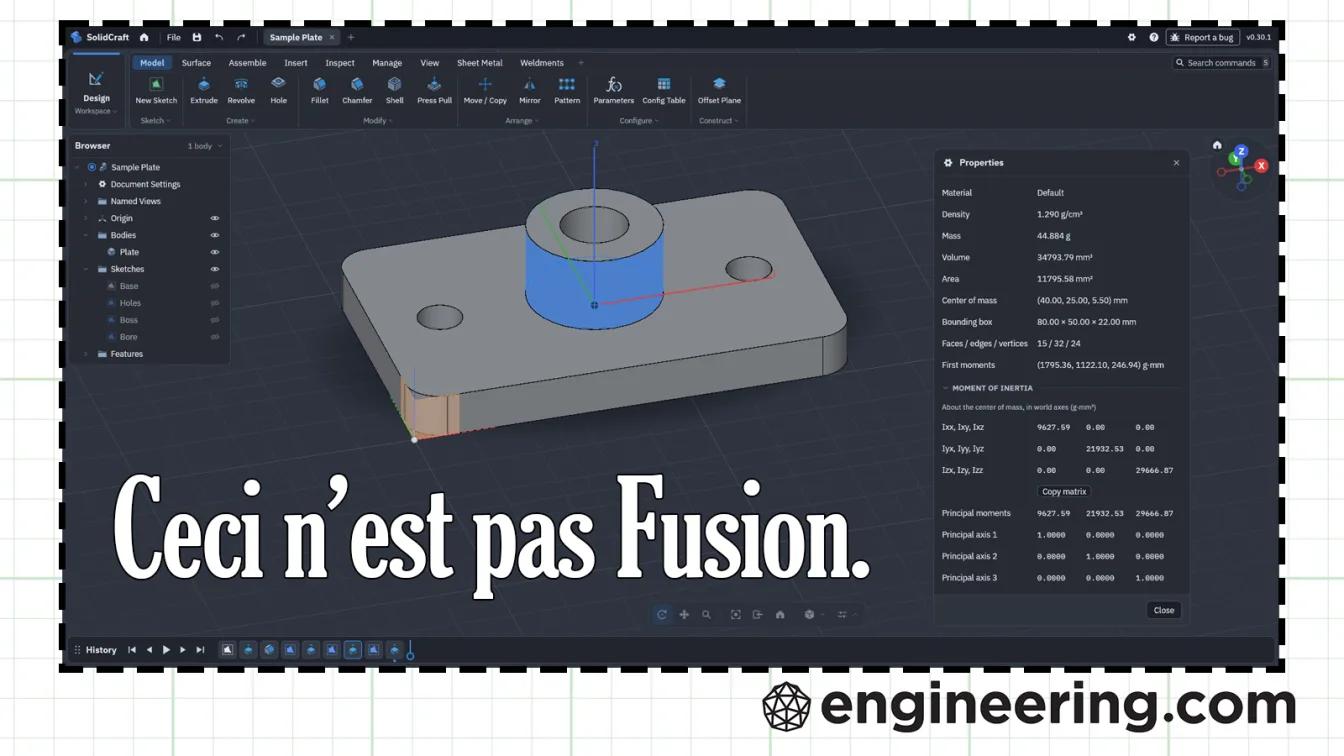
I waited for a 3D CAD clone to arrive, and not for long. SolidCraft (not part of the ArtCraft suite) is a clone of Autodesk Fusion that runs in your browser. Some quick testing shows that, again, this is not a production replacement—yet. But improvements and other CAD clones seem inevitable.
Or maybe not. Frontier AI labs are clamping down on the trend of “reverse engineer anything,” as reported by 404 Media, with Claude and Codex now hitting guardrails when users attempt to decompile or tinker with software (which isn’t limited to cloning SaaS apps; users have also been modifying video games, freeing smart TVs from spyware, and much more). Whether these barriers will stay up remains to be seen. If they do, though open source and open-weight AI models are still available, it will be more difficult for non tech-savvy users to carry on the project.
So will you eventually be able to cancel your subscription CAD software and switch to an enterprise-grade AI clone? Who knows. As with everything else about AI, we’ll just have to wait and see (and maybe pray). In the meantime, if you’re looking to cut costs and you don’t trust vibe-coded software, there’s always FreeCAD.
And, in case you missed another bizarre twist in the AI world: Nvidia, the company whose chips drive the AI industry, launched an independent investigation into CEO Jensen Huang after it came to light that he’d had an affair with a suspected Chinese spy. I’ll refrain from comment, but given Huang’s importance to the AI industry and the national security implications of this charge, I suspect there’s more to come.
Following up on aerospace and defense
For those of you who attended Tuesday’s editorial roundtable, Keeping Pace with Aerospace and Defense, in which I and my colleagues Rachael Pasini, Ian Wright, and Michael Ouellette took turns talking trends in A&D, I promised to provide a few links in today’s Engineering Paper:
- How real engineers are using AI surrogate models for simulation
- AI model promises “almost-instantaneous aerodynamic predictions”
- How a space startup used AI to go from design to test flight in two years
The inaugural AI Engineering Board
The Arrowfly AI Engineering Industry Board, chaired by the aforementioned Rachael Pasini and Michael Ouellette, recently met for the first time, and Michael reported on its findings in Arrowfly’s AI Engineering Board turns big questions into practical direction.
Here’s a sample:
“A company can be an early adopter of AI but still be left in the dust. An engineer can build a new AI-powered tool, a leadership team can commit to an ambitious AI strategy, and a manufacturer can give employees access to the latest models, but none of those actions answer the question that matters most: What will actually improve?
This is the question that ran through the inaugural Arrowfly AI Engineering Board meeting on September 24, 2026. The result was not a slate of predictions or a celebration of technology. It was a candid exploration of how to choose worthwhile problems, preserve engineering knowledge, validate results and build trust, all while keeping pace with the technology and your competition.
The board’s industry members span a broad cross-section of manufacturing, enterprise technology, energy, and healthcare. This type of cross-industry conversation is where the true value of the board emerged, as participants built on each other’s observations and experiences. As the discussion went along, a practical theme took shape. Success depends less on using AI everywhere than on understanding where it belongs.”
Read the article to learn more.
Quick hits
- CoLab has announced that it will be expanding its AI design review platform to include bills of materials, simulation, and ECAD data alongside the existing mechanical CAD review. BOM review will launch this month, while simulation and ECAD review are planned for next year.
- Trimble has released SketchUp 2027 with several new features including a non-destructive modeling system called Procedures, a new tool to apply hatch patterns to section fills in technical drawings, the ability to draft in 2D at 1:1 scale before committing to page size or drawing scale, and more. Trimble also released the new SketchUp Importer for Revit, which recognizes component tags and classes and maps them into Revit for a smoother transition.
- Cadence announced the OrCAD Xplore Design Platform, a new platform for solo engineers and small design teams developing electronics systems that “combines trusted manufacturer content, component intelligence and supply-chain awareness with procurement in a single design environment,” according to Cadence.
- The Nemetschek Group has introduced Archicad Max, Allplan Max, and Bluebeam Max, three new “premium AI offerings” that “build on the Group’s AI journey, from the AI Layer announced in 2024 and the Nemetschek AI Assistant rolled out across brands since 2025, to today’s agentic, model-aware capabilities,” according to the press release.
- IronCAD announced the latest update for IronCAD 2027, including improvements to the AI Design Assistant, an update to the shrink wrap command that ignores hidden parts, enhanced algorithms for converting imported models into editable IronCAD features, and more.
One last link
A reader named John M. Christy reached out to me recently in response to a previous edition of Engineering Paper, Welcome to the vibe-CAD era.
John had a lot to say about AI in CAD, and, since he’s carried his own CAD program from the 1980s to today, he had a lot to say about AI in CAD development as well. He was kind enough to elaborate in a stimulating opinion piece for Engineering.com: What I learned from 45 years of CAD development: Doing more with less.
Got news, tips, comments, or complaints? Reach me at malba@arrowfly.com.