QuiX Quantum and Partners Target Single-Photon Detection Near Room Temperature
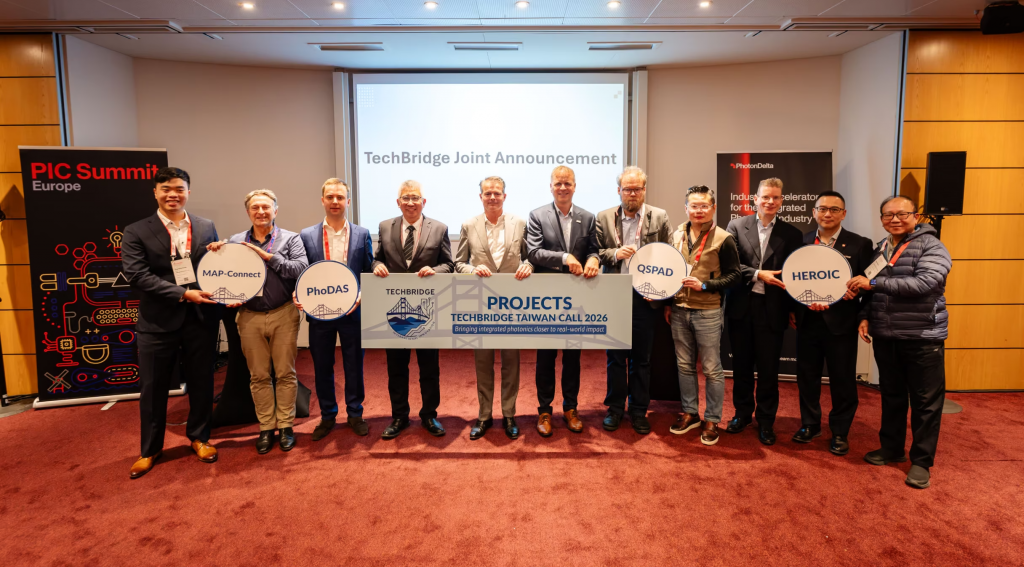
ENSCHEDE, Netherlands, and HSINCHU, Taiwan, Nov. 23, 2026 — QuiX Quantum, a Dutch-German developer of universal photonic quantum computers, together with Taiwanese partners Artilux Inc. and its affiliate Brillink Inc., has been awarded funding under the TechBridge Taiwan Call 2026 – Photonics Integrated Circuits, a joint program of the Netherlands Enterprise Agency (RVO) and Taiwan’s Industrial Development Administration (IDA). The 36-month project, QSPAD, will run from Jan. 2027 to Dec. 2029 to develop, integrate and demonstrate photonically integrated single-photon detectors that operate near room temperature.
Credit: QuiX Quantum
For QuiX Quantum, QSPAD represents an important industrial building block for its long-term roadmap toward scalable, fault-tolerant quantum computing — removing one of the last hardware barriers to quantum systems that can be deployed beyond specialized laboratories.
Removing the Cryogenic Bottleneck in Photonic Quantum Computing
Today, the most advanced photonic quantum computers depend on superconducting nanowire single-photon detectors that operate only below about 2.5 kelvin — colder than deep space. This requirement binds an expensive, bulky cryogenic system to the heart of every machine and keeps the technology out of environments where such cooling is impractical.
QSPAD is designed to remove that constraint. The project will develop and demonstrate waveguide-based germanium-silicon (GeSi) single-photon avalanche diode (SPAD) arrays that operate at or near room temperature — down to –40 °C using conventional thermoelectric cooling — co-integrated with QuiX Quantum’s low-loss silicon nitride photonic integrated circuits. The detectors are CMOS-compatible and sensitive at the 1310/1550 nm telecom wavelength, and the detector and photon-source circuits are joined through an engineered optical coupling packaged in a compact Photonic Assembly Control Unit.
Eliminating cryogenic detection removes the single largest cost item from a photonic quantum system and opens applications that are structurally closed to cryogenic hardware, from commercial data centers to field-deployed quantum sensing, while supporting a route to European volume manufacturing for the underlying photonic circuits.
Supporting the Path Toward Fault-Tolerant Quantum Computing
QSPAD’s objectives align closely with QuiX Quantum’s development roadmap. Building on CARINA, the universal photonic quantum computing platform the company delivered in 2026, QuiX Quantum is advancing its next-generation Dedalo architecture, with loss-tolerant logical-qubit capabilities planned throughout 2028–2030 and commercially deployable fault-tolerant systems targeted beyond 2030.
Dedalo is designed around modular photonic hardware, quantum error correction, photon-loss protection, energy-efficient operation, and integration with classical HPC and data-center infrastructure. Achieving these objectives requires not only advances in quantum-system architecture but also the industrial manufacturing and integration of high-performance photonic components — including efficient, scalable single-photon detection.
By developing non-cryogenic, chip-integrated detectors across the 2027–2029 period, QSPAD helps translate the system-level requirements of this roadmap into concrete, manufacturable technology, supporting the industrial foundations on which increasingly scalable photonic quantum computers can be built.
A Netherlands–Taiwan Partnership Strengthening the Photonic Quantum Supply Chain
QSPAD pairs two ecosystems whose strengths are highly complementary. QuiX Quantum contributes its silicon nitride photonic platform, photon-source design and quantum-system integration expertise; Artilux contributes GeSi single-photon detector technology, CMOS-compatible fabrication at commercial volumes, while Brillink bridges the region’s world-class advanced packaging and testing supply chain. Neither partner could deliver QSPAD alone.
The collaboration also strengthens a resilient, internationally competitive quantum-photonics supply chain — combining Taiwan’s detector leadership with a European manufacturing pathway and deepening a long-term partnership between the Dutch and Taiwanese photonics ecosystems. QuiX Quantum and its partners look forward to beginning the joint work in early 2027.
“Room-temperature single-photon detection is one of the missing industrial building blocks on the path to deployable fault-tolerant quantum computers. With Artilux and Brillink, we are combining Taiwan’s leadership in GeSi detectors and advanced packaging and testing supply chain with our photonic-integration and system expertise to remove the cryogenic bottleneck — and we are proud to be building this bridge between the Dutch and Taiwanese photonics ecosystems,” said Stefan Hengesbach, CEO of QuiX Quantum.
About QuiX Quantum
QuiX Quantum is a European photonic quantum computing company founded in Enschede, the Netherlands, in 2019. The company develops integrated photonic quantum computing hardware and describes its approach as full-stack and fabless, with systems designed for modularity, scalability, and compatibility with data center and HPC environments. QuiX Quantum has offices in the Netherlands and Germany and is developing universal photonic quantum computing systems based on its silicon nitride photonic technology. More information: www.quixquantum.com.
Source: QuiX Quantum
The post QuiX Quantum and Partners Target Single-Photon Detection Near Room Temperature appeared first on HPCwire.