← Technology, Science & Infrastructure
▣ Distilled locally
Turning Up the Heat to Cool Down
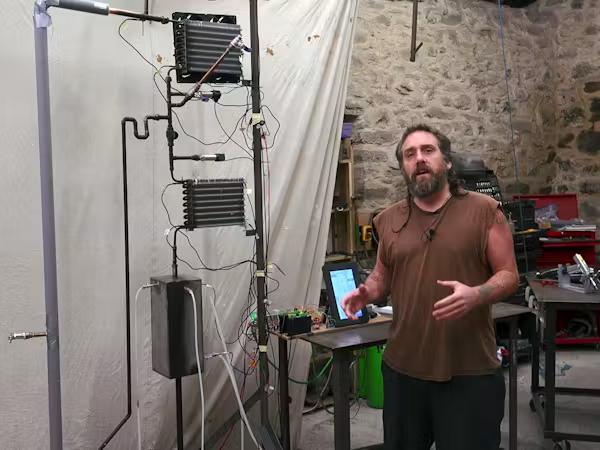
Most people wouldn't think to start a fire when they want to cool something down. After all, fire produces heat, which is the exact opposite of what a refrigerator or air conditioner is supposed to do. But as Greenhill Forge demonstrates in a recent video, it is possible to build a refrigeration system that runs on fire instead of electricity. The project uses a technology known as absorption refrigeration, which has been around for more than a century. While modern refrigerators typically use an electrically powered compressor to circulate refrigerant, absorption refrigerators use heat to drive a chemical and thermodynamic process that produces cooling. This makes them particularly useful in off-grid locations where electricity may not be readily available. The system operates on a relatively simple principle: the boiling point of water decreases as pressure drops. At atmospheric pressure, water boils at 100°C, but under a sufficiently strong vacuum, it can boil at temperatures near freezing. As the water evaporates, it absorbs heat from its surroundings, producing a cooling effect. Greenhill Forge's design consists of two interconnected sections called the generator and absorber. The generator contains a 38% solution of calcium chloride and distilled water. When heated by a fire, water evaporates from the solution and travels through a pipe to a condenser, where it cools and returns to liquid form. That water then passes through an adjustable needle valve into the evaporator on the absorber side. With the pressure maintained at approximately six millibars, the water evaporates at a low temperature and draws heat away from the surrounding area. Ordinarily, the resulting water vapor would increase the pressure and eventually stop the cooling process. To prevent this, concentrated calcium chloride solution is sprayed into the absorber through a perforated shower head. The solution absorbs the water vapor, maintaining the vacuum needed for continuous cooling. Electric pumps circulate the solution between the two sections. Much of the refrigerator was fabricated from stainless steel sheet metal and tubing. Greenhill Forge formed the cooling coil by filling a tube with water, freezing it, and bending it into shape — the frozen water helped prevent crimping during the process. The metal enclosures were welded together, while thinner tubing connections were silver-brazed to avoid damaging them. After assembly, the system was pressurized to locate leaks, then evacuated with a vacuum pump. Even microscopic leaks were identified and repaired before the system was filled with its calcium chloride solution. An Arduino monitors temperatures and pressures, controls pump speeds, and provides safety alarms. Although the refrigeration cycle doesn't require a mechanical compressor, the prototype still uses approximately 30 to 50 watts for its circulation pumps, plus electricity for cooling fans. While the system still requires a small amount of electricity to operate its pumps and fans, most of the energy needed for refrigeration comes from the fire. With further refinement, this approach could offer a practical way to keep things cool in off-grid locations, particularly where firewood or other sources of heat are more readily available than electricity.This refrigerator is powered by fire (📷: Greenhill Forge) An Arduino monitors the system for safety (📷: Greenhill Forge) Making the coils (📷: Greenhill Forge)
↑ Back to top
Originally published by Hackster News ↗
· rebuilt here from its own full-text RSS feed · all rights
remain with the publisher, please read and support them there.