← Technology, Science & Infrastructure
▣ Distilled locally
Spray-On Displays Take Shape
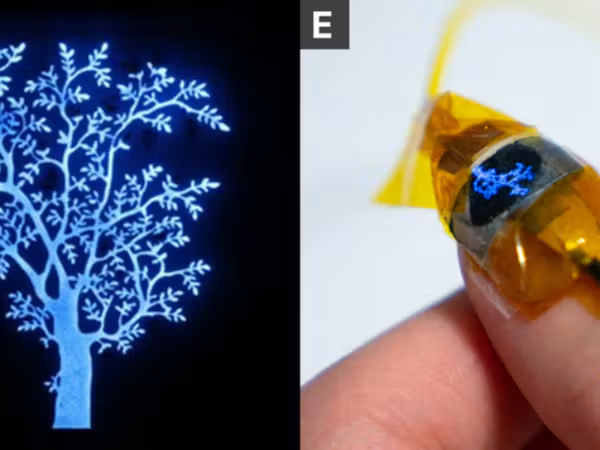
Making your own electronics is easier than ever, but building a display from scratch is still out of reach. While hobbyists can buy LCD and OLED panels in many shapes and sizes, creating a custom display that fits an unusual surface or application requires specialized equipment and a lot of expertise. Researchers at the University of Bath have developed a new technique that could change that, making it possible to fabricate high-resolution electroluminescent displays using little more than an airbrush and a laser cutter. The technique, called Spray and Etch , combines the simplicity of spraying conductive and electroluminescent materials onto a surface with the precision of laser etching to create detailed patterns and individually addressable pixels. Unlike conventional display fabrication methods, it doesn't require expensive industrial equipment or complicated masking procedures. The process begins by spraying a thin layer of conductive copper-based ink onto a substrate. A standard, unmodified CO2 laser cutter then removes selected portions of the coating to form precisely defined electrodes. Additional layers of dielectric material, electroluminescent phosphor, and a transparent conductive coating are applied before another round of laser etching creates the remaining electrode structures. One of the key innovations is a technique the researchers call depth-selective laser etching. By carefully adjusting the laser's power, speed, and focus, they can remove material from one layer without damaging the layers underneath. This makes it possible to construct complex, multilayer electronic structures that would be difficult to produce using traditional masking techniques. The team demonstrated the process by fabricating a functional 32×32-pixel electroluminescent display with pixels measuring just 0.4 mm across. That works out to a resolution of 50.8 pixels per inch (PPI), considerably higher than the 16 and 30 PPI achieved by earlier personally fabricated electroluminescent displays. Spray and Etch also opens up possibilities beyond flat, monochromatic displays. The team experimented with stacking different colored electroluminescent phosphors and selectively removing layers to create multicolored pixels. While the results demonstrated the feasibility of this approach, the researchers encountered problems with brightness and color separation that still need improvement. It was shown that the process can even be applied to gently curved surfaces. To demonstrate this, the researchers fabricated illuminated features on objects including a game controller, glasses, and an artificial fingernail. Such applications could eventually make it possible to integrate custom displays directly into wearables and other everyday objects. There are still limitations, particularly when it comes to laser calibration, material compatibility, and producing reliable multicolored displays. Even so, Spray and Etch offers an accessible alternative to conventional display manufacturing. For makers who have ever wished they could build a display that fits their project instead of designing their project around an off-the-shelf screen, this research could be a big step in the right direction.These displays were created with Spray and Etch (📷: C. Wu et al.) The necessary equipment is highly accessible (📷: C. Wu et al.)
↑ Back to top
Originally published by Hackster News ↗
· rebuilt here from its own full-text RSS feed · all rights
remain with the publisher, please read and support them there.