Scaling an autonomous agent from one team to fifty: A serverless-to-container decision framework

QA teams shipping complex products generate test failures around the clock. Every failure needs a bug ticket with steps, screenshots, repro rates, and regression labels. The manual process takes 10-15 minutes per failure. Multiply that by 30+ failures per week across a team, and you have burned an entire engineering day on documentation that should be automatic.
I built a system to eliminate this entirely. Not a dashboard. Not a notification bot. An autonomous agent that observes test results, makes judgment calls – is this a new bug, a duplicate, or a regression? And takes action without human intervention. It files structured bugs, attaches screenshots, calculates repro rates, detects regressions build-over-build, and notifies the right people. The team just marks FAIL and moves on.
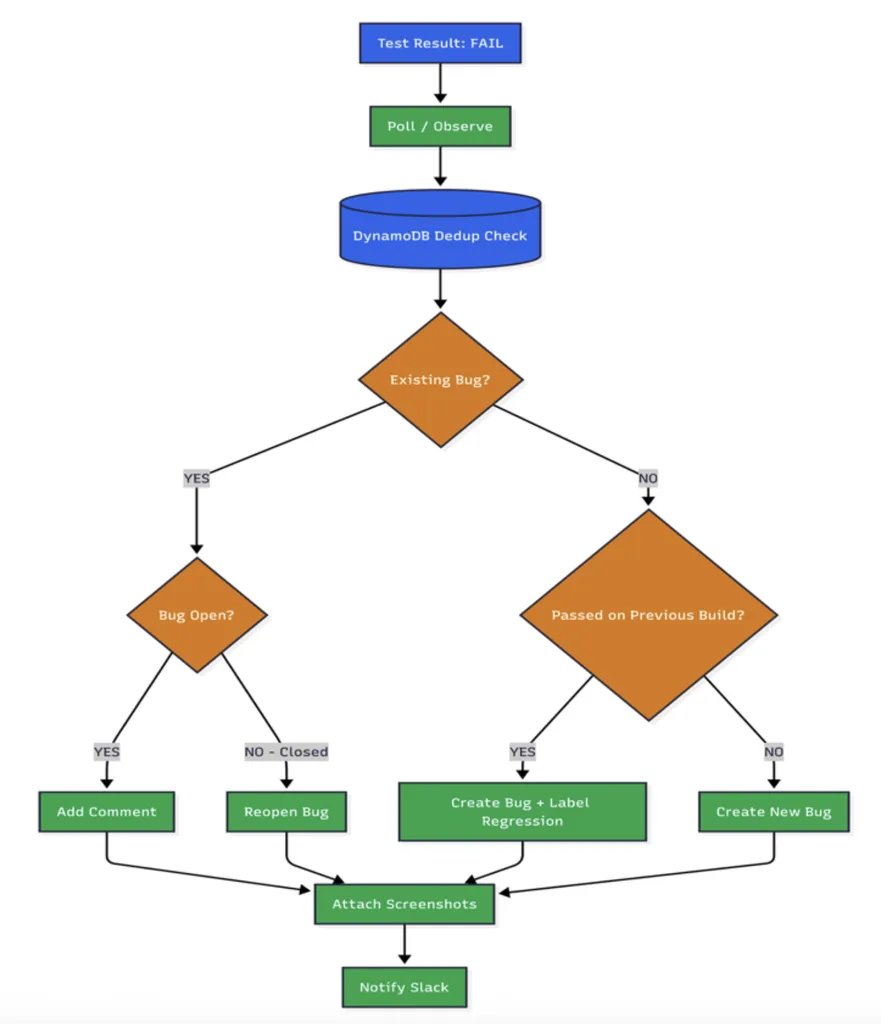
The system runs on Lambda today. It works perfectly for one team. But what happens when other teams want it? What happens when you need to serve 10, 50, or 100 teams? That’s where the architectural decisions get interesting – not because Lambda fails, but because the workload characteristics shift into territory where a different tool becomes the better fit.
What I built (and why it works)
The architecture is elegant: an EventBridge rule triggers a Lambda function every 15 minutes. The function polls the test management API, processes failures through a decision engine (dedup check against DynamoDB, regression detection against previous build results), and files bugs via the JIRA API. Total infrastructure cost: under $5/month.
Lambda was the correct choice here for three reasons:
- Zero operational overhead: No servers, no scaling config, no patching. Deploy and forget.
- Cost proportional to usage: One team generates ~200 invocations/month. At Lambda pricing, this is effectively free.
- Fast iteration: The decision engine went through 20+ revisions in the first month. Lambda’s deployment model let me ship changes in seconds.
Within weeks of deploying, the system filed more complete and consistent bugs than the team had ever produced manually. Zero missed failures. Regressions caught in minutes instead of days. Status interruptions to QA dropped to zero because anyone could query the system directly via Slack. 8-10 hours per week saved.
Other teams have noticed. “Can we have that?” is a recurring question. The answer seems simple – deploy another instance per team. But at scale, the workload characteristics change in ways that shift the architectural decision.
The scaling decision
Lambda handles single-tenant agentic workloads beautifully. The challenge at multi-tenant scale isn’t that Lambda can’t do it; it’s that the workload characteristics shift:
From stateless events to long-running context: A single team’s poll cycle finishes in seconds. But cross-project correlation – “is this the same failure pattern we’re seeing across three teams?” requires analyzing hundreds of results and their relationships in a single pass. That’s a fundamentally different compute profile.
From isolated invocations to shared resource contention: When 50 functions trigger on the same EventBridge schedule, they all hit TestRail and JIRA APIs simultaneously. You need centralized rate limiting, connection pooling, and backpressure – patterns that benefit from persistent, shared infrastructure.
From single-team to multi-tenant isolation: Each team needs guaranteed resources, network boundaries, and scoped credentials. The isolation model becomes as important as the compute model.
Lambda’s recent launches address many of these individually – Managed Instances solve connection persistence, Durable Functions break the 15-minute ceiling for long-running workflows, and Tenant Isolation provides native tenant boundaries. For many multi-tenant workloads, these capabilities narrow the gap significantly.
But for this specific workload – long-running agents that need persistent connections, cross-tenant analysis, GPU inference, and namespace-level isolation simultaneously- the decision framework points toward a container-native execution model with serverless-like operations. That’s where EKS Auto Mode fits.
The decision framework
This led me to build a simple decision rubric – not Lambda vs. containers, but which characteristics does your workload actually exhibit?
“The deciding factor for my workload: I need all of the right-column characteristics simultaneously. Together, they compose more naturally in a container-native environment.”
The deciding factor for my workload: I need all of the right-column characteristics simultaneously. Cross-team pattern detection requires a shared analysis context. ML-based bug classification requires burst GPU. Per-team isolation requires namespace-level boundaries. Centralized rate limiting requires a persistent shared service. Each of these is individually solvable in Lambda. Together, they compose more naturally in a container-native environment.
What unlocks at scale: cross-team intelligence
The most interesting architectural capability that emerges at multi-tenant scale isn’t per-team automation – it’s cross-team pattern detection. This is what makes the scaling exercise worthwhile.
Cross-team failure correlation
When 50 teams run their test suites independently, failures appear isolated. But patterns emerge across teams that no single team can see:
- Three teams report navigation failures on the same firmware build → systemic regression, not three independent bugs
- Test failures correlate with deployment timing across unrelated services → infrastructure issue, not product bugs
- Identical error signatures across teams with different test suites → shared dependency failure
This requires an analysis engine that can hold context from all teams simultaneously – comparing fingerprints, correlating timestamps, and identifying shared root causes. That’s a persistent, long-running workload with access to cross-tenant state. It runs naturally as a shared service in a platform namespace, consuming events from all tenant agents.
ML-based bug classification
Once you have enough historical data (thousands of bugs filed across teams), patterns become classifiable:
- Auto-assign bugs to the correct component owner based on failure signature
- Predict severity based on failure characteristics (crash vs. degraded behavior vs. cosmetic)
- Suggest related bugs for investigation (“this looks like the same root cause as PROJ-4521”)
- Detect anomalous failure rates before they become incident-scale
This inference workload is bursty – you need GPU when bugs arrive, not 24/7. A GPU NodePool that scales to zero when idle and provisions g5 instances only during inference keeps costs proportional to actual usage. The same pod that files a bug can synchronously call the classification service, get a component assignment, and include it in the ticket – all within the same request path.
Queryable knowledge base via Slack
The agent isn’t just an automation – it becomes the organization’s queryable QA state. Via Slack, anyone can ask:
- “What’s the failure rate for navigation this week across all teams?”
- “Show me regressions introduced in build 2.4.1”
- “Which teams are seeing the most P0 bugs right now?”
This transforms the agent from a task automator into an intelligence layer. The answers require cross-team state aggregation, trend computation, and natural language interpretation – all served from persistent, indexed state that accumulates over time.
What EKS Auto Mode brings to this architecture
EKS Auto Mode launched at re:Invent 2024 with a specific promise: full Kubernetes without managing nodes. For a multi-tenant agent platform, this means:
- Nodes appear when pods need them. Deploy a tenant namespace with an auto-filer pod. The Karpenter-based scheduler provisions a node within seconds. When the pod is deleted (tenant offboarded), the node is consolidated or terminated automatically. You never think about EC2 instances.
- Security is not your configuration burden. Nodes run immutable Bottlerocket AMIs – read-only root filesystem, SELinux enforcing, no SSH access. Nodes rotate every 21 days automatically. For long-running agent pods, this means a graceful drain roughly every three weeks. At most one missed poll cycle.
- Scaling is reactive to demand. During off-hours when agents are idle between polls, Auto Mode consolidates workloads onto fewer nodes. You pay for what you use.
- GPU workloads slot in without architectural changes. Define a GPU NodePool for the ML classification service. EKS Auto Mode provisions g5 instances only when inference pods are scheduled and terminates them when done.
The multi-tenant architecture
At scale, the system would have three layers:
- Shared platform services: a rate limiter that prevents any single tenant from exhausting external API quotas, a connection pool manager that maintains persistent sessions to TestRail and JIRA, and a Prometheus instance collecting metrics across all tenants.
- Per-tenant agent namespaces: each team gets an isolated namespace containing their auto-filer pod, reporter pod, and Slack bot pod. ResourceQuotas guarantee resources. NetworkPolicies enforce that Team A’s pods cannot talk to Team B’s pods. Each namespace’s service account assumes a tenant-scoped IAM role via IRSA.
- Shared ML inference namespace: GPU-enabled pods running classification models that all tenants can call. This namespace has its own NodePool that scales to zero when no inference is happening.
The agent code would remain essentially the same Python that runs on Lambda today – the core decision engine (observe, dedup, decide, act) doesn’t change. What changes is the execution model: instead of being invoked per-event and destroyed, the agent runs as a long-lived async loop with persistent connections, graceful shutdown handling, and internal scheduling.
The AWS portfolio working together
The right framing isn’t “migrate off Lambda onto EKS.” It’s “use each service where it fits”:
- Lambda remains the entry point. New teams start here. Single-team automation at $5/month with zero ops. Event-driven triggers, rapid iteration, pay-per-invocation economics.
- Lambda + Durable Functions handles teams that need longer analysis windows or multi-step orchestration without leaving the serverless model.
- EKS Auto Mode serves the platform layer when you need persistent multi-tenant services, cross-team intelligence, GPU inference, and namespace-level isolation working together.
- DynamoDB persists state across all layers – dedup records, bug history, trend data.
- EventBridge orchestrates events whether the consumer is a Lambda function or a Kubernetes pod.
A team that needs 30-minute analysis windows or multi-step workflows (poll → correlate → file → notify → wait for response → update) benefits from Durable Functions without leaving serverless. You stay here until you need cross-tenant shared state or GPU – that’s the signal to evaluate Auto Mode.
“Lambda validates the pattern. EKS Auto Mode operationalizes it at scale. They’re stages in a journey, not competitors.”
The intelligence moves up the stack as the organization’s needs mature. Lambda validates the pattern. EKS Auto Mode operationalizes it at scale. They’re stages in a journey, not competitors.
Key takeaways
- Start serverless: Lambda lets you validate the agentic pattern at zero operational cost. The $5/month price point removes all friction for proving the concept works. Don’t prematurely optimize for scale you don’t have.
- Design for portability from day one: Structure your Lambda function as a pure decision engine with external state. Containerizing it means wrapping it in an async loop and adding a health endpoint. If you build Lambda functions as self-contained decision engines rather than tightly coupled to the invocation model, the transition is a one-day exercise whenever you need it.
- The decision trigger isn’t scale – it’s workload characteristics: Don’t move because you hit 50 teams. Move when you need capabilities that benefit from persistent, shared infrastructure: cross-team correlation, centralized rate limiting, GPU inference, streaming connections.
- Multi-tenancy is an isolation problem, not a compute problem: Both Lambda (Tenant Isolation) and Kubernetes (namespaces) solve this. Choose based on what other characteristics your workload needs alongside isolation.
- EKS Auto Mode closes the operational gap: Before Auto Mode, choosing EKS meant accepting node management overhead. Auto Mode removes that tradeoff. You get container-native execution with serverless-like operations.
The cost math
Single team on Lambda today: $3-5/month. 8-10 hours/week saved. 67x ROI. Fifty teams on EKS Auto Mode would cost approximately $200-250/month total – roughly $4-5 per team per month. Same per-team economics as Lambda, but with namespace isolation, persistent connections, GPU-ready infrastructure, centralized observability, and built-in organizational governance.
The cost-per-team barely changes. What changes is what you get for it!
What comes next?
The agentic pattern – ‘observe, decide, act’ is infrastructure-agnostic. The decision logic doesn’t care about its deployment target. What changes is what becomes possible when agents stop operating in isolation.
“The next frontier isn’t single agents doing single tasks faster. It’s agents coordinating with other agents.”
The next frontier isn’t single agents doing single tasks faster. It’s agents coordinating with other agents. An auto-filer agent detects a failure pattern and hands context to a root-cause agent, which traces the dependency chain across services, identifies the offending commit, and drafts a fix recommendation – all before a human sees the bug ticket. Agent-to-agent delegation, where one agent’s output becomes another’s input without human routing in between.
Beyond that: agents that build their own decision models. Today, I hand-code the dedup logic and regression detection rules. Tomorrow, the agent observes which of its filed bugs humans close as duplicates, learns from those corrections, and tightens its own classification boundaries. The system improves not because I ship better code, but because it accumulates organizational judgment over time.
The system started as a weekend project to stop filing bugs manually. It now runs in production, eliminating an entire category of manual work from QA operations.
The infrastructure question stays the same – serverless for validation, containers for scale. But the agents running on that infrastructure are about to get significantly more capable. Teams with the platform layer ready will be the ones that can adopt those capabilities without rearchitecting.