← Technology, Science & Infrastructure
▣ Distilled locally
Plenty of Fish in the AI Sea
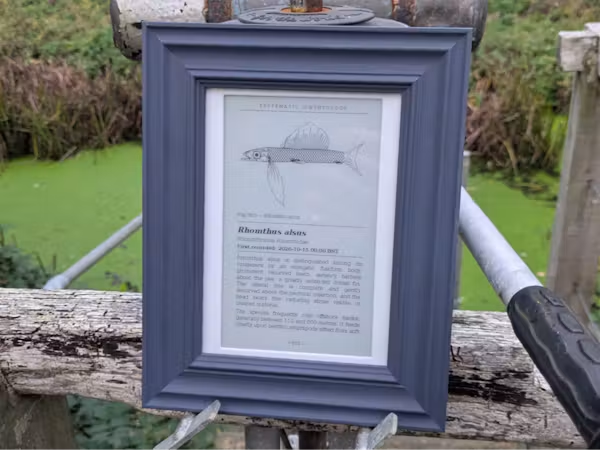
There are millions of animal species on Earth, and scientists are still discovering new ones all the time. But if you're tired of waiting for the next discovery, you can always invent a few species of your own. That's what maker Jim Bruges has done with his project called This Fish Does Not Exist , which uses an Arduino UNO Q to generate illustrations and scientific descriptions of fish that have never existed. The device looks like a framed page from a 19th-century ichthyology textbook, complete with a detailed illustration, scientific name, classification, and description. Every few minutes, it generates an entirely new fish, gradually draws it on an E Ink display, and fills in the accompanying information. Each imaginary species is also assigned a specimen number and a date and time of discovery. The hardware is built around an Arduino UNO Q with 2 GB of RAM, connected to a Waveshare 7.5-inch monochrome E Ink display through an Arduino-compatible shield. The 800×480 display is mounted in a standard 7×5-inch photo frame, with custom 3D-printed PETG mounting plates holding the electronics behind it. An optional 5,000 mAh USB power bank allows the device to operate when no power outlet is nearby. The UNO Q's unusual combination of a Linux operating system and a microcontroller makes the project possible. On the Linux side, a Python implementation of the fishdraw algorithm generates each fish procedurally, determining characteristics such as its body shape, fins, and markings. Those characteristics are then passed to a locally running Gemma 3 1B language model, which invents a plausible scientific description. This includes information about the fish's habitat, diet, depth range, and distinguishing features. The model runs entirely offline after an initial download, so no cloud services are required. Once the illustration and description are ready, a Python library renders the textbook page. The resulting image is transferred to the UNO Q's microcontroller, which uses the GxEPD2 library to update the E Ink display. Rather than displaying the entire page at once, the system uses partial refreshes to create an animation in which the fish is drawn stroke by stroke and the description appears word by word. Only changed image data is transferred between the processors, reducing unnecessary communication. Bruges also developed a web interface for configuring the device, including its layout, generation interval, and drawing speed. Three layouts are available, ranging from a simple specimen plate to a full textbook page. To learn more about this project, or build your own copy of it, be sure to check out Bruges' full project write-up .That's the finest fake fish I've ever seen (📷: Jim Bruges) The hardware is accessible from the back (📷: Jim Bruges)
↑ Back to top
Originally published by Hackster News ↗
· rebuilt here from its own full-text RSS feed · all rights
remain with the publisher, please read and support them there.