← Technology, Science & Infrastructure
▣ Distilled locally
Build a 5.8 GHz FPV Receiver with an ESP32-C5
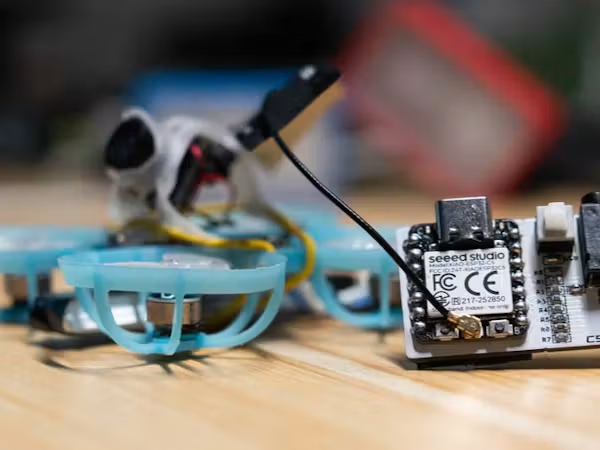
First-person view (FPV) drones allow pilots to see what their aircraft sees through a camera that transmits live video to a pair of goggles or a monitor. Many FPV systems use analog video transmission in the 5.8 GHz band, which requires a compatible receiver to pick up the signal and convert it into something that can be displayed. These receivers typically contain specialized radio hardware, but a project called C5VRX-5 shows that much of the same functionality can be achieved with an inexpensive ESP32 development board and a handful of resistors. Developed by a hardware hacker named Leon as part of the open source C5VRX project, C5VRX-5 turns a Seeed Studio XIAO ESP32-C5 into a functional 5.8 GHz analog FPV receiver. You might expect there to be a separate radio receiver module connected to this board, but that is not how the device works. Instead, it takes advantage of the ESP32-C5's built-in Wi-Fi radio to receive and demodulate analog video signals, even though the chip wasn't designed for that purpose. The ESP32-C5's radio hardware handles reception, while custom firmware processes the incoming signal to recover the video. The system samples selected bits from the radio's analog-to-digital converter at 40 million samples per second, using a processing pipeline that avoids involving the CPU in the sample path to achieve this level of performance. Video reception works in conjunction with a demodulation algorithm called U85Q. It uses an untrained 32-phase tracker to maintain video reception despite differences in transmitter frequencies, multipath interference, and other signal imperfections that might otherwise cause the picture to disappear. The firmware also incorporates Direct Gain V6 for automatic gain adjustment, AFC for carrier centering, and configurable filtering to help maintain reception under changing conditions. The system remembers previous gain settings and can maintain them through brief signal interruptions. Some of these capabilities have been validated on hardware, while others still require additional testing. Getting the recovered video into a pair of goggles took some extra work, but also followed a minimalistic approach. Rather than adding a dedicated digital-to-analog converter, C5VRX-5 uses six resistors connected to GPIO pins D4 through D9 to construct a passive 6-bit DAC. A seventh resistor provides the output load. This simple circuit produces a composite video signal compatible with PAL or NTSC displays. The output can be connected directly to the analog video input of compatible FPV goggles, a monitor, or a video recorder. C5VRX-5 supports 48 channels, and its firmware can be installed through a browser-based flashing utility. The project is open source, with firmware, hardware documentation, and testing tools available for anyone interested in building one. If that might be you, be sure to check out the project's GitHub repository for all the information you need to get started.Little more than the development board is needed (📷: Leon) The receiver is mounted on these googles (📷: Leon)
↑ Back to top
Originally published by Hackster News ↗
· rebuilt here from its own full-text RSS feed · all rights
remain with the publisher, please read and support them there.