← Technology, Science & Infrastructure
▣ Distilled locally
This Flying Robot Weighs Less Than a Paperclip
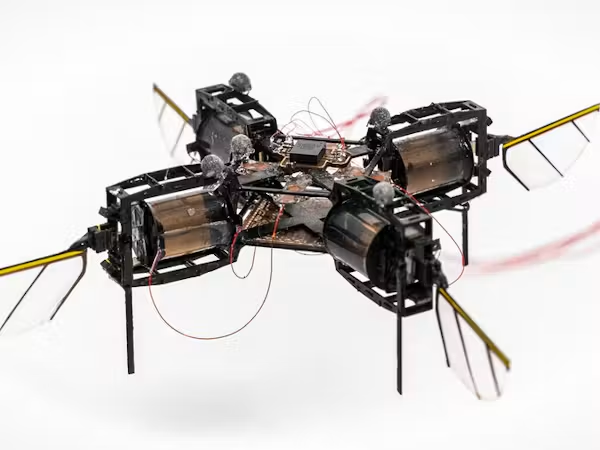
Researchers have been working on insect-sized flying robots for years, with the hope that they might someday be used to pollinate crops, inspect machinery, or explore places that larger drones can't reach. But there's a problem with making robots that small: they can't carry much weight. Even the sensors and electronics needed for navigation can be too heavy. Now, a team at MIT has developed a tiny flying robot that can carry its own sensors and computer, allowing it to navigate without relying on external cameras. The robot, which weighs less than a paperclip, is roughly the size of a microcassette. It has four wings powered by soft artificial muscles that rapidly contract and expand, allowing it to hover and maneuver much like a real insect. MIT has been developing these kinds of robots for some time, but previous versions relied on external motion-capture cameras to track their movements. That meant they could perform impressive aerial maneuvers in a laboratory, but couldn't navigate on their own in the real world. To overcome this limitation, the researchers first needed to increase the robot's lifting capacity. They redesigned the artificial muscles that drive its wings, carefully adjusting their dimensions to improve performance. By increasing the size of the actuators by 50%, they were able to boost the robot's net lift force by 46%, achieving a lift-to-weight ratio of 1.9. That gave the robot enough extra lifting capacity to carry a custom electronics package weighing just 244 milligrams. The package contains a microcontroller and three sensors. An inertial measurement unit measures the robot's orientation, while an optical flow sensor tracks its horizontal movement. A time-of-flight distance sensor measures its height above the ground. Together, these components provide the information needed to keep the robot stable and navigate through its surroundings. However, without external cameras tracking its exact position, small measurement errors can accumulate and cause it to drift off course. The researchers addressed this by developing a lightweight algorithm that continuously estimates the robot's position, orientation, and movement. Rather than performing complicated calculations that would overwhelm the tiny processor, the system makes simpler calculations more frequently. This turned out to be more effective at keeping the robot on course. In flight tests, the robot successfully hovered at different heights and followed predetermined paths with positional errors of just a few centimeters. The team also demonstrated its capabilities by using a joystick to guide it around several plants before landing on a sunflower. The electronics are remarkably efficient, consuming only about 6% of the robot's total power. Most of the energy goes toward keeping its wings flapping. There is still one major limitation, however. While the robot can now sense its surroundings and control its flight without external tracking equipment, it still needs a wired connection to an external power supply. The researchers are working on adding batteries and a camera that would allow the robot to recognize objects and avoid obstacles. There's still plenty of work to do before these little machines can fly around a farm pollinating flowers on their own, but getting the sensors and computer onboard is an important step toward making that possible.This drone is as light as a paperclip (📷: Y. Hsiao et al.) The custom electronics are very compact (📷: Y. Hsiao et al.)
↑ Back to top
Originally published by Hackster News ↗
· rebuilt here from its own full-text RSS feed · all rights
remain with the publisher, please read and support them there.